What happens in your brain when you get rejected?
Updated
When rejected, your amygdala flags the social threat, the anterior cingulate and insula generate a 'social pain' response, and the prefrontal cortex steps in to regulate the distress.
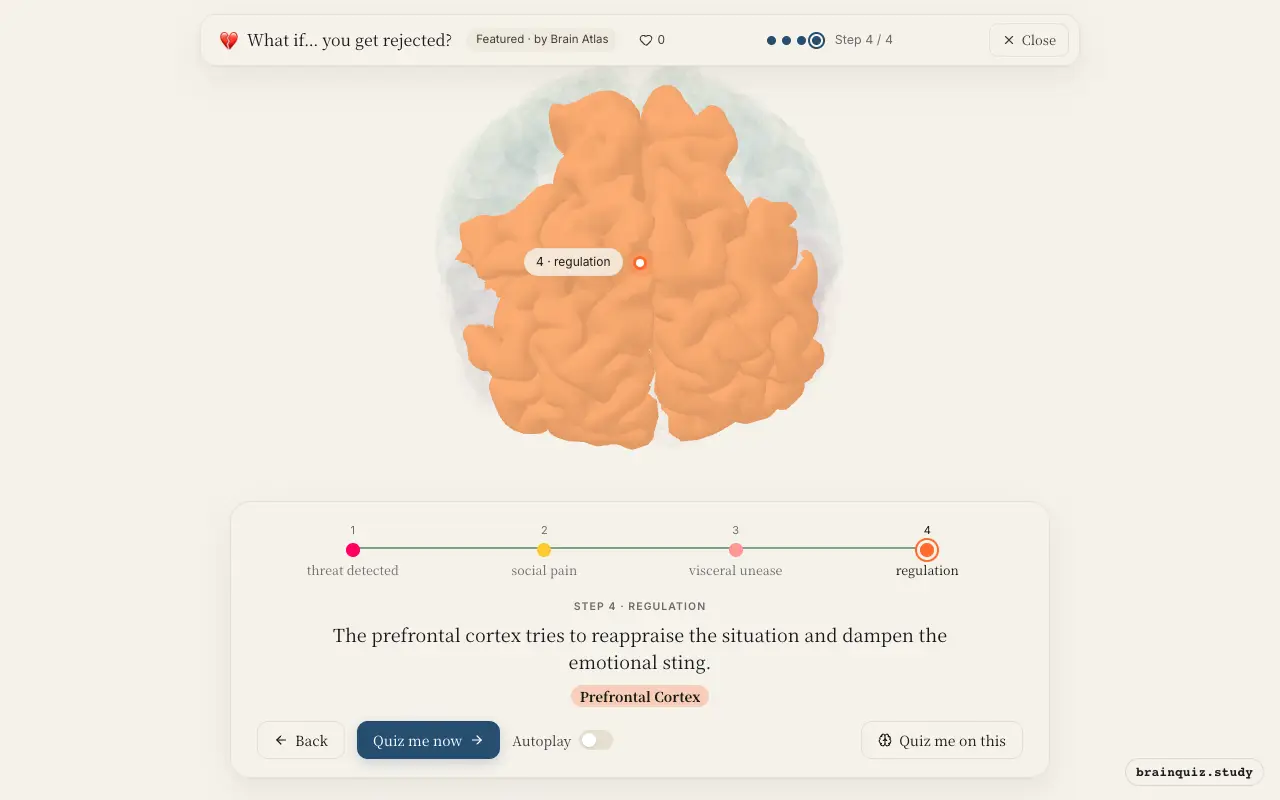
Watch it light up on the 3D brain
Brain regions that light up
| Order | Region | What it does here |
|---|---|---|
| 1 | Amygdala | The amygdala rapidly flags the rejection as socially threatening and emotionally significant. |
| 2 | Anterior Cingulate Cortex | The anterior cingulate cortex registers the rejection as painful, similar to physical injury. |
| 3 | Insula | The insula produces the bodily feeling of rejection—a knot in the stomach or a heavy chest. |
| 4 | Prefrontal Cortex | The prefrontal cortex tries to reappraise the situation and dampen the emotional sting. |
1. Amygdala: threat detected
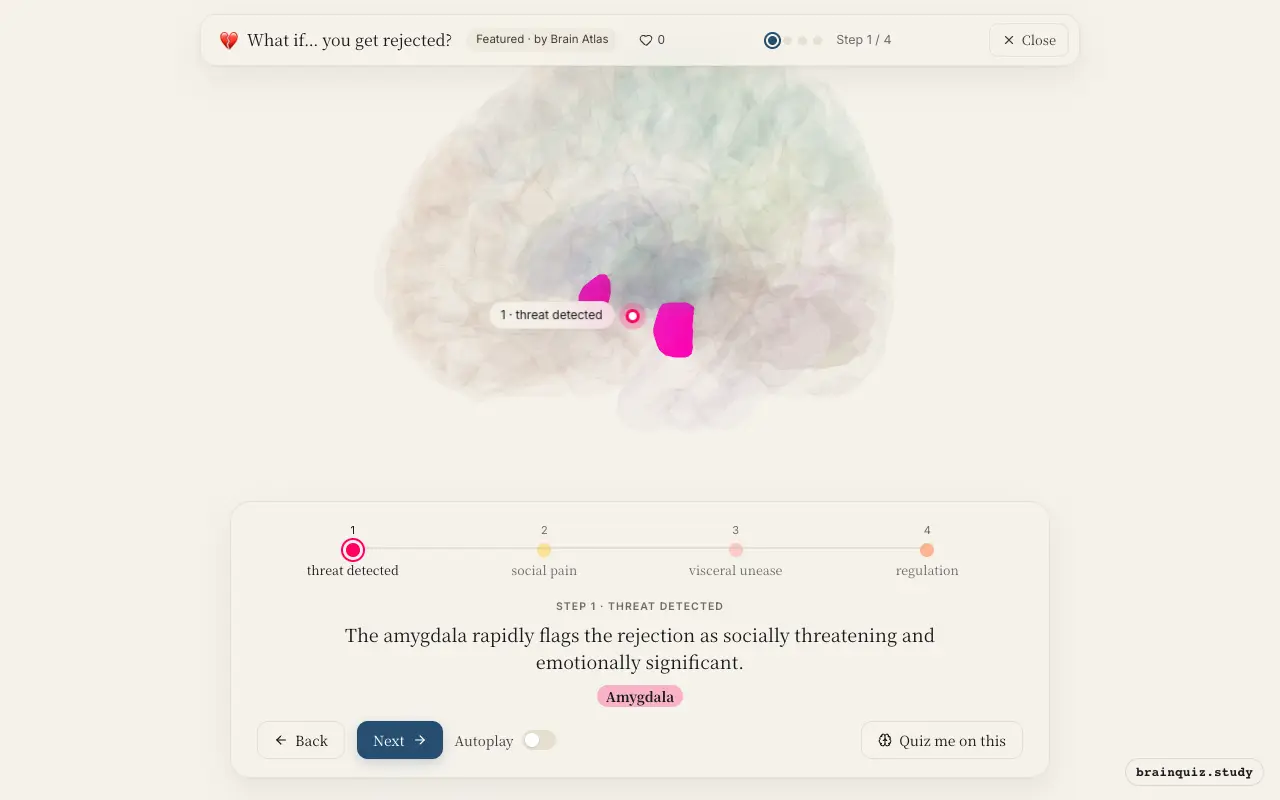
The amygdala is a key node for detecting social threats and negative emotional cues. In rejection, it activates quickly, enhancing attention to the rejecting person or situation. This early response sets the stage for the distress that follows.
2. Anterior Cingulate Cortex: social pain
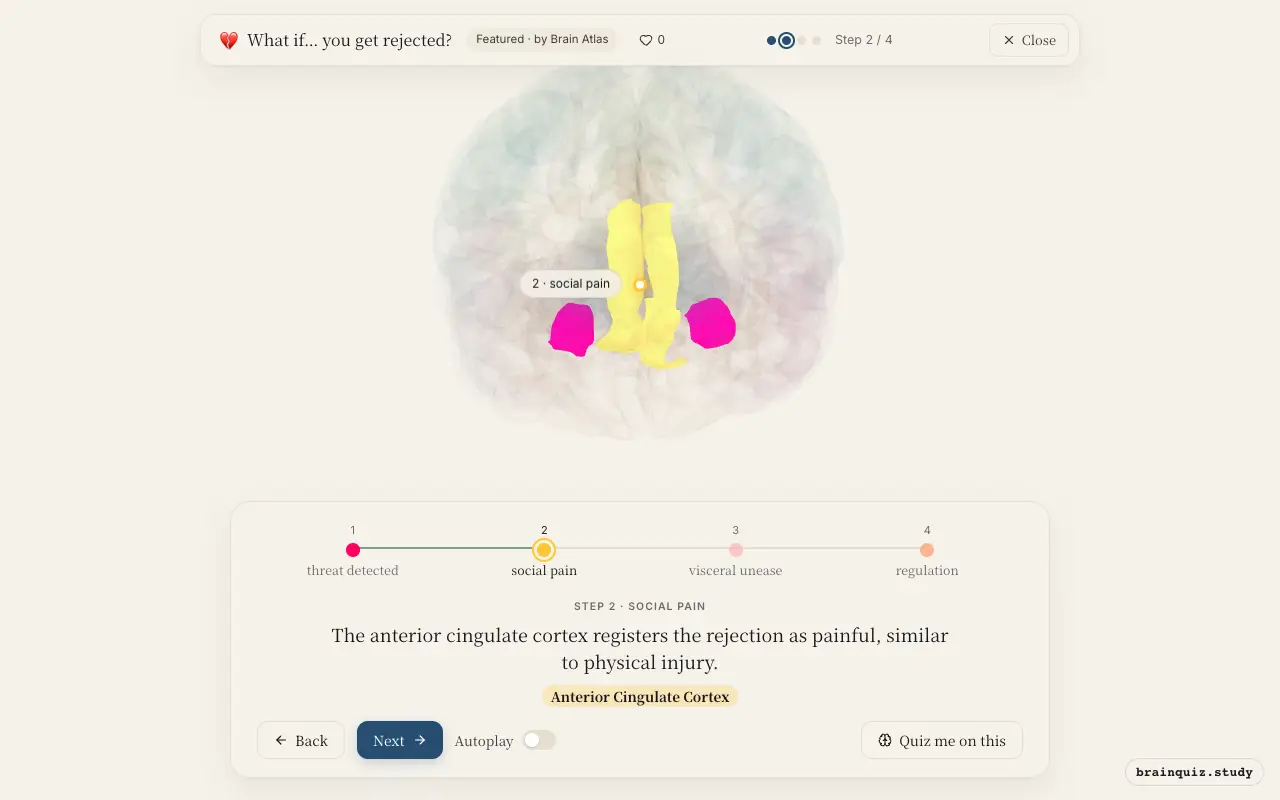
The dorsal anterior cingulate cortex (dACC) is a central hub for the distress of social rejection. It responds to conflict between expected and actual social outcomes, generating a 'social pain' signal. This activation overlaps with physical pain processing.
3. Insula: visceral unease
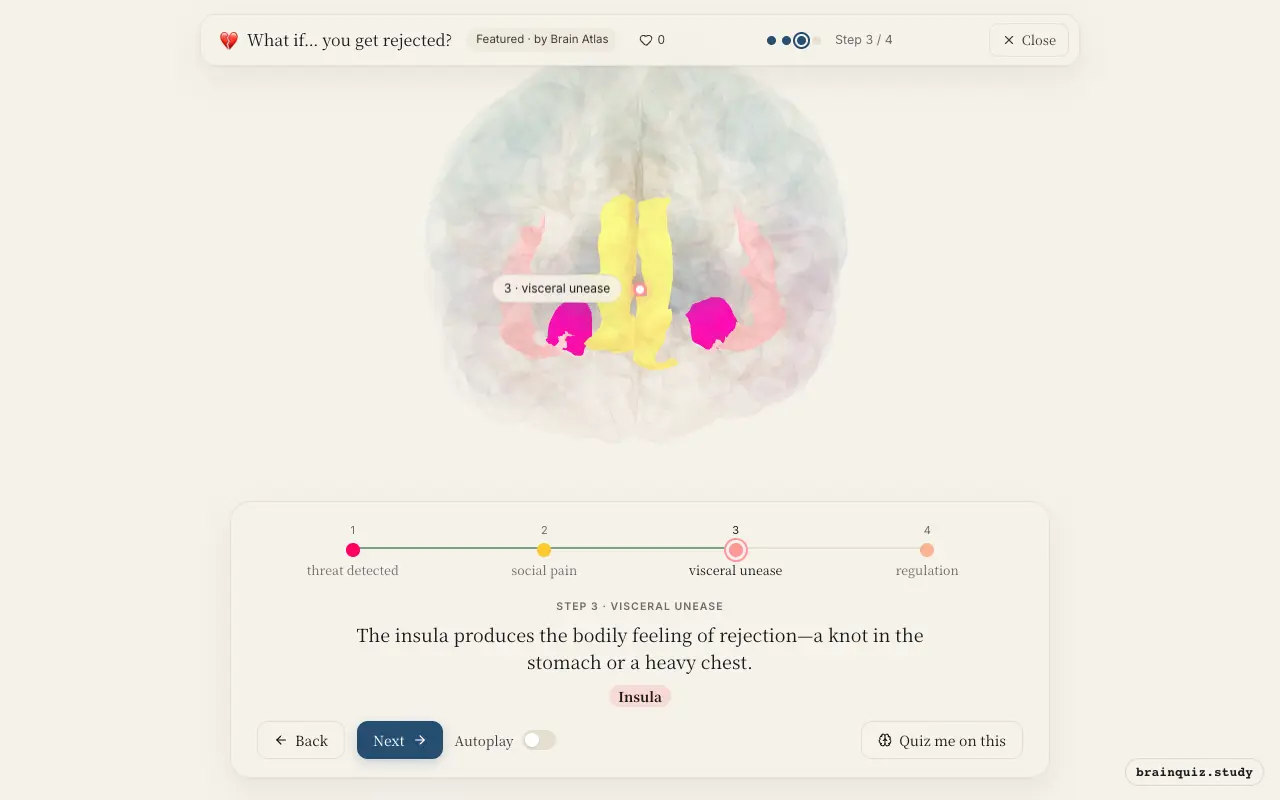
The anterior insula maps internal bodily states, so during rejection it generates the subjective, visceral experience of distress. It integrates signals from the body with emotional evaluation, making the rejection feel physically uncomfortable. The insula's activity is tightly coupled with the ACC.
4. Prefrontal Cortex: regulation
The lateral prefrontal cortex, especially on the right, supports emotion regulation strategies like cognitive reappraisal. After rejection, it works to reinterpret the event as less threatening or less self-relevant. Individuals with stronger PFC engagement may regulate emotions more effectively. This top-down control tempers the initial pain signal.
Good to know
- The dorsal anterior cingulate cortex and anterior insula form a 'salience network' that responds to both physical and social pain.
- People who are more sensitive to rejection show greater ACC and insula responses to social exclusion.
- The prefrontal cortex can reduce rejection distress through cognitive reappraisal, but this requires effort.
Social rejection vs physical pain
Social rejection activates the dorsal anterior cingulate and anterior insula, which also respond to physical pain, giving rise to the 'social pain' metaphor. However, physical pain also activates the somatosensory cortex, while social rejection recruits additional prefrontal regions for social evaluation.
Test yourself
Which brain region is most consistently activated by social rejection?
The insula's role in rejection primarily involves generating what?
After rejection, what does the prefrontal cortex typically do?
0 of 3 answered · 0 correct
Simplified: many regions work together at once, and this shows the main players in the order they act.