What happens in your brain when you tell a lie?
Updated
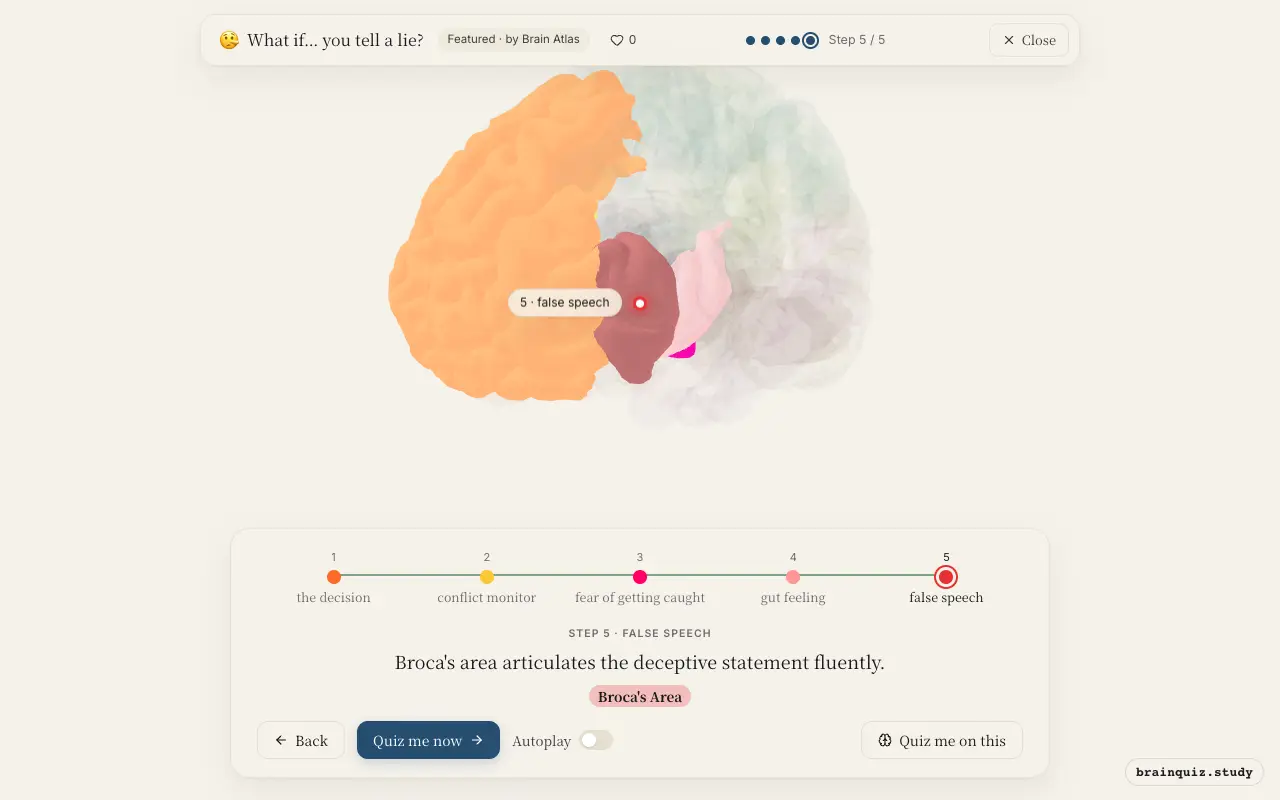
Prefrontal cortex suppresses the truth and plans the lie. Anterior cingulate monitors conflict between fact and fiction. Amygdala and insula generate emotional arousal. Broca's area produces the false speech.
Watch it light up on the 3D brain
Brain regions that light up
| Order | Region | What it does here |
|---|---|---|
| 1 | Prefrontal Cortex | Prefrontal cortex weighs the social stakes and chooses to deceive. |
| 2 | Anterior Cingulate Cortex | Anterior cingulate detects the mismatch between what you know and what you say. |
| 3 | Amygdala | Amygdala triggers anxiety about the potential consequences of the lie. |
| 4 | Insula | Insula registers the bodily sensation of guilt or unease. |
| 5 | Broca's Area | Broca's area articulates the deceptive statement fluently. |
1. Prefrontal Cortex: the decision
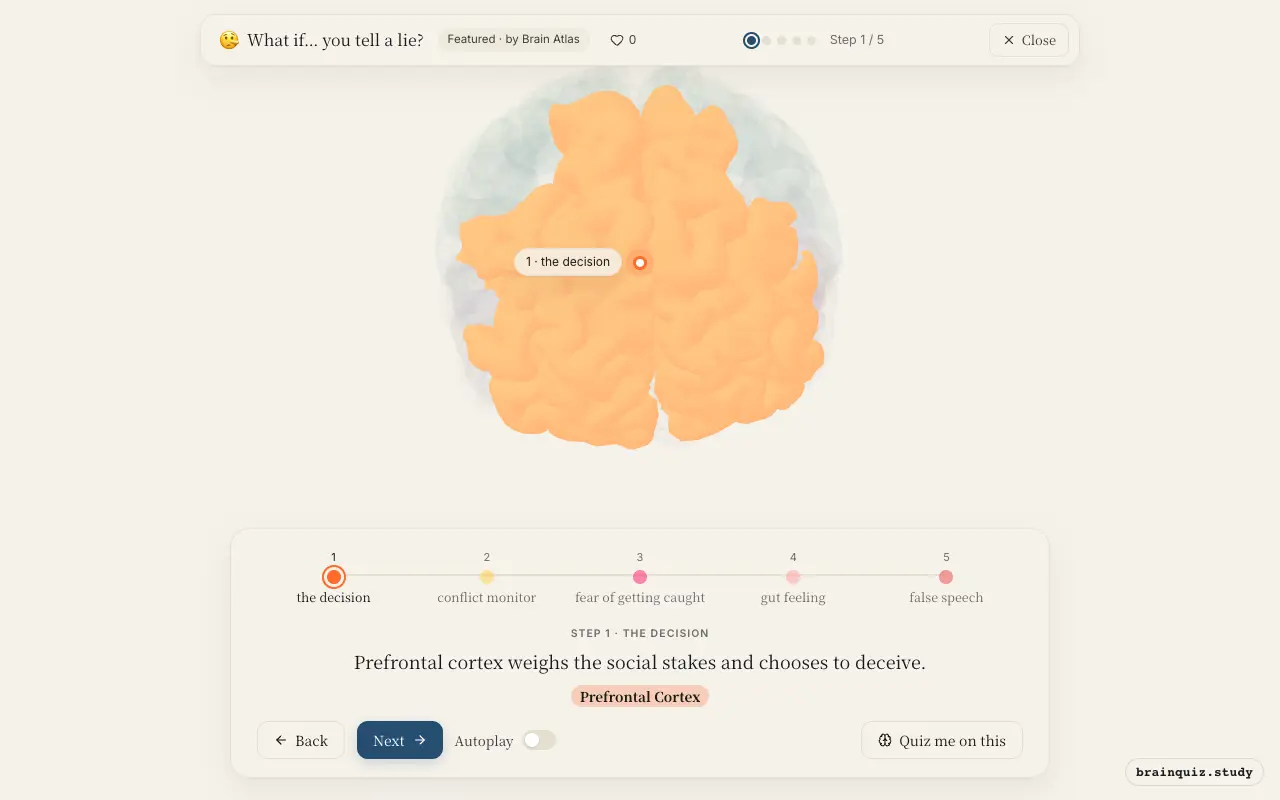
This region handles executive functions like planning and inhibition. When you decide to lie, it suppresses the automatic truthful response and constructs a false narrative. It holds the lie in working memory while monitoring the social context.
2. Anterior Cingulate Cortex: conflict monitor
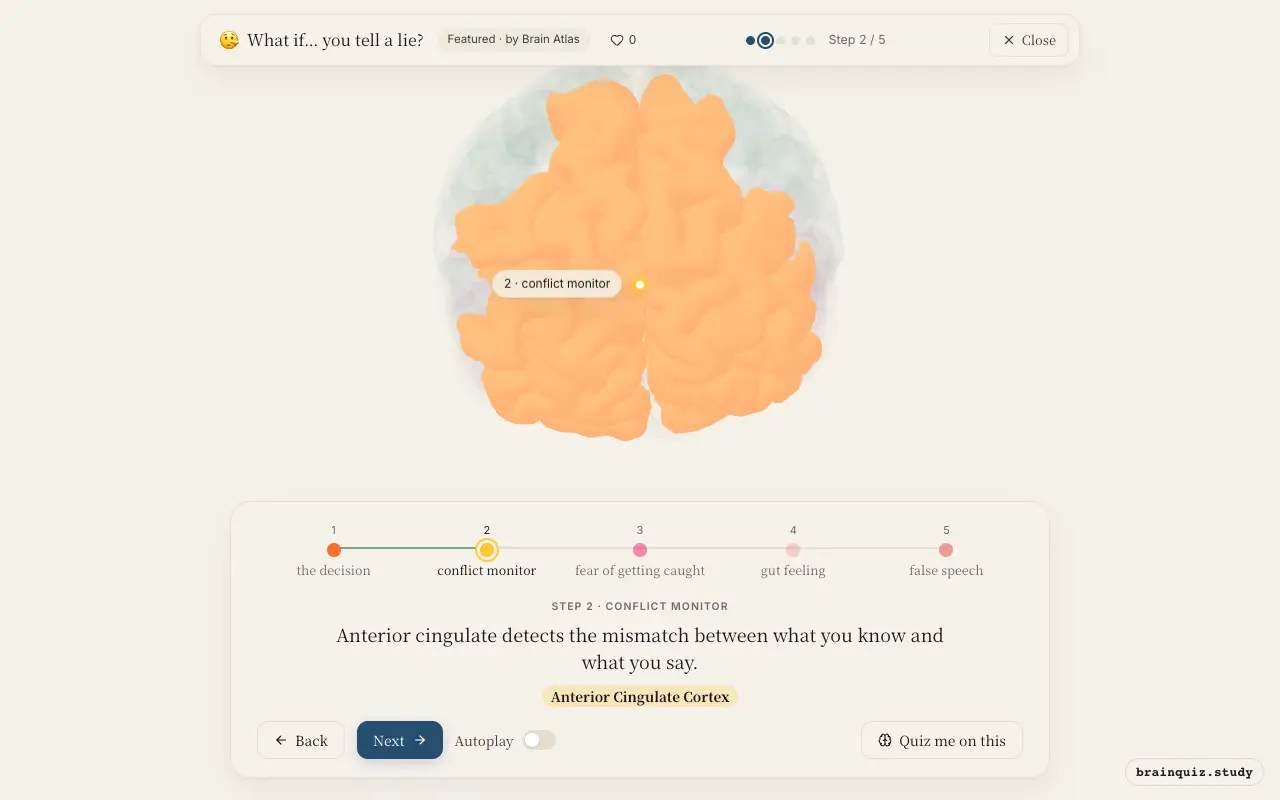
This region signals cognitive conflict, acting like an error detector. When you state a falsehood, it flags the discrepancy between the stored truth and the spoken lie. This prompts additional cognitive control to maintain the deception.
3. Amygdala: fear of getting caught
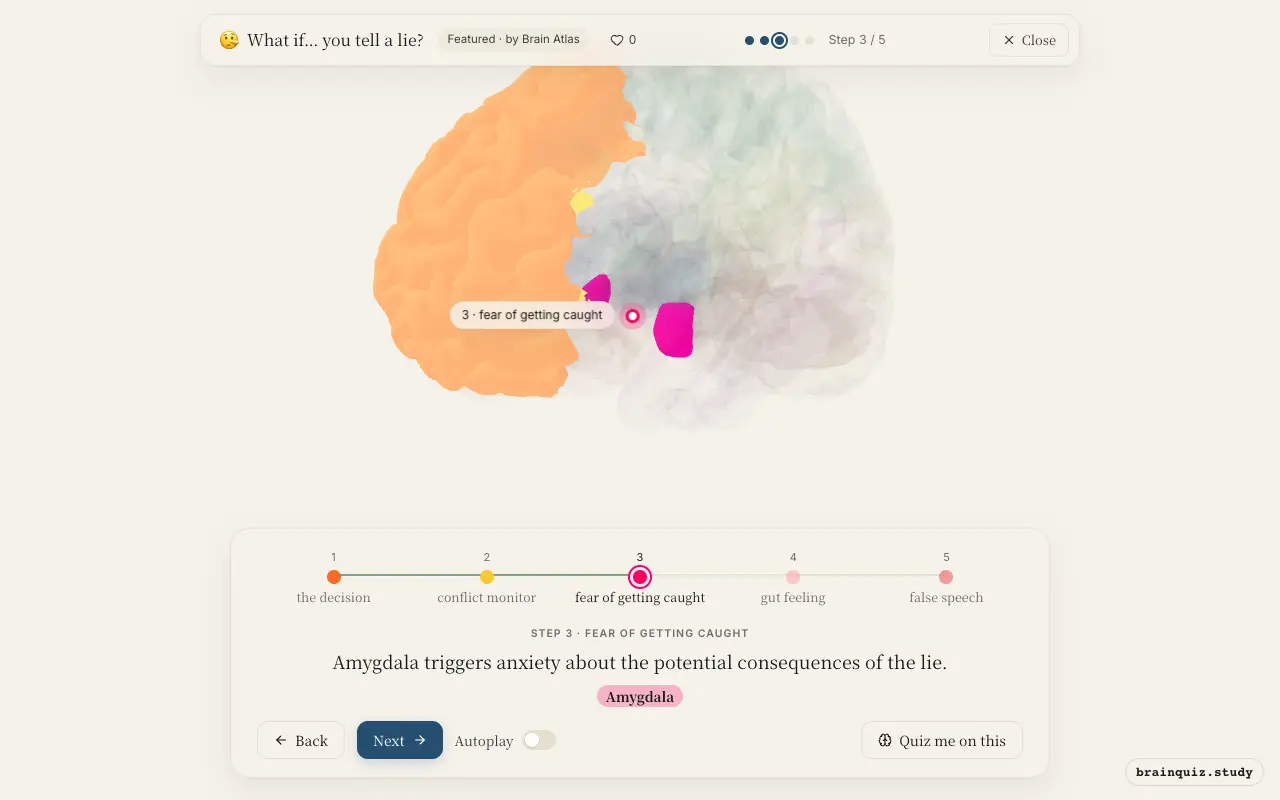
The amygdala processes emotional salience, especially threat. Lying often feels risky, so it activates a fear response, raising arousal and making you more vigilant. This emotional cost can make lying stressful.
4. Insula: gut feeling
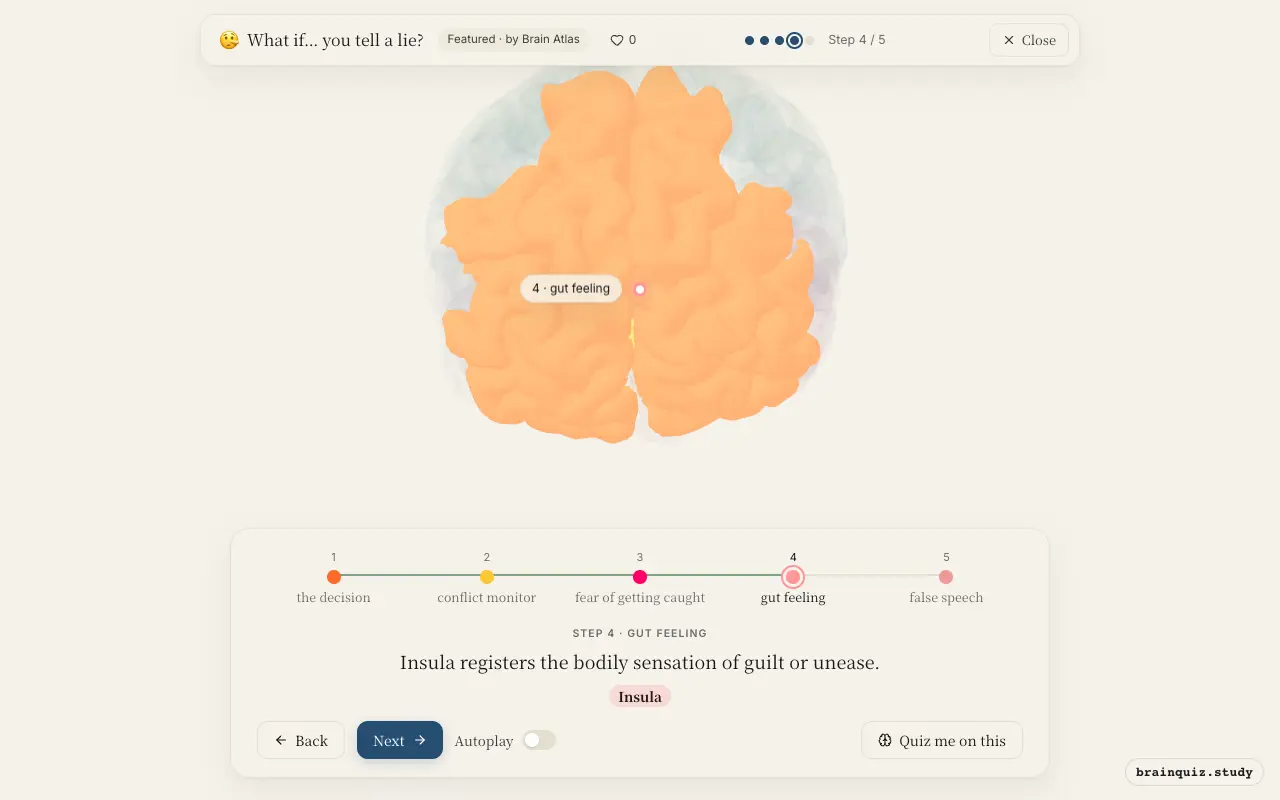
The insula integrates interoceptive signals, creating awareness of internal states. When you lie, it may generate feelings of disgust or guilt, contributing to the 'gut feeling' that something is wrong. This can motivate you to confess or avoid lying in the future.
5. Broca's Area: false speech
Broca's area is essential for speech production and language sequencing. It coordinates the motor programs for speaking, allowing you to deliver the lie smoothly. Increased activity here reflects the extra effort of constructing an untruthful sentence.
Good to know
- Neuroimaging studies find that lying activates the prefrontal cortex and anterior cingulate more than telling the truth.
- The amygdala's response to lying can be reduced with repetition, making lies easier over time.
- People with damage to the prefrontal cortex may have difficulty inhibiting truthful responses, leading to more honest behavior.
Lying vs Telling the Truth
In truth-telling, prefrontal and anterior cingulate activity is lower because there is no conflict to manage. The amygdala and insula show less arousal, as no guilt or fear is triggered. Broca's area is active in both, but lying demands more cognitive control.
Test yourself
Which region is most associated with detecting the conflict between truth and lie?
Why does the amygdala activate during lying?
Which area is responsible for producing the actual speech of the lie?
0 of 3 answered · 0 correct
Simplified: many regions work together at once, and this shows the main players in the order they act.