What happens in your brain when you speak in public?
Updated
Amygdala detects threat, prefrontal cortex regulates and plans, Broca's area formulates speech, premotor and motor cortices execute articulation, auditory cortex monitors output.
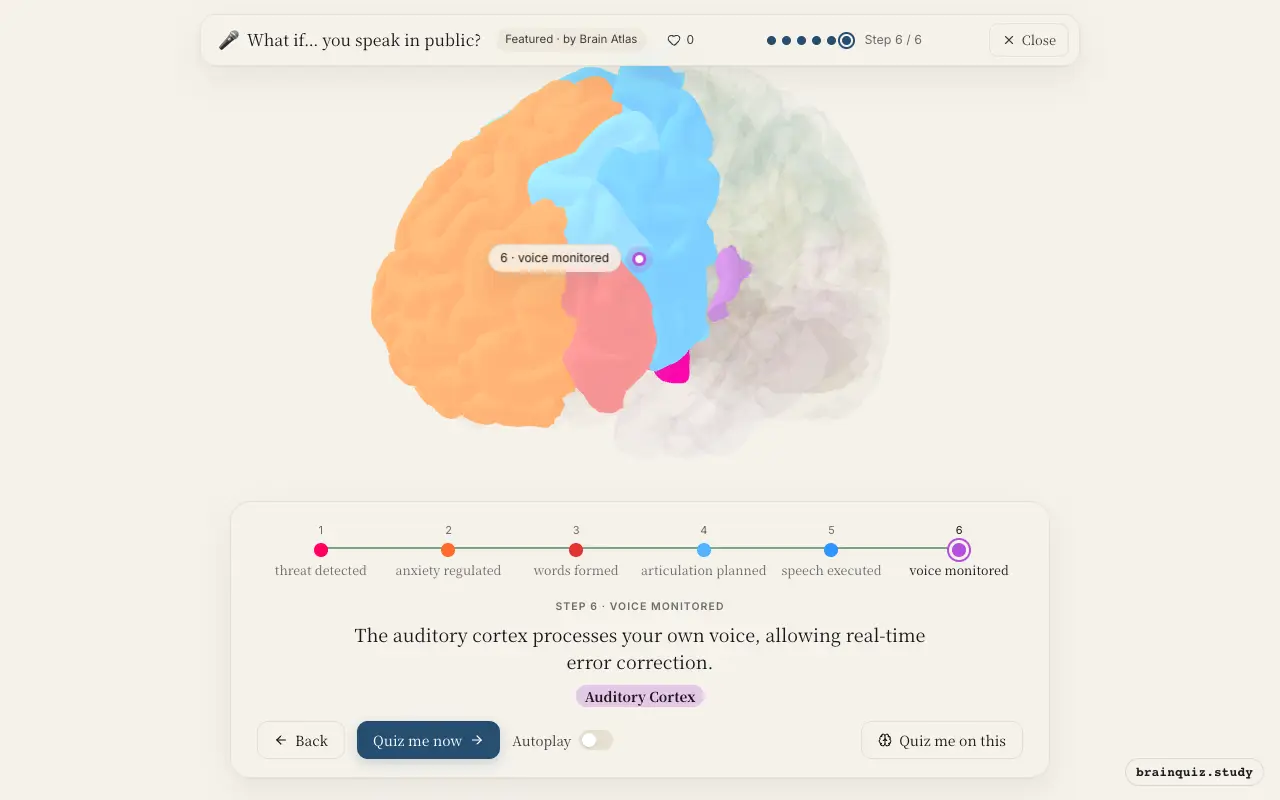
Watch it light up on the 3D brain
Brain regions that light up
| Order | Region | What it does here |
|---|---|---|
| 1 | Amygdala | The amygdala reacts to the audience as a social threat, triggering fear. |
| 2 | Prefrontal Cortex | The prefrontal cortex steps in to calm the amygdala and plan your talk. |
| 3 | Broca's Area | Broca's area selects words and grammar to express your ideas. |
| 4 | Premotor Cortex | The premotor cortex plans the precise sequence of muscle movements for speech. |
| 5 | Motor Cortex | The motor cortex sends commands to your speech muscles, producing audible words. |
| 6 | Auditory Cortex | The auditory cortex processes your own voice, allowing real-time error correction. |
1. Amygdala: threat detected
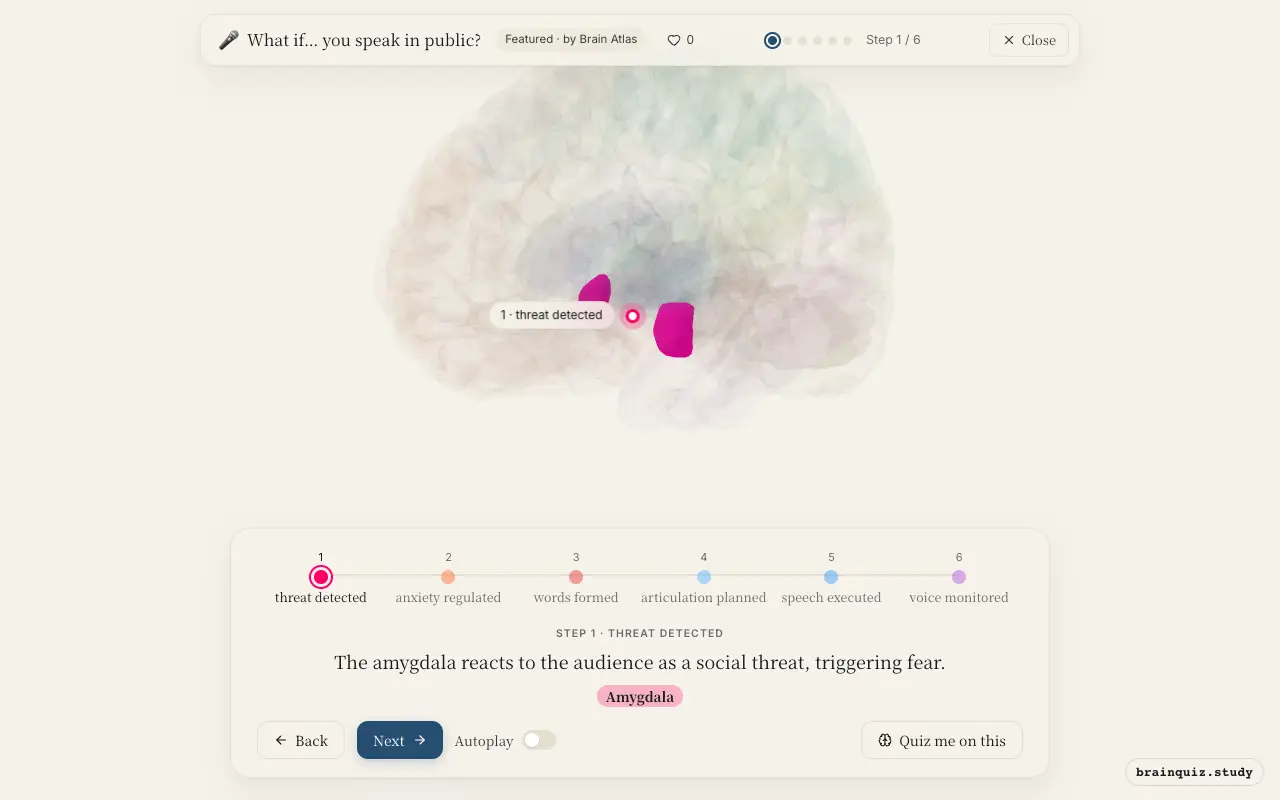
The amygdala is central to fear processing and threat detection. It fires rapidly when you perceive being judged, initiating a stress response that includes increased heart rate and sweating.
2. Prefrontal Cortex: anxiety regulated
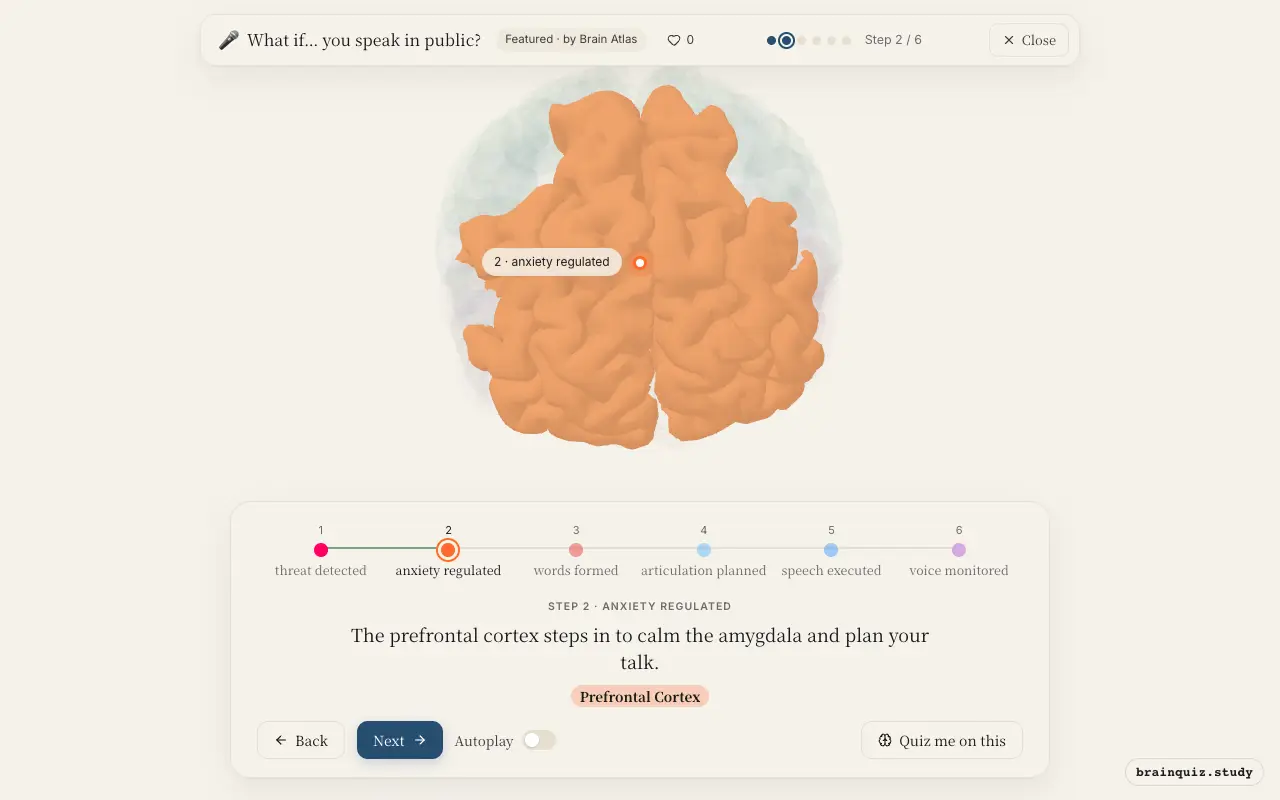
The prefrontal cortex exerts top-down control, dampening the amygdala's fear response. It also engages working memory to hold your talking points and organize the structure of your speech.
3. Broca's Area: words formed
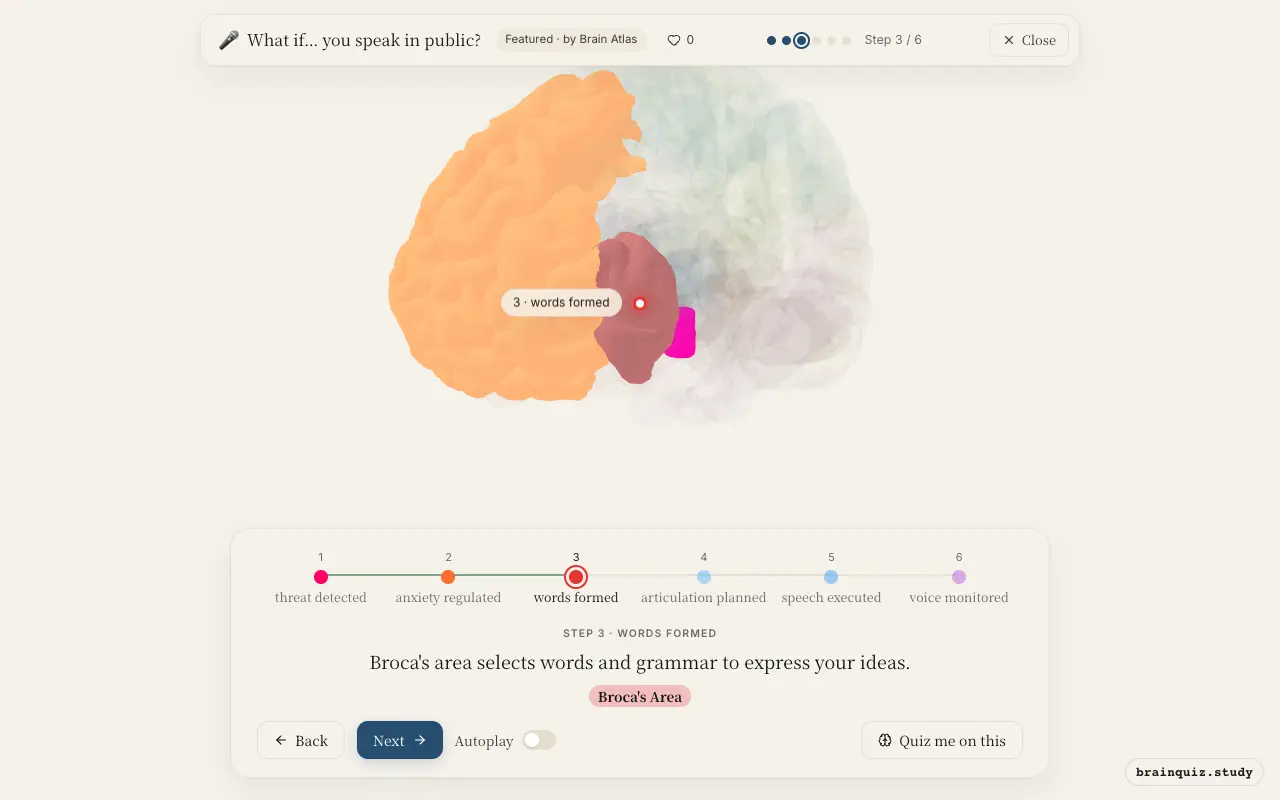
Broca's area is responsible for language production. It assembles words into grammatical sentences, drawing on vocabulary and syntactic rules to transform your thoughts into spoken language.
4. Premotor Cortex: articulation planned
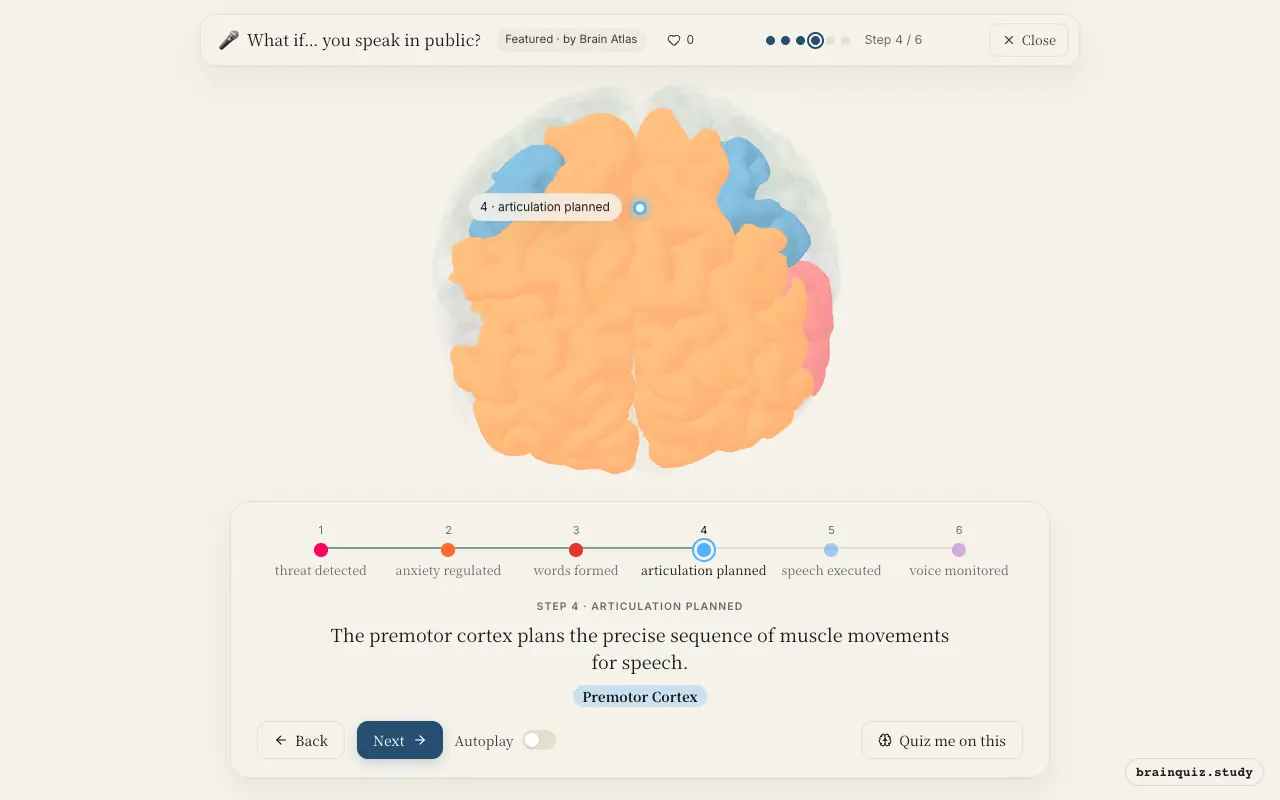
The premotor cortex organizes the motor plan for articulation, specifying which muscles in the lips, tongue, and jaw need to contract in what order to produce the planned sounds.
5. Motor Cortex: speech executed
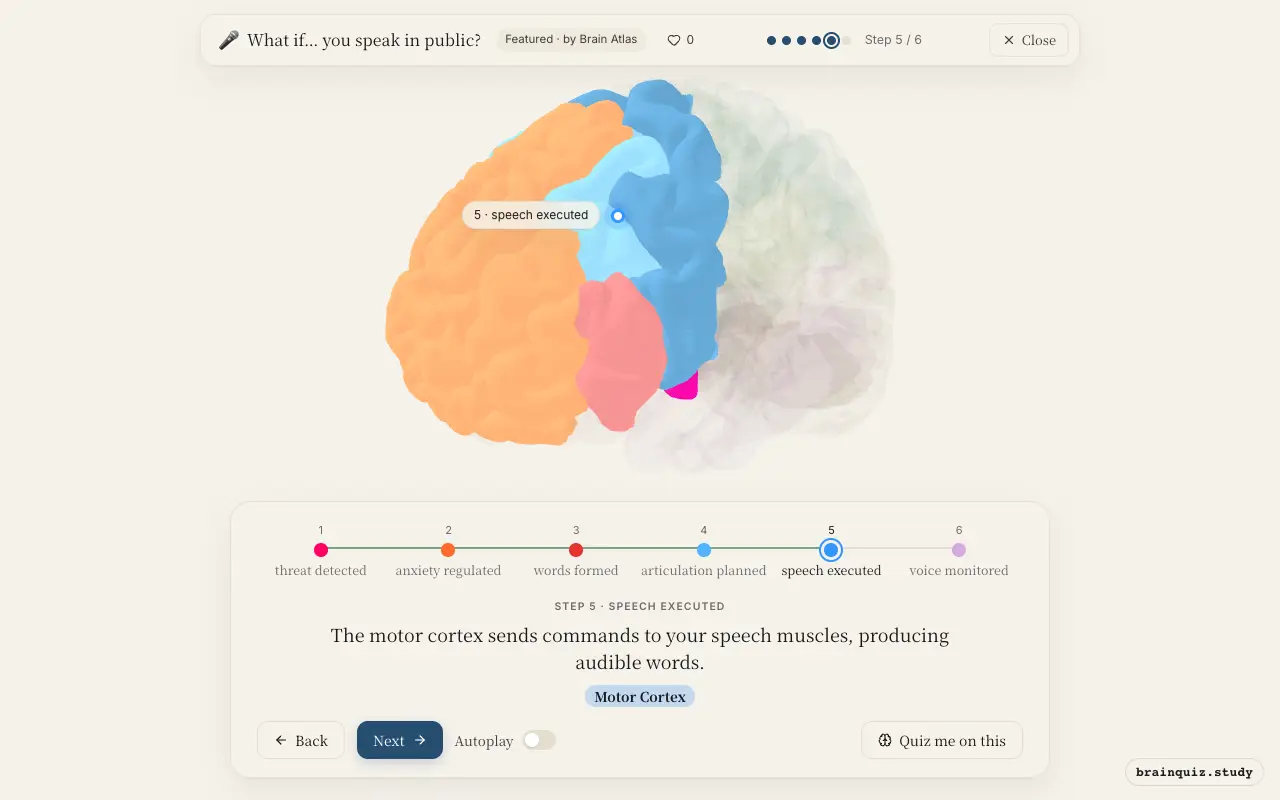
The motor cortex executes the motor plan, sending signals through the corticobulbar tract to cranial nerve nuclei that control the muscles of articulation, resulting in actual speech production.
6. Auditory Cortex: voice monitored
The auditory cortex receives input from your ears as you hear yourself speak. It compares the actual sound to the intended speech, enabling you to adjust volume, pitch, or articulation if you detect errors.
Good to know
- Public speaking anxiety is a form of social evaluation threat, which reliably activates the amygdala.
- The prefrontal cortex's regulatory influence on the amygdala is a key mechanism in cognitive reappraisal of stress.
- Speech production involves a network including Broca's area, premotor cortex, and motor cortex, with feedback from auditory cortex.
Public Speaking vs. Casual Conversation
During public speaking, the amygdala and prefrontal cortex are much more active due to social evaluation, while casual conversation relies more on automatic speech production with less emotional regulation. The auditory cortex also shows heightened monitoring when speaking publicly because errors have higher stakes.
Test yourself
Which brain region is first to react to the audience as a threat during public speaking?
What is the primary role of the prefrontal cortex in this scenario?
Which region compares the sound of your own voice to your intended speech for error correction?
0 of 3 answered · 0 correct
Simplified: many regions work together at once, and this shows the main players in the order they act.