What happens in your brain when you get a compliment?
Updated
A compliment triggers a reward cascade: the orbitofrontal cortex evaluates its positive value, the ventral tegmental area releases dopamine to the nucleus accumbens, and the posterior cingulate ties it to your self-concept.
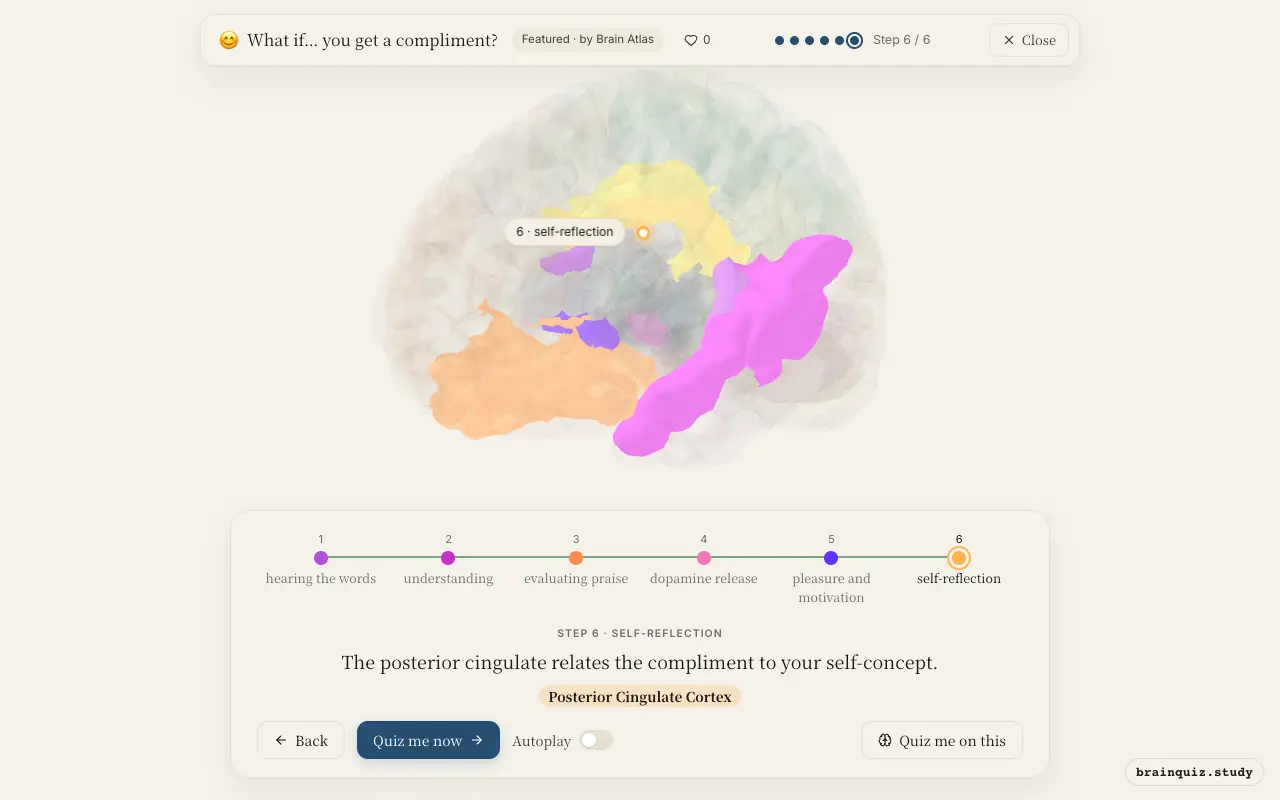
Watch it light up on the 3D brain
Brain regions that light up
| Order | Region | What it does here |
|---|---|---|
| 1 | Auditory Cortex | The auditory cortex processes the sound of the compliment. |
| 2 | Wernicke's Area | Wernicke's area decodes the words and grammar to grasp the compliment's meaning. |
| 3 | Orbitofrontal Cortex | The orbitofrontal cortex assesses the compliment's positive social value. |
| 4 | Ventral Tegmental Area | The VTA fires dopamine neurons, broadcasting a reward signal. |
| 5 | Nucleus Accumbens | The nucleus accumbens receives dopamine, generating feelings of pleasure and drive. |
| 6 | Posterior Cingulate Cortex | The posterior cingulate relates the compliment to your self-concept. |
1. Auditory Cortex: hearing the words
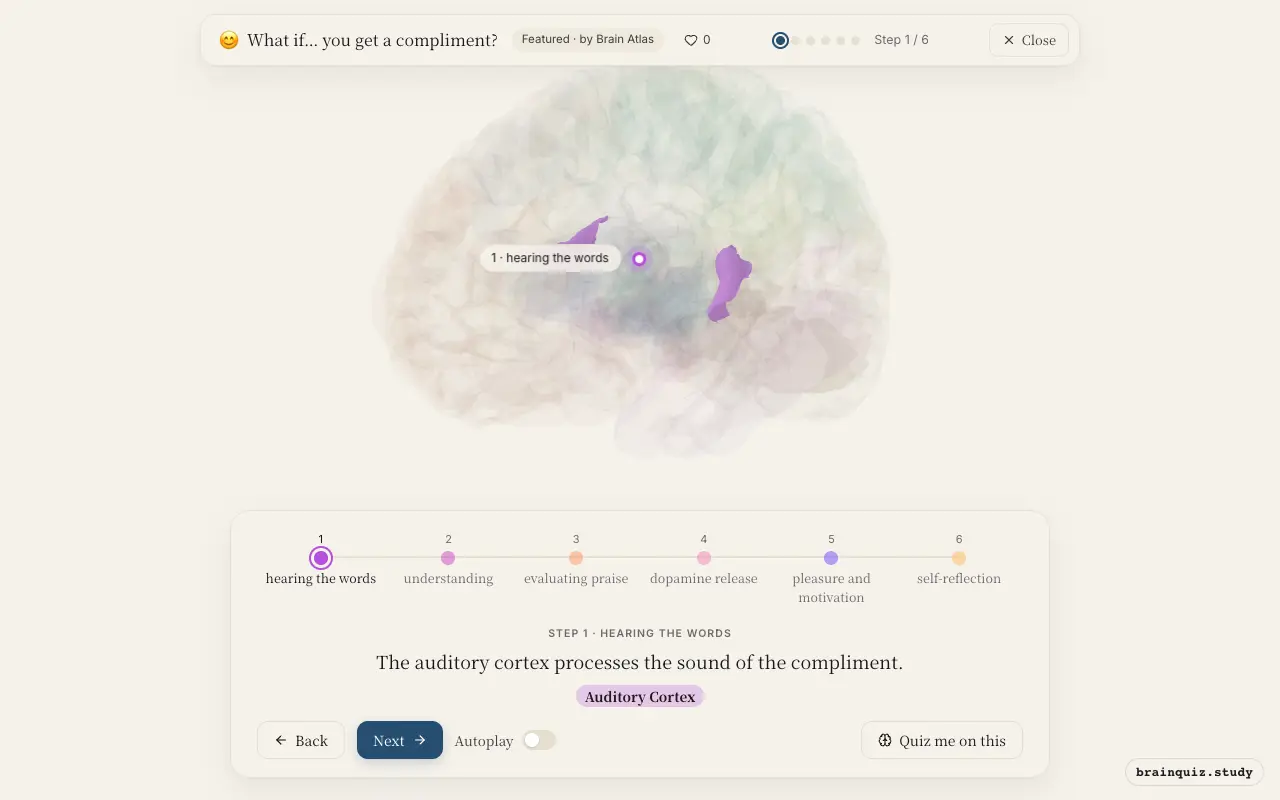
This region decodes the acoustic features of speech, such as pitch and timing, before language areas extract meaning. It is the first cortical stop for auditory information from the ears.
2. Wernicke's Area: understanding
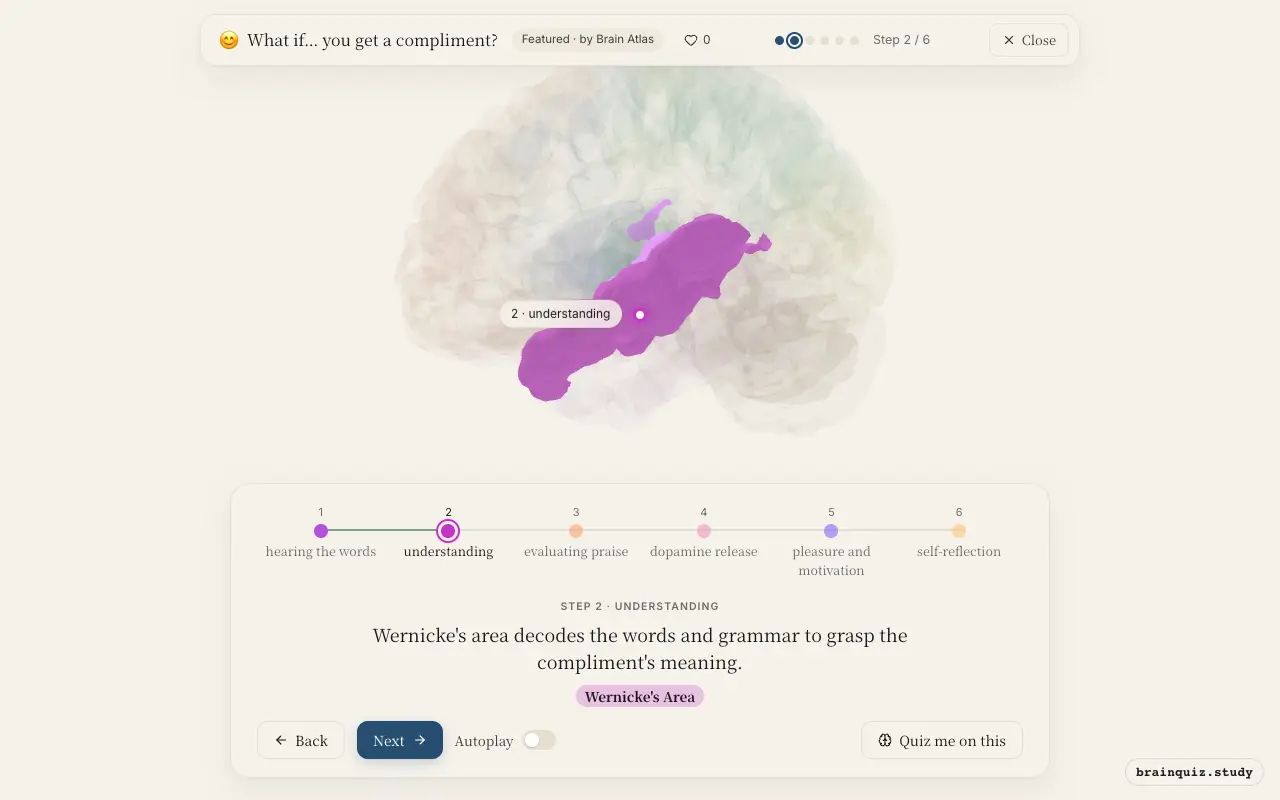
Located in the left temporal lobe, it maps sounds to known vocabulary and syntax. Damage here causes receptive aphasia, where speech sounds are heard but not understood.
3. Orbitofrontal Cortex: evaluating praise
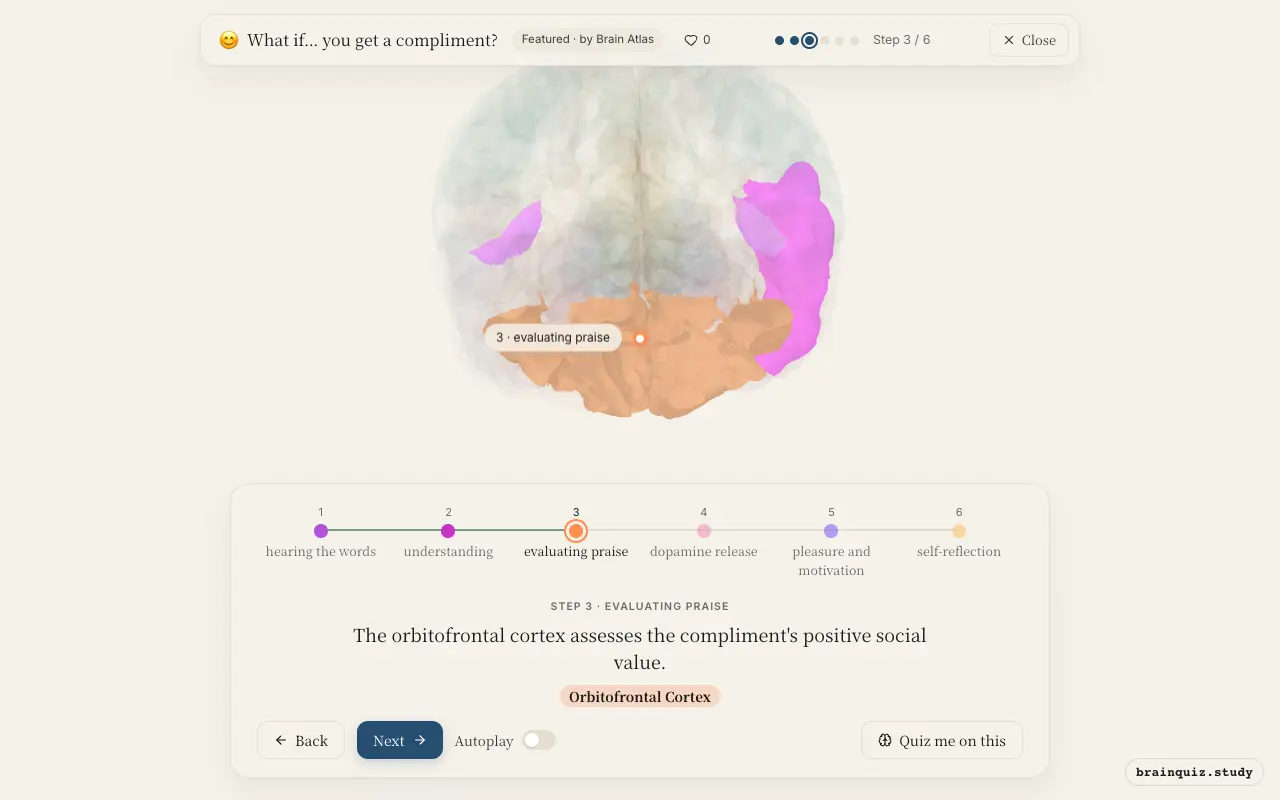
This region integrates sensory and social information to determine reward significance. Some studies show it is more active when receiving praise than neutral statements, reflecting its role in value-based decisions.
4. Ventral Tegmental Area: dopamine release
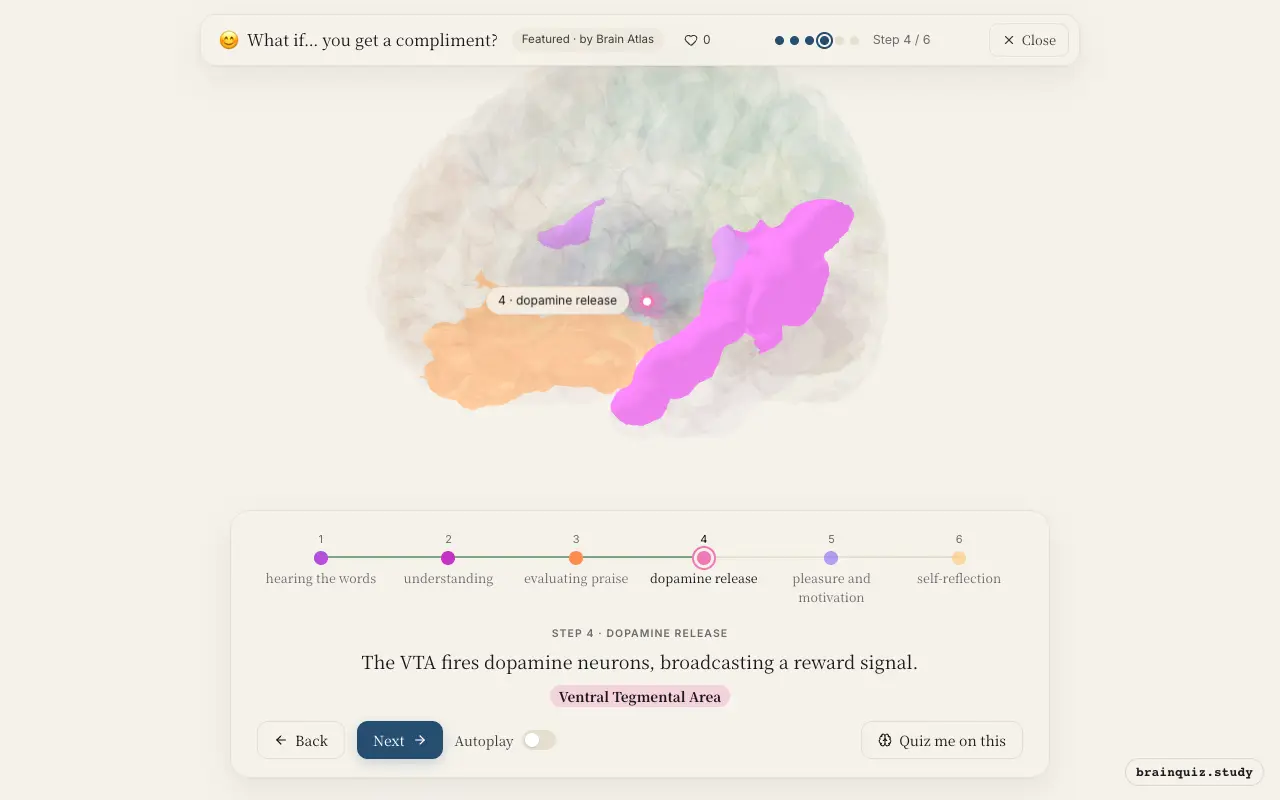
Dopamine from the VTA to the nucleus accumbens and prefrontal cortex reinforces the behavior of seeking social approval. This pathway is central to motivation and learning from positive feedback.
5. Nucleus Accumbens: pleasure and motivation
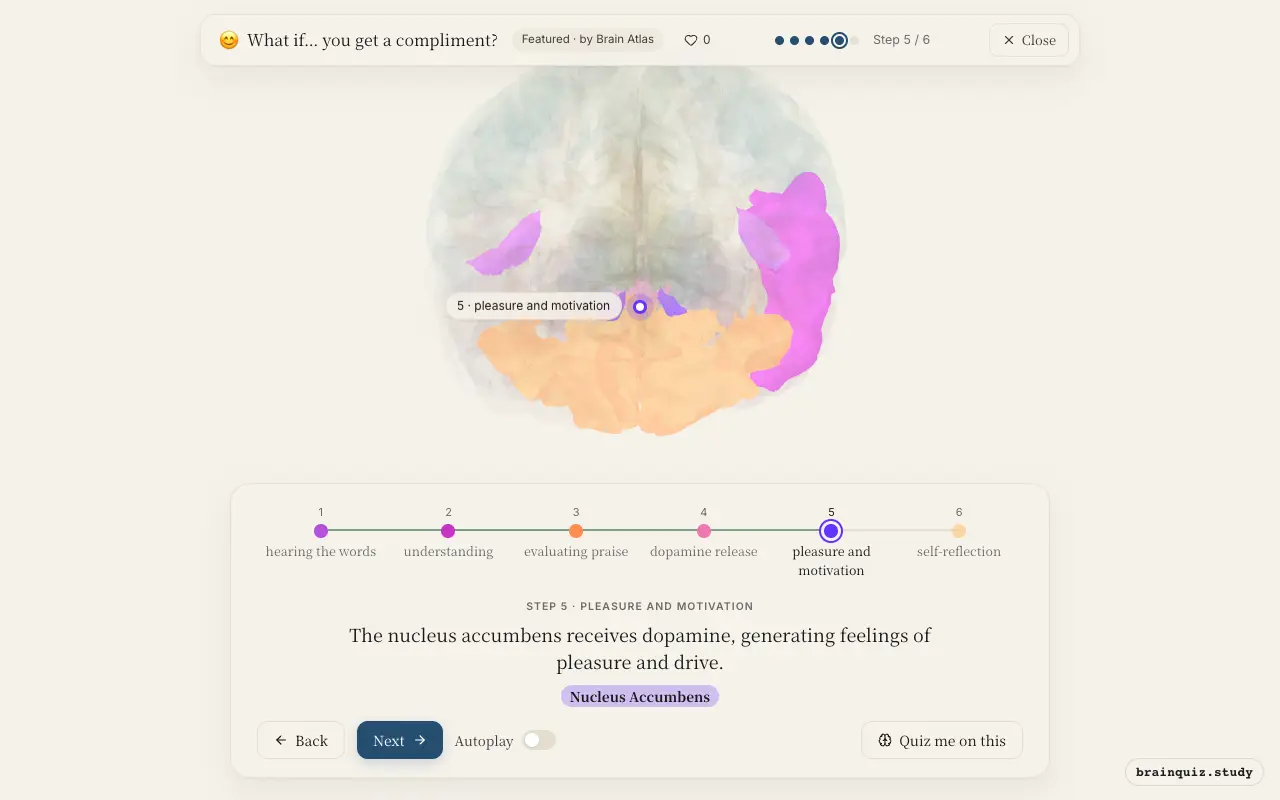
As part of the ventral striatum, it is a key hub for reward processing. Some studies link activation here to subjective ratings of happiness and the urge to repeat the rewarding interaction.
6. Posterior Cingulate Cortex: self-reflection
This region is a core node of the default mode network, active during self-referential thought. It helps integrate the compliment into autobiographical memory, shaping your self-esteem.
Good to know
- Social rewards like praise activate the same dopaminergic pathways as primary rewards such as food.
- The nucleus accumbens response to compliments predicts subsequent changes in self-esteem in some studies.
- The orbitofrontal cortex is part of the prefrontal cortex that tracks subjective value across many reward types.
Compliment vs Criticism
Criticism activates the anterior cingulate and amygdala, signaling error and threat, while compliments engage reward regions like the nucleus accumbens. The brain treats social evaluation as either rewarding or aversive, with distinct neural circuits.
Test yourself
Which brain region releases dopamine in response to a compliment?
Which region is most associated with evaluating the positive value of social feedback?
Damage to which area would prevent understanding the words of a compliment?
0 of 3 answered · 0 correct
Simplified: many regions work together at once, and this shows the main players in the order they act.