What happens in your brain when you make eye contact?
Updated
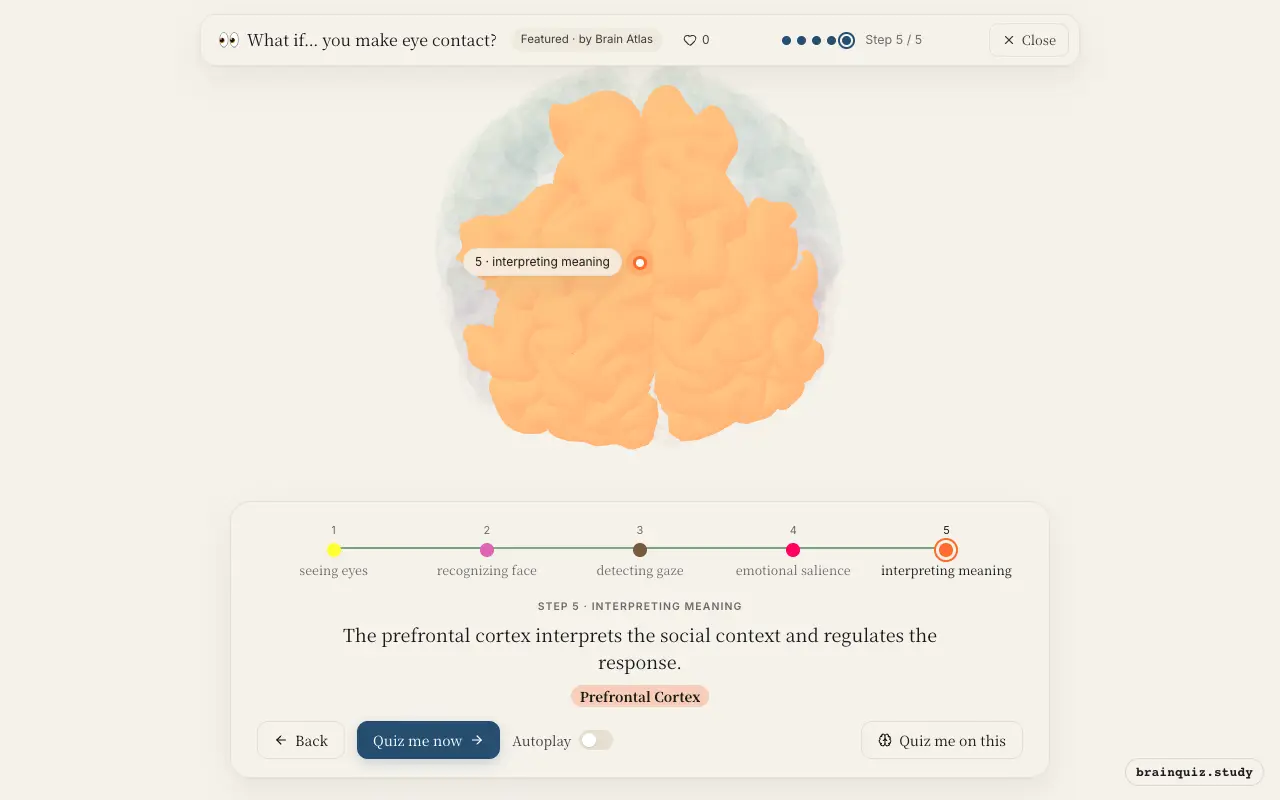
Visual cortex detects the eyes, fusiform gyrus recognizes the face, superior colliculus flags direct gaze, amygdala assesses emotional salience, and prefrontal cortex interprets social meaning.
Watch it light up on the 3D brain
Brain regions that light up
| Order | Region | What it does here |
|---|---|---|
| 1 | Visual Cortex | The visual cortex processes the basic features of the other person's eyes and face. |
| 2 | Fusiform Gyrus | The fusiform gyrus integrates features to recognize the face and locate the eyes. |
| 3 | Superior Colliculus | The superior colliculus rapidly detects direct eye contact and shifts attention. |
| 4 | Amygdala | The amygdala evaluates the emotional significance of the mutual gaze. |
| 5 | Prefrontal Cortex | The prefrontal cortex interprets the social context and regulates the response. |
1. Visual Cortex: seeing eyes
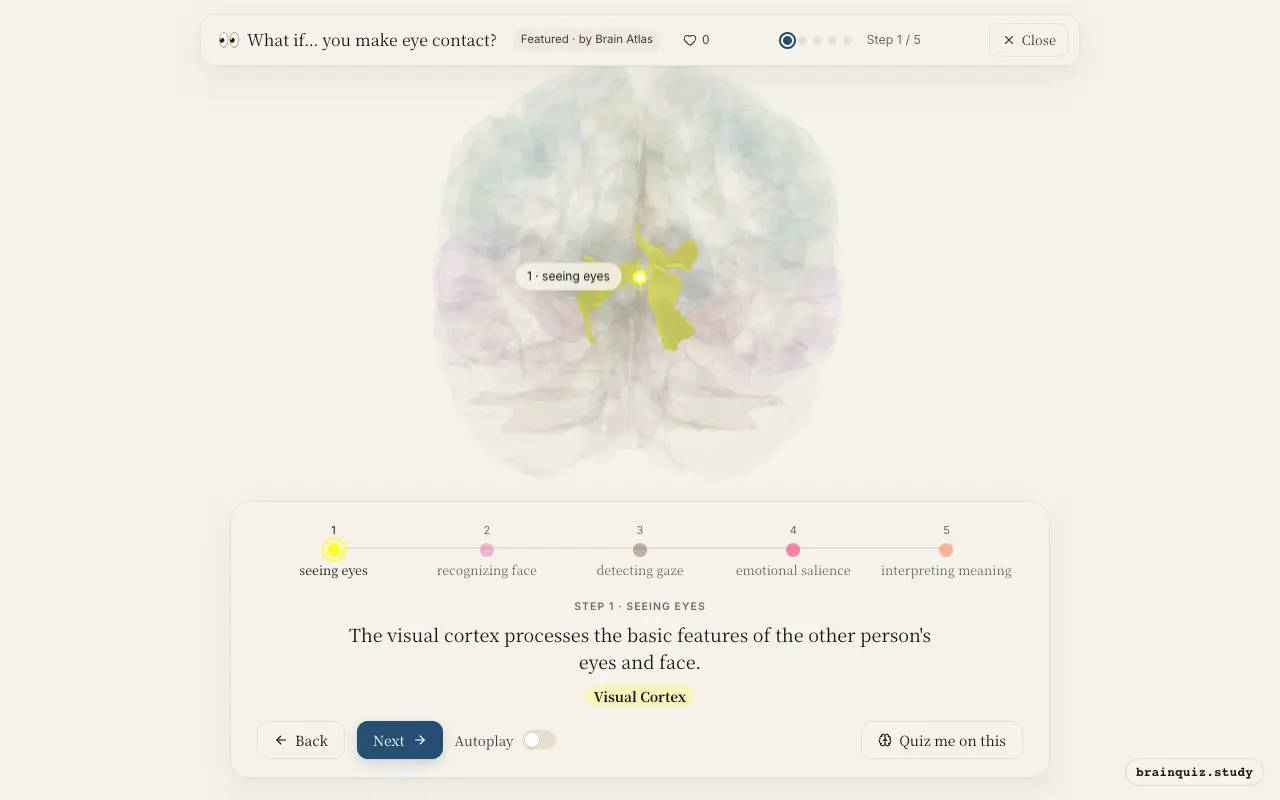
The primary visual cortex receives input from the retina and extracts edges, orientation, and movement. It sends this information to higher visual areas for further analysis.
2. Fusiform Gyrus: recognizing face
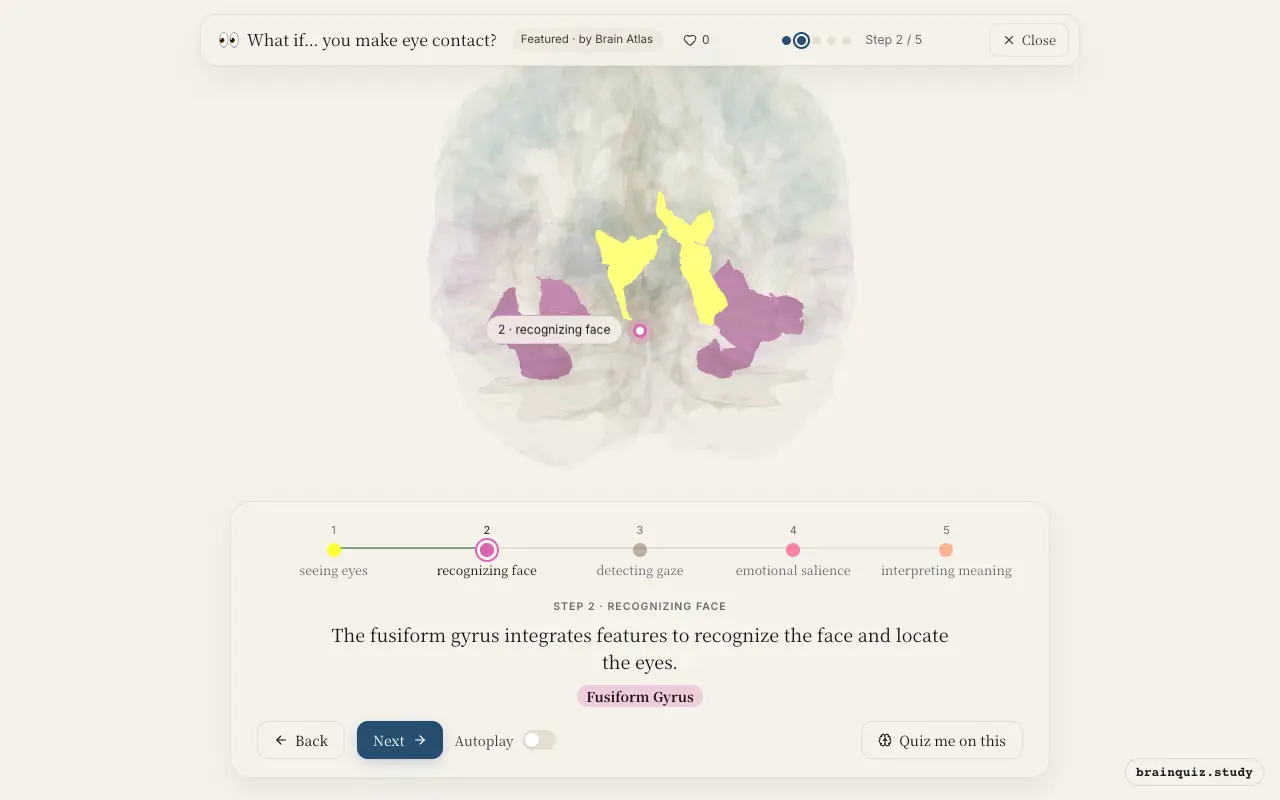
The fusiform gyrus is specialized for face processing. It is especially responsive to the eye region, helping to identify the individual and determine gaze direction.
3. Superior Colliculus: detecting gaze
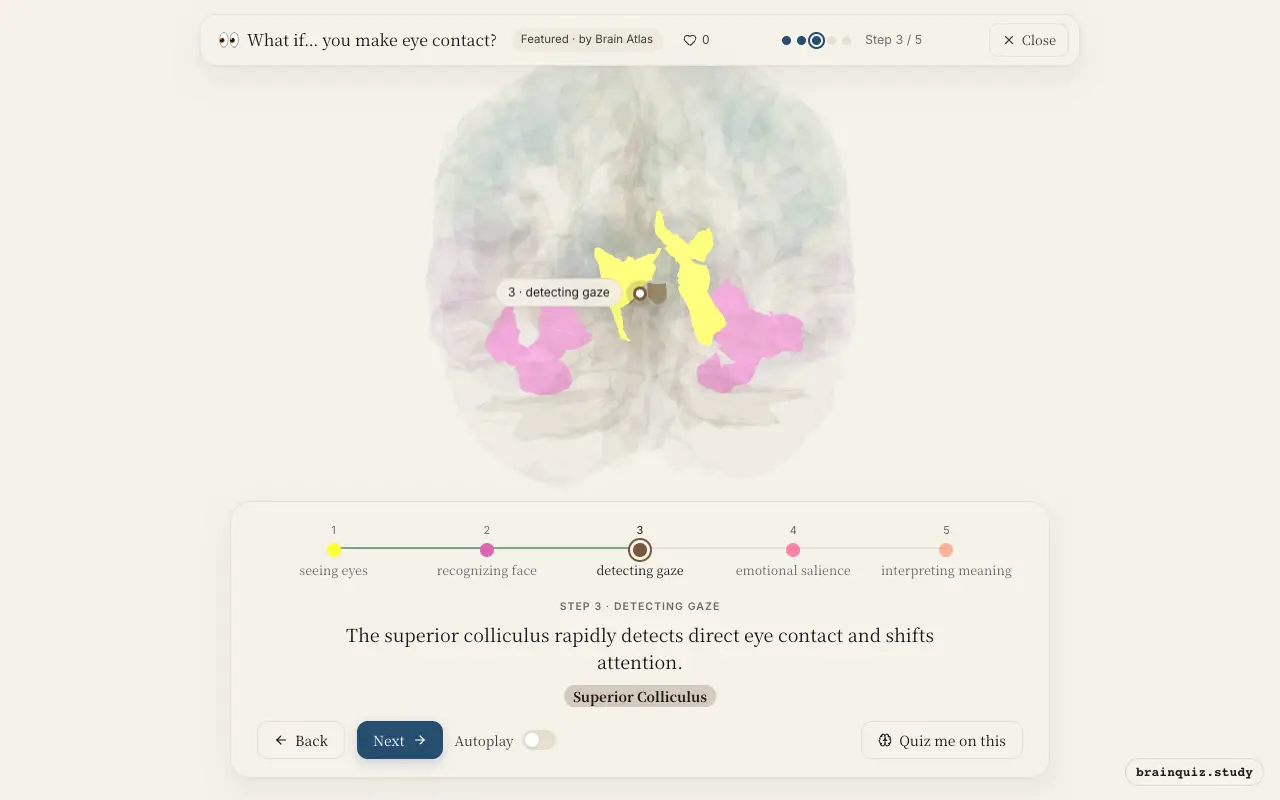
The superior colliculus is part of a fast subcortical pathway that responds to eye-like stimuli. It helps prioritize direct gaze as a salient social cue, triggering orienting responses.
4. Amygdala: emotional salience
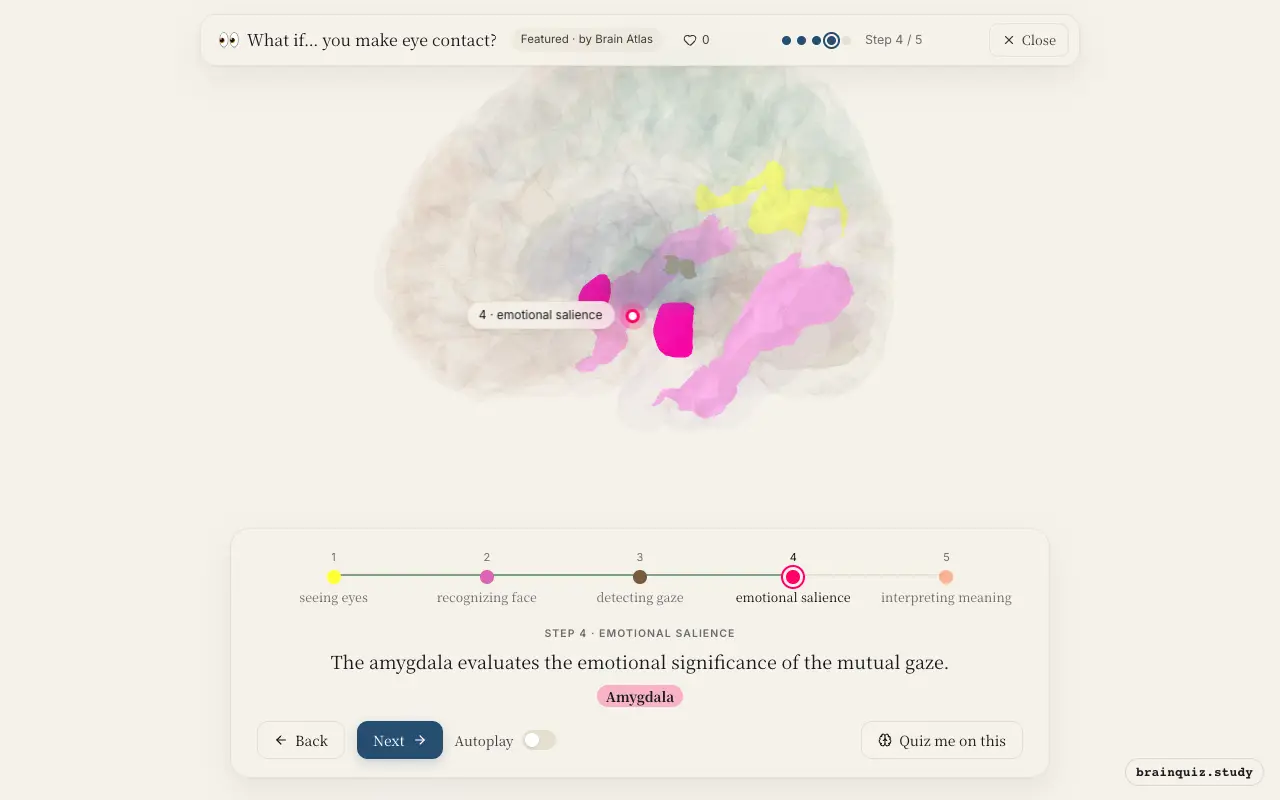
Direct eye contact can signal threat, intimacy, or social interest. The amygdala activates in response to mutual gaze, especially with unfamiliar people, and modulates autonomic arousal.
5. Prefrontal Cortex: interpreting meaning
The prefrontal cortex uses contextual information to decide whether the eye contact is friendly or hostile. It helps modulate the emotional response and plan appropriate social behavior.
Good to know
- Mutual eye contact increases autonomic arousal, including heart rate and skin conductance.
- Individuals with autism spectrum disorder may show reduced amygdala response to direct gaze.
- Eye contact between mother and infant may synchronize brain activity in social regions.
Mutual gaze vs averted gaze
Direct eye contact may elicit stronger activation in the amygdala and superior colliculus than averted gaze, but this is not universal. Averted gaze reduces social threat and allows the prefrontal cortex to focus on other aspects of the interaction.
Test yourself
Which brain region is specialized for face recognition and is particularly responsive to the eyes?
Direct eye contact with a stranger typically increases activity in which region associated with emotional salience?
The rapid orienting to eye contact is partly driven by which subcortical structure?
0 of 3 answered · 0 correct
Simplified: many regions work together at once, and this shows the main players in the order they act.