Superior Colliculus — Function, Location & Quiz
The superior colliculus is a midbrain priority map that turns a selected location into an orienting eye movement. It integrates visual, auditory and somatosensory space, unlike primary visual cortex, which builds a detailed cortical representation of the visual field.
Its output is normally held under tonic inhibition by substantia nigra pars reticulata. Releasing that brake permits a saccade, echoing the disinhibition logic used by basal-ganglia motor circuits elsewhere in the brain.
Test this anatomy in the Lesion Localization Quiz: 15 Clinical Questions or explore it on the interactive 3D brain.
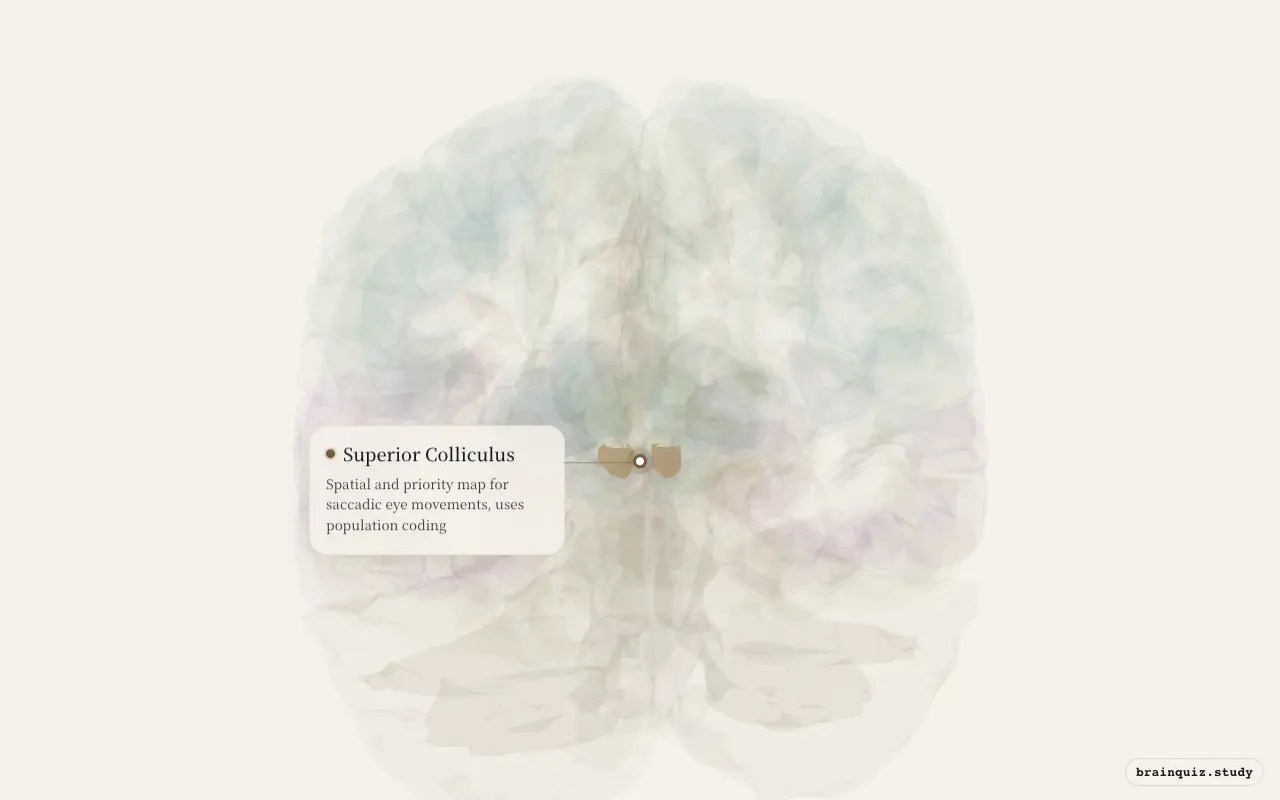
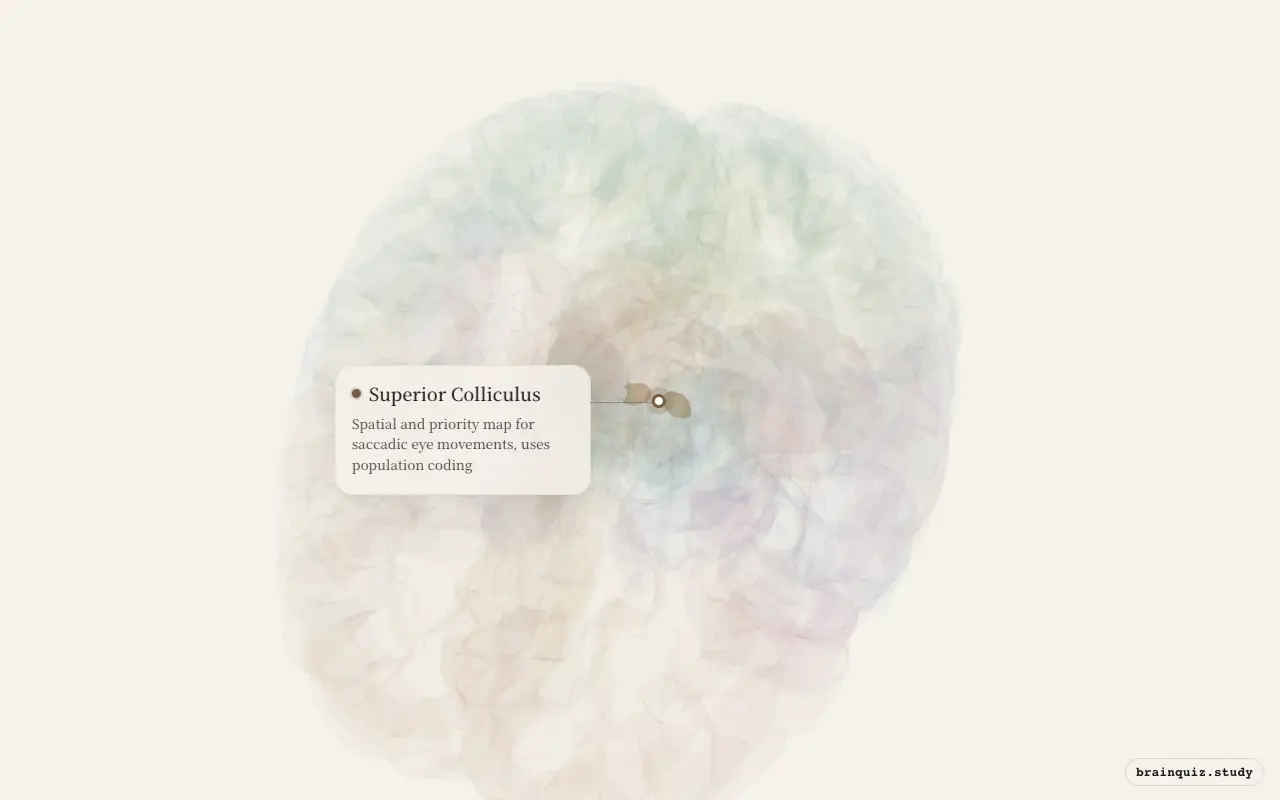
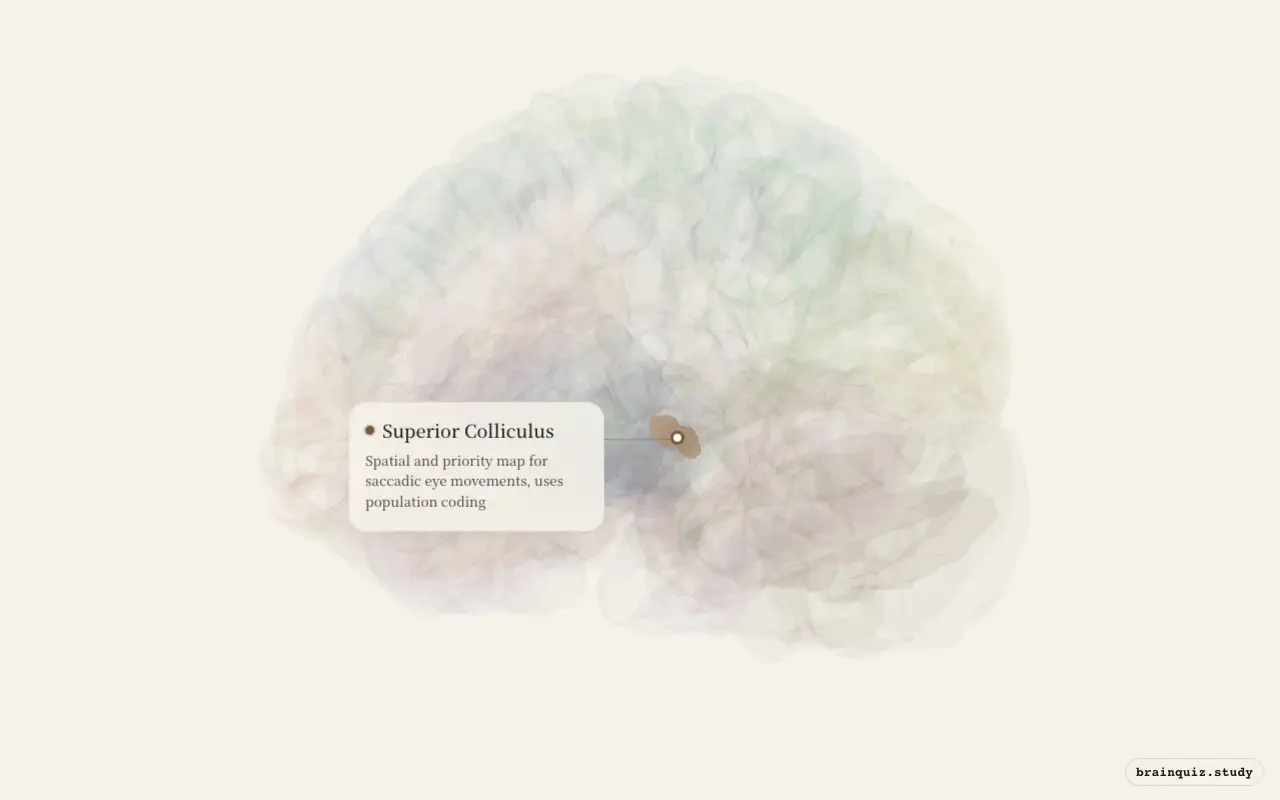
Where is the Superior Colliculus located?
Spatial and priority map for saccadic eye movements, uses population coding.
What does the Superior Colliculus do?
- Spatial/priority map for saccadic eye movements
- Population coding — movement direction encoded by activity across many neurons
- Multisensory integration — aligns visual, auditory, and somatosensory maps
Superior Colliculus pathways and connections
- SC ← Frontal eye fields (voluntary saccade commands)
- SC ← SNr (tonic inhibition — the eye movement brake, always on)
- SC → Brainstem saccade generators (executes the actual eye movement)
What happens when the Superior Colliculus is damaged?
- SNr damage = uncontrolled saccades (brake is off — eyes move involuntarily)
- SC lesions impair reflexive saccades and visual orienting
Superior Colliculus key facts
Atlas category: subcortical.
- Lee, Rohrer & Sparks (1988): pharmacological silencing proved population coding in SC
- Hikosaka & Wurtz (1989): demonstrated SNr→SC braking mechanism for eye movements
- Same brake principle as BG motor circuit (GP→thalamus) but for eyes (SNr→SC)
Superior Colliculus exam tip
SC uses same brake principle as BG motor circuit but for eyes. SNr = eye movement brake. Lee/Rohrer/Sparks proved population coding.
Common questions
What does the superior colliculus do?
It creates a spatial priority map, integrates multiple senses and helps execute reflexive and selected saccadic eye movements.
How do frontal eye fields connect to the superior colliculus?
Frontal eye fields provide voluntary saccade commands, while superior colliculus passes the selected movement toward brainstem gaze generators.
How do basal ganglia control the superior colliculus?
Substantia nigra pars reticulata tonically inhibits it. Caudate-mediated inhibition of SNr releases that brake so the chosen eye movement can occur.
When does the Superior Colliculus light up?
- 👀 When you make eye contact: The superior colliculus rapidly detects direct eye contact and shifts attention.