Substantia Nigra — Function, Location & Quiz
The substantia nigra contains two functionally different systems that should not be blended. Pars compacta supplies striatal dopamine for movement and reinforcement, while pars reticulata acts as an inhibitory output nucleus that restrains the superior colliculus.
Loss of pigmented pars compacta neurons drives the dopamine depletion of Parkinson’s disease. The resulting bradykinesia and rigidity are circuit effects in the striatum and pallidum, not simply a failure of muscles or primary motor cortex.
Test this anatomy in the Neurotransmitter Pathways Quiz: Dopamine, Serotonin & More or explore it on the interactive 3D brain.
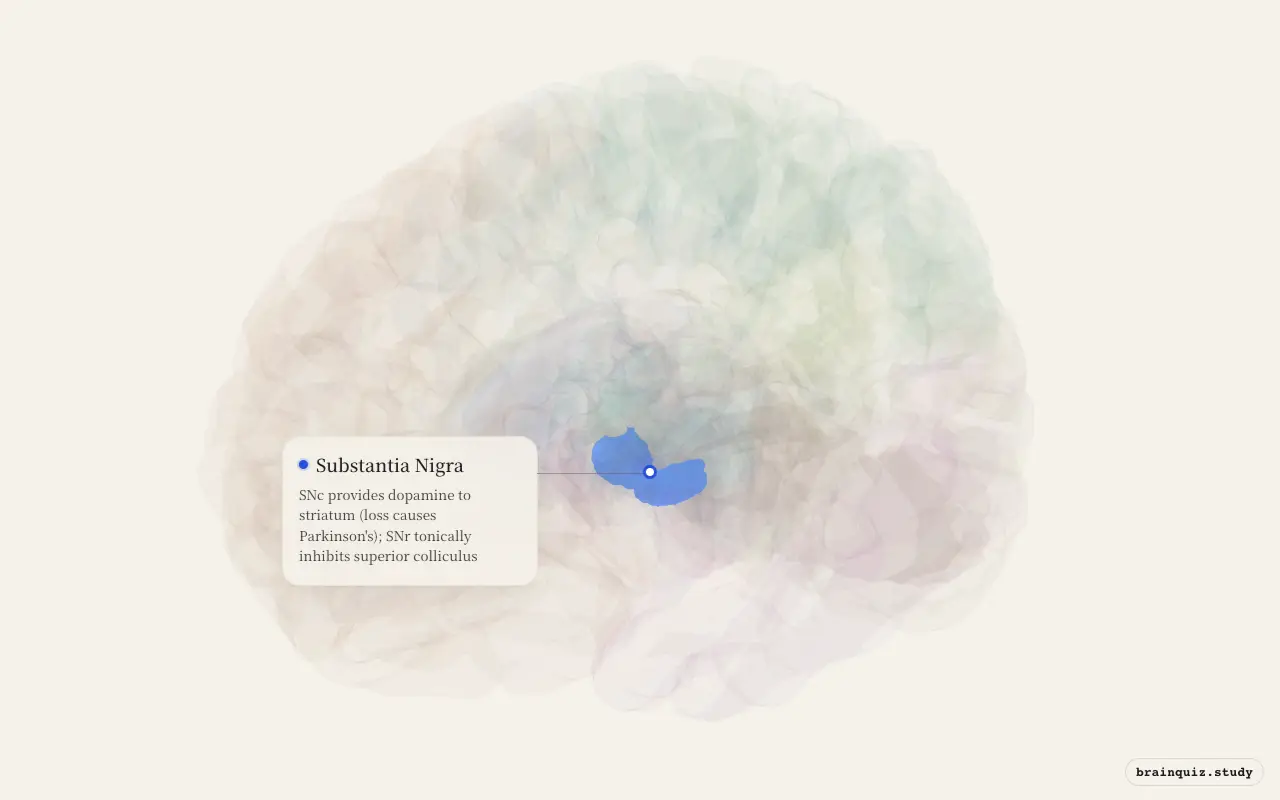
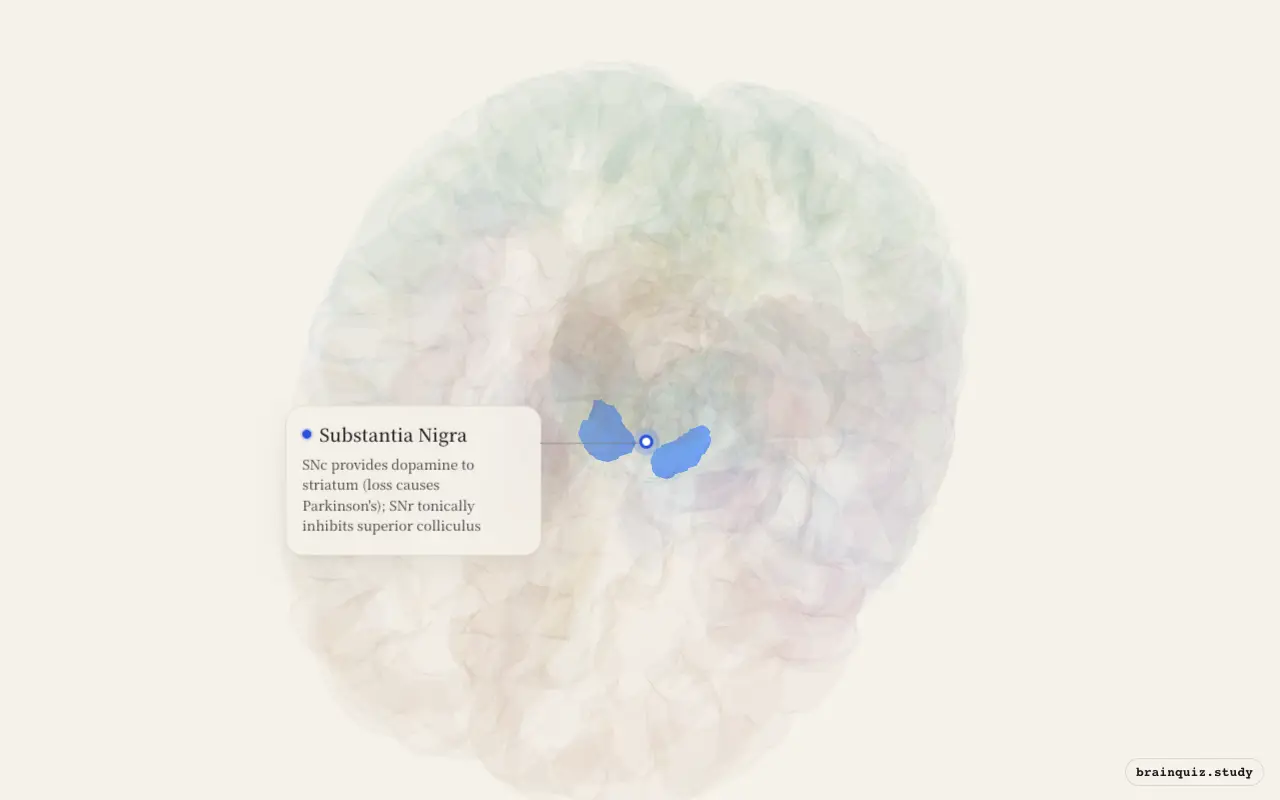
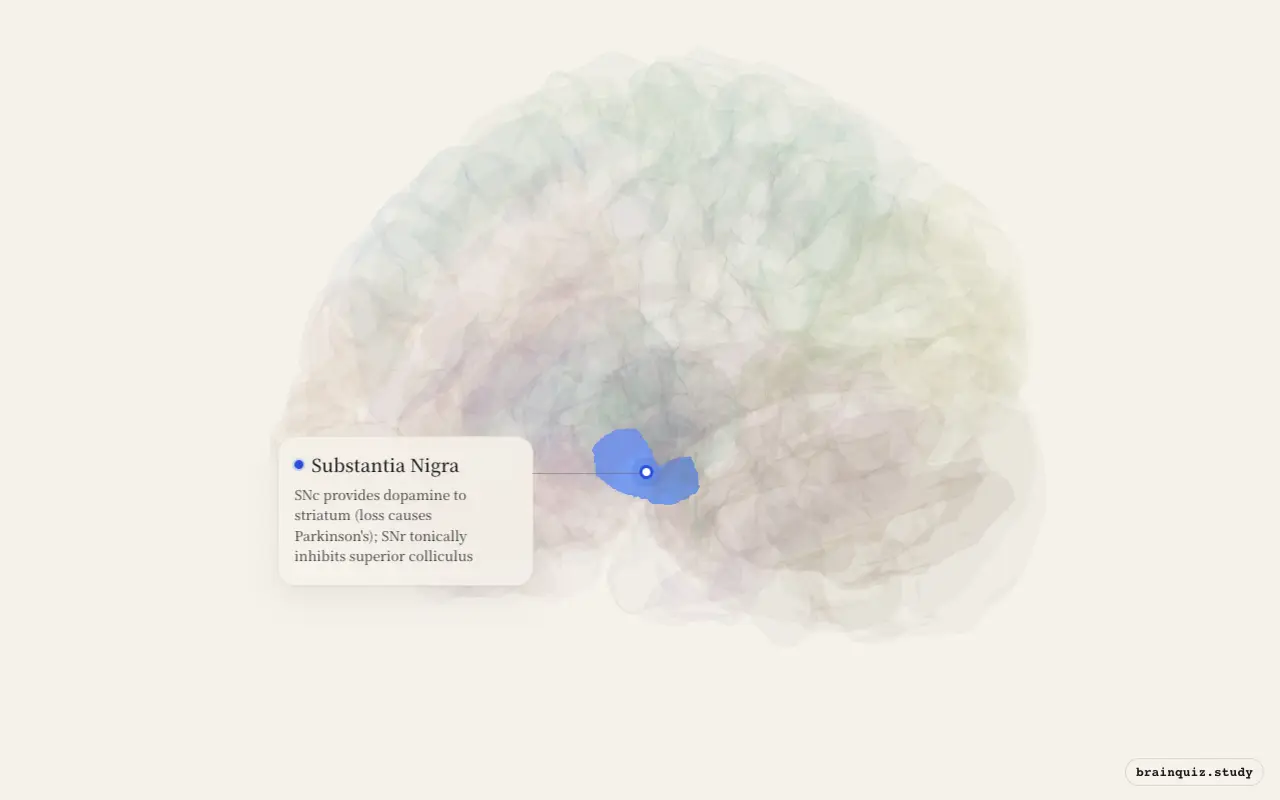
Where is the Substantia Nigra located?
SNc provides dopamine to striatum (loss causes Parkinson's); SNr tonically inhibits superior colliculus.
What does the Substantia Nigra do?
- SNc (pars compacta): produces dopamine for the striatum — modulates direct/indirect pathways
- SNr (pars reticulata): tonically inhibits superior colliculus — the eye movement brake
- SNc dopamine signals reward prediction errors (Schultz)
Substantia Nigra pathways and connections
- SNc → Striatum (dopaminergic — nigrostriatal pathway, modulates Go/NoGo balance)
- SNr → Superior colliculus (inhibitory — tonic brake on eye movements)
- SNr ← Caudate (eye movement circuit — caudate inhibits SNr to release saccades)
What happens when the Substantia Nigra is damaged?
- SNc death = Parkinson's disease — dopamine loss in striatum → bradykinesia, rigidity, tremor
- Treatment = L-DOPA (dopamine precursor) — restores striatal dopamine
- L-DOPA side effect: compulsive gambling — dopamine affects reward/decision pathways too
Substantia Nigra key facts
Atlas category: subcortical.
- SNc = dopamine factory for movement. SNr = eye movement brake
- Named 'substantia nigra' (black substance) due to neuromelanin pigment in dopamine neurons
- Parkinson's: loss of >60-80% of SNc neurons before motor symptoms appear
Substantia Nigra exam tip
SNc = dopamine factory for movement (death = Parkinson's). SNr = eye movement brake (inhibits superior colliculus). Know both parts!
Common questions
What is the difference between SNc and SNr?
Substantia nigra pars compacta produces dopamine for the striatum; pars reticulata provides tonic inhibitory output, including a brake on the superior colliculus.
Why is substantia nigra dark?
Its name means “black substance” and reflects neuromelanin pigment in dopamine-producing neurons, especially within pars compacta.
How is substantia nigra involved in Parkinson’s disease?
Degeneration of pars compacta neurons removes nigrostriatal dopamine, shifting direct and indirect pathway balance toward excessive movement inhibition.
When does the Substantia Nigra light up?
- 🔁 When you form a new habit: Substantia nigra releases dopamine to strengthen the habit circuit.
- 🧠 When you get Parkinson's disease: Dopamine-producing neurons in the substantia nigra degenerate.
- 🧠 When you grow old: Dopamine-producing neurons in the substantia nigra decline, affecting movement and cognition.