What Is the Salience Network? Brain Regions and Function
Updated
The Salience Network is a set of brain regions—including the anterior insula, dorsal anterior cingulate cortex, and amygdala—that detects salient internal and external events and switches between the default mode and executive networks.
The salience network was first identified in resting-state fMRI studies around 2007, with Seeley and colleagues highlighting the anterior insula and dorsal anterior cingulate cortex as key hubs. It later became central to Menon's triple network model, linking internal thought and externally focused attention.
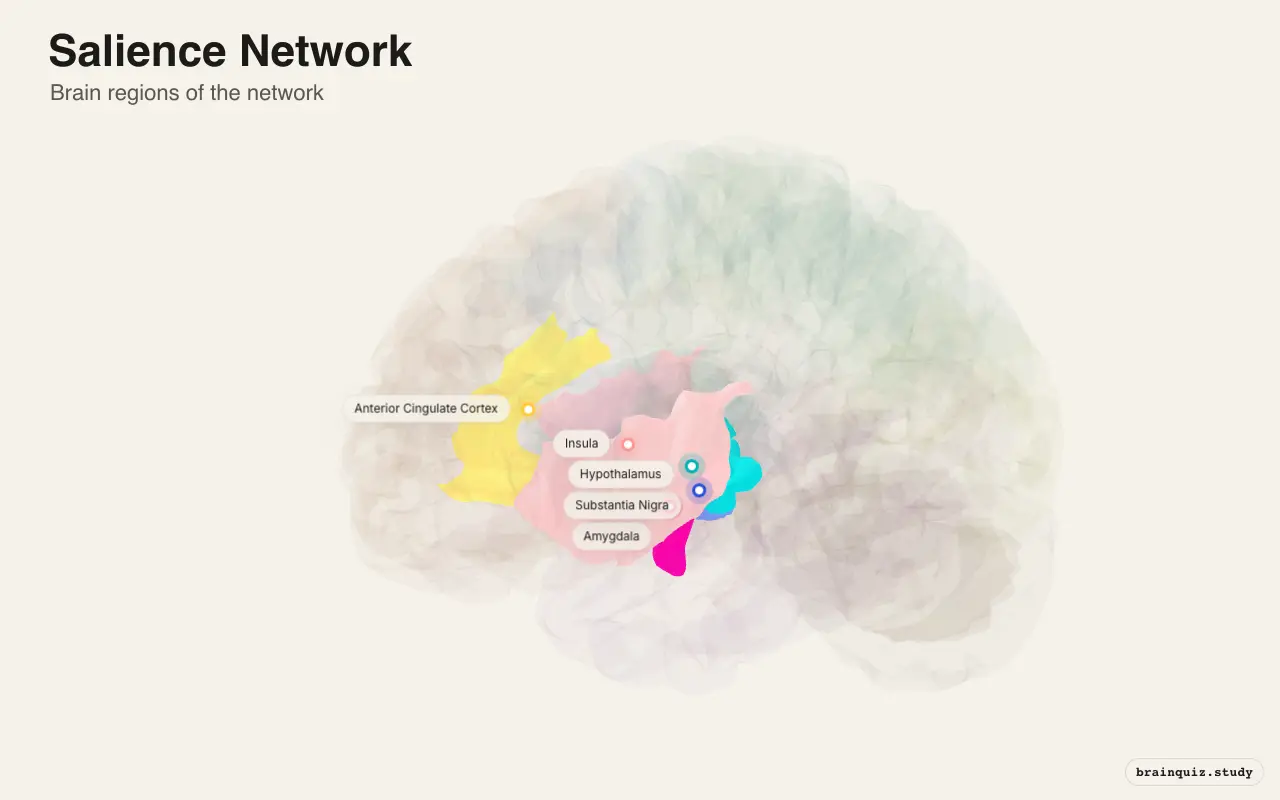
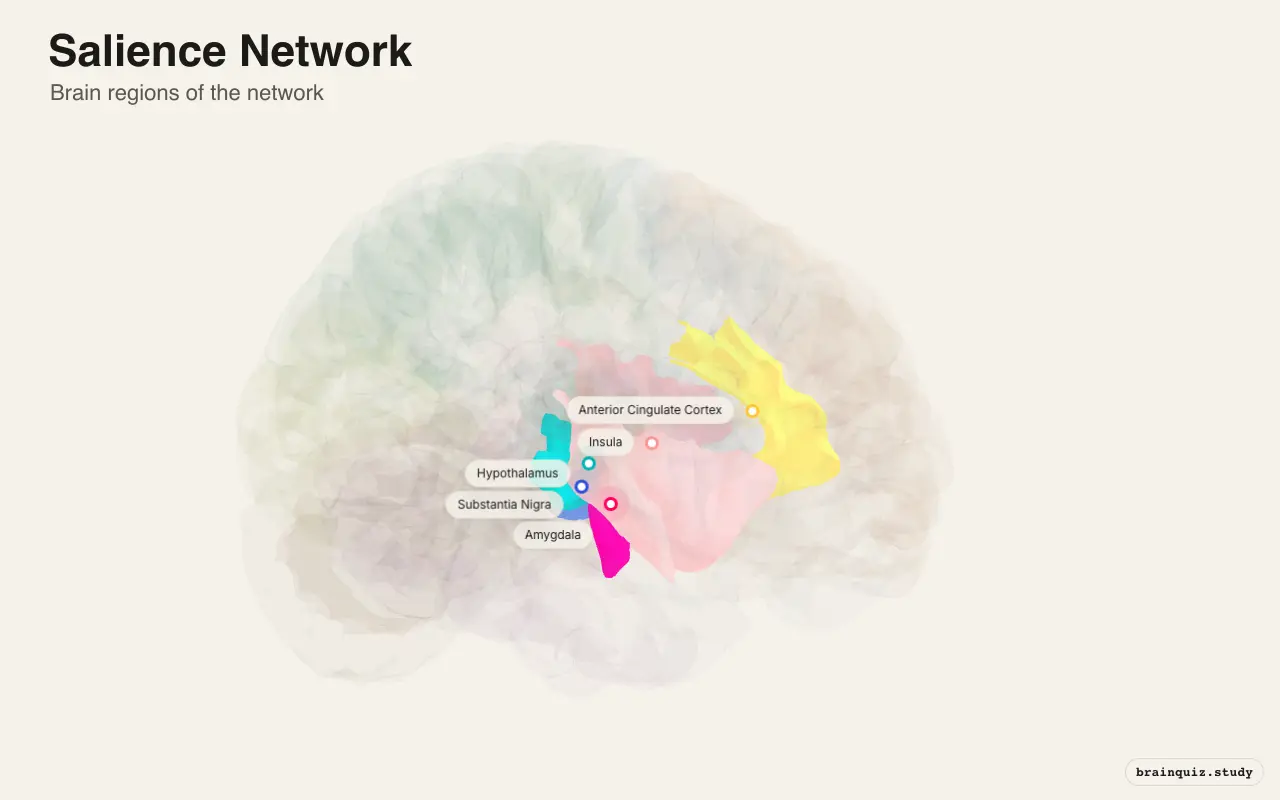
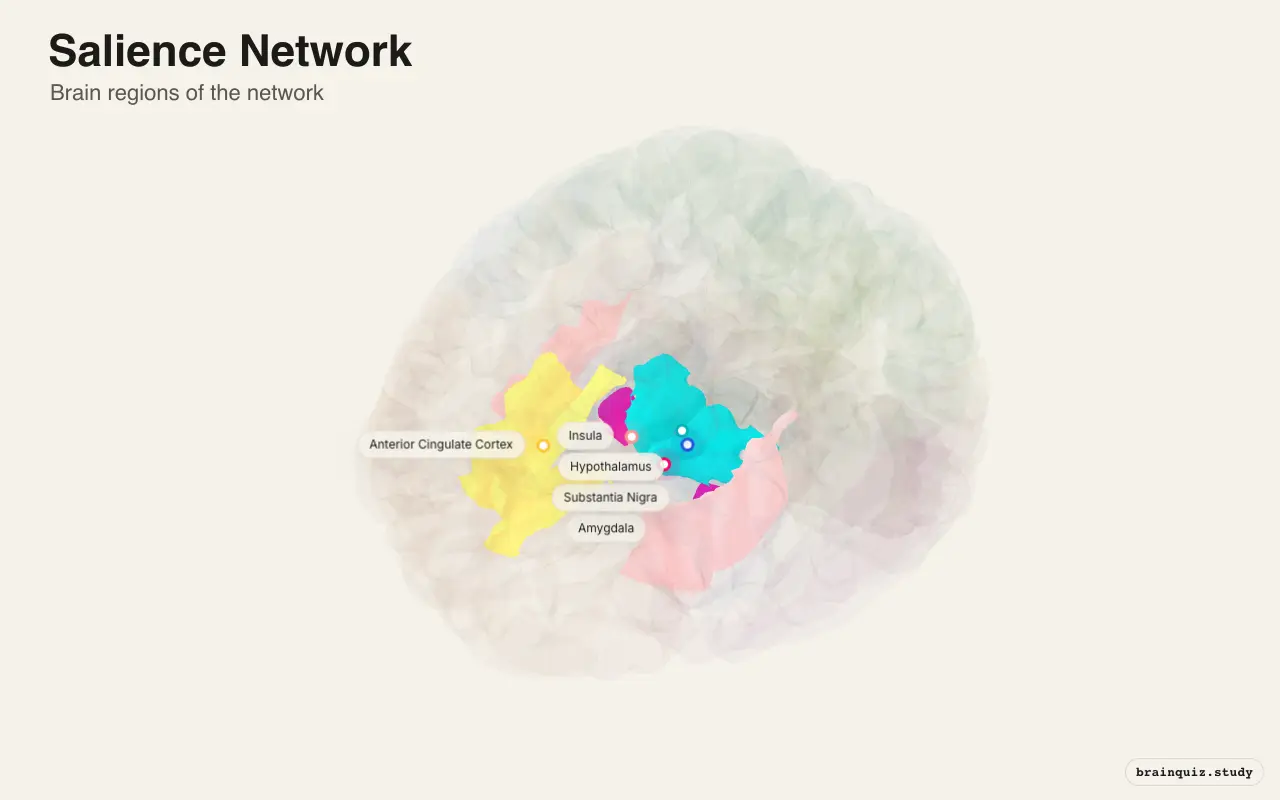
Which brain regions are in the Salience Network?
- Insula: Acts as the dynamic hub, integrating interoceptive, emotional, and cognitive signals to flag salient events.
- Anterior Cingulate Cortex: Monitors conflict and errors, and helps initiate switches between default mode and executive networks.
- Amygdala: Rapidly detects emotionally significant stimuli and contributes to arousal and vigilance.
- Substantia Nigra: Provides dopaminergic modulation that enhances salience processing and reward-based learning.
- Hypothalamus: Links interoceptive signals to autonomic and endocrine responses, supporting bodily regulation.
What does the Salience Network do?
What does the Salience Network do? It identifies the most relevant internal or external stimuli and reallocates brain resources accordingly. The anterior insula integrates bodily feelings, emotions, and cognitive demands to flag what matters most right now. By dynamically engaging either the default mode network or the central executive network, it helps shift between self-referential thought and goal-directed attention. This switching underlies everyday decisions, from noticing an unexpected sound to focusing on a demanding task.
- Salience detection — Flags surprising or biologically important events in the environment or within the body.
- Network switching — Shifts brain resources between the default mode network and the central executive network.
- Interoceptive awareness — Processes signals from internal organs, such as heartbeat and gut sensations, to inform decisions.
- Error monitoring — Signals when an action or thought conflicts with current goals or expectations.
- Emotional awareness — Contributes to conscious feelings by linking bodily changes, memories, and contextual cues.
When is the Salience Network active?
The salience network is most active when you encounter something unexpected, painful, or emotionally significant, such as a loud noise or a racing heartbeat. It also ramps up when switching between a daydream and a demanding task. Activity decreases during deep sleep, anesthesia, or highly practiced routine actions where little needs monitoring.
- You hear a sudden siren while reading and instantly look up.
- Your stomach growls during a meeting, and you notice you're hungry.
- You realize you've made a mistake in an email and feel a flash of concern.
- You snap out of a daydream when a friend calls your name.
- You feel your heart race when you see a near miss in traffic.
Salience Network vs Ventral Attention Network
The salience network and ventral attention network overlap in detecting important events, but they have distinct roles. The ventral attention network primarily reorients spatial attention to unexpected stimuli, acting as a circuit breaker for the dorsal attention network. The salience network casts a wider net, evaluating internal and external signals for relevance and switching between the default mode and executive networks. The two often cooperate when an unexpected event requires a global shift in brain state.
SN vs VAN at a glance
| Aspect | Salience Network | Ventral Attention Network |
|---|---|---|
| Primary role | Detects salient stimuli and switches large-scale networks | Detects unexpected events and reorients attention |
| Trigger | Internal or external signals marked as important | Unexpected environmental events outside current focus |
| Network interaction | Switches between default mode and executive networks | Interrupts dorsal attention network |
| Key regions | Anterior insula, dorsal anterior cingulate, amygdala | Temporoparietal junction, ventral frontal cortex |
| Attention type | Broad salience evaluation, not purely spatial | Spatial reorienting to peripheral stimuli |
What happens when the Salience Network is disrupted?
Changes in salience network function are linked to several psychiatric and neurological conditions. Because it coordinates brain-wide shifts, problems in this network can lead to difficulties in filtering information, regulating emotion, or engaging appropriately with tasks. Research findings are associations; they do not show that salience network changes alone cause any disorder.
- Behavioral variant frontotemporal dementia — Atrophy of the anterior insula and anterior cingulate cortex is an early marker, linked to loss of empathy and social disinhibition.
- Schizophrenia — Aberrant salience attribution is thought to contribute to delusion formation, as neutral events acquire inappropriate personal significance.
- Autism spectrum disorder — Reduced functional connectivity between salience network nodes is associated with difficulty shifting attention between internal and external states.
- Anxiety disorders — Hyperactivity in the salience network, particularly the anterior insula, may drive excessive threat vigilance and worry.
- Attention-deficit/hyperactivity disorder — Atypical switching between the default mode and task-positive networks is associated with inattention and poor task engagement.
How does the Salience Network work with other networks?
Within Menon's triple network model, the salience network sits between the default mode network and the central executive network. When you are internally focused, the default mode network is active and the salience network monitors for important changes. When a salient event occurs, the salience network fires and triggers a switch: it suppresses the default mode network and activates the central executive network. This flexible coupling allows rapid shifts from rest to externally focused tasks. The salience network also interacts with subcortical arousal and reward systems to prioritize urgent signals.
- Salience Network suppresses Default Mode Network — The anterior insula of the salience network deactivates the DMN when task-relevant external stimuli are detected, shifting the brain from internal mentation to externally focused processing.
- Salience Network activates Central Executive Network — The salience network engages the central executive network to allocate cognitive resources toward the detected salient stimulus, enabling goal-directed analysis and response planning.
How do scientists find the Salience Network?
Researchers identify the salience network using resting-state fMRI, where spontaneous fluctuations in blood oxygen level are correlated across brain regions. Seed-based analysis places a seed in the anterior insula or dorsal anterior cingulate cortex and finds connected areas; independent component analysis also extracts the network. A key limitation is that brain networks are not entirely separate—boundaries can shift across individuals and cognitive states.
Key facts about the Salience Network
- The salience network was first described by Seeley and colleagues in 2007 using resting-state functional connectivity.
- The anterior insula is often considered the main hub of the salience network because of its role in interoception.
- Menon's triple network model places the salience network as a switch between the default mode and central executive networks.
Sources
- Seeley WW et al. (2007). Dissociable intrinsic connectivity networks for salience processing and executive control. Journal of Neuroscience, 27(9), 2349–2356.
- Menon V, Uddin LQ (2010). Saliency, switching, attention and control: a network model of insula function. Brain Structure and Function, 214, 655–667.
- Menon V (2011). Large-scale brain networks and psychopathology: a unifying triple network model. Trends in Cognitive Sciences, 15(10), 483–506.