What Is the Ventral Attention Network? Brain Regions and Function
Updated
The Ventral Attention Network is a brain system for detecting unexpected, behaviorally relevant stimuli and reorienting attention. Core regions include ventral posterior parietal cortex, insula, anterior cingulate cortex, and temporal cortex. It acts as a circuit breaker for focused attention.
In the mid-2000s, Maurizio Corbetta and Gordon Shulman described the ventral attention network as a right-lateralized system for detecting unexpected events. Its discovery helped explain how the brain breaks focused attention to respond to new, important stimuli. Dysfunction in this network is linked to attention disorders and neglect.
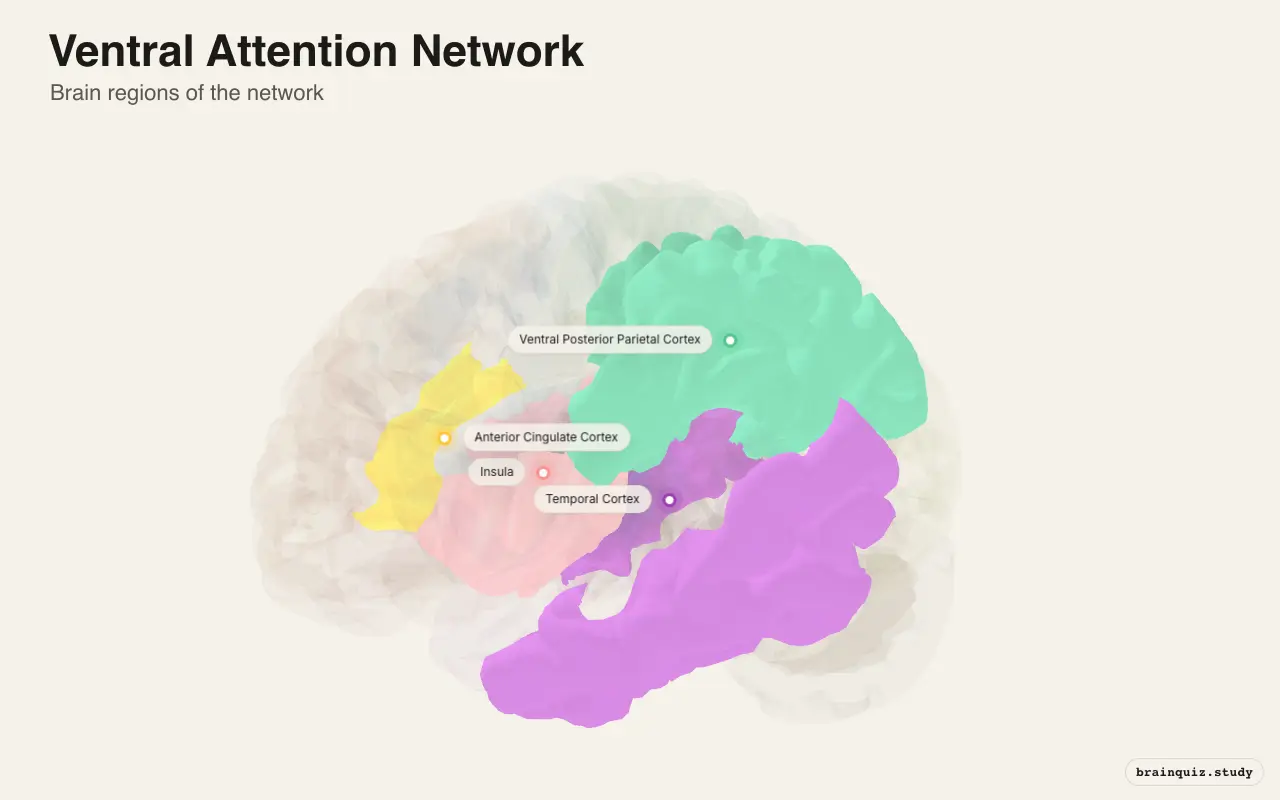
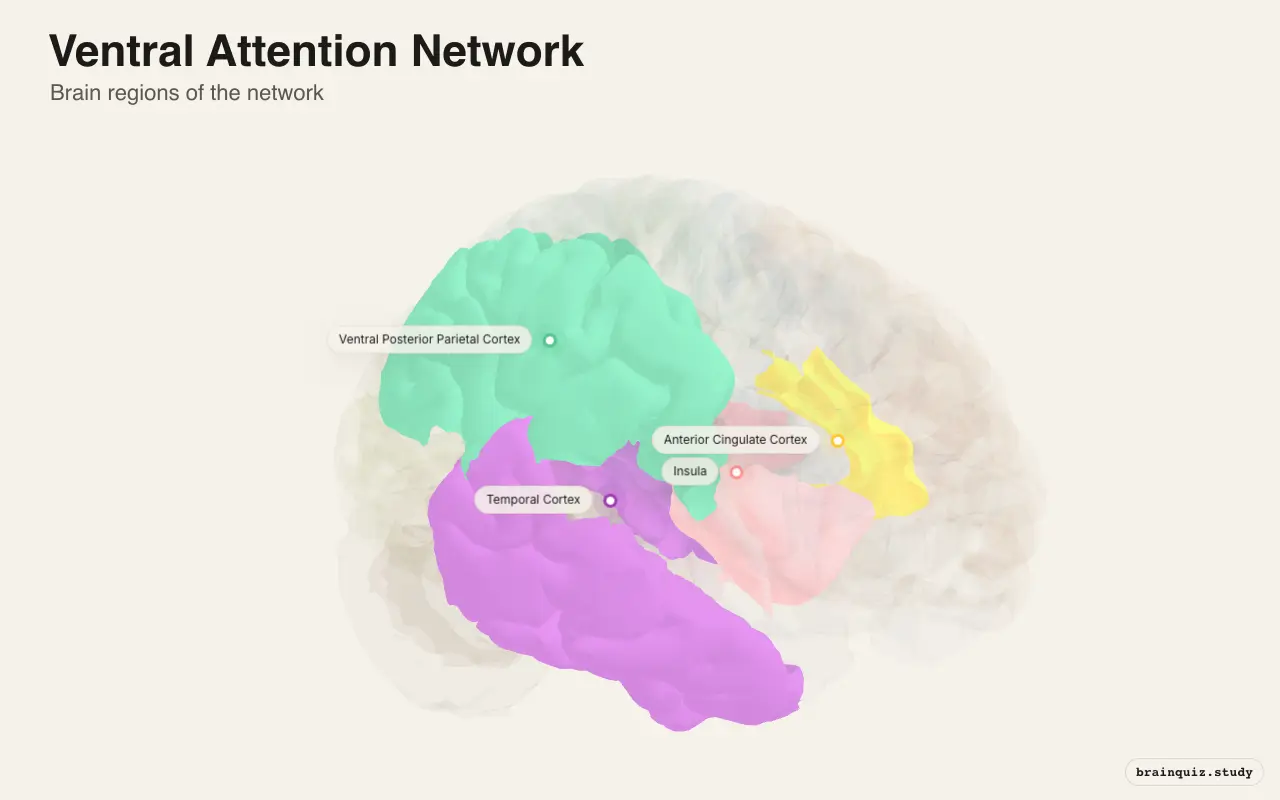
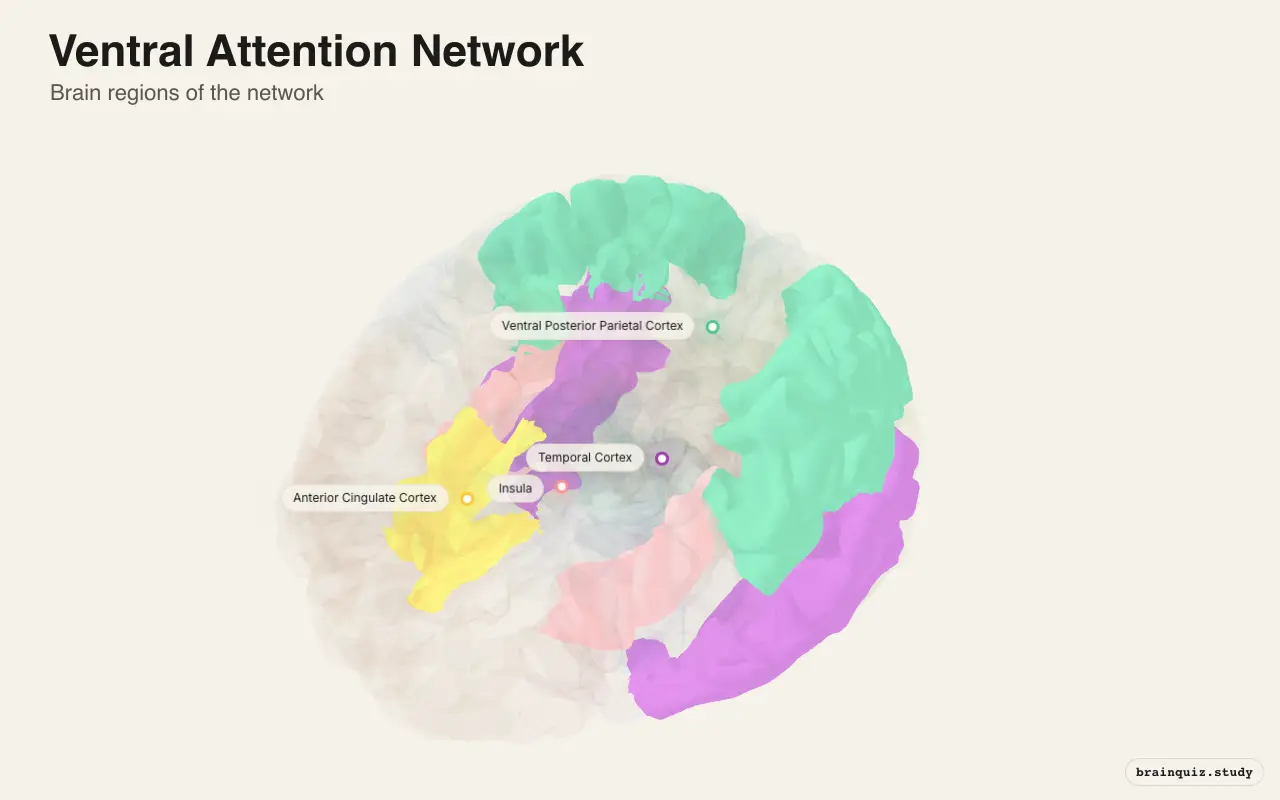
Which brain regions are in the Ventral Attention Network?
- Ventral Posterior Parietal Cortex: Contains the temporoparietal junction, a key hub for detecting salient, unexpected stimuli and triggering attention shifts to new locations.
- Insula: Registers the subjective importance of stimuli and helps switch between internal and external attention based on salience.
- Temporal Cortex: Processes auditory and visual features of unexpected events, aiding their quick recognition and localization.
- Anterior Cingulate Cortex: Monitors conflict and signals when new information requires updating ongoing goals or behavior.
What does the Ventral Attention Network do?
The ventral attention network detects unexpected, behaviorally relevant stimuli and reorients attention through a bottom-up mechanism. It acts as a circuit breaker for the dorsal attention network, interrupting focused attention when salient events occur outside the current focus. It integrates salience signals with current goals to decide whether to shift attention. Core regions include the temporoparietal junction, insula, anterior cingulate cortex, and temporal cortex.
- Stimulus-driven reorienting — Shifts attention to unexpected, salient events in the environment regardless of the current task.
- Detection of unexpected events — Identifies novel or surprising stimuli that may require immediate behavioral response.
- Circuit-breaking focused attention — Interrupts ongoing top-down attention to allow processing of new relevant information.
- Contextual updating — Updates the brain’s model of the environment when new information changes current goals.
- Integrating salience and goals — Combines bottom-up salience signals with top-down expectations to guide attention shifts.
When is the Ventral Attention Network active?
The ventral attention network is most active when an unexpected, salient stimulus appears outside the current focus of attention, such as a sudden loud noise or a flashing light. It also responds when a task requires detecting rare targets. It becomes less active during sustained, effortful concentration on a single task, when top-down goals dominate and few distracting events occur.
- A car horn honks while you are reading a book.
- Someone calls your name in a noisy room.
- A bright flash appears in your peripheral vision during a conversation.
- You notice a child running toward the street while talking on the phone.
Ventral Attention Network vs Dorsal Attention Network
The dorsal attention network mediates voluntary, goal-directed allocation of attention to spatial locations and features. In contrast, the ventral attention network detects unexpected, relevant stimuli and reorients attention through a bottom-up mechanism. The two networks interact: the ventral network acts as a circuit breaker that interrupts dorsal network activity when a salient event requires a shift of attention, then the dorsal network takes over to maintain the new focus.
VAN vs DAN at a glance
| Aspect | Ventral Attention Network | Dorsal Attention Network |
|---|---|---|
| Control mode | Bottom-up, stimulus-driven | Top-down, goal-directed |
| Main function | Detect unexpected events | Maintain focused attention |
| Triggers | Salient stimuli outside focus | Current goals and expectations |
| Interrupts | Ongoing focused attention | Is interrupted by salient events |
| Hemisphere bias | Right-lateralized | Bilateral, more dorsal |
What happens when the Ventral Attention Network is disrupted?
Disruption of the ventral attention network is associated with several neurological and psychiatric conditions. Lesions or dysfunction in its nodes can impair the ability to detect and reorient to unexpected events. The following associations are based on research findings and should not be interpreted as definitive causal links; individual variation and comorbidity are common.
- Hemispatial neglect — Damage to the right temporoparietal junction, a core ventral attention network region, is strongly associated with neglect of the left side of space.
- ADHD (inattentive subtype) — Studies suggest hypoactivation in ventral attention network nodes may contribute to difficulties in detecting and reorienting to relevant stimuli.
- Post-traumatic stress disorder — Aberrant ventral attention network activity, including hypervigilance to threat, is thought to play a role in PTSD symptomatology.
- Autism spectrum disorder — Ventral attention network dysfunction is associated with inflexible attention shifting and difficulty disengaging from focused interests.
- Age-related cognitive decline — Impaired reorienting of attention in older adults has been linked to reduced ventral attention network responsiveness.
How does the Ventral Attention Network work with other networks?
The ventral attention network works closely with the dorsal attention network to shift and maintain attention. It also interacts with the salience network, which shares key nodes such as the anterior insula and anterior cingulate cortex, to evaluate the importance of stimuli. The default mode network is typically suppressed when the ventral attention network detects an external event, aiding task engagement. These interactions allow the brain to balance internal thoughts, focused attention, and responsiveness to the environment.
How do scientists find the Ventral Attention Network?
Researchers identify the ventral attention network using resting-state fMRI functional connectivity, often with seed-based correlation or independent component analysis. A seed in the right temporoparietal junction or anterior insula reveals correlated activity across the network. One limitation is that resting-state connectivity reflects stable functional architecture but may not fully capture rapid, trial-by-trial reorienting dynamics; task-based neuroimaging is needed to study moment-to-moment activity.
Key facts about the Ventral Attention Network
- Maurizio Corbetta and Gordon Shulman introduced the concept of separate dorsal and ventral attention systems.
- The right temporoparietal junction is a critical node for reorienting attention to unexpected stimuli.
- The ventral attention network is strongly right-lateralized, whereas the dorsal attention network is more bilateral.
Sources
- Corbetta M, Shulman GL (2002). Control of goal-directed and stimulus-driven attention in the brain. Nature Reviews Neuroscience, 3(3), 201–215.
- Vossel S, Geng JJ, Fink GR (2014). Dorsal and ventral attention systems: distinct neural circuits but collaborative roles. The Neuroscientist, 20(2), 150–159.
- Yeo BTT et al. (2011). The organization of the human cerebral cortex estimated by intrinsic functional connectivity. Journal of Neurophysiology, 106(3), 1125–1165.