What Is the Dorsal Attention Network? Brain Regions and Function
Updated
The Dorsal Attention Network is a set of brain areas including the frontal eye fields, dorsal posterior parietal cortex, and premotor cortex. It controls voluntary, goal-directed attention to spatial locations and features.
The Dorsal Attention Network is one of the most consistently identified large-scale brain networks. It was first characterized in resting-state functional connectivity studies in the early 2000s. It is crucial for everyday tasks that require focused attention.
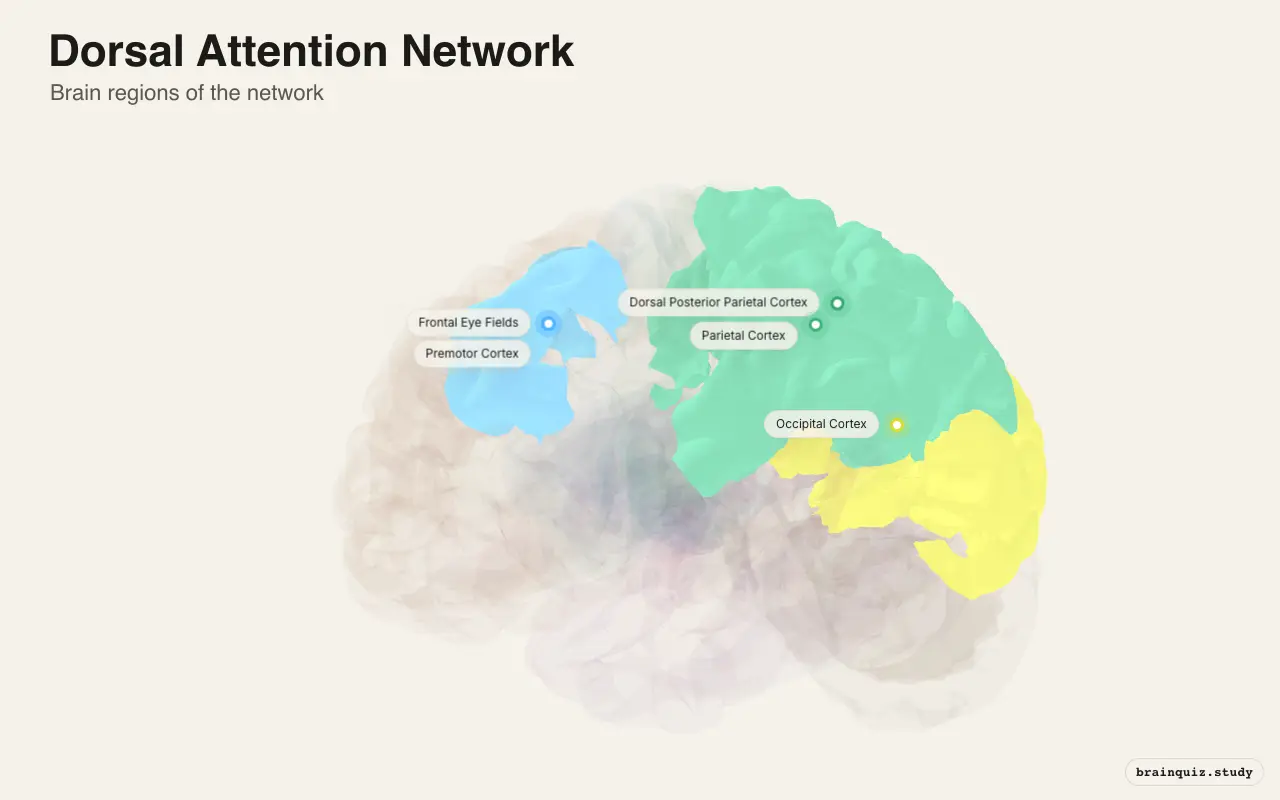
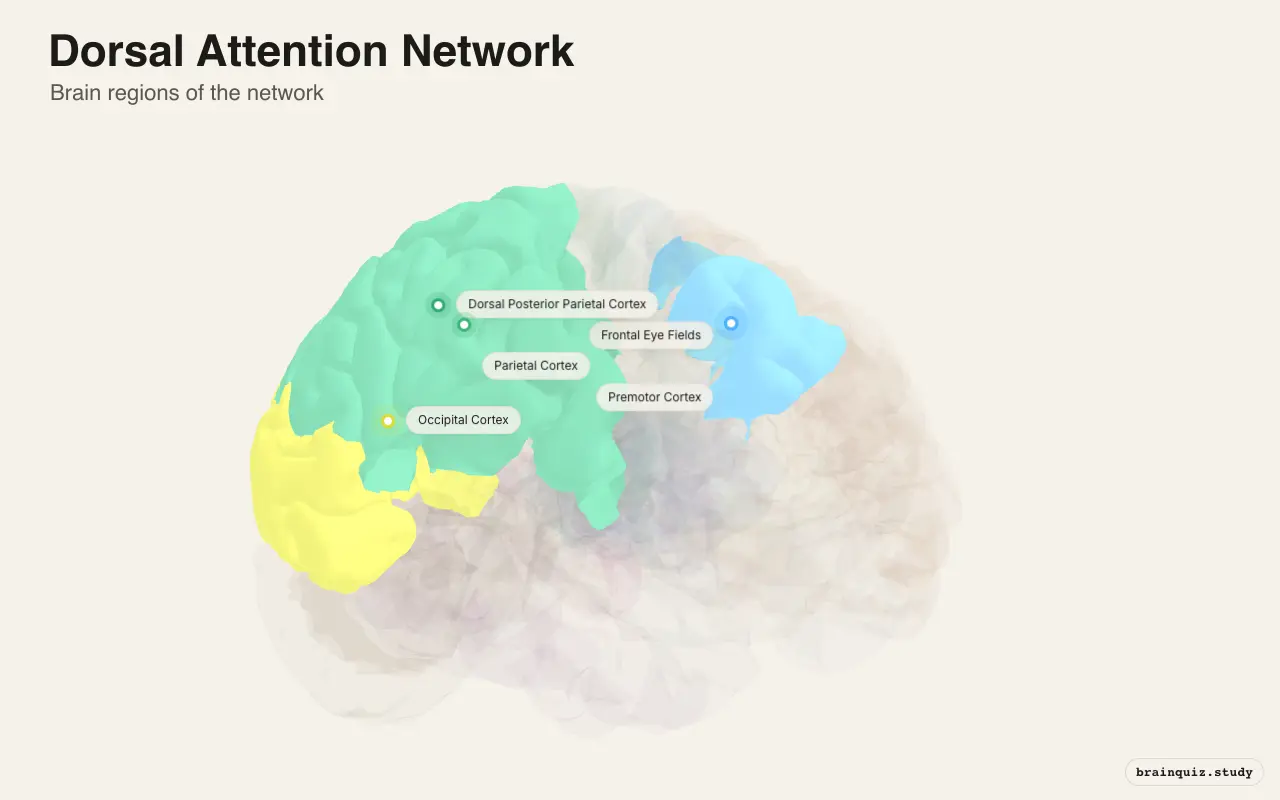
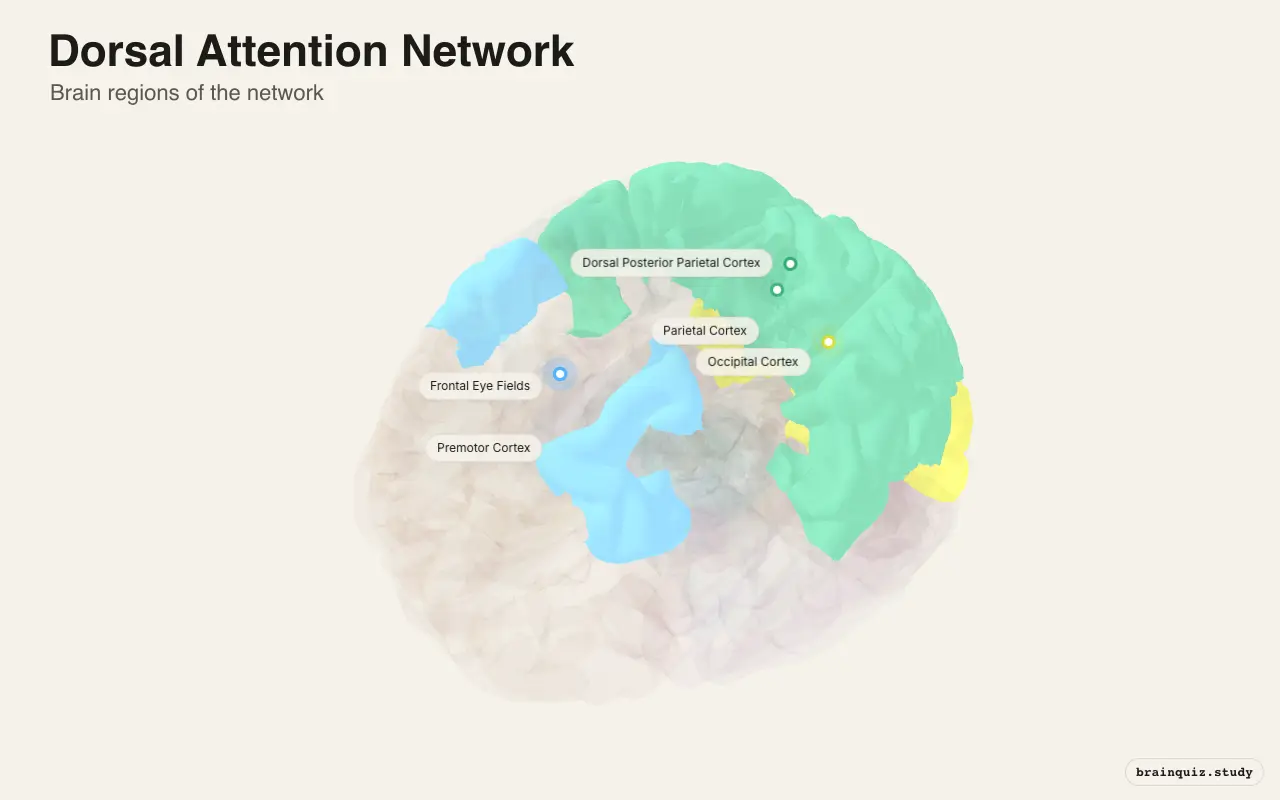
Which brain regions are in the Dorsal Attention Network?
- Frontal Eye Fields: Generates top-down signals for voluntary eye movements and spatial attention, coordinating with other regions to select relevant locations.
- Dorsal Posterior Parietal Cortex: Contains the intraparietal sulcus, which maintains a priority map of spatial locations and integrates sensory information for attentional control.
- Premotor Cortex: Plans and prepares motor responses, including saccades, and contributes to the selection of actions based on attended stimuli.
- Parietal Cortex: Broader parietal areas support spatial representation and attentional shifts, extending the core dorsal attention functions.
- Occipital Cortex: Visual areas receive top-down modulation from the DAN, enhancing processing of attended stimuli and suppressing distractors.
What does the Dorsal Attention Network do?
What does the Dorsal Attention Network do? The Dorsal Attention Network mediates voluntary, goal-directed attention, enabling us to focus on relevant spatial locations and features. It generates endogenous signals that bias processing in sensory cortices, enhancing responses to attended stimuli. This network is essential for tasks like visual search, where we actively look for a target among distractors.
- Spatial attention — Directs attention to specific locations in space, enhancing processing of stimuli at those locations.
- Visual search — Supports the active scanning of the environment for a target among distractors.
- Saccade planning — Plans and initiates eye movements to bring attended locations onto the fovea.
- Feature-based selection — Selects stimuli based on non-spatial features like color or shape when they are relevant to the task.
- Visuospatial working memory — Maintains spatial information online to guide attention and action over short delays.
When is the Dorsal Attention Network active?
The Dorsal Attention Network is most active during demanding tasks that require focused attention, such as visual search or preparing an eye movement. It shows increased activity when you are intentionally directing attention or expecting a stimulus at a specific location. It quiets down during rest, mind-wandering, or passive viewing, when external attention is not required.
- Scanning a crowd for a friend's face.
- Looking for your keys on a cluttered desk.
- Focusing on a specific word while reading.
- Watching for the traffic light to turn green.
- Preparing to catch a ball thrown to you.
Dorsal Attention Network vs Ventral Attention Network
The Dorsal Attention Network controls voluntary, goal-directed attention, while the Ventral Attention Network detects unexpected, salient stimuli and reorients attention automatically. The VAN acts as a circuit breaker, interrupting DAN activity when a behaviorally relevant event occurs outside the current focus. This interplay allows flexible shifts between focused attention and reorientation to new events.
DAN vs VAN at a glance
| Aspect | Dorsal Attention Network | Ventral Attention Network |
|---|---|---|
| Control | Top-down, goal-directed | Bottom-up, stimulus-driven |
| Trigger | Internal goals or expectations | Unexpected salient events |
| Function | Maintains attention on task | Reorients attention to new stimuli |
| Activity | Increases during focused tasks | Transient increases to salient stimuli |
| Interaction | Interrupted by VAN when needed | Interrupts DAN to reorient attention |
What happens when the Dorsal Attention Network is disrupted?
Disruption of the Dorsal Attention Network is associated with a range of attentional deficits. Damage to this network, particularly in the right hemisphere, can lead to hemispatial neglect. Reduced DAN activity has been observed in conditions such as ADHD and in disorders of consciousness. Alterations in DAN connectivity are also linked to age-related declines in attention.
- Hemispatial neglect — Damage to right-hemisphere DAN regions is associated with neglect of the left side of space, a common consequence of stroke.
- ADHD — Reduced activation in DAN regions is thought to contribute to the inattention symptoms observed in attention-deficit/hyperactivity disorder.
- Disorders of consciousness — Impaired engagement of the DAN is observed in patients with disorders of consciousness, correlating with reduced awareness.
- Age-related cognitive decline — Altered functional connectivity within the DAN is associated with declines in attentional performance in older adults.
How does the Dorsal Attention Network work with other networks?
The Dorsal Attention Network works closely with sensory cortices, particularly visual areas, to enhance processing of relevant stimuli. It is anticorrelated with the Default Mode Network, which is active during rest and internally focused thought. The DAN also interacts with the Frontoparietal Control Network for complex task control and with the Ventral Attention Network for reorienting. These interactions coordinate attention across changing task demands.
How do scientists find the Dorsal Attention Network?
The Dorsal Attention Network is typically identified using resting-state functional connectivity MRI. Researchers use seed-based analysis, placing a seed in a region like the intraparietal sulcus, or independent component analysis to detect coherent activity patterns. A limitation is that resting-state measures reflect intrinsic connectivity, which may not fully capture task-related dynamics or individual differences in network engagement.
Key facts about the Dorsal Attention Network
- The dorsal attention network was one of the first networks identified using resting-state fMRI by Fox et al. in 2005.
- The frontal eye fields and intraparietal sulcus are the two core nodes most consistently implicated in voluntary attention.
- The DAN shows strong anticorrelation with the default mode network, a finding reported in numerous studies.
Sources
- Corbetta M, Shulman GL (2002). Control of goal-directed and stimulus-driven attention in the brain. Nature Reviews Neuroscience, 3(3), 201–215.
- Vossel S, Geng JJ, Fink GR (2014). Dorsal and ventral attention systems: distinct neural circuits but collaborative roles. The Neuroscientist, 20(2), 150–159.
- Yeo BTT et al. (2011). The organization of the human cerebral cortex estimated by intrinsic functional connectivity. Journal of Neurophysiology, 106(3), 1125–1165.