Ventral Posterior Parietal Cortex — Function & Quiz
Ventral posterior parietal cortex is recruited when a recovered memory captures attention, rather than when attention is deliberately sent out to search. That “captured by memory” role distinguishes it from dorsal parietal systems for top-down retrieval effort.
Its encoding-retrieval flip is particularly memorable: distraction-like activation during encoding can predict poorer later memory, yet activation during retrieval accompanies vivid recollection. The same territory changes meaning with the phase of the task.
Test this anatomy in the Brain Networks Quiz: Default Mode, Salience & More or explore it on the interactive 3D brain.
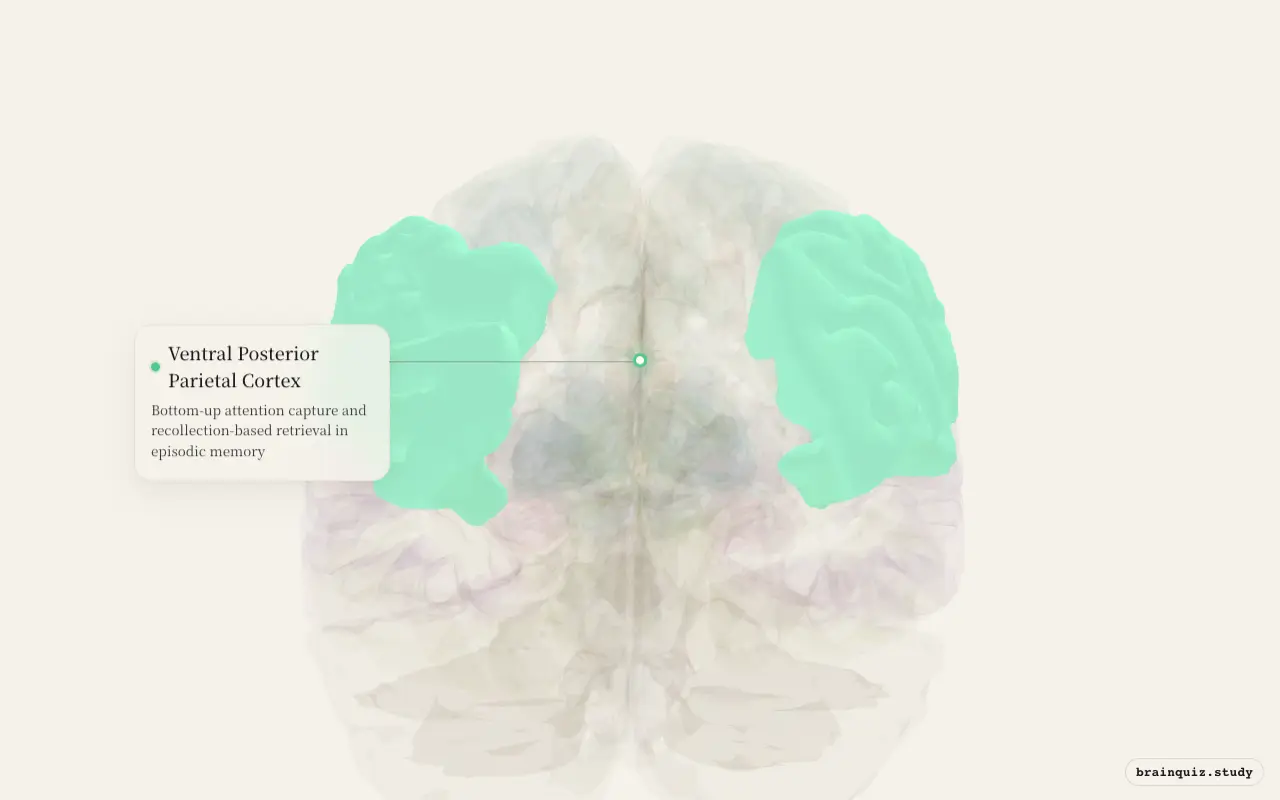
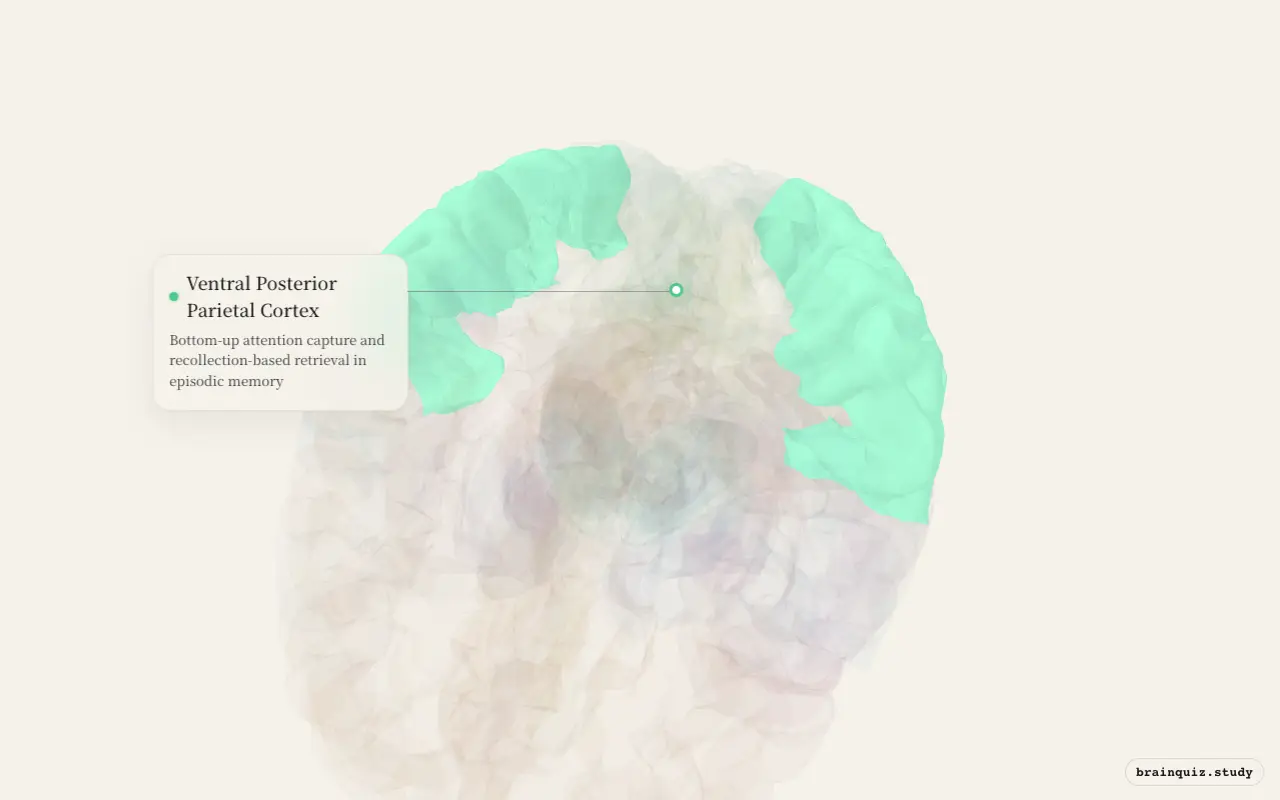
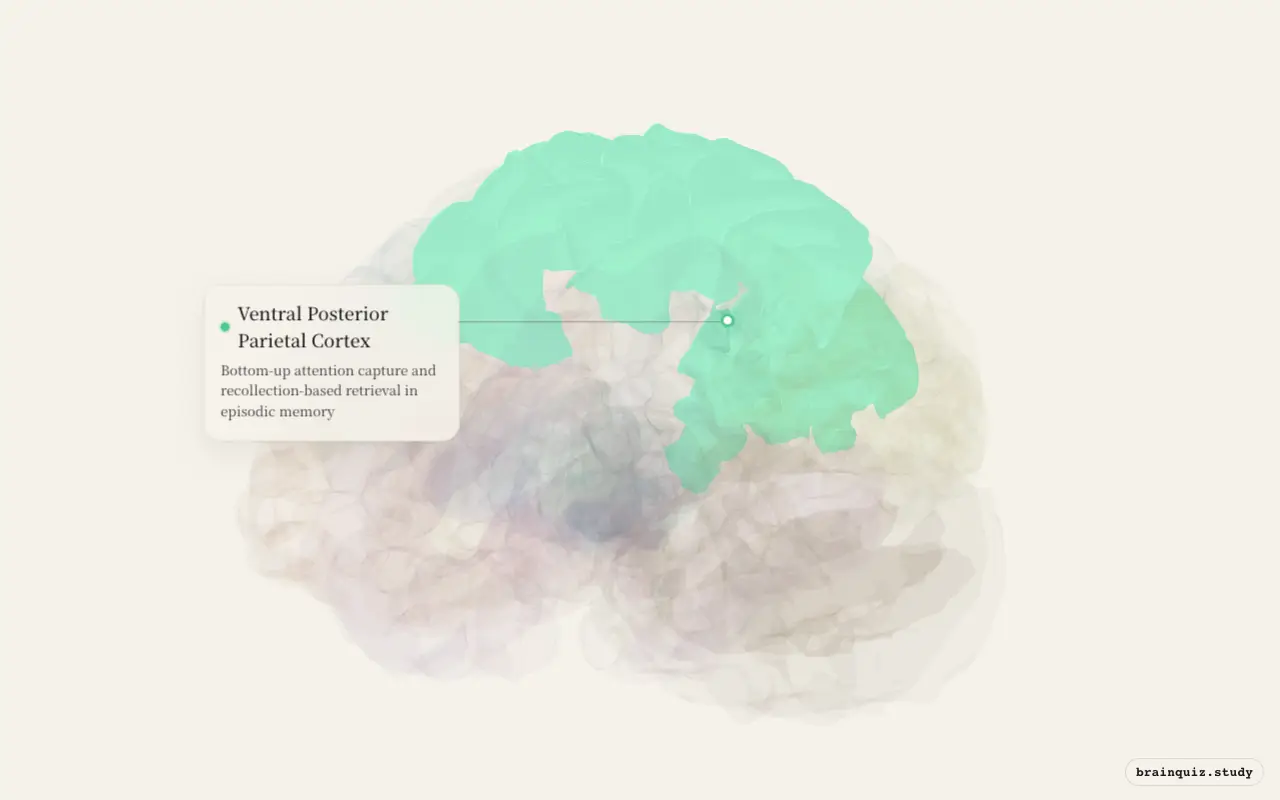
Where is the Ventral Posterior Parietal Cortex located?
Bottom-up attention capture and recollection-based retrieval in episodic memory.
What does the Ventral Posterior Parietal Cortex do?
- Bottom-up attention capture — involuntary orienting to salient stimuli
- Recollection signal — attention captured BY memories (AtoM model: Attention to Memory)
- Shows encoding-retrieval flip: negative SME during encoding, positive during retrieval
Ventral Posterior Parietal Cortex pathways and connections
- Ventral PPC ← Hippocampus (recollection signal drives bottom-up attention capture)
- Ventral PPC ↔ Frontal cortex (ventral attention network)
What happens when the Ventral Posterior Parietal Cortex is damaged?
- Negative SME during encoding — activity here = distraction, hurts memory formation
- Positive activation during retrieval — signals successful recollection
Ventral Posterior Parietal Cortex key facts
Atlas category: cortical. Brodmann areas or landmark: BA 40 (supramarginal gyrus), BA 39 (angular gyrus) — ventral parietal cortex.
- AtoM (Attention to Memory) model: ventral PPC captures attention WHEN memories are retrieved
- Encoding-retrieval flip: same region shows opposite effects depending on task phase
- Recollection (vivid, detailed) activates ventral PPC more than familiarity
Ventral Posterior Parietal Cortex exam tip
Ventral PPC = attention captured BY memories (bottom-up recollection). Encoding-retrieval flip is a key concept.
Common questions
What does ventral posterior parietal cortex do in memory?
It supports bottom-up attention to retrieved content, especially vivid recollection. In the Attention to Memory model, a recovered memory itself captures attention.
What is the encoding-retrieval flip?
Ventral parietal activity can be negatively related to successful encoding but positively related to successful retrieval, reflecting distraction during learning and attention capture during recollection.
How does ventral PPC differ from dorsal PPC?
Ventral PPC is associated with attention captured by memories; dorsal PPC supports deliberate, top-down searching for memories and graded familiarity judgments.
When does the Ventral Posterior Parietal Cortex light up?
- 📱 When you get distracted while studying: The ventral posterior parietal cortex detects the salient stimulus and triggers a bottom-up shift of attention.