Angular Gyrus — Function, Location & Quiz
The angular gyrus sits at a crossroads rather than belonging to one tidy faculty. Visual words, language meaning, number knowledge and perspective-taking all recruit this association territory, which is why the label “language area” alone undersells it.
Its clinical signature also separates it from nearby Wernicke territory. Dominant angular gyrus damage can impair reading, writing, arithmetic, finger knowledge and left-right orientation—a convergence failure rather than simply fluent aphasia.
Test this anatomy in the Brodmann Areas Quiz: 15 Questions With Answers or explore it on the interactive 3D brain.
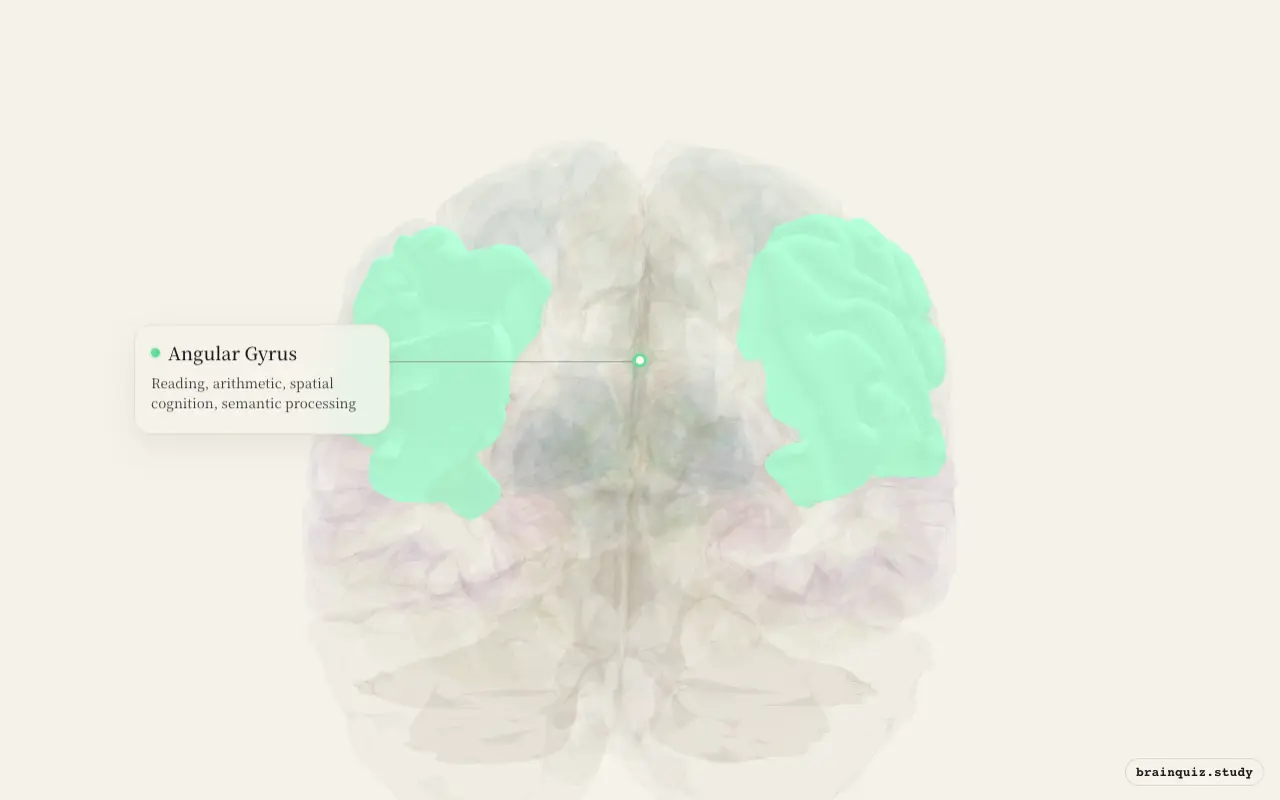
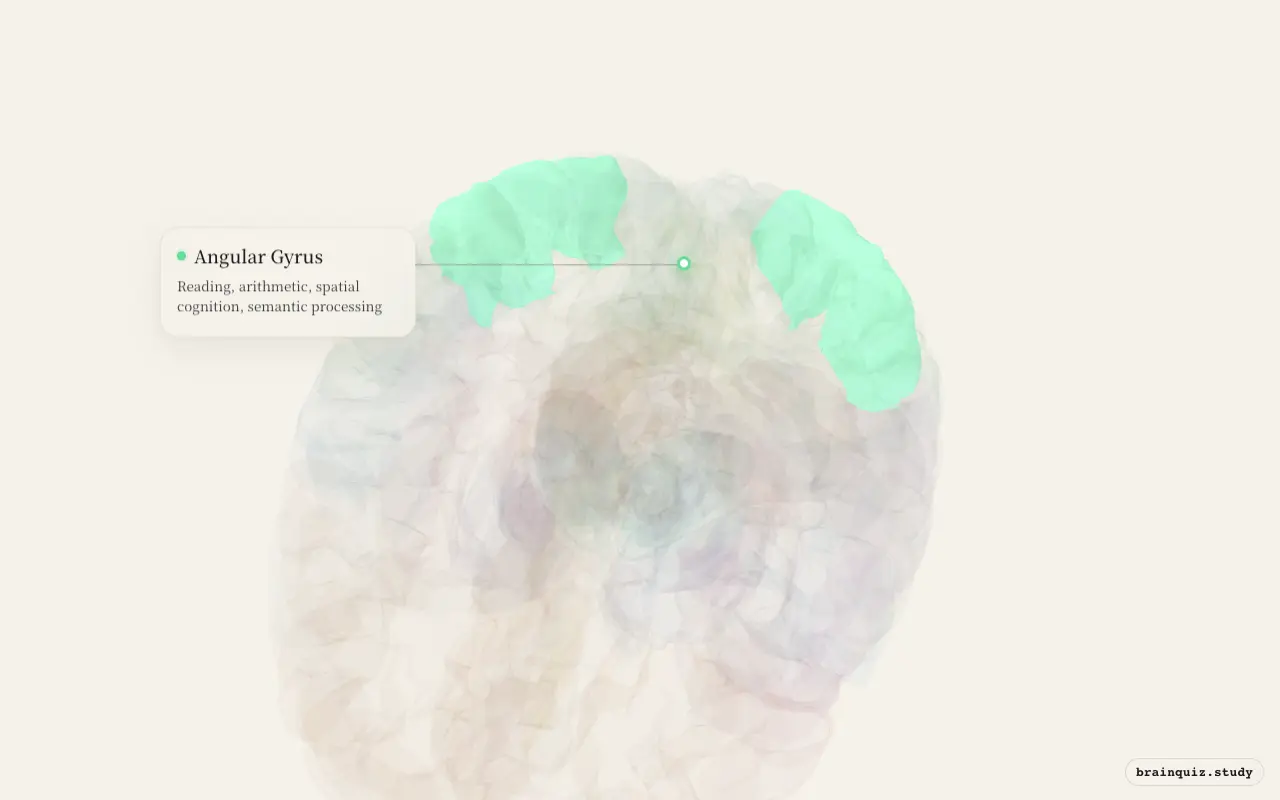
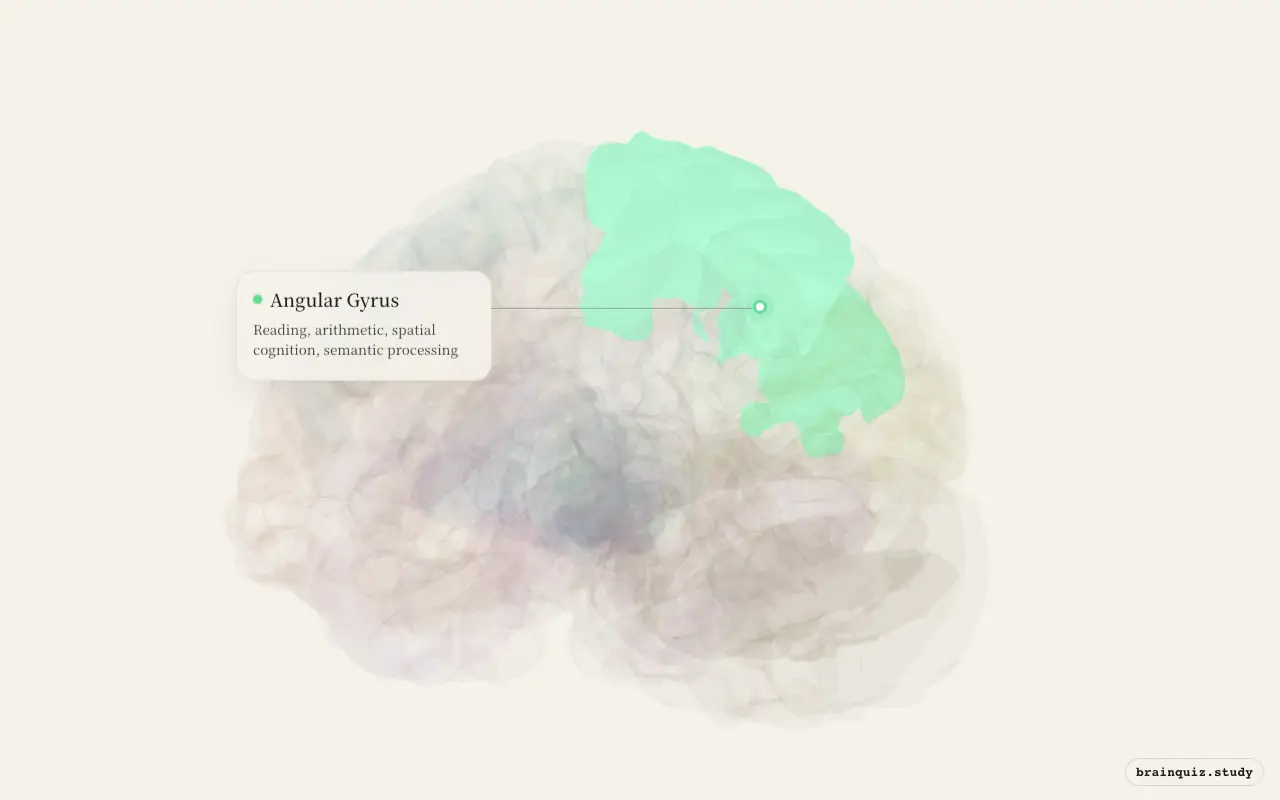
Where is the Angular Gyrus located?
Reading, arithmetic, spatial cognition, semantic processing.
What does the Angular Gyrus do?
- Reading and literacy — converting visual words to meaning
- Arithmetic and number processing
- Semantic integration — combining meaning across modalities
- Theory of mind and mentalizing
- Default mode network node
Angular Gyrus pathways and connections
- Angular gyrus ↔ Visual cortex (reading)
- Angular gyrus ↔ Wernicke's area (meaning)
- Angular gyrus ↔ PCC, mPFC (default mode network)
What happens when the Angular Gyrus is damaged?
- Gerstmann syndrome (left angular gyrus): agraphia + acalculia + finger agnosia + left-right confusion
- Alexia with agraphia (can't read or write — vs. pure alexia which spares writing)
- Stimulation can trigger out-of-body experiences (Blanke, 2002)
Angular Gyrus key facts
Atlas category: cortical. Brodmann areas or landmark: BA 39.
- Geschwind: angular gyrus = 'association area of association areas'
- Dehaene: angular gyrus involved in exact arithmetic (language-dependent)
- Part of the temporo-parietal junction (TPJ) — theory of mind, perspective-taking
Angular Gyrus exam tip
Angular gyrus = Gerstmann syndrome (4 symptoms). It's where reading, math, and meaning converge. Left lateralized for language functions.
Common questions
What does the angular gyrus do?
It contributes to reading, arithmetic, semantic integration, theory of mind and default-mode processing by combining information across sensory and conceptual systems.
Where is the angular gyrus located?
It is part of the inferior parietal lobule near the temporoparietal junction and corresponds mainly to Brodmann area 39.
Which syndrome is linked to the angular gyrus?
A left angular gyrus lesion is classically associated with Gerstmann syndrome: agraphia, acalculia, finger agnosia and left-right confusion.
When does the Angular Gyrus light up?
- 💭 When you daydream: The angular gyrus integrates sensory details, language, and memory into a coherent narrative.
- 📖 When you read a book: The angular gyrus links the visual word form to its sound and meaning.
- 🧮 When you solve a maths problem: The angular gyrus retrieves arithmetic facts and processes mathematical symbols.
- 🧠 When you learn a new word: The angular gyrus searches semantic networks for possible meanings.
- 🗺️ When you read a map: The angular gyrus integrates visual input to understand spatial relationships and map orientation.
- 💭 When you imagine the future: The angular gyrus helps assemble perceptual details and spatial context for the imagined scene.