What happens in your brain when you learn a new word?
Updated
Auditory cortex processes the sound. Wernicke's area attempts word recognition. Angular gyrus seeks semantic links. Prefrontal cortex holds it in working memory. Hippocampus encodes the new word.
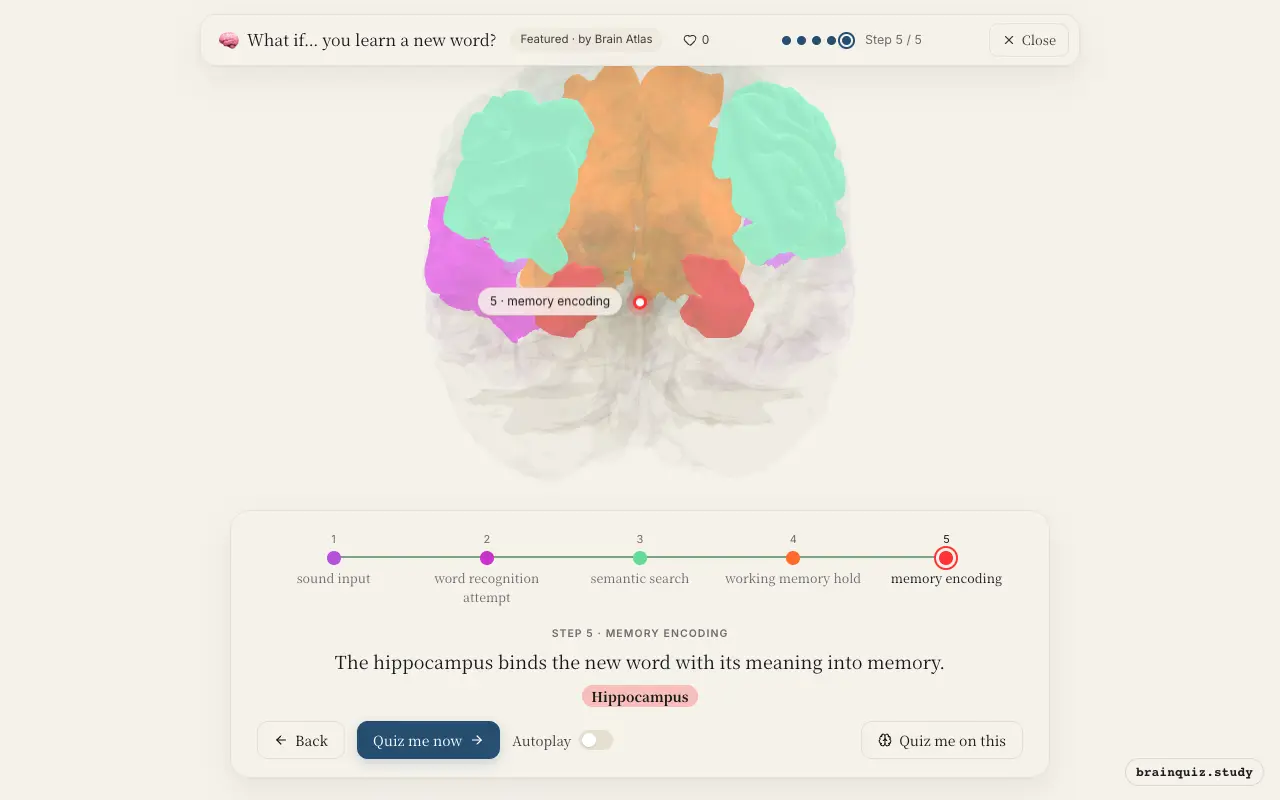
Watch it light up on the 3D brain
Brain regions that light up
| Order | Region | What it does here |
|---|---|---|
| 1 | Auditory Cortex | The auditory cortex processes the acoustic features of the new word. |
| 2 | Wernicke's Area | Wernicke's area tries to match the sound to known word forms. |
| 3 | Angular Gyrus | The angular gyrus searches semantic networks for possible meanings. |
| 4 | Prefrontal Cortex | The prefrontal cortex holds the word and its context in working memory. |
| 5 | Hippocampus | The hippocampus binds the new word with its meaning into memory. |
1. Auditory Cortex: sound input
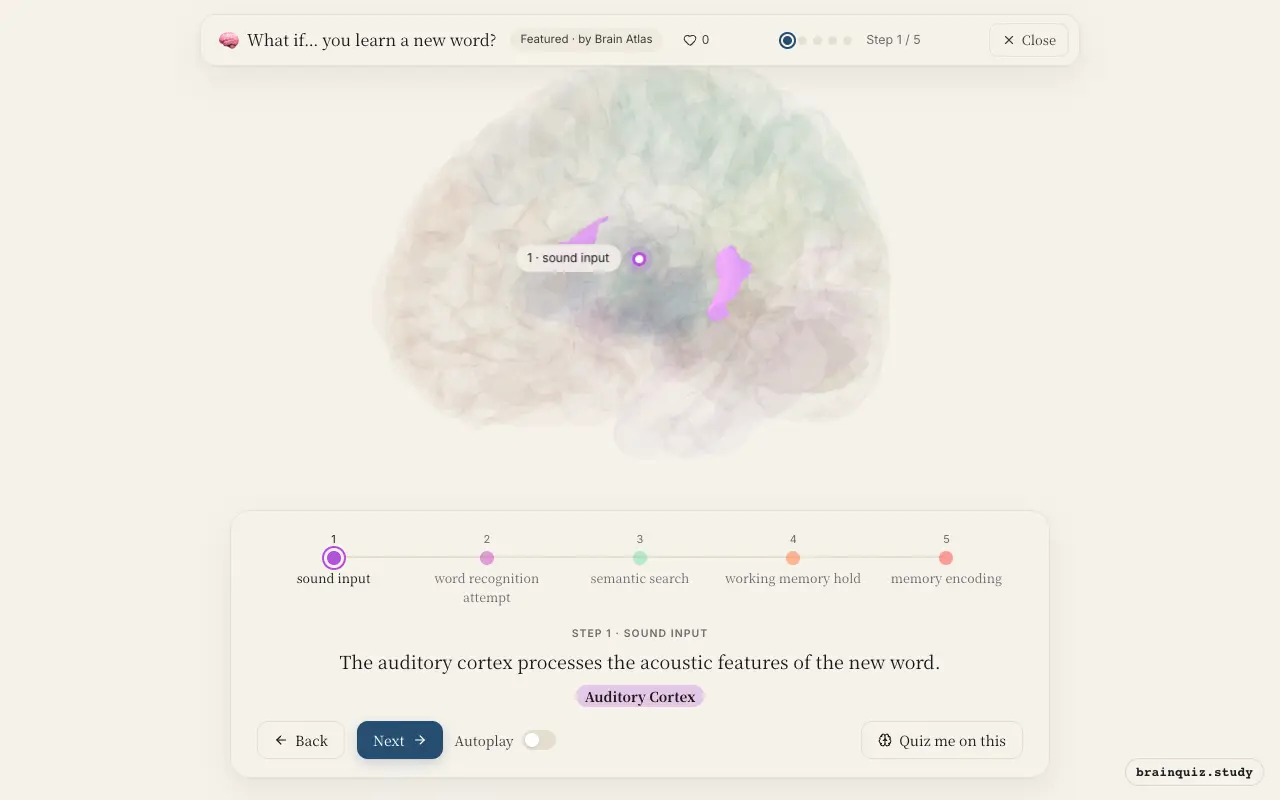
The primary and secondary auditory cortices in the temporal lobe analyze the word's phonemes, pitch, and timing. This initial processing is crucial for distinguishing the new word from other sounds. The auditory cortex sends this information to language areas for further analysis.
2. Wernicke's Area: word recognition attempt
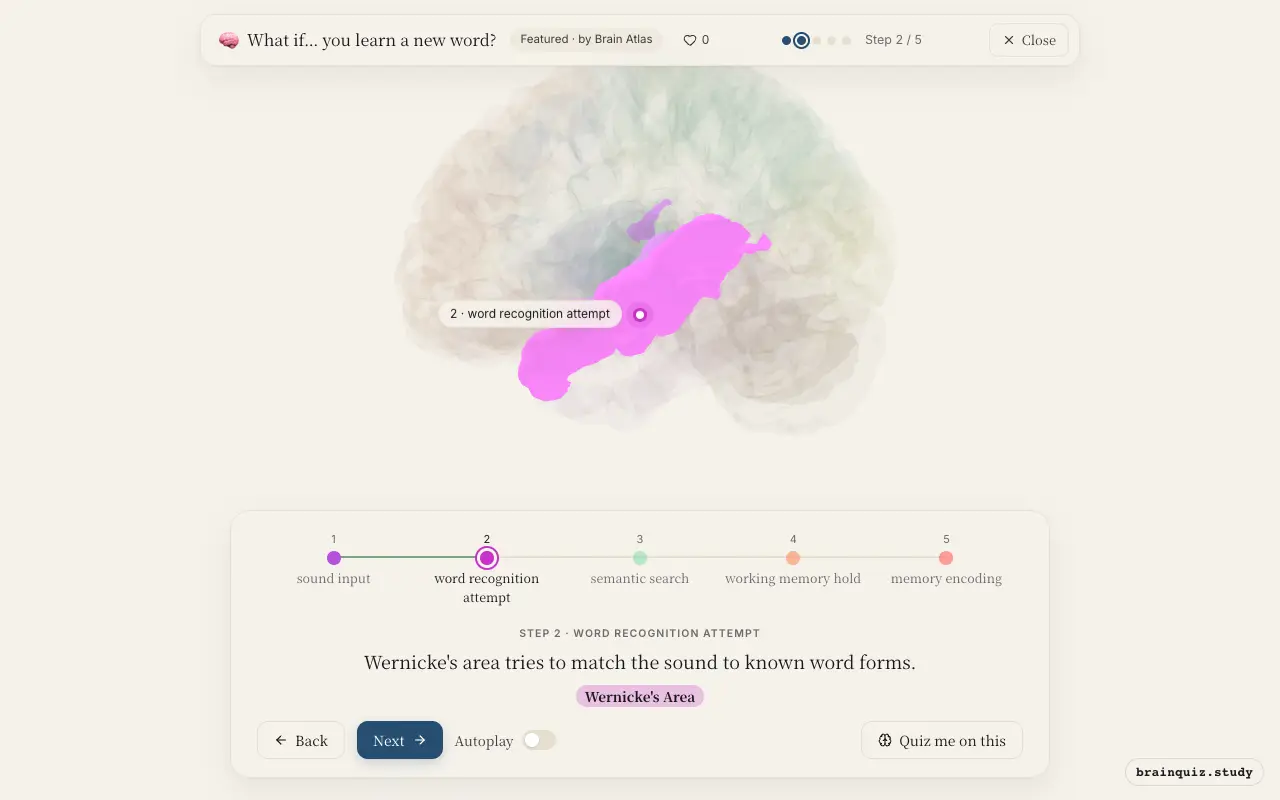
Wernicke's area, located in the posterior superior temporal gyrus, compares the incoming phonological sequence to stored representations. If no match is found, it signals novelty. This triggers additional processing to understand the word's meaning from context. It also integrates the sound with grammatical and contextual cues.
3. Angular Gyrus: semantic search
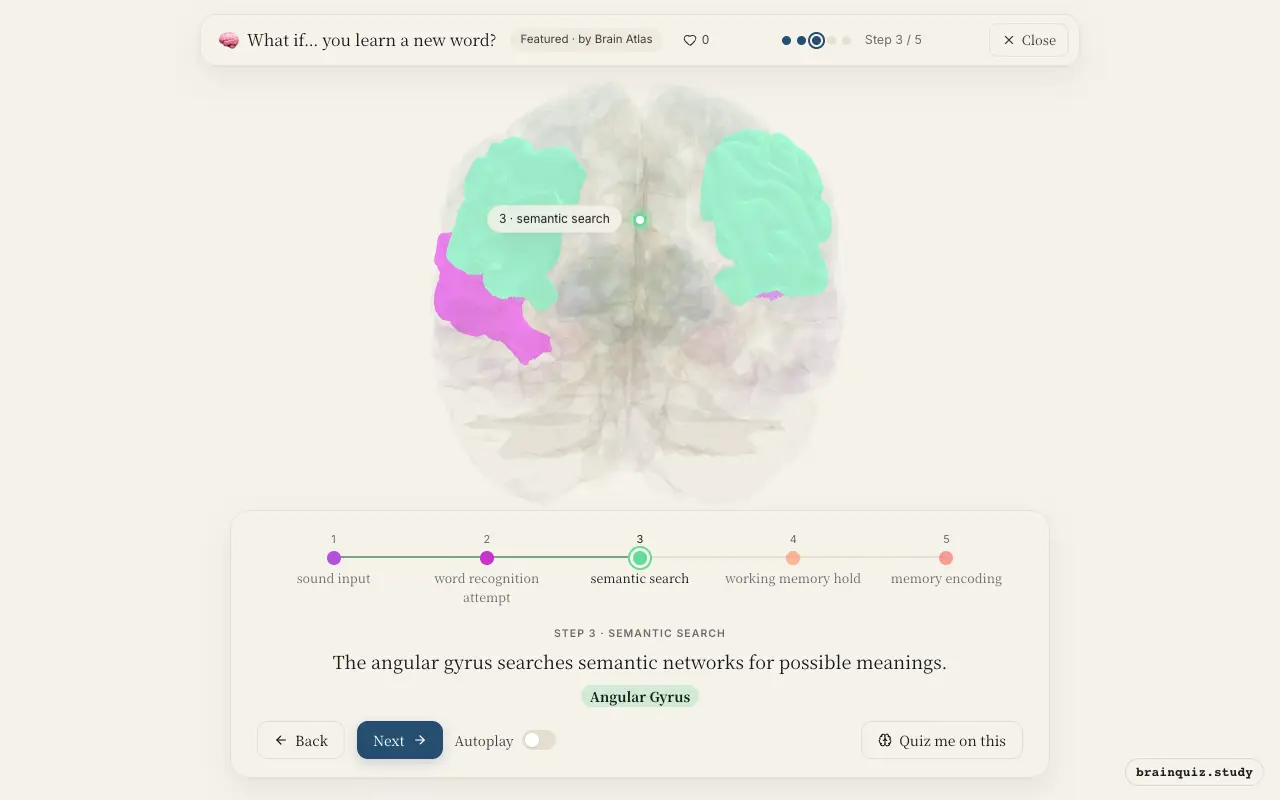
The angular gyrus, at the temporoparietal junction, links the phonological form to semantic concepts. It activates related words and concepts that might share features with the new word. This cross-modal association helps infer the word's meaning from context.
4. Prefrontal Cortex: working memory hold
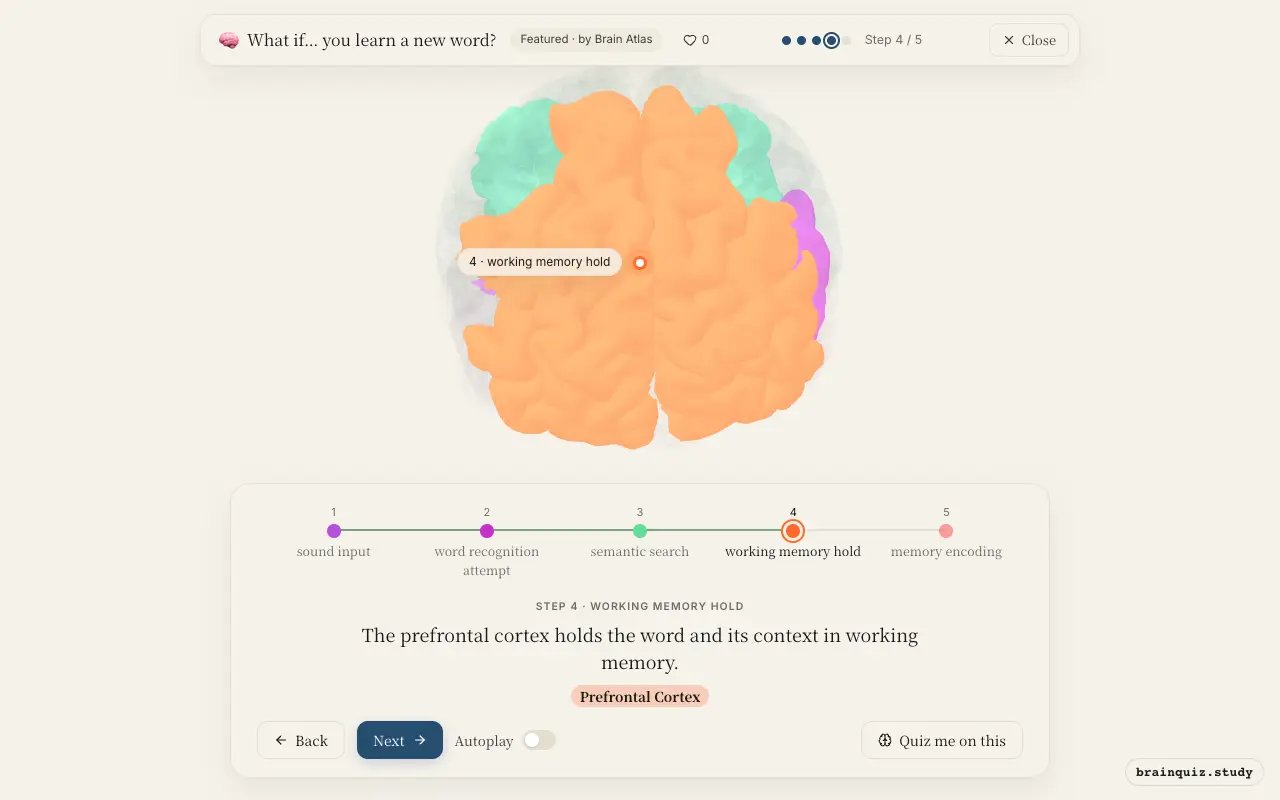
The dorsolateral prefrontal cortex maintains the new word and its associated information online. It directs attention to relevant features and suppresses irrelevant ones. This allows the learner to combine phonological, semantic, and contextual details into a coherent representation.
5. Hippocampus: memory encoding
The hippocampus rapidly forms a new association between the word's sound and its meaning. It integrates this with existing knowledge and the learning episode. Over time, consolidation transfers this memory to neocortical areas for long-term storage.
Good to know
- The left hemisphere is dominant for language in about 95% of right-handed individuals.
- The hippocampus is essential for forming new declarative memories, including vocabulary.
- Repetition and active recall strengthen the neural pathways for new words.
New word vs. familiar word
When you hear a familiar word, Wernicke's area quickly matches it to stored representations and the angular gyrus retrieves meaning with minimal effort. Learning a new word requires much greater prefrontal and hippocampal engagement to encode the novel association. Familiar words rely on established cortical networks, while new words demand plasticity.
Test yourself
Which brain region is primarily responsible for processing the sound of a new word?
What is the role of the hippocampus in learning a new word?
Which region is part of the default mode network and involved in semantic integration?
0 of 3 answered · 0 correct
Simplified: many regions work together at once, and this shows the main players in the order they act.