What happens in your brain when you practise a skill until it's automatic?
Updated
Practising a skill until automatic shifts control from the prefrontal cortex to the basal ganglia and cerebellum. Early on, the prefrontal cortex and premotor cortex plan each action; with repetition, the putamen and cerebellum take over, while the motor cortex executes the movement efficiently.
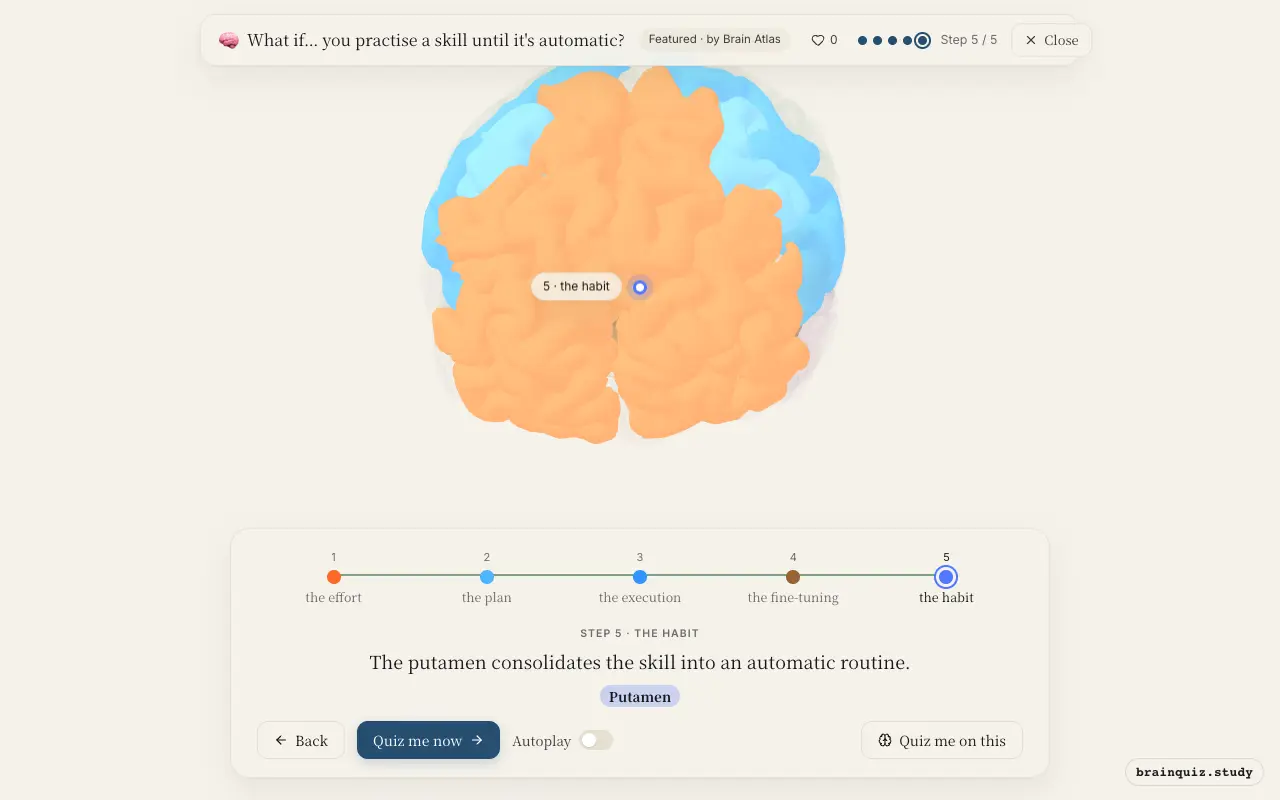
Watch it light up on the 3D brain
Brain regions that light up
| Order | Region | What it does here |
|---|---|---|
| 1 | Prefrontal Cortex | The prefrontal cortex directs attention and working memory during early practice. |
| 2 | Premotor Cortex | The premotor cortex sequences the movements into a correct order. |
| 3 | Motor Cortex | The motor cortex sends commands to muscles to perform the skill. |
| 4 | Cerebellum | The cerebellum compares intended and actual movement, correcting errors in real time. |
| 5 | Putamen | The putamen consolidates the skill into an automatic routine. |
1. Prefrontal Cortex: the effort
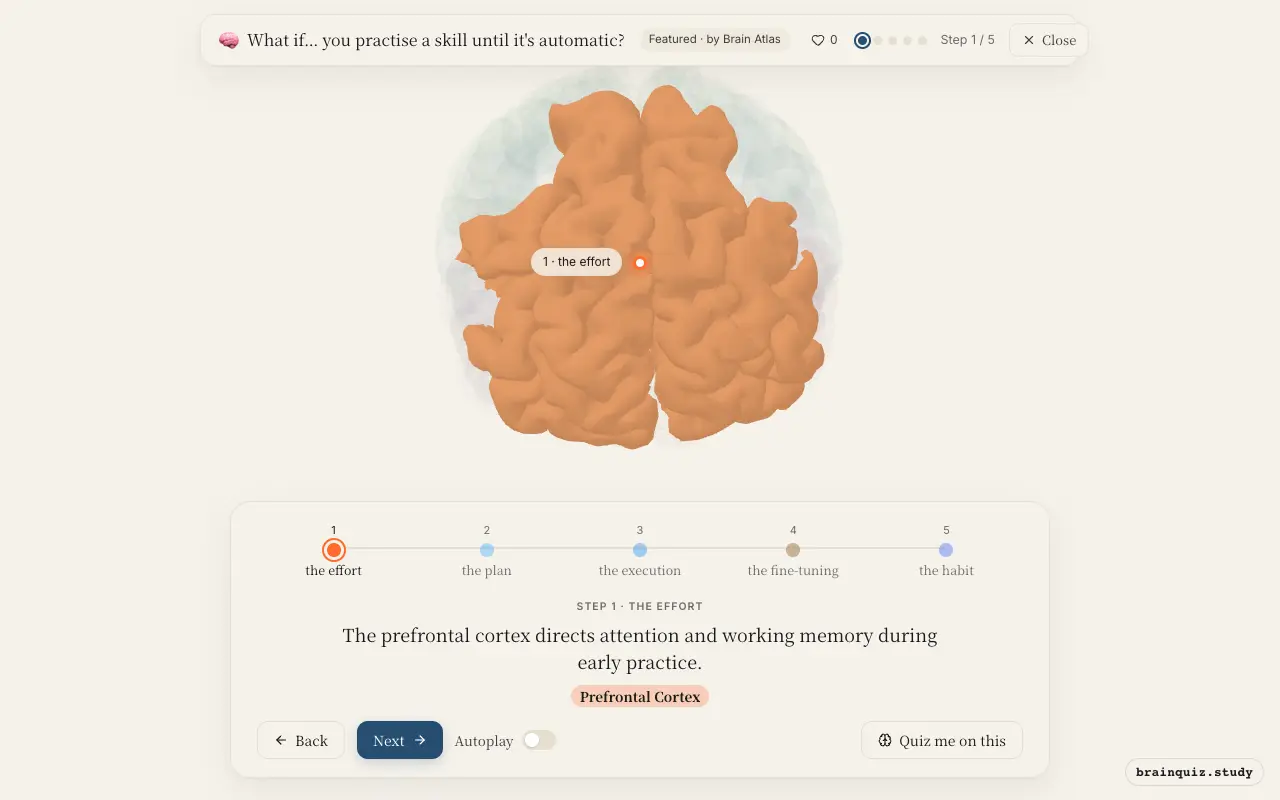
When a skill is new, the prefrontal cortex is highly active. It holds the rules in working memory, monitors performance, and suppresses errors. This effortful control is essential for learning but fades as the skill becomes automatic.
2. Premotor Cortex: the plan
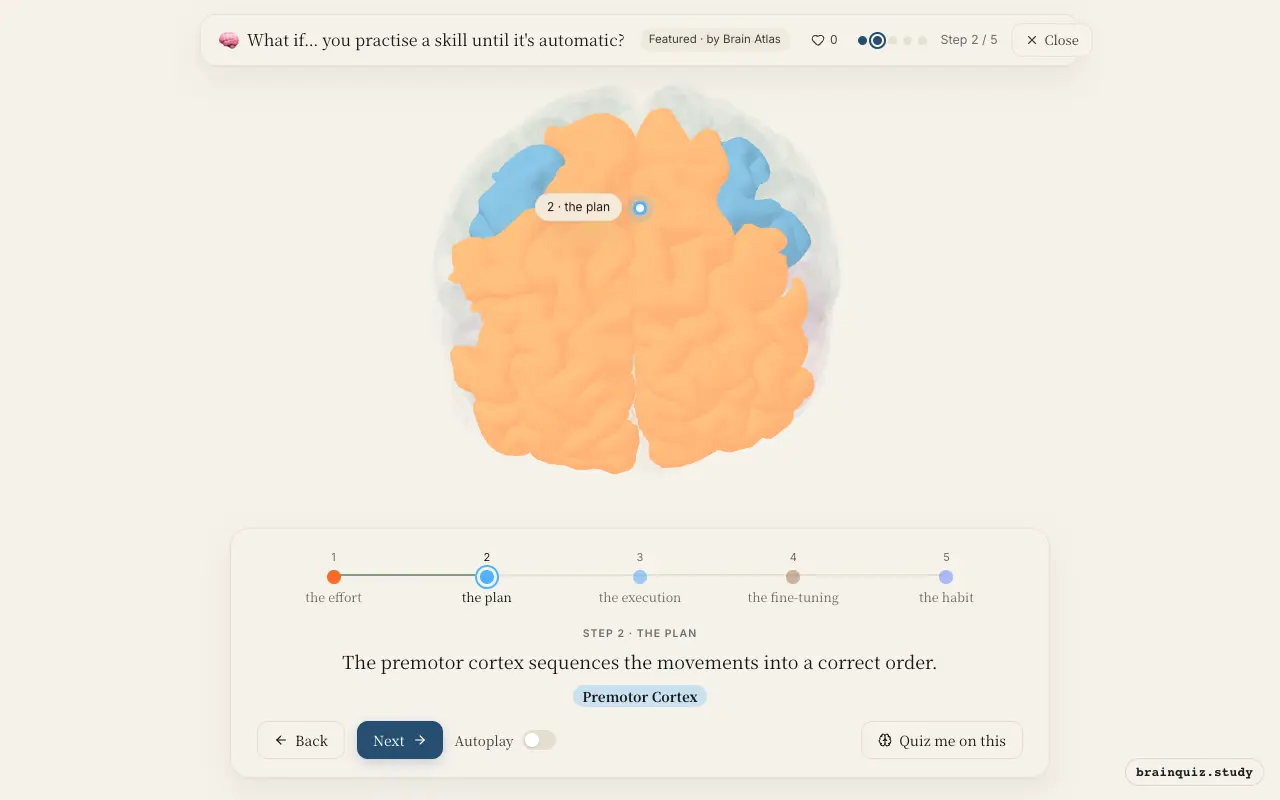
The premotor cortex uses sensory information and past experience to prepare the motor commands. It helps chain individual actions into a smooth sequence. As practice continues, its role diminishes because the sequence becomes stored elsewhere.
3. Motor Cortex: the execution
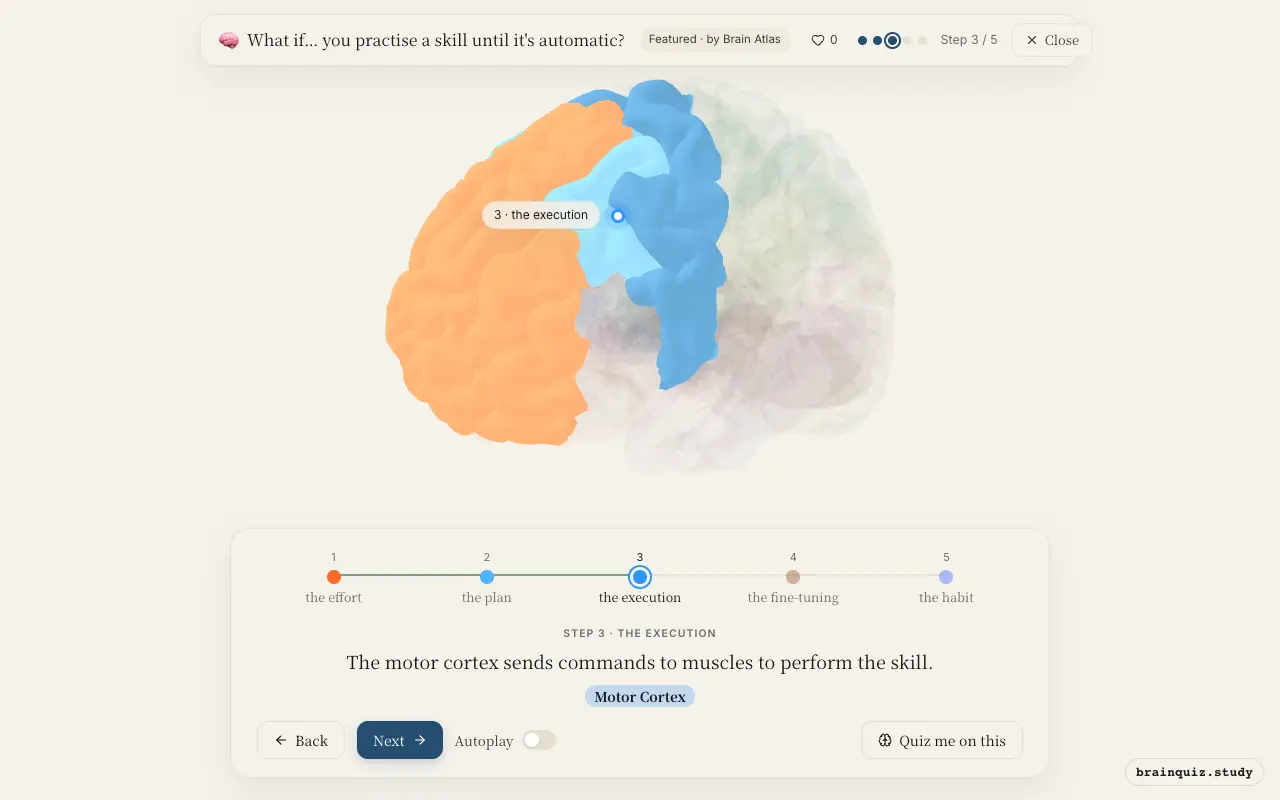
The motor cortex is always needed to execute voluntary movements. During automatic performance, it still fires, but its activity becomes more efficient and less variable. It no longer requires constant input from the prefrontal cortex.
4. Cerebellum: the fine-tuning
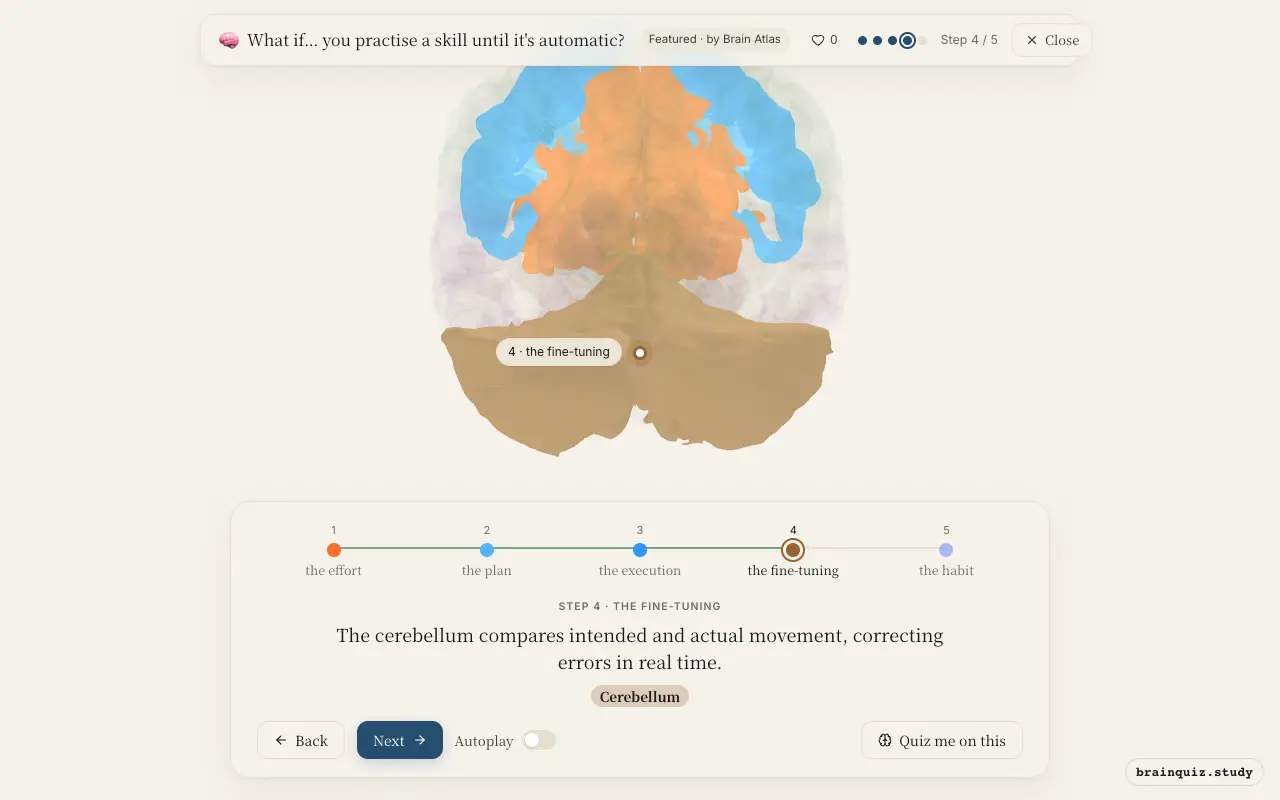
The cerebellum receives a copy of the motor command and sensory feedback from the moving body. It learns to anticipate the consequences of each movement and adjusts timing and force. With practice, it builds an internal model that makes the skill fluid and accurate.
5. Putamen: the habit
The putamen is part of the basal ganglia and is critical for habit formation. Repeated practice strengthens the neural pathways in the putamen, allowing the skill to run without conscious thought. Once automatic, the putamen initiates and sustains the routine.
Good to know
- As a skill becomes automatic, overall brain activity decreases, especially in the prefrontal cortex.
- The cerebellum can contain more than half of the brain's neurons, reflecting its role in motor learning.
- Basal ganglia disorders like Parkinson's disease can disrupt automatic movements, causing patients to rely on conscious control.
Effortful vs Automatic
During effortful practice, the prefrontal cortex and anterior cingulate cortex are highly active for attention and error monitoring. Once automatic, activity shifts to the putamen and cerebellum, and the prefrontal cortex becomes less active. This is why you can perform an automatic skill while thinking about something else.
Test yourself
Which region is most active when a skill is new and requires conscious effort?
What role does the cerebellum play in skill automaticity?
When a skill becomes automatic, activity typically decreases in which brain region?
0 of 3 answered · 0 correct
Simplified: many regions work together at once, and this shows the main players in the order they act.