What happens in your brain when you learn a new language?
Updated
When learning a new language, your auditory cortex processes novel sounds, Wernicke's area decodes meaning, Broca's area plans speech production, the hippocampus encodes new vocabulary, and the prefrontal cortex manages attention and working memory.
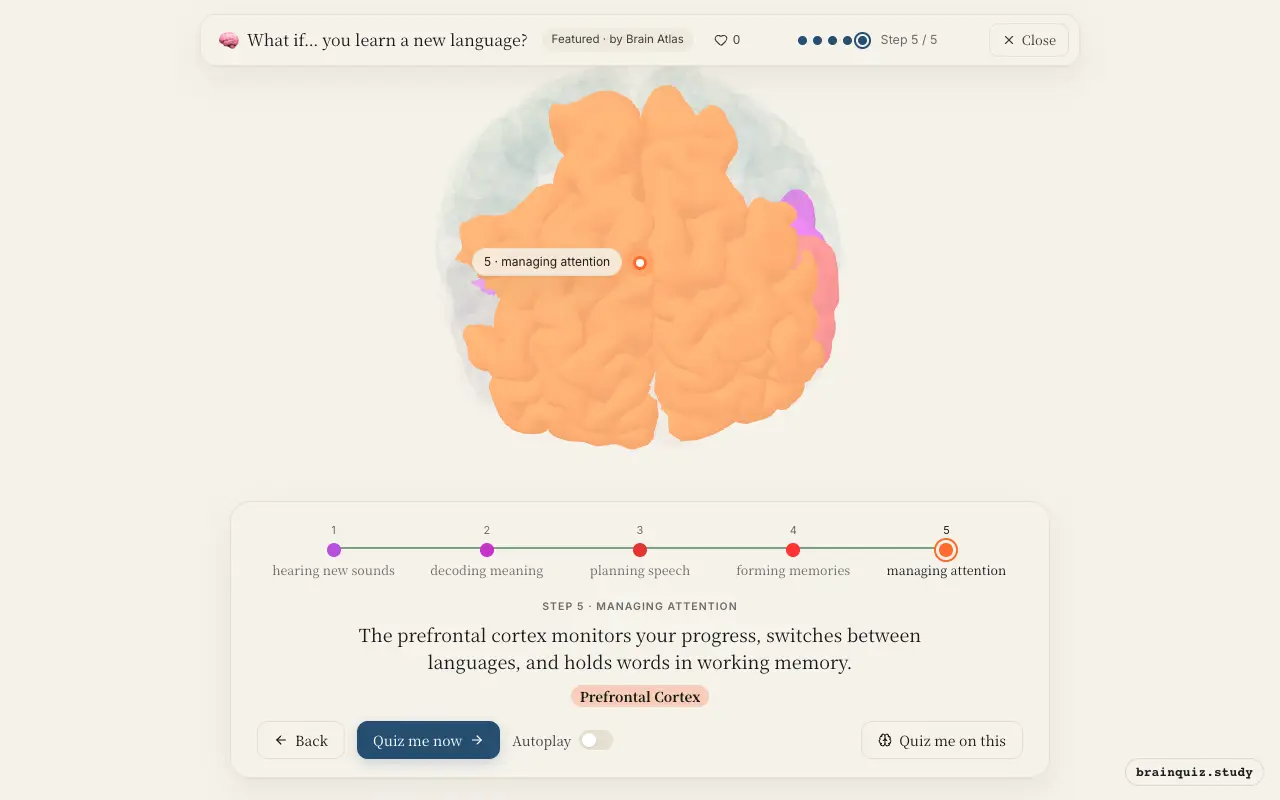
Watch it light up on the 3D brain
Brain regions that light up
| Order | Region | What it does here |
|---|---|---|
| 1 | Auditory Cortex | The auditory cortex breaks down unfamiliar phonemes into acoustic patterns. |
| 2 | Wernicke's Area | Wernicke's area maps the sound patterns to meaning, allowing comprehension. |
| 3 | Broca's Area | Broca's area prepares the motor programs for articulating new words. |
| 4 | Hippocampus | The hippocampus rapidly encodes new vocabulary and grammar rules for later recall. |
| 5 | Prefrontal Cortex | The prefrontal cortex monitors your progress, switches between languages, and holds words in working memory. |
1. Auditory Cortex: hearing new sounds
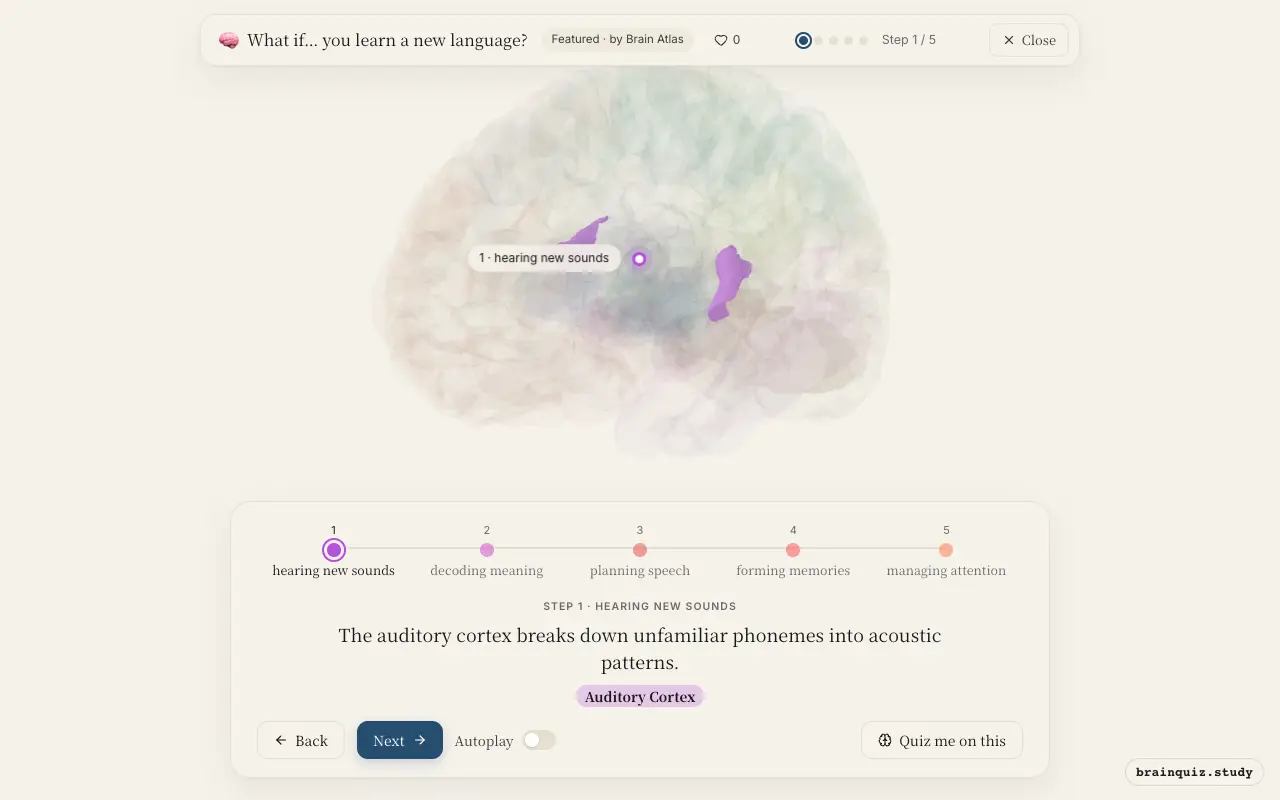
The auditory cortex analyzes pitch, timing, and spectral features of the new language's sounds. It is essential for distinguishing sounds that do not exist in your native language. Without this, you could not even perceive the building blocks of the new language.
2. Wernicke's Area: decoding meaning
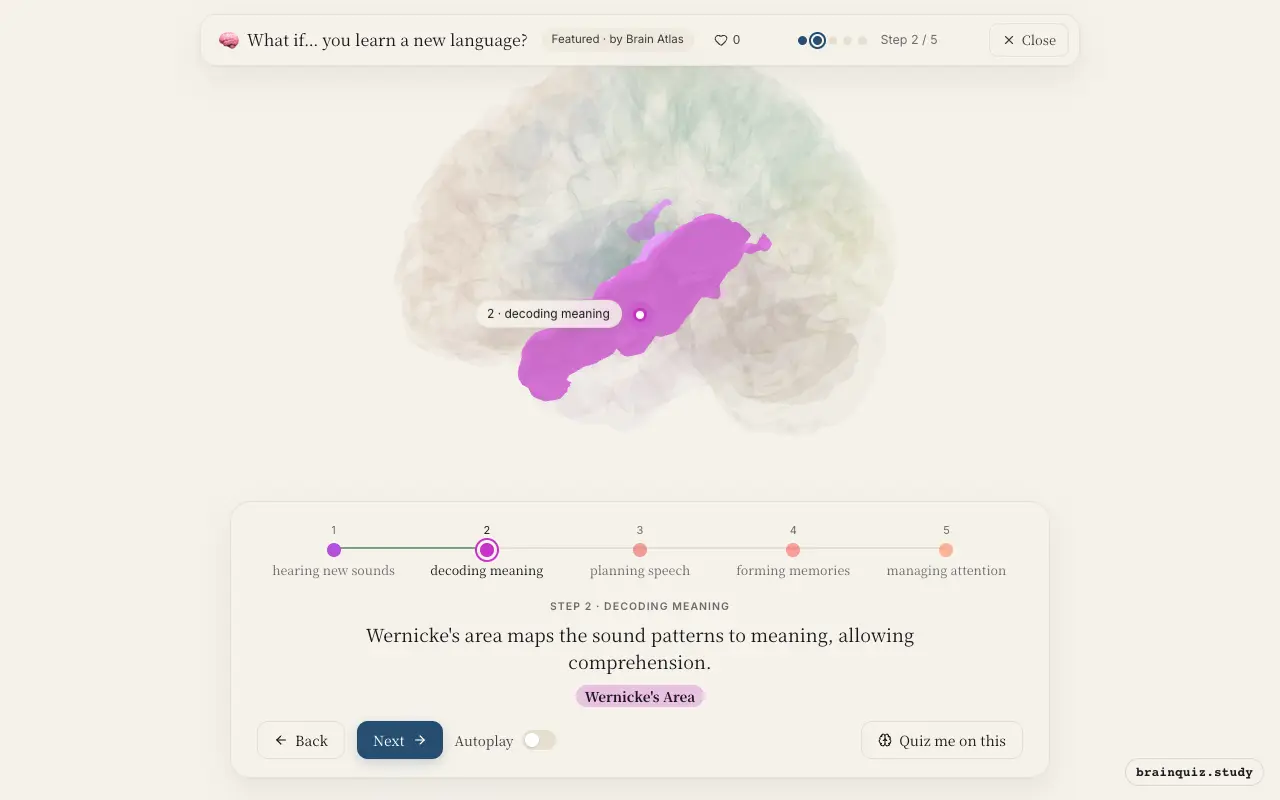
Wernicke's area is the hub for language understanding. It links the auditory patterns to stored semantic knowledge, so you can recognize words and phrases. Damage here causes fluent but meaningless speech, showing its role in comprehension.
3. Broca's Area: planning speech
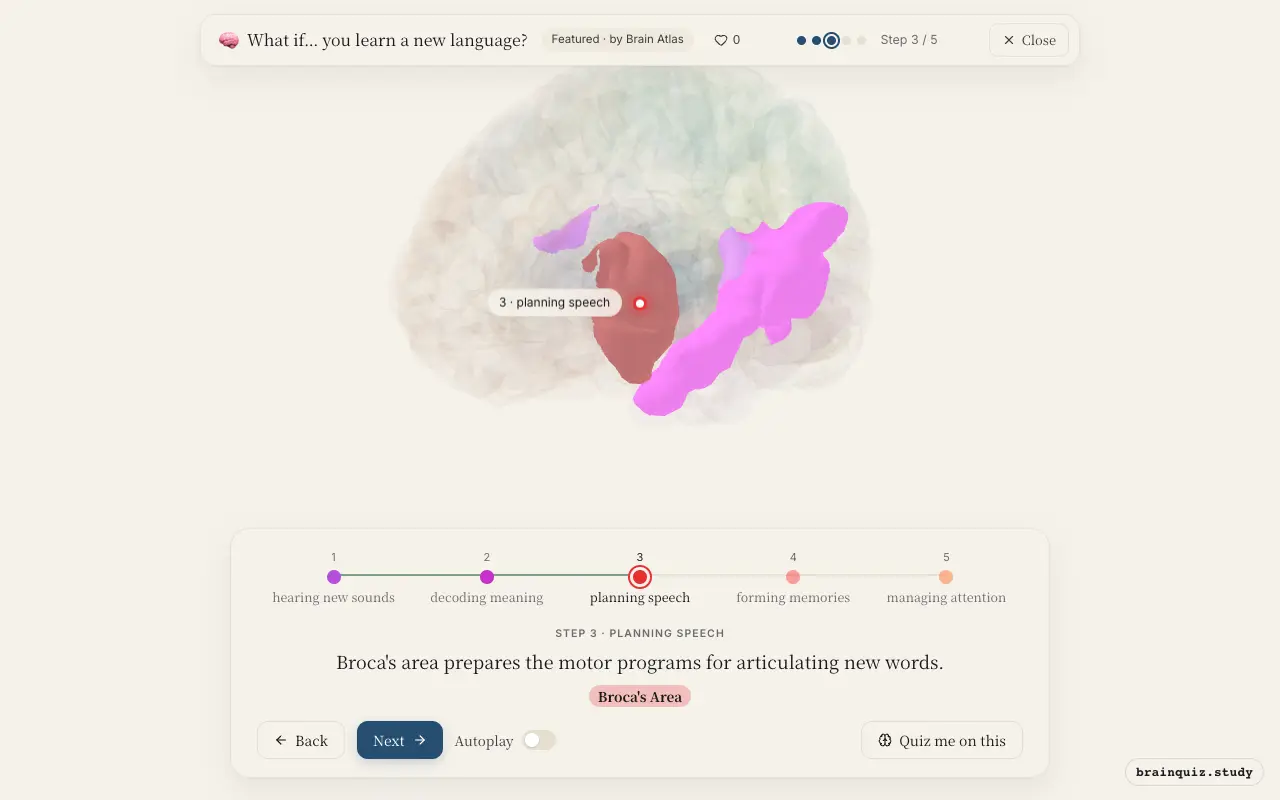
Broca's area is critical for grammar and speech production. When you try to speak the new language, it sequences the sounds and words into correct syntactic order. It sends instructions to the motor cortex to actually move your mouth and vocal cords.
4. Hippocampus: forming memories
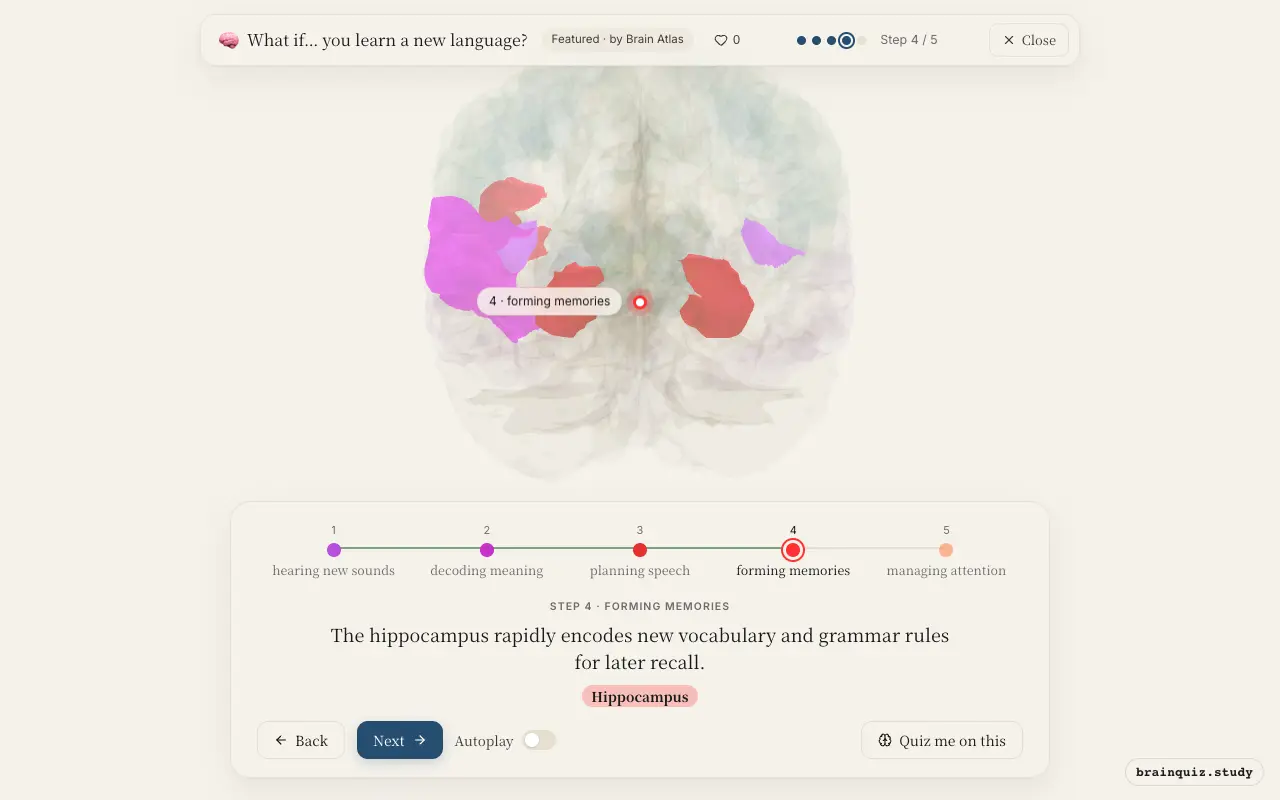
The hippocampus is essential for forming new memories, including linguistic ones. It binds together the sound, meaning, and context of new words so they can be stored in the cortex over time. Without the hippocampus, learning new words would be severely impaired.
5. Prefrontal Cortex: managing attention
The prefrontal cortex is the executive center. It focuses your attention on relevant language input, inhibits your native language when necessary, and manipulates new words in working memory during practice. This region is heavily engaged in the early stages of learning.
Good to know
- Studies suggest that learning a second language may increase grey matter density in the left inferior parietal cortex, a region involved in phonological processing.
- As proficiency grows, language processing is thought to shift from the prefrontal cortex to more automatic circuits involving the basal ganglia and cerebellum.
New language vs native language
Speaking your native language relies on efficient, automatic pathways between auditory, Wernicke's, and Broca's areas. Learning a new language heavily engages the prefrontal cortex and hippocampus for conscious effort and memory encoding. With practice, the new language becomes more automatic, resembling native processing.
Test yourself
Which brain region is most directly responsible for understanding the meaning of words in a new language?
What role does the hippocampus play in learning a new language?
As you become more fluent, which brain regions take over more of the language processing?
0 of 3 answered · 0 correct
Simplified: many regions work together at once, and this shows the main players in the order they act.