What happens in your brain when you have an aha moment?
Updated
Your prefrontal cortex works the problem, the anterior cingulate detects the impasse, the hippocampus retrieves and recombines memories, then the nucleus accumbens fires with reward when the insight clicks.
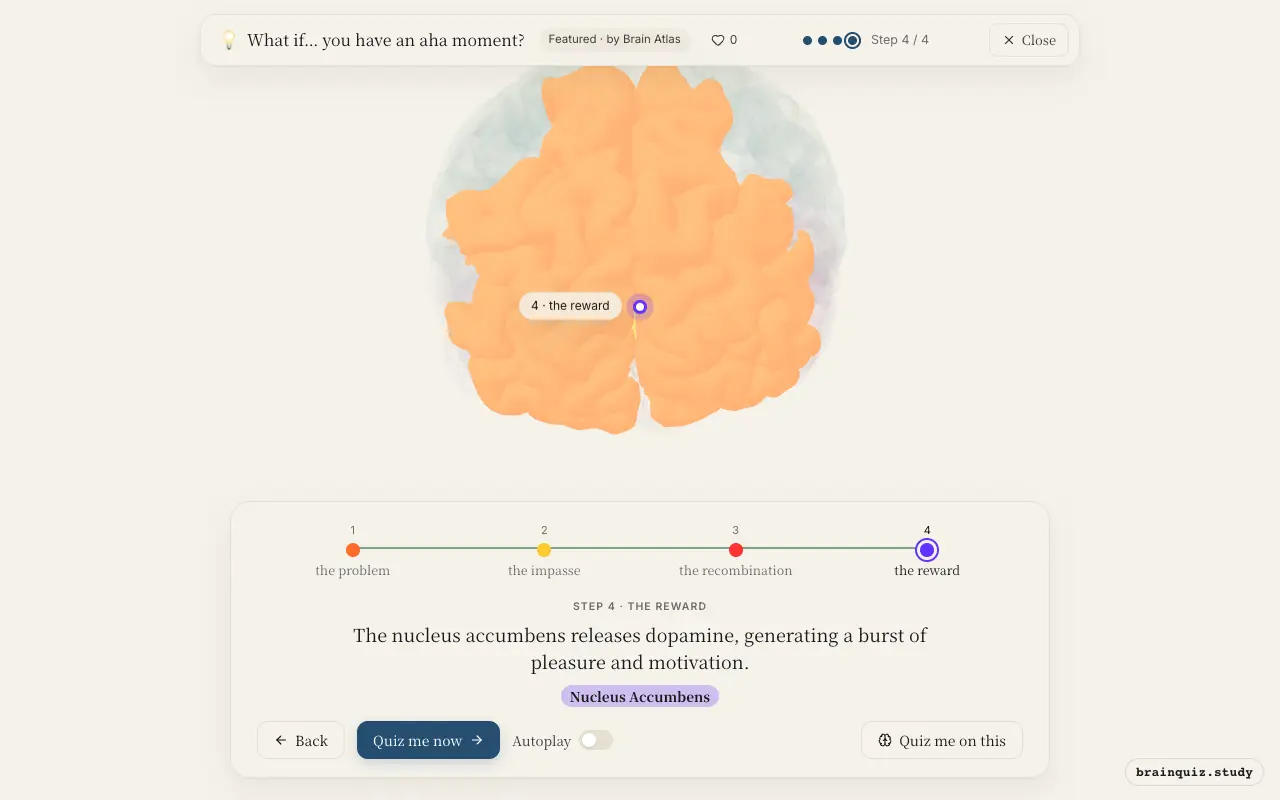
Watch it light up on the 3D brain
Brain regions that light up
| Order | Region | What it does here |
|---|---|---|
| 1 | Prefrontal Cortex | Your prefrontal cortex holds the problem in mind and directs attention. |
| 2 | Anterior Cingulate Cortex | The anterior cingulate cortex detects the conflict between old assumptions and new evidence. |
| 3 | Hippocampus | Your hippocampus retrieves relevant memories and binds them into a novel association. |
| 4 | Nucleus Accumbens | The nucleus accumbens releases dopamine, generating a burst of pleasure and motivation. |
1. Prefrontal Cortex: the problem
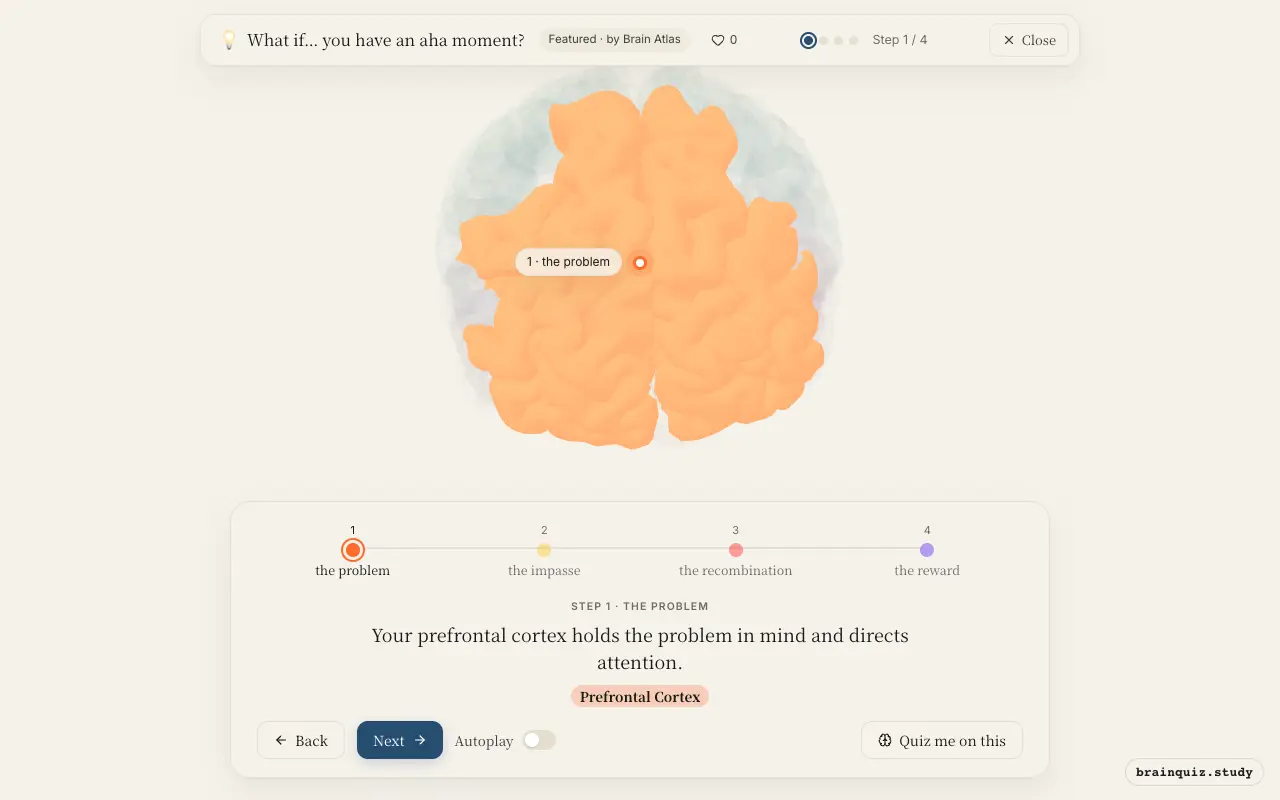
The prefrontal cortex maintains the goal in working memory and inhibits irrelevant information. It coordinates executive functions like planning and cognitive flexibility, which are essential for restructuring a problem. Studies suggest it remains active while you deliberately search for a solution.
2. Anterior Cingulate Cortex: the impasse
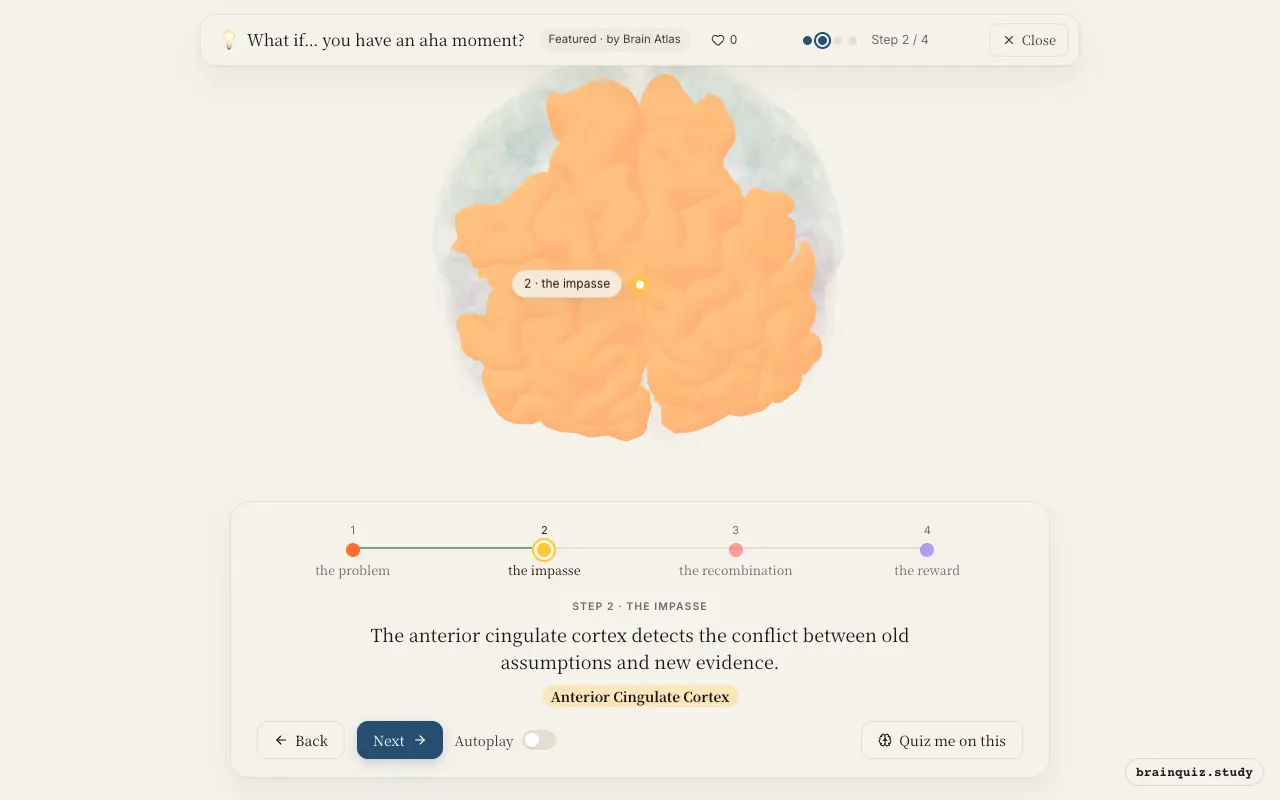
This region monitors for errors and conflicting information. When your current mental set fails, it signals that a new approach is needed. This 'impasse' signal may trigger a shift in strategy, allowing for a non-obvious solution to emerge.
3. Hippocampus: the recombination
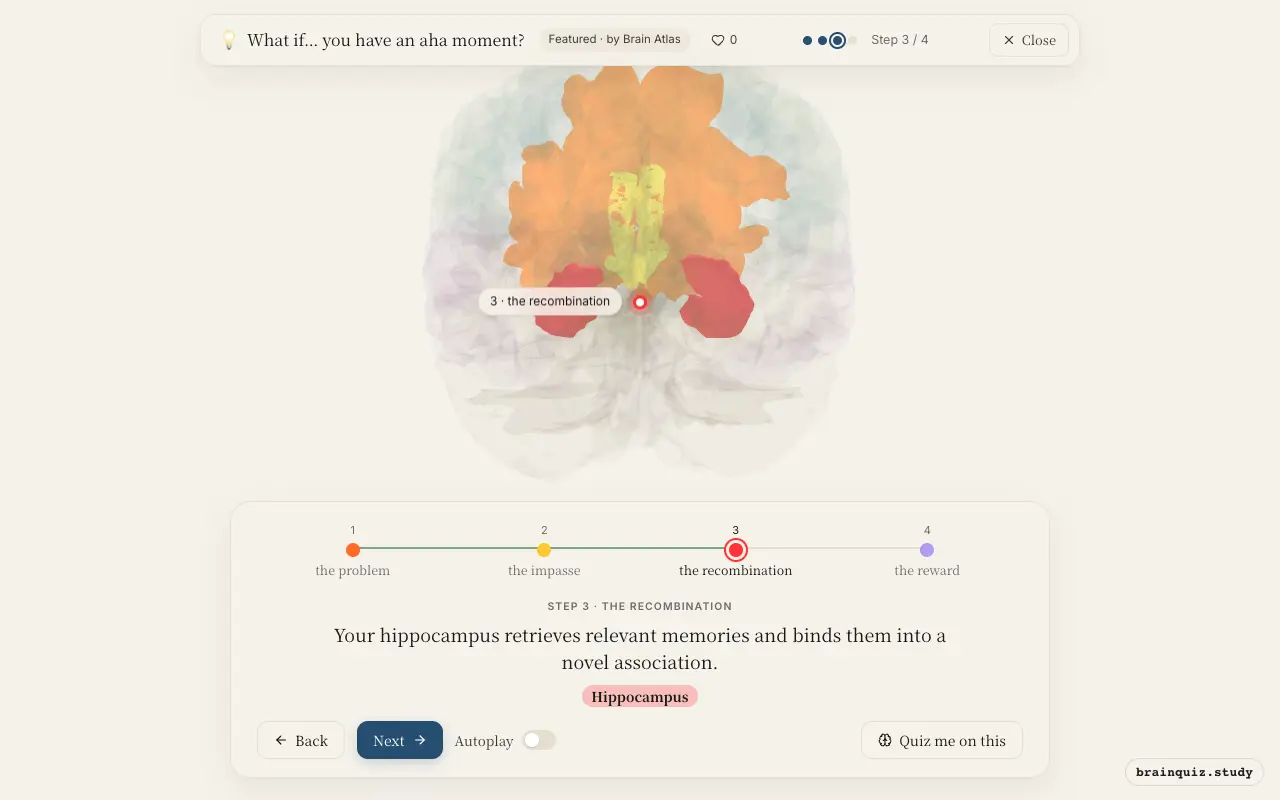
The hippocampus is crucial for forming new connections between previously unrelated concepts. During insight, it may reactivate scattered pieces of knowledge and integrate them. This process is thought to underlie the sudden 'aha' when a solution feels obvious in hindsight.
4. Nucleus Accumbens: the reward
When the solution clicks, the nucleus accumbens fires, creating a rewarding feeling. This dopamine surge reinforces the new insight, making it memorable and motivating you to apply it. It is why aha moments feel so satisfying.
Good to know
- Activity in the nucleus accumbens during insight correlates with the subjective feeling of reward and predicts better memory for the solution.
- An aha moment often follows a period of mental relaxation, possibly allowing the prefrontal cortex to disengage briefly so the hippocampus can recombine ideas.
- The anterior cingulate cortex signals the need to switch strategies, which is a critical step before the insight occurs.
Insight vs. Analytical Problem-Solving
In analytical solving, the prefrontal cortex works step-by-step with little anterior cingulate conflict. In insight, the anterior cingulate detects an impasse, and the hippocampus recombines memories before the nucleus accumbens rewards the sudden solution.
Test yourself
Which brain region is primarily responsible for detecting the impasse that precedes an aha moment?
What role does the nucleus accumbens play in an aha moment?
The hippocampus contributes to insight by:
0 of 3 answered · 0 correct
Simplified: many regions work together at once, and this shows the main players in the order they act.