What happens in your brain when you solve a maths problem?
Updated
To solve a maths problem, your visual cortex reads it, the parietal cortex and angular gyrus process the numbers and retrieve arithmetic facts, and the prefrontal cortex holds information in working memory. The motor cortex then writes the answer.
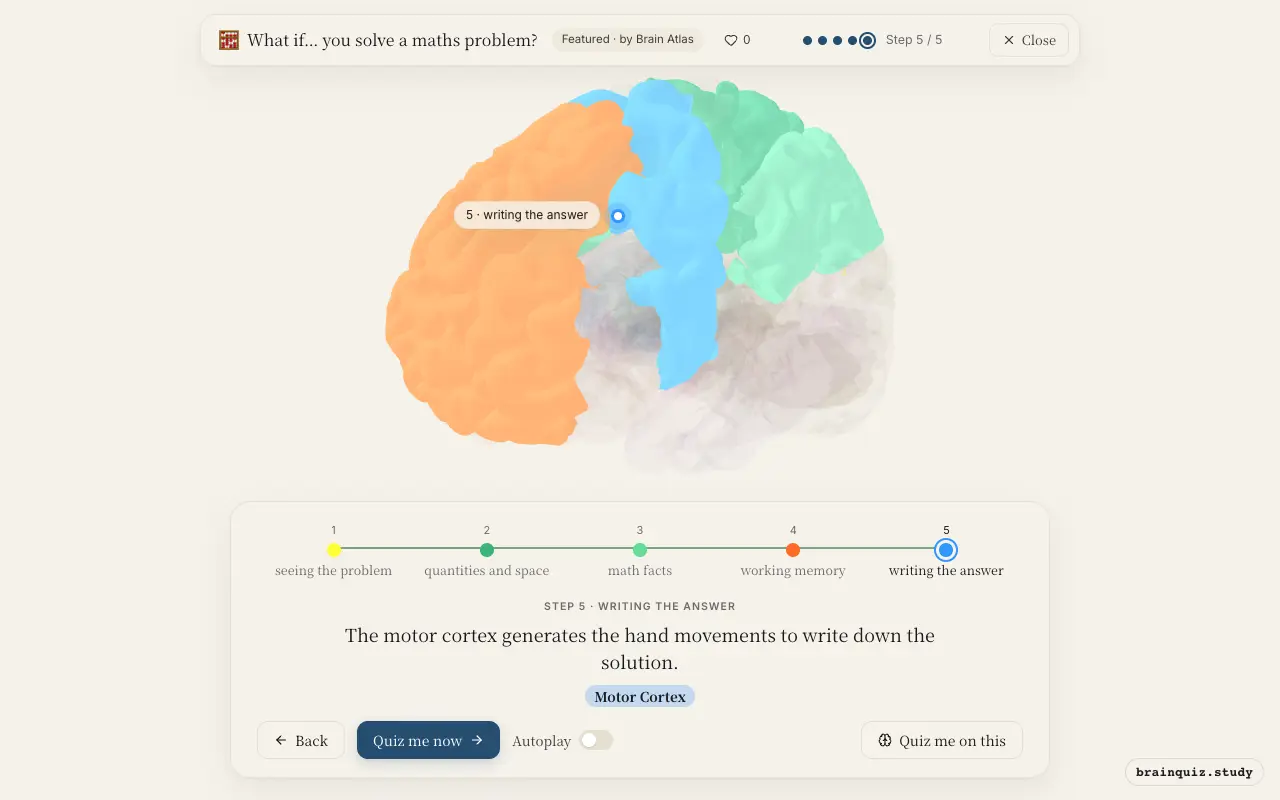
Watch it light up on the 3D brain
Brain regions that light up
| Order | Region | What it does here |
|---|---|---|
| 1 | Visual Cortex | The visual cortex processes the written numbers and symbols. |
| 2 | Parietal Cortex | The parietal cortex represents numerical quantities and directs attention to the problem. |
| 3 | Angular Gyrus | The angular gyrus retrieves arithmetic facts and processes mathematical symbols. |
| 4 | Prefrontal Cortex | The prefrontal cortex holds intermediate results and plans the solution steps. |
| 5 | Motor Cortex | The motor cortex generates the hand movements to write down the solution. |
1. Visual Cortex: seeing the problem
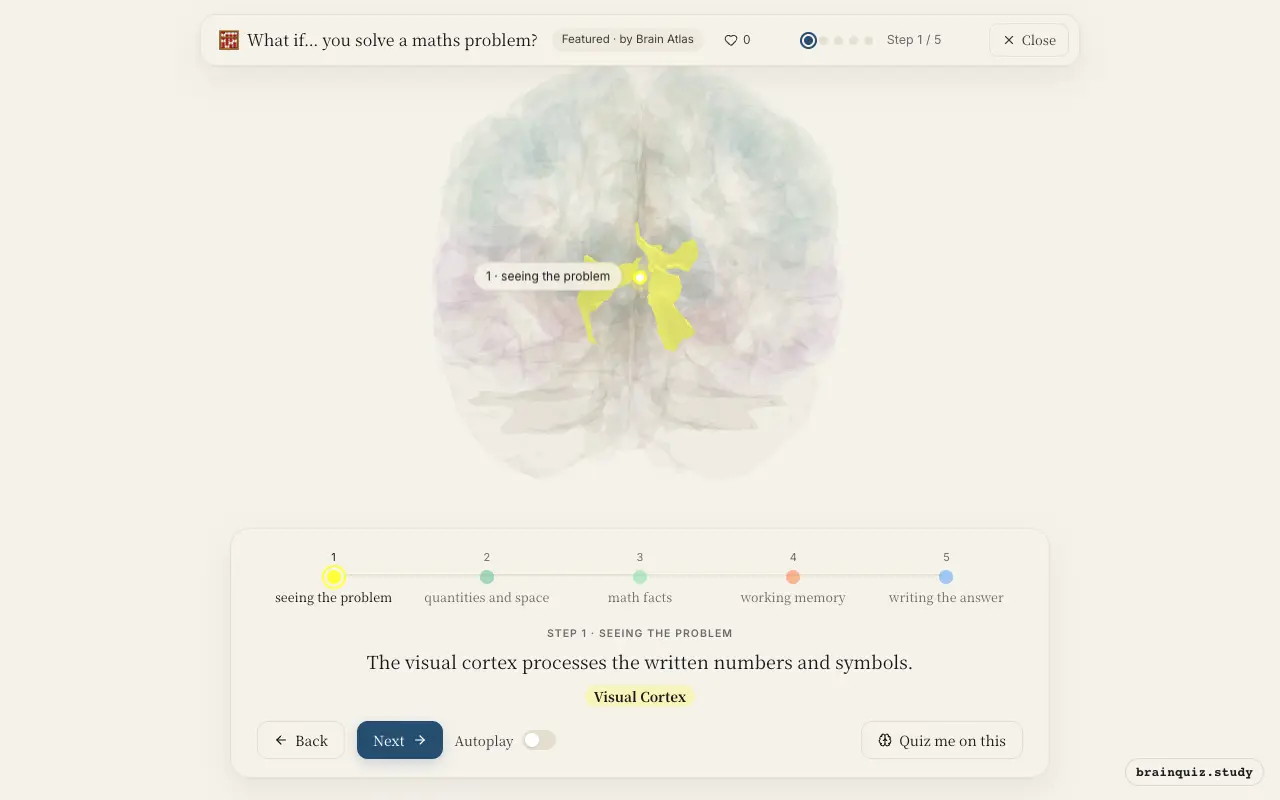
The primary visual cortex in the occipital lobe receives input from the eyes and extracts basic features like edges and shapes. This initial processing allows the brain to recognize the characters as numbers and operators. It is the first step in reading the problem.
2. Parietal Cortex: quantities and space
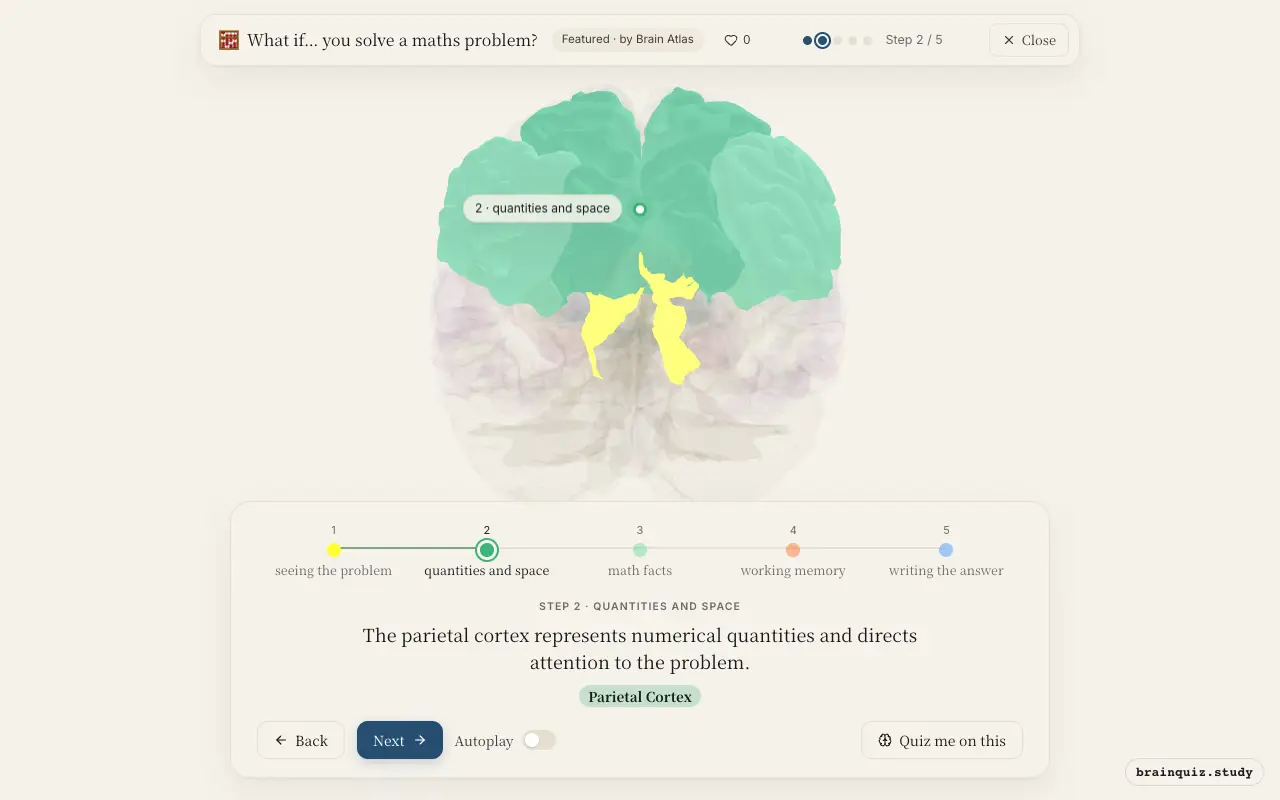
The parietal cortex, especially the intraparietal sulcus, is crucial for numerical cognition. It encodes the magnitude of numbers and their spatial relationships, supporting the manipulation of quantities. This region also helps focus attention on relevant parts of the problem.
3. Angular Gyrus: math facts
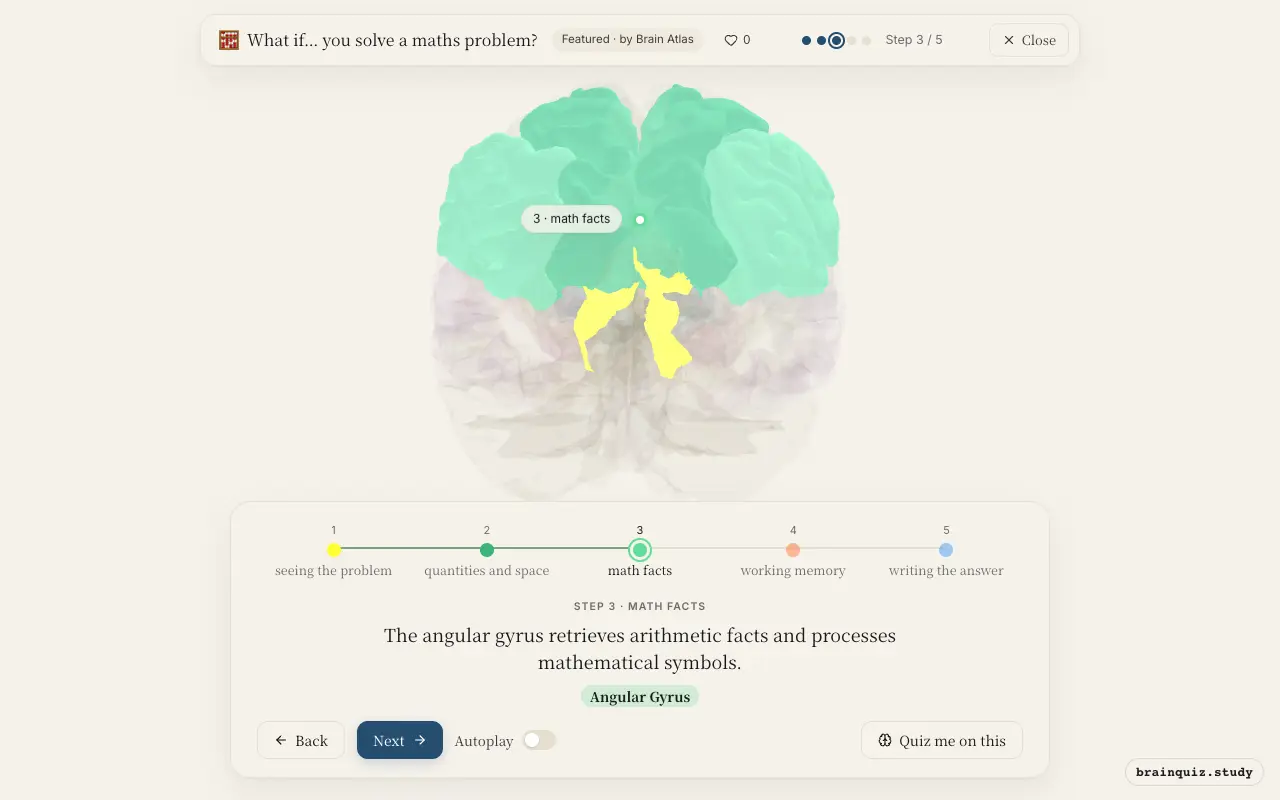
The angular gyrus, at the temporoparietal junction, is part of the brain's arithmetic network. It is thought to mediate the retrieval of overlearned arithmetic facts from long-term memory, such as multiplication tables. Damage to this area can lead to acalculia, a selective impairment in arithmetic.
4. Prefrontal Cortex: working memory
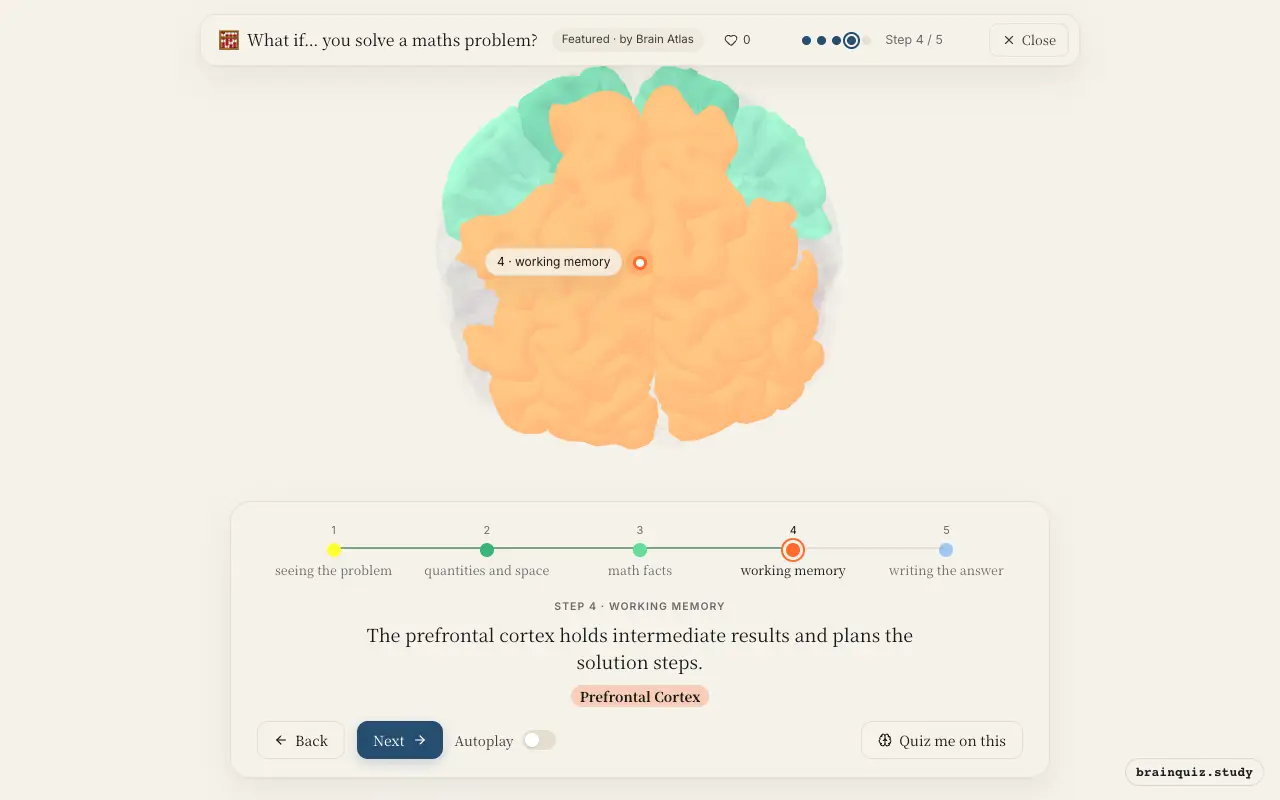
The dorsolateral prefrontal cortex is essential for working memory, allowing you to keep numbers in mind while performing calculations. It also exerts executive control, selecting appropriate strategies and monitoring progress. This region is more active for complex, multi-step problems than for simple recall.
5. Motor Cortex: writing the answer
If the answer is written, the primary motor cortex in the frontal lobe sends signals to the spinal cord to control the muscles of the hand and fingers. This region executes the voluntary movements needed to produce the written response. Its activity is contralateral to the writing hand.
Good to know
- The parietal cortex shows increased activity during numerical comparison and arithmetic tasks, suggesting a core role in number processing.
- The angular gyrus is part of the brain's 'arithmetic network' and is thought to store or retrieve well-learned math facts.
- The prefrontal cortex maintains intermediate results in working memory, which is essential for multi-step calculations.
Mental arithmetic vs. reading a sentence
Both tasks activate visual cortex for reading, but arithmetic additionally recruits the parietal cortex and angular gyrus for number processing, while reading a sentence engages Broca's and Wernicke's areas for language. Thus, the spatial and numerical networks distinguish math from pure reading.
Test yourself
Which brain region is most responsible for holding numbers in working memory during a multi-step calculation?
If a person sustains damage to the angular gyrus, what aspect of maths problem solving would likely be impaired?
Which region processes the initial visual input of the written problem?
0 of 3 answered · 0 correct
Simplified: many regions work together at once, and this shows the main players in the order they act.