Putamen — Function, Location & Quiz
The putamen is the motor-weighted part of the dorsal striatum, turning repeated choices into efficient habits and shaping movement through basal-ganglia loops. Its close partner, the caudate, leans more toward flexible goals and cognition, though the boundary is functional rather than absolute.
Dopamine loss in the putamen is central to the slowness and rigidity of Parkinson’s disease. It is also a practical imaging landmark because putaminal haemorrhage is a common form of hypertensive intracerebral bleeding.
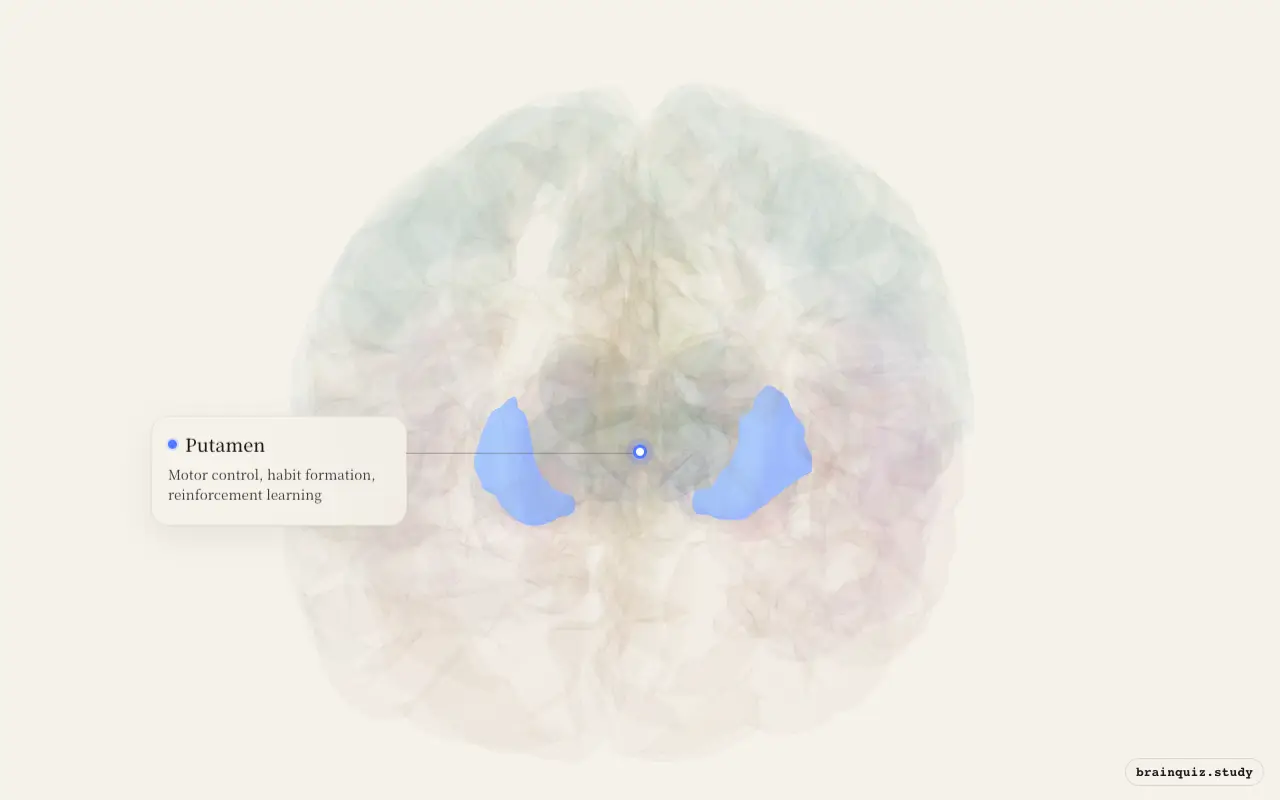
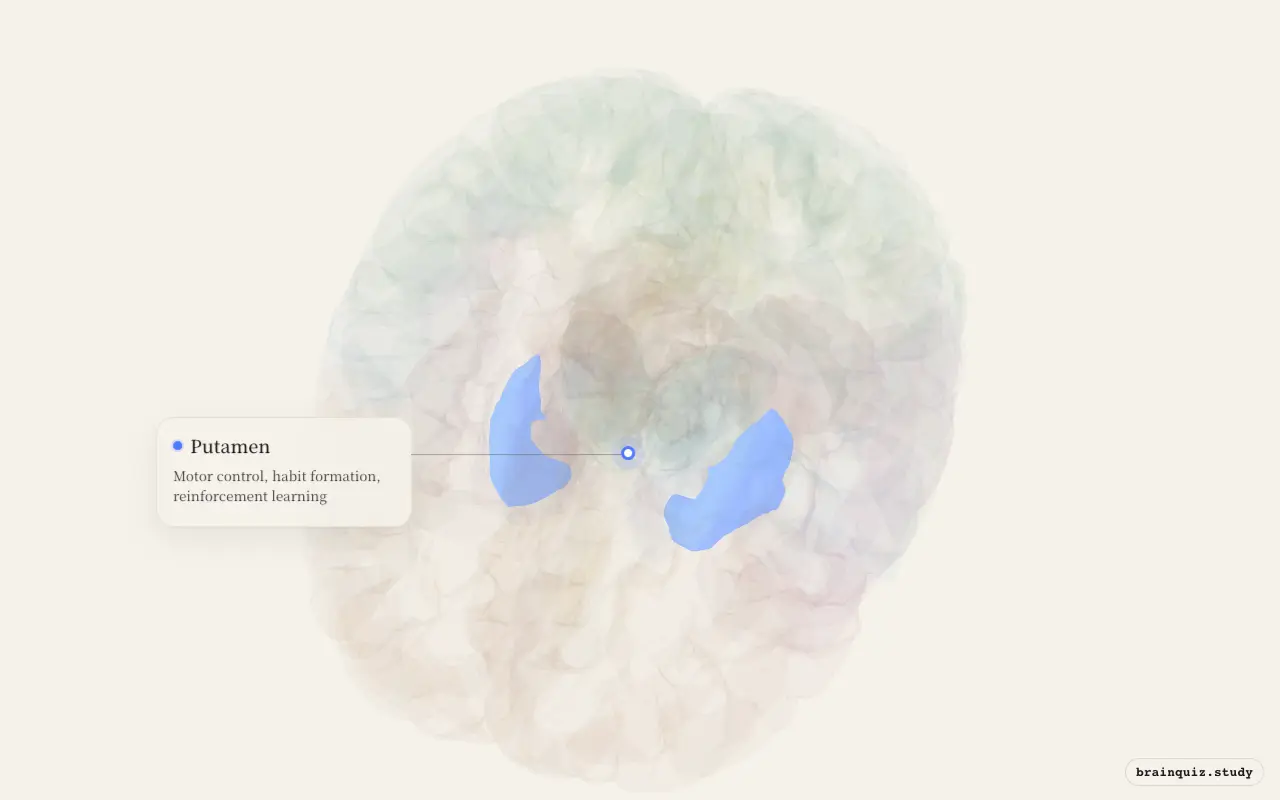
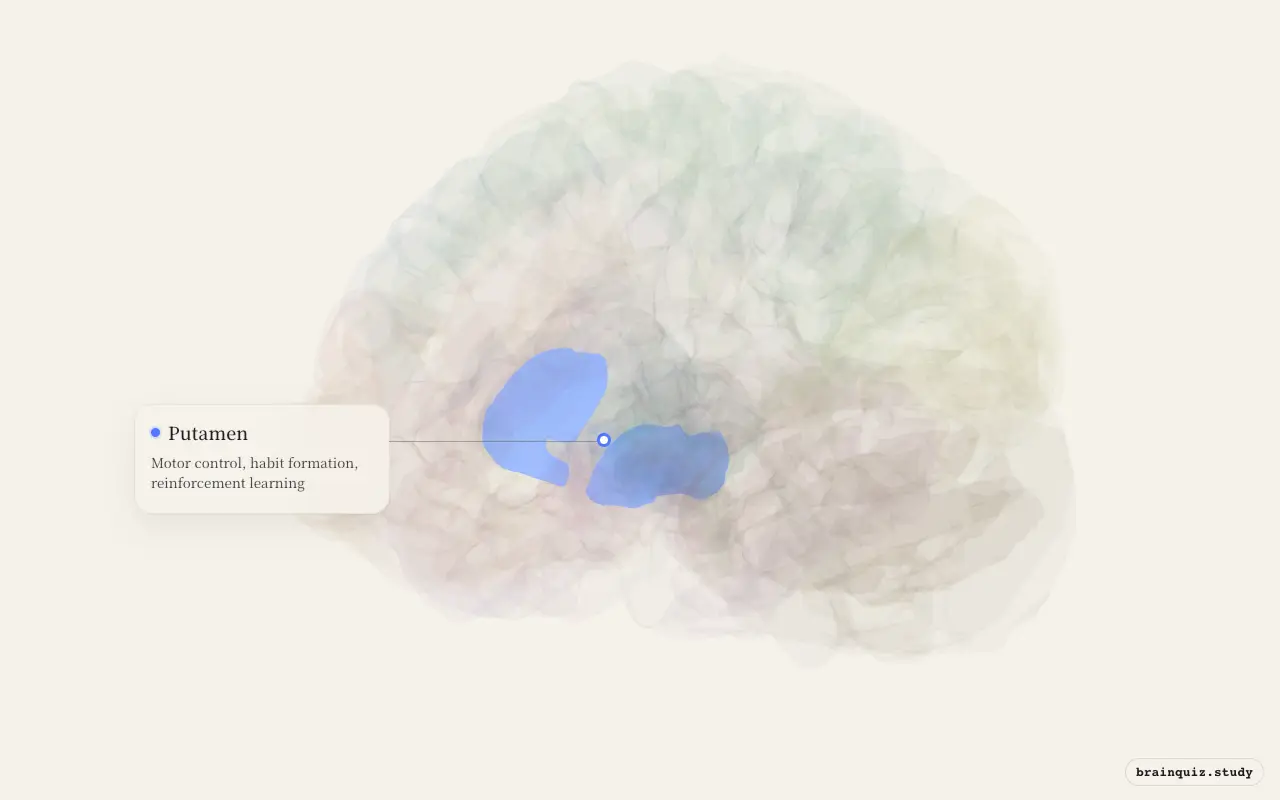
Test this anatomy in the Lesion Localization Quiz: 15 Clinical Questions or explore it on the interactive 3D brain.
Where is the Putamen located?
Motor control, habit formation, reinforcement learning.
What does the Putamen do?
- Motor control and movement execution
- Habit formation — automatic stimulus-response associations
- Reinforcement learning (reward prediction errors via dopamine)
Putamen pathways and connections
- Putamen ← Motor cortex, premotor cortex (motor inputs)
- Putamen → GPi → Thalamus → Motor cortex (motor loop)
- Putamen ← Substantia nigra pars compacta (dopamine)
What happens when the Putamen is damaged?
- Parkinson's disease: dopamine depletion in putamen → bradykinesia, rigidity, tremor
- Putaminal hemorrhage — most common site of hypertensive intracerebral hemorrhage
Putamen key facts
Atlas category: subcortical.
- Dopamine from SNc signals reward prediction errors in putamen (Schultz)
- Shift from caudate (goal-directed) to putamen (habitual) with overtraining
Putamen exam tip
Parkinson's = putamen dopamine loss. Huntington's = caudate degeneration. Different parts of striatum, different diseases.
Common questions
What does the putamen do?
It helps regulate movement execution, reinforcement learning and the shift from deliberate actions toward automatic stimulus-response habits.
Where does putamen dopamine come from?
The substantia nigra pars compacta sends nigrostriatal dopamine to the putamen and other striatal regions, modulating direct and indirect pathway balance.
How is the putamen involved in Parkinson’s disease?
Degeneration of substantia nigra dopamine neurons depletes putaminal dopamine, biasing basal-ganglia output toward excessive inhibition and producing bradykinesia and rigidity.
When does the Putamen light up?
- 🤢 When you feel disgusted: The putamen helps produce the facial expression of disgust and avoidance actions.
- ☕ When you drink coffee: Dopamine signaling increases in the putamen, enhancing motor readiness and reaction time.
- 😴 When you quit caffeine: Motor pathways slow as striatal dopamine falls.
- ⏰ When you hit snooze: Your putamen runs the well-practiced snooze-pressing sequence automatically.
- 🧠 When you practise a skill until it's automatic: The putamen consolidates the skill into an automatic routine.
- 🔁 When you form a new habit: Putamen executes the behavior automatically, no longer needing conscious thought.
- 🧠 When you get Parkinson's disease: Reduced dopamine disrupts the putamen's control of basal ganglia pathways.
- 🧠 When you have ADHD: The putamen's role in motor control is disrupted, contributing to hyperactivity and restlessness.