Caudate Nucleus — Function, Location & Quiz
The caudate is the cognitive-weighted part of the dorsal striatum, receiving strong prefrontal input for goals, rules and flexible choices. It is paired with the putamen anatomically, but the putamen is more directly associated with sensorimotor habits and movement execution.
Huntington’s disease makes the caudate clinically recognizable because atrophy is visible on imaging and accompanies chorea, cognitive decline and psychiatric change. The same cortico-striato-thalamic architecture also places caudate dysfunction in models of compulsive behaviour.
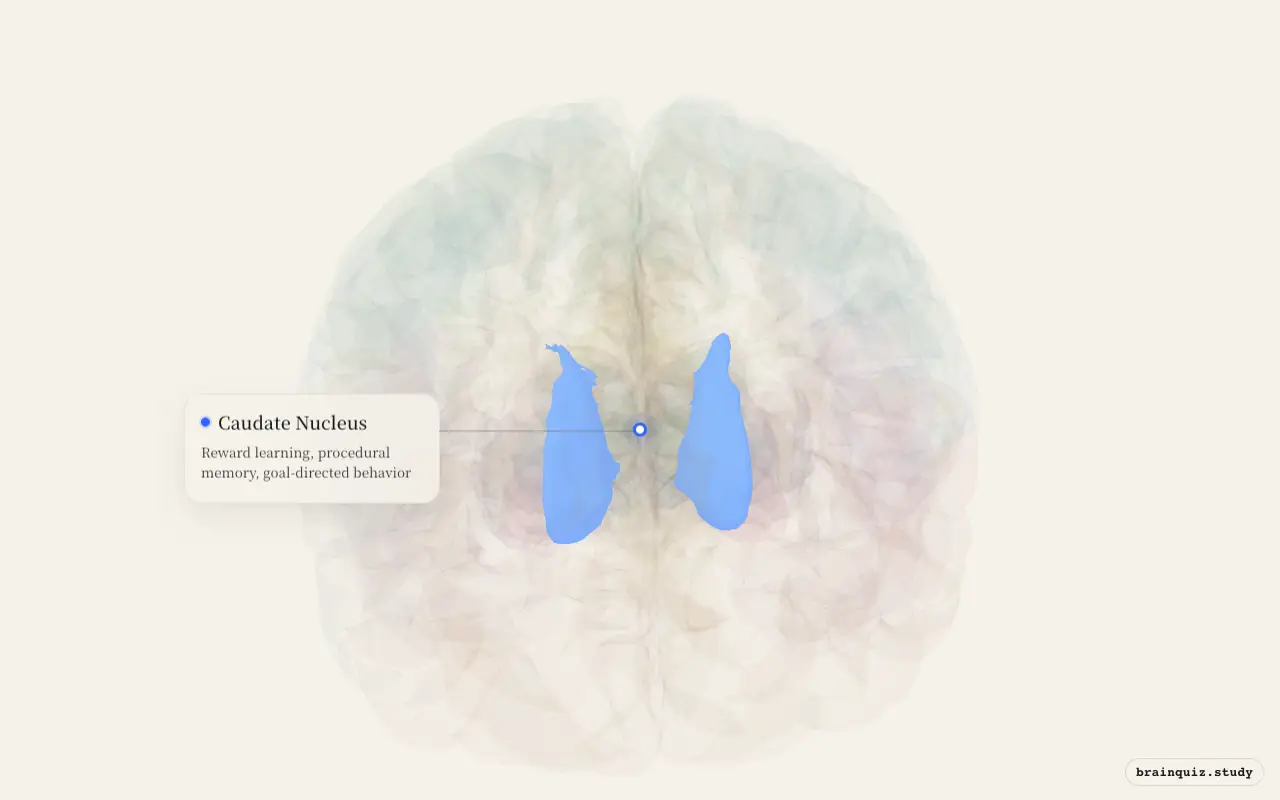
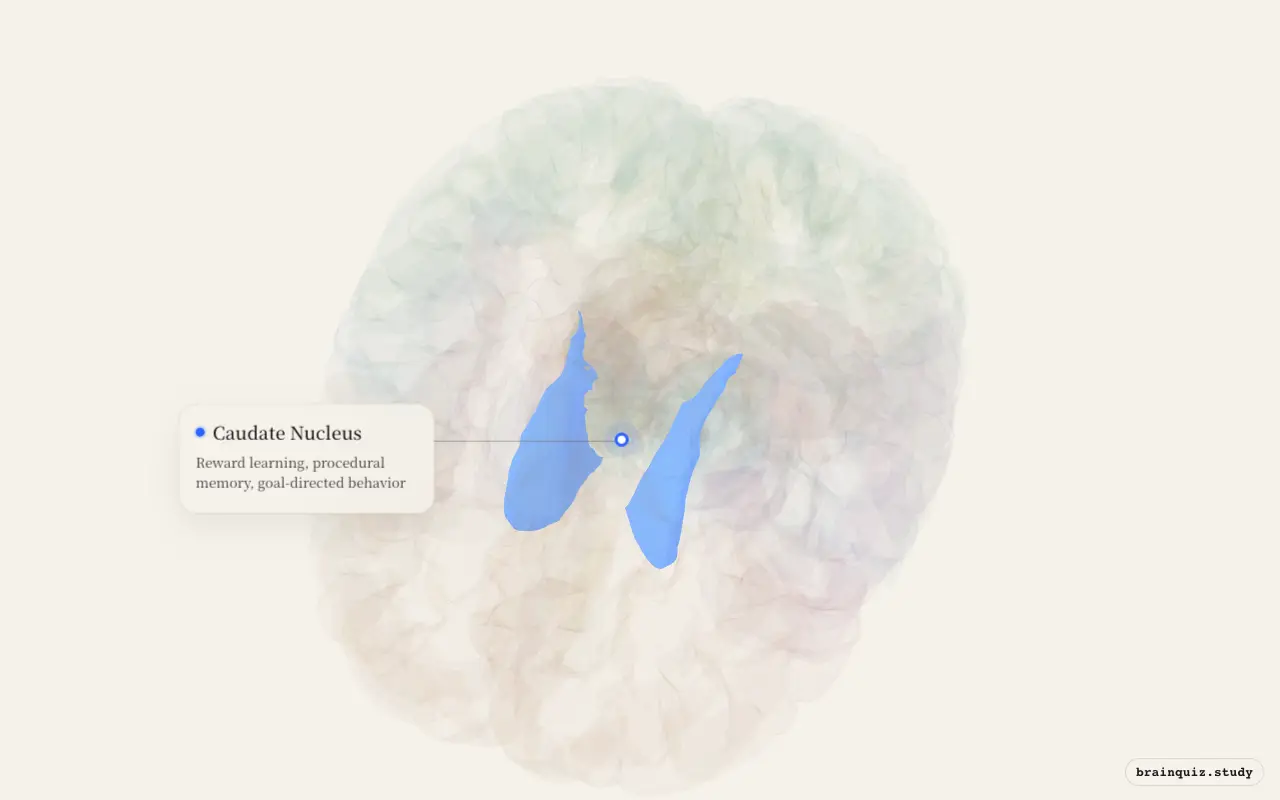
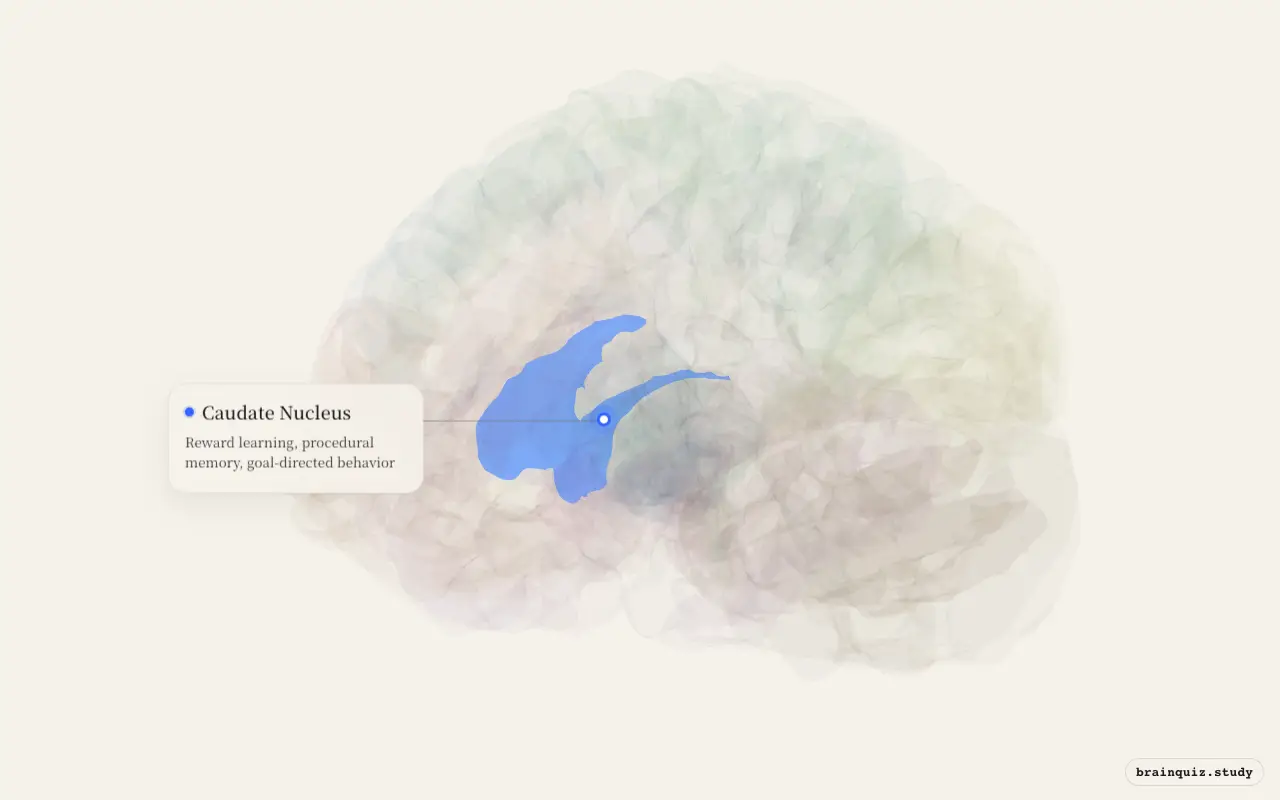
Test this anatomy in the Lesion Localization Quiz: 15 Clinical Questions or explore it on the interactive 3D brain.
Where is the Caudate Nucleus located?
Reward learning, procedural memory, goal-directed behavior.
What does the Caudate Nucleus do?
- Goal-directed behavior and reward learning
- Procedural memory and habit formation
- Working memory support (caudate-PFC loop)
- Cognitive flexibility — switching between tasks
Caudate Nucleus pathways and connections
- Caudate ← Cortex (especially PFC — cognitive inputs)
- Caudate → Globus pallidus → Thalamus → Cortex (basal ganglia loop)
- Direct pathway (Go) and Indirect pathway (No-Go)
What happens when the Caudate Nucleus is damaged?
- Huntington's disease: caudate atrophy → chorea, cognitive decline, psychiatric symptoms
- OCD: caudate hyperactivity in cortico-striato-thalamic loop
Caudate Nucleus key facts
Atlas category: subcortical.
- Head of caudate = cognitive functions (PFC input). Tail = visual/emotional (temporal input)
- Caudate shrinks visibly on MRI in Huntington's disease
Caudate Nucleus exam tip
Caudate = cognitive part of striatum. Putamen = motor part. Together they form the dorsal striatum.
Common questions
What does the caudate nucleus do?
It contributes to goal-directed action, reward learning, procedural memory, working-memory loops and flexible switching between behavioural rules.
How are the caudate and putamen different?
Both form the dorsal striatum. The caudate receives more cognitive and prefrontal input, while the putamen is more strongly engaged by motor and habit circuits.
Which disease prominently affects the caudate?
Huntington’s disease produces marked caudate degeneration, along with chorea, psychiatric symptoms and progressive cognitive impairment.
When does the Caudate Nucleus light up?
- ❤️ When you fall in love: The caudate drives craving and goal-directed pursuit of the beloved.
- 💊 When you take ADHD medication: The caudate nucleus integrates dopamine signals to support goal-directed behavior and attention shifting.
- 🧠 When you make a decision: The caudate nucleus links choices to outcomes, reinforcing successful strategies.
- ♟️ When you play chess: Your caudate nucleus taps into stored chess patterns and procedural memory.
- 🔁 When you form a new habit: Caudate nucleus links each action to its outcome, reinforcing deliberate repetition.
- 🤝 When you trust a stranger: The caudate registers the reward of a positive interaction.
- 🧠 When you have ADHD: The caudate nucleus shows altered dopamine transmission, impairing goal-directed behavior and reward learning.
- 🔁 When you have OCD: The caudate normally filters out irrelevant worries but fails in OCD.