What happens in your brain when you have OCD?
Updated
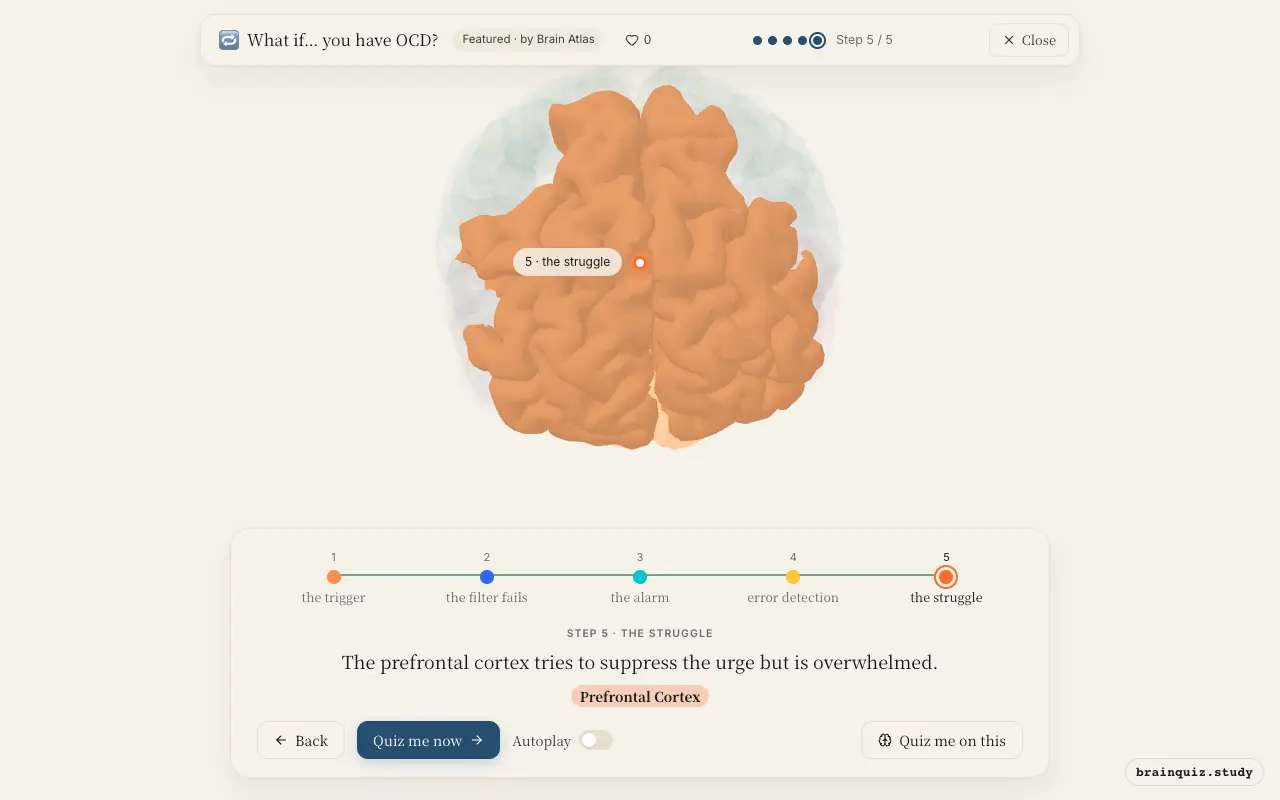
In OCD, the orbitofrontal cortex flags concerns, the caudate fails to filter them, the thalamus amplifies signals, the anterior cingulate detects error, and the prefrontal cortex struggles to suppress urges.
Watch it light up on the 3D brain
Brain regions that light up
| Order | Region | What it does here |
|---|---|---|
| 1 | Orbitofrontal Cortex | The orbitofrontal cortex flags a concern, like contamination or doubt. |
| 2 | Caudate Nucleus | The caudate normally filters out irrelevant worries but fails in OCD. |
| 3 | Thalamus | The thalamus relays the amplified signal, creating a strong urge. |
| 4 | Anterior Cingulate Cortex | The anterior cingulate detects conflict or error, adding to distress. |
| 5 | Prefrontal Cortex | The prefrontal cortex tries to suppress the urge but is overwhelmed. |
1. Orbitofrontal Cortex: the trigger
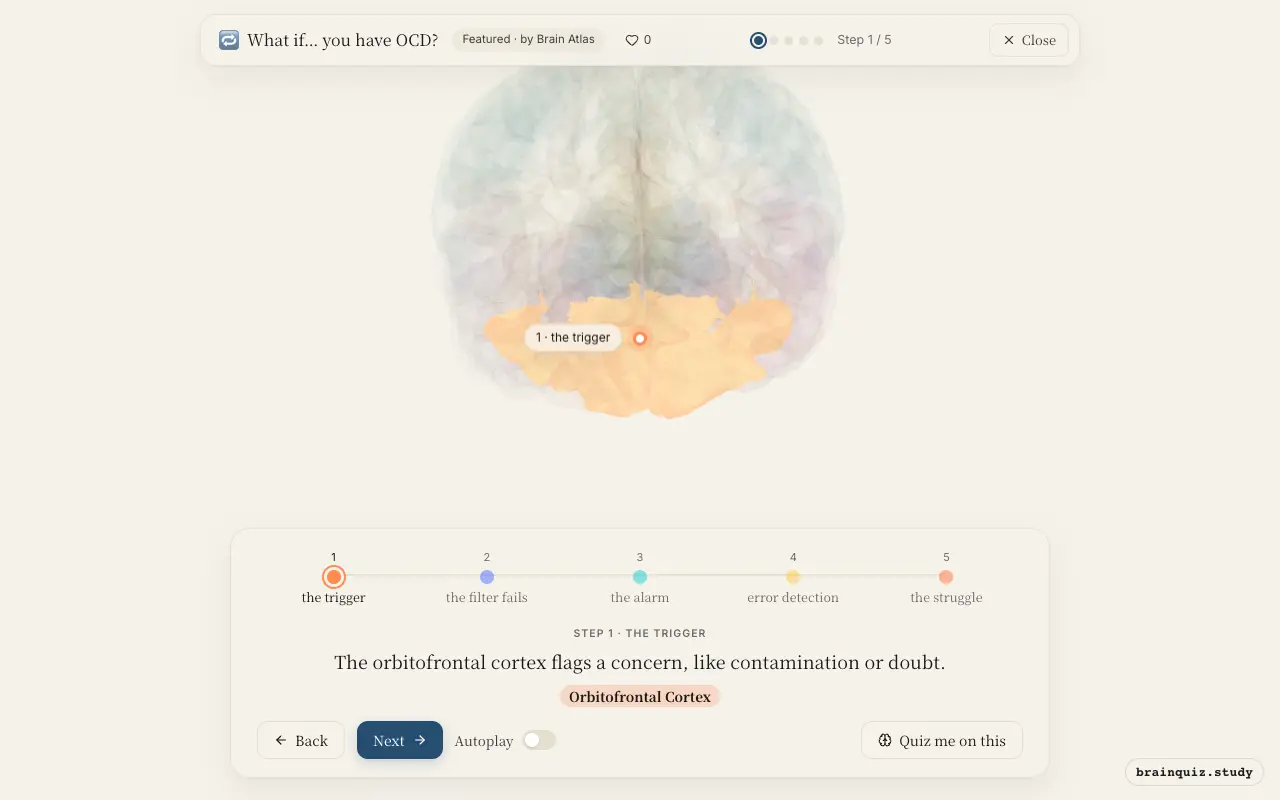
This region evaluates the emotional significance of stimuli. In OCD, it fires excessively, creating a sense that something is wrong even when it isn't. This overactivity is a hallmark of obsessive thoughts.
2. Caudate Nucleus: the filter fails
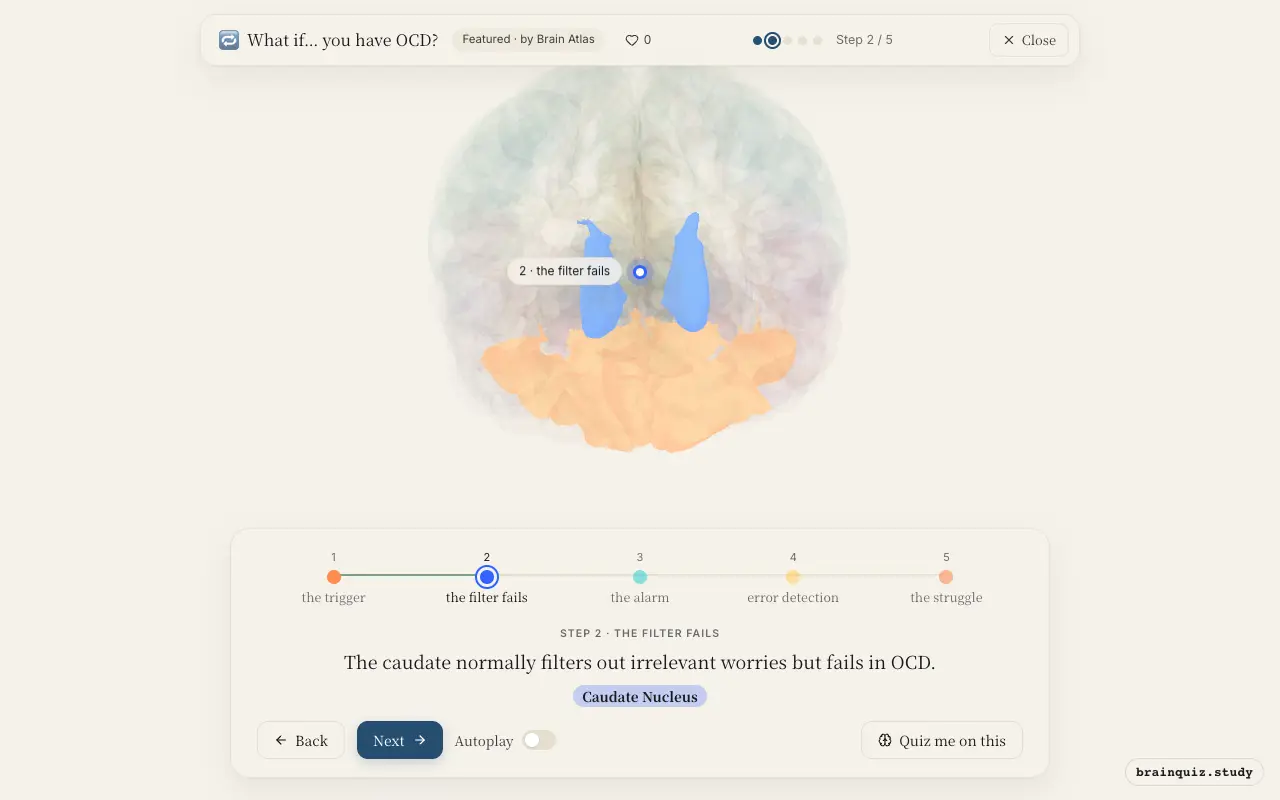
Part of the basal ganglia, the caudate helps select actions and suppress unwanted thoughts. In OCD, its gating function is impaired, so the orbitofrontal signal isn't dampened. This allows the worry to persist and grow.
3. Thalamus: the alarm
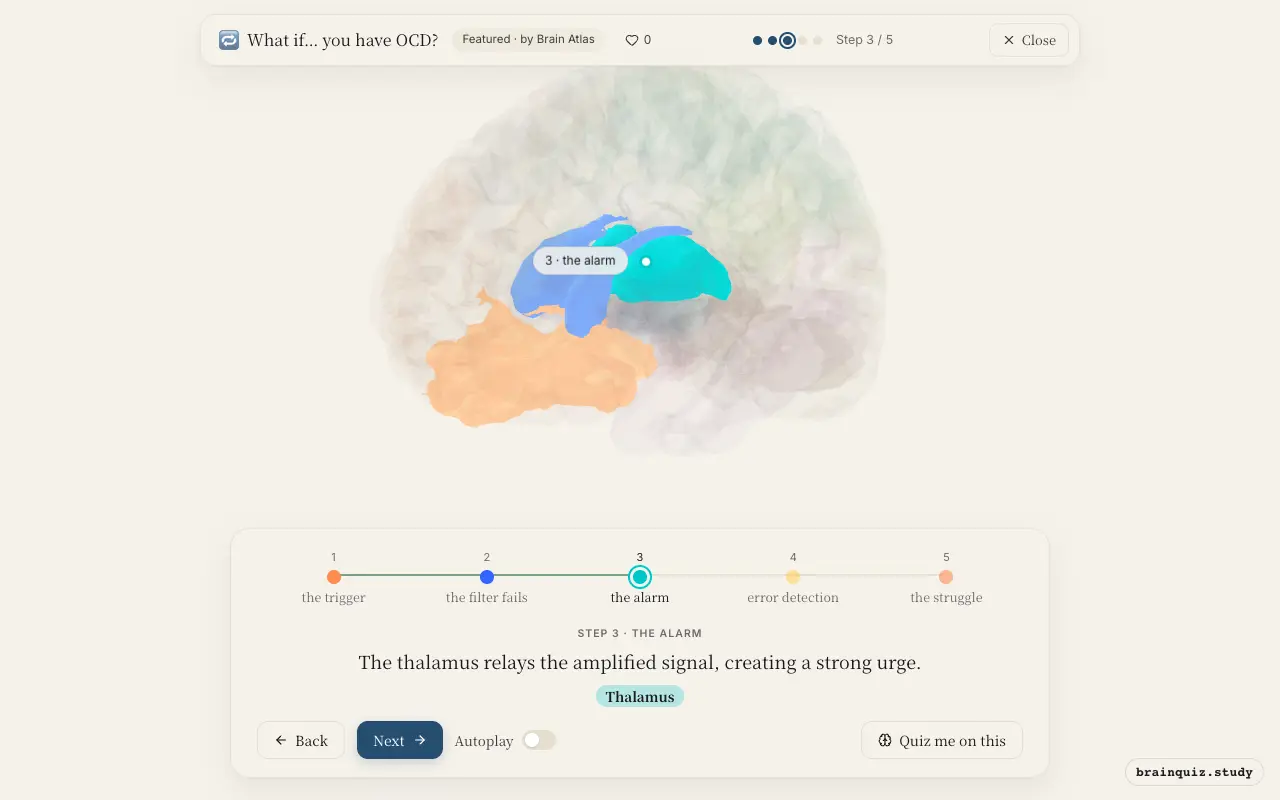
Acting as a relay station, the thalamus passes the unchecked signal from the basal ganglia to the cortex. The result is a powerful feeling that action is urgently needed. This drives the compulsive behavior.
4. Anterior Cingulate Cortex: error detection
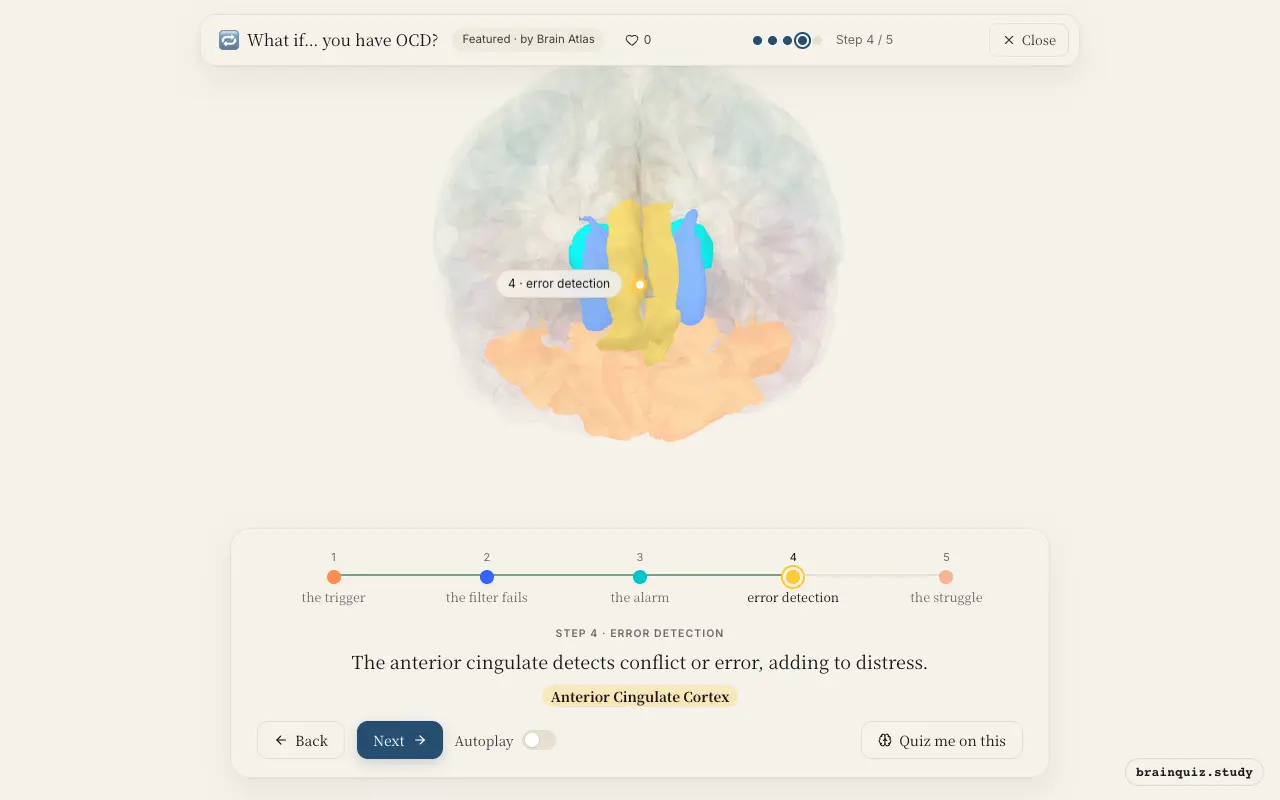
This region monitors for mistakes and mismatches. In OCD, it is overactive, signaling constant error even when no real error exists. This contributes to the feeling that something must be corrected.
5. Prefrontal Cortex: the struggle
Responsible for executive control, the prefrontal cortex attempts to inhibit the compulsive response. However, in OCD, the strong signals from the orbitofrontal and cingulate circuits overpower its efforts. This leads to difficulty resisting rituals.
Good to know
- OCD is associated with overactivity in the orbitofrontal cortex, anterior cingulate, and caudate, forming a hyperactive loop.
- Selective serotonin reuptake inhibitors (SSRIs) can reduce OCD symptoms, suggesting serotonin plays a role in modulating this circuit.
- Performing a compulsion temporarily reduces anxiety, which negatively reinforces the behavior and strengthens the loop.
OCD vs. habit
In a habit, the basal ganglia streamline repeated actions without distress. In OCD, the orbitofrontal and cingulate overdrive creates anxiety, making actions feel compelled rather than automatic. The key difference is the presence of intrusive thoughts and distress.
Test yourself
Which brain region fails to filter intrusive thoughts in OCD?
Which region's overactivity contributes to the feeling that a mistake has been made?
What role does the thalamus play in the OCD circuit?
0 of 3 answered · 0 correct
Simplified: many regions work together at once, and this shows the main players in the order they act. For learning only, not medical advice.