What happens in your brain when you have a stroke?
Updated
A stroke interrupts blood flow, causing rapid neuron death. In a typical left hemisphere stroke, the motor cortex and Broca's area are commonly affected, leading to weakness and aphasia; surrounding penumbra may be salvageable.
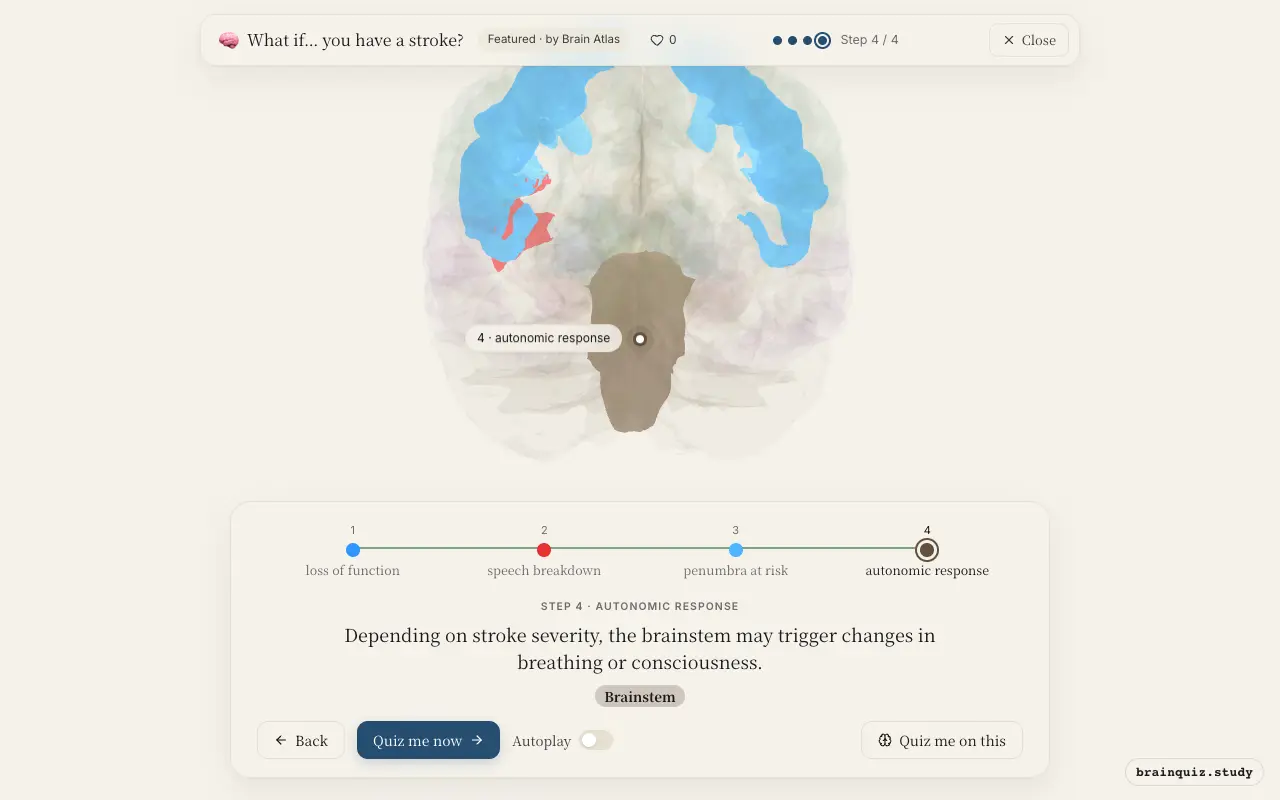
Watch it light up on the 3D brain
Brain regions that light up
| Order | Region | What it does here |
|---|---|---|
| 1 | Motor Cortex | Neurons in the motor cortex suddenly stop firing due to lack of oxygen and glucose. |
| 2 | Broca's Area | If Broca's area is affected, speech production becomes slow and effortful. |
| 3 | Premotor Cortex | Surrounding premotor cortex in the penumbra may still recover if blood flow is restored quickly. |
| 4 | Brainstem | Depending on stroke severity, the brainstem may trigger changes in breathing or consciousness. |
1. Motor Cortex: loss of function
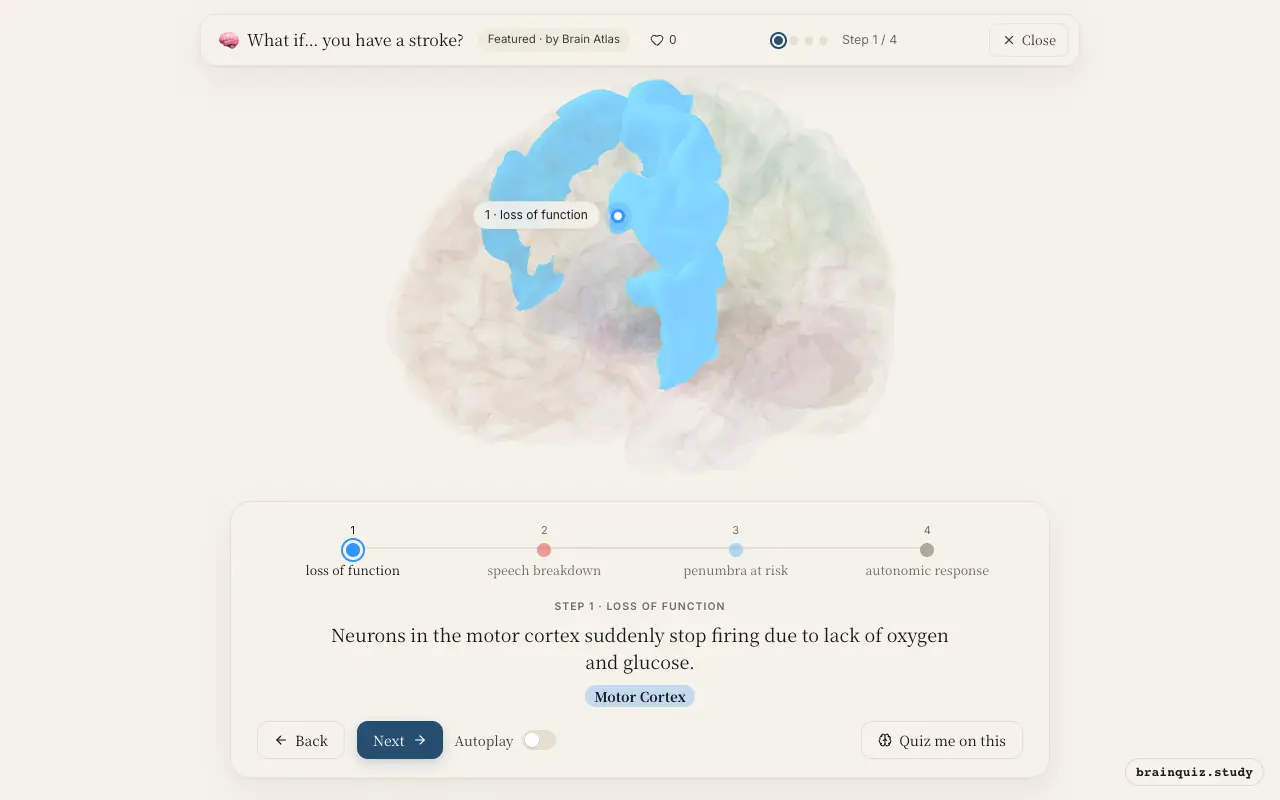
The motor cortex controls voluntary movement on the opposite side of the body. When its blood supply is cut off, the affected neurons cannot maintain their electrical activity, leading to immediate paralysis or weakness in the corresponding body part. This is often the first noticeable sign of a stroke.
2. Broca's Area: speech breakdown
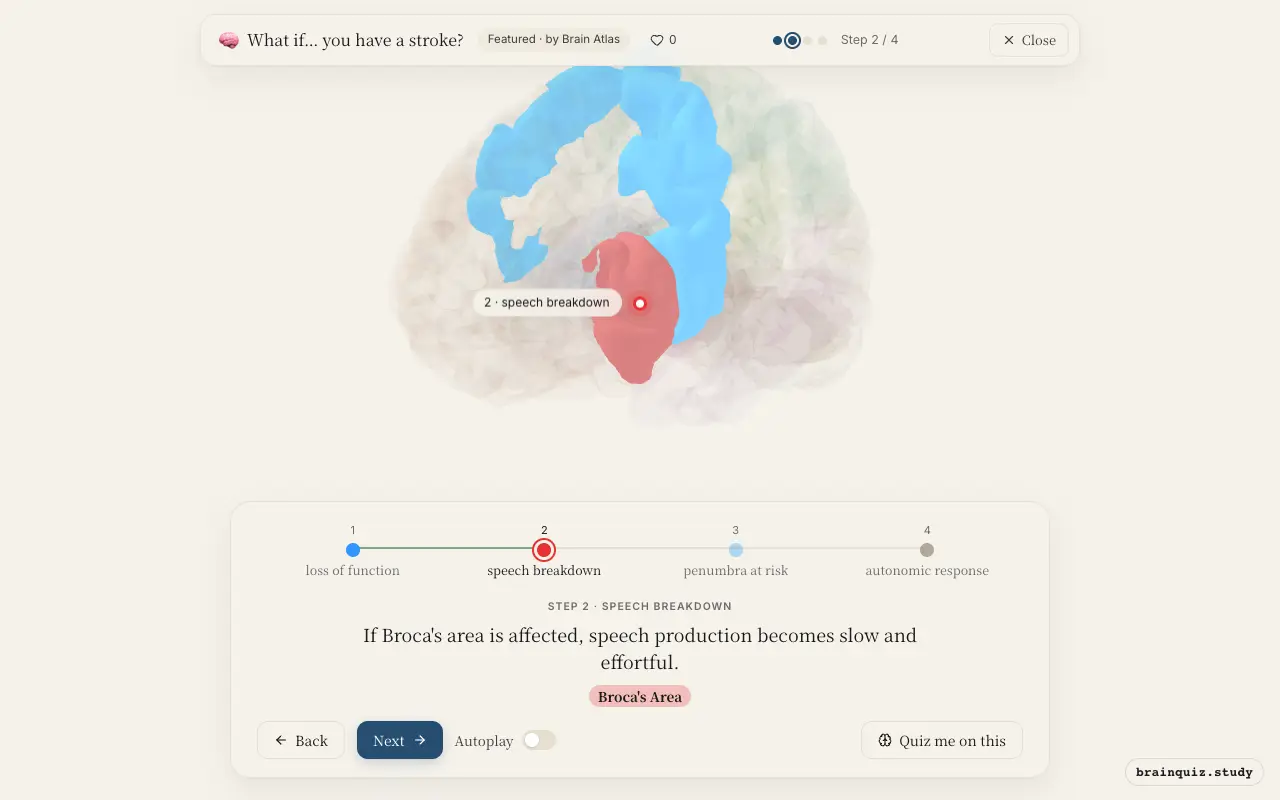
Broca's area in the left frontal lobe is crucial for generating fluent speech. Ischemia here causes expressive aphasia, where the person understands language but struggles to form words. This region is commonly affected in left middle cerebral artery strokes, often resulting in slow, non-fluent speech.
3. Premotor Cortex: penumbra at risk
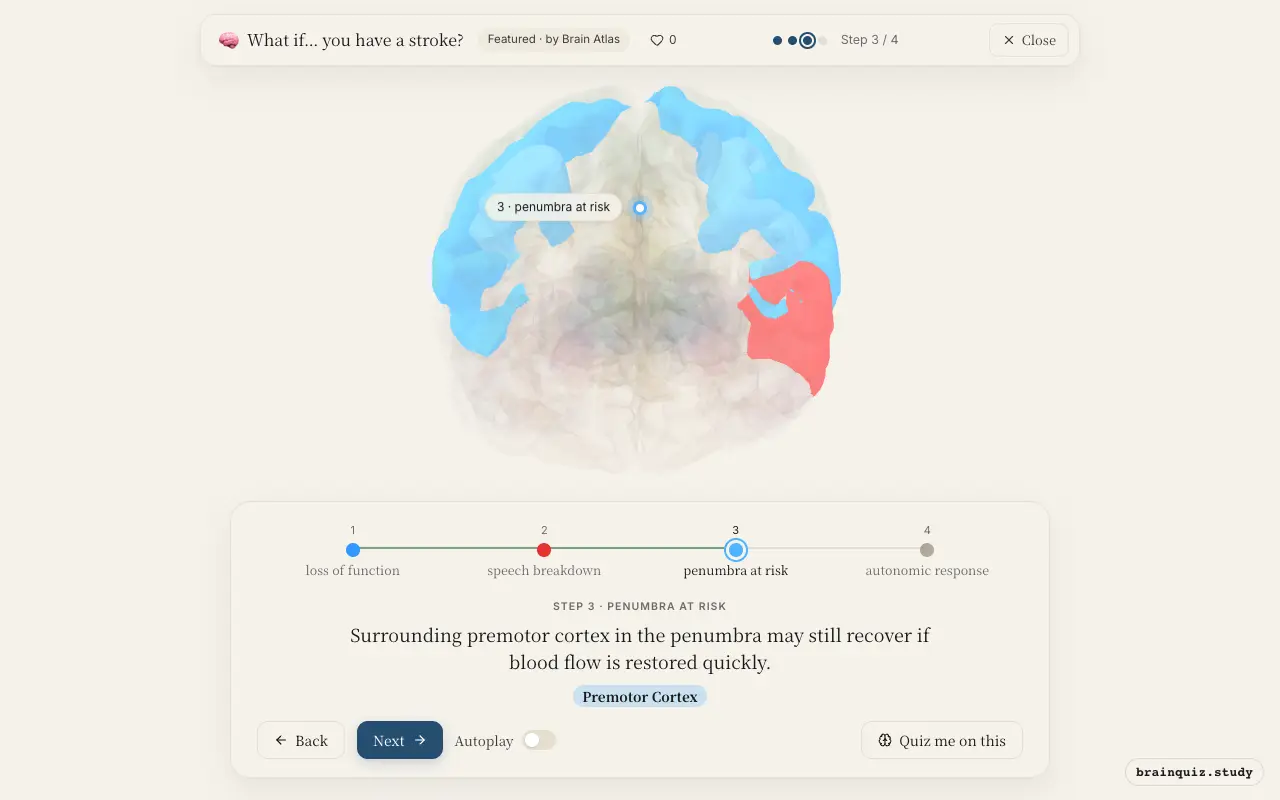
The penumbra is the area around the core infarct where blood flow is reduced but not completely absent. Neurons here are electrically silent but may survive for hours if reperfusion occurs. The premotor cortex, involved in planning movements, is often part of the penumbra in MCA strokes.
4. Brainstem: autonomic response
If the stroke is large or affects the brainstem directly, vital functions like breathing and heart rate can be compromised. The brainstem's reticular formation also regulates arousal, so a severe stroke can lead to coma. However, for a typical cortical stroke, brainstem function remains intact.
Good to know
- Ischemic strokes account for about 87% of all strokes, caused by a blood clot blocking a brain artery.
- During a large vessel ischemic stroke, many neurons are thought to die each minute without treatment.
- The 'penumbra' is the target for acute stroke therapies like clot-busting drugs to save salvageable tissue.
Stroke vs TIA
A TIA causes temporary symptoms because the blockage is brief and dissolves, while a stroke causes permanent damage. In a TIA, brain regions like the motor cortex may malfunction for minutes but recover without cell death. In a stroke, prolonged ischemia leads to irreversible infarction.
Test yourself
Which brain region is most commonly affected in a left middle cerebral artery stroke, leading to right-sided weakness?
What is the penumbra?
Damage to Broca's area results in:
0 of 3 answered · 0 correct
Simplified: many regions work together at once, and this shows the main players in the order they act. For learning only, not medical advice.