What happens in your brain when you get Alzheimer's disease?
Updated
Alzheimer's disease starts in the entorhinal cortex and hippocampus, destroying memory formation, then spreads to temporal, parietal, and prefrontal cortices, causing language problems, spatial disorientation, and executive dysfunction.
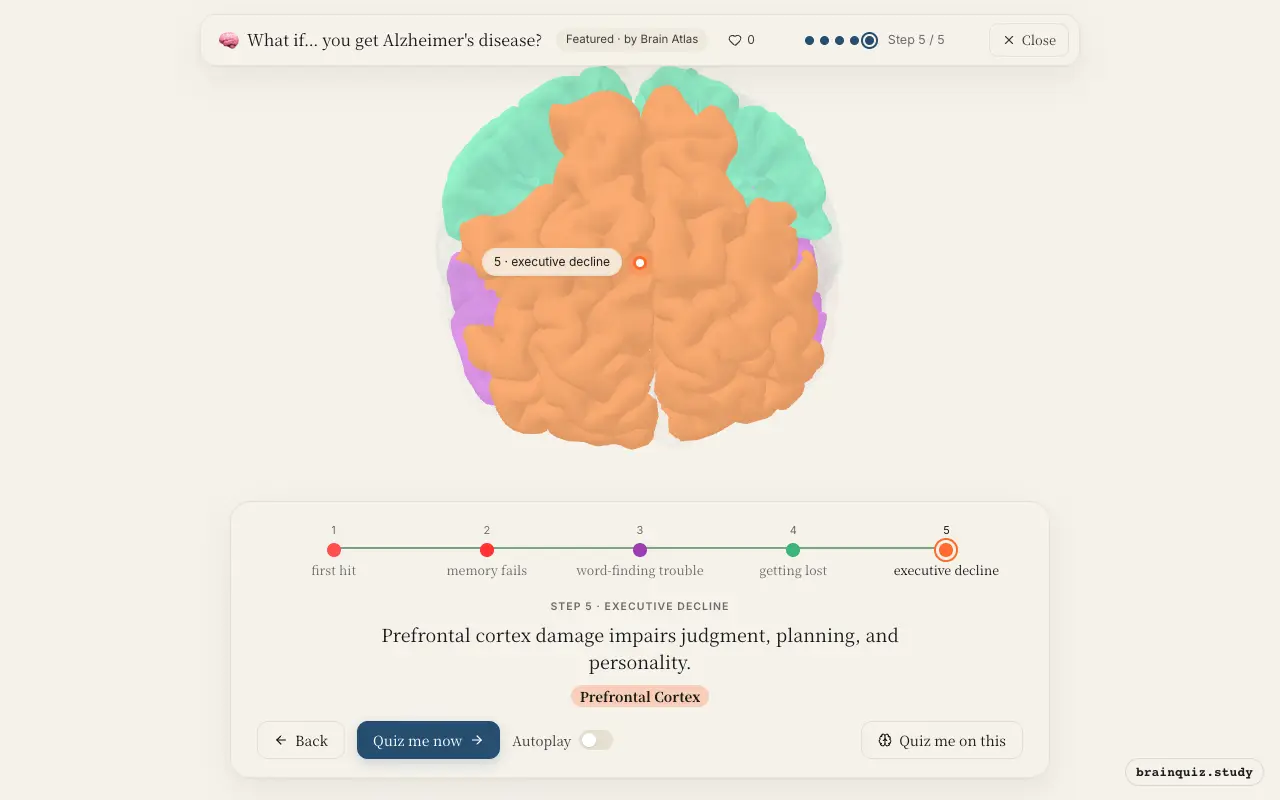
Watch it light up on the 3D brain
Brain regions that light up
| Order | Region | What it does here |
|---|---|---|
| 1 | Entorhinal Cortex | Tau tangles and neuronal loss begin in the entorhinal cortex, the gateway to the hippocampus. |
| 2 | Hippocampus | The hippocampus degenerates, impairing the formation of new memories. |
| 3 | Temporal Cortex | Spread to the temporal cortex disrupts semantic memory and language. |
| 4 | Parietal Cortex | Parietal involvement causes visuospatial deficits and apraxia. |
| 5 | Prefrontal Cortex | Prefrontal cortex damage impairs judgment, planning, and personality. |
1. Entorhinal Cortex: first hit
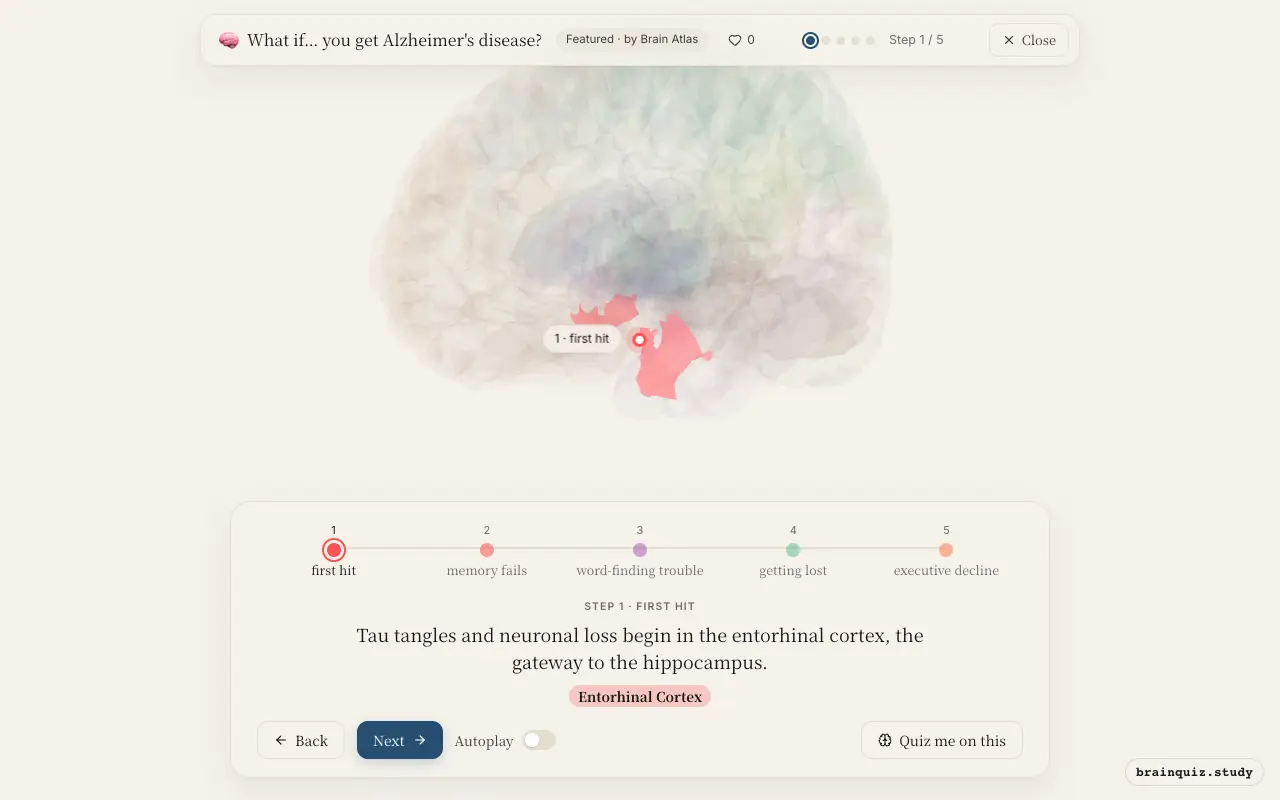
The entorhinal cortex provides the main input to the hippocampus and is critical for spatial navigation and memory consolidation. In Alzheimer's, it is one of the earliest sites of neurofibrillary tangle formation, disrupting the flow of information into the memory system and causing subtle spatial disorientation before obvious memory loss.
2. Hippocampus: memory fails
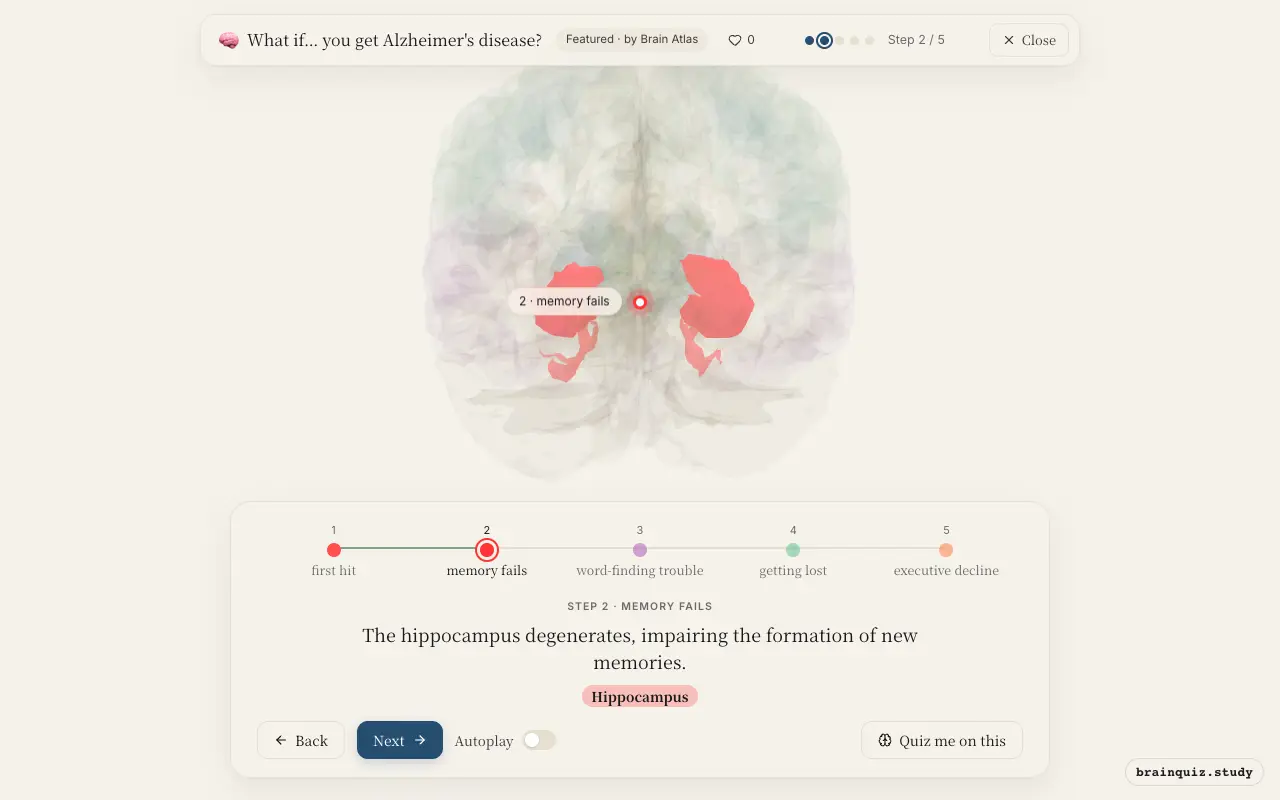
The hippocampus is essential for converting short-term memories into long-term storage. As neurons die and synapses are lost, patients struggle to remember recent events while older memories may remain relatively intact initially. This is the hallmark amnesia of early Alzheimer's.
3. Temporal Cortex: word-finding trouble
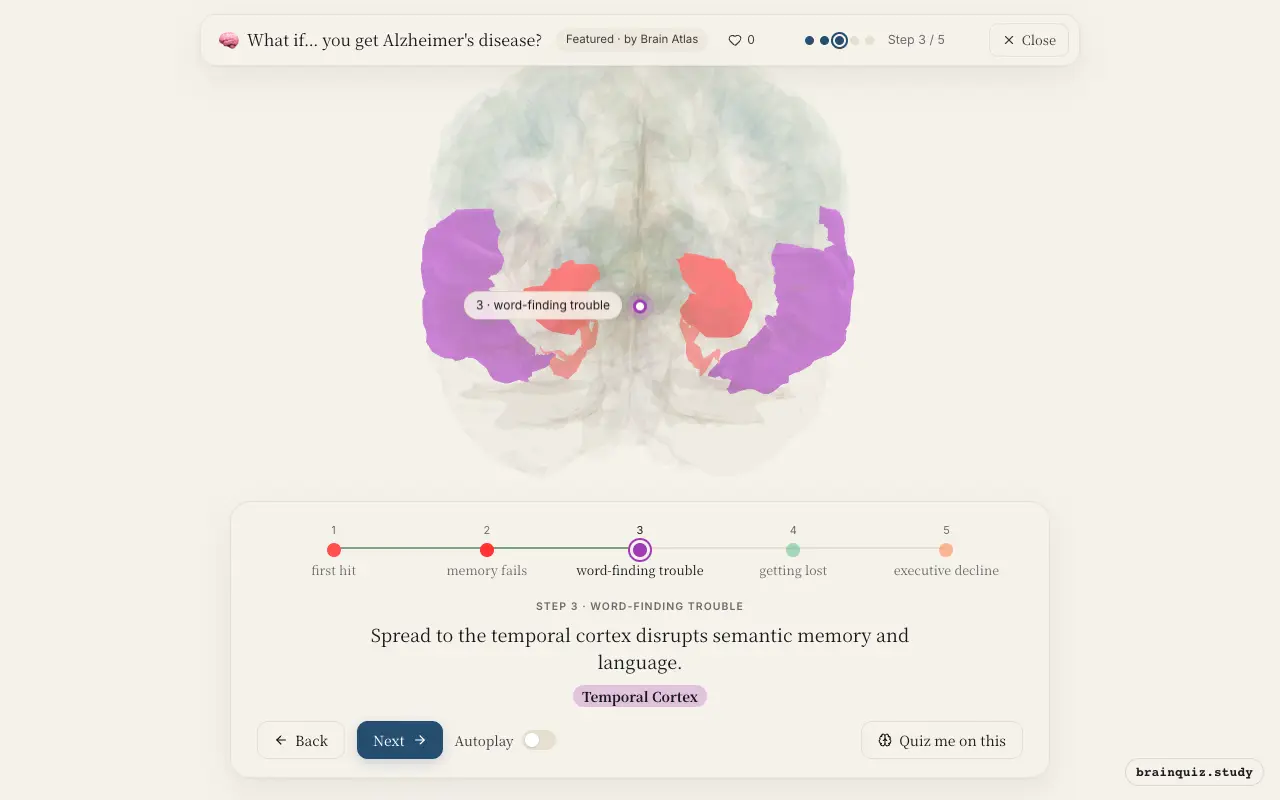
The temporal cortex houses semantic knowledge and object recognition. As pathology spreads here, patients develop anomia (difficulty naming objects) and impaired comprehension. This reflects the breakdown of the stored knowledge about words and concepts.
4. Parietal Cortex: getting lost
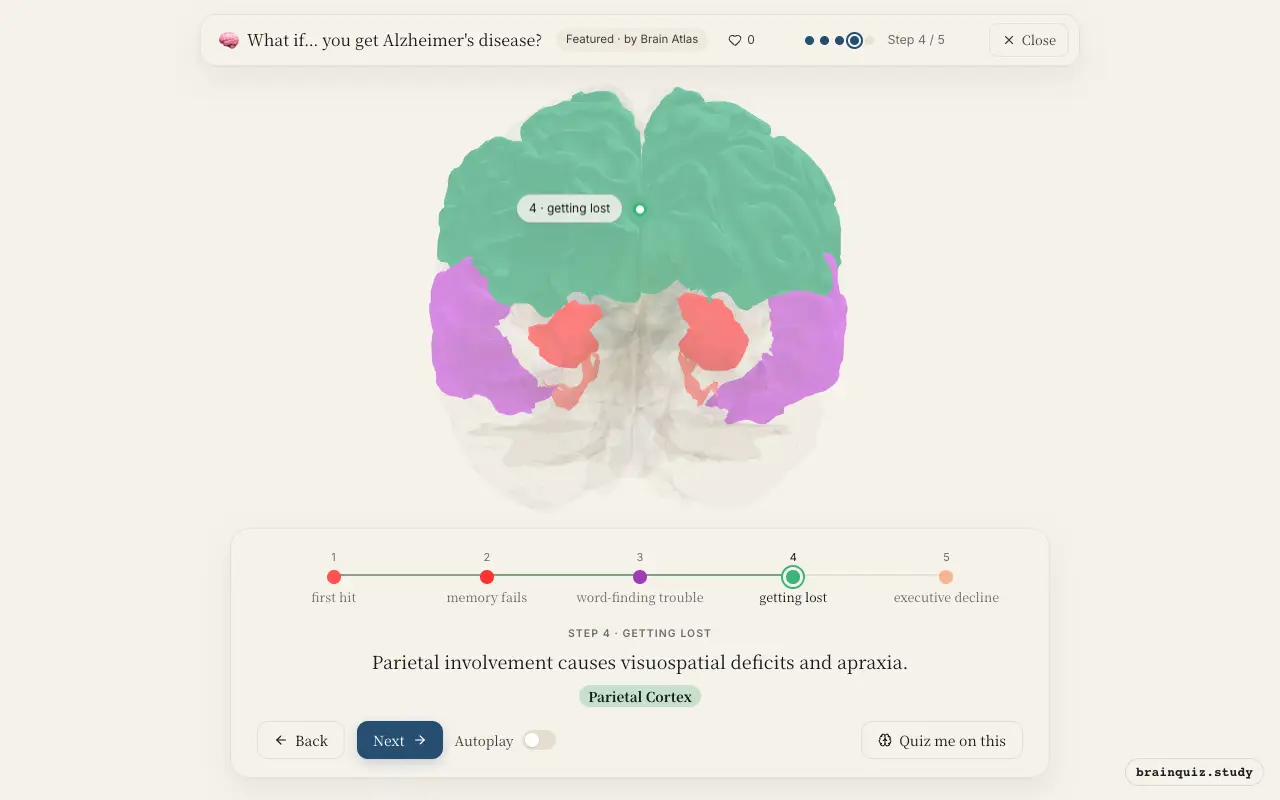
The parietal cortex integrates sensory information for spatial awareness and coordinated movement. Degeneration here leads to getting lost in familiar places, difficulty with tasks like dressing (apraxia), and problems with calculations, contributing to the disorientation seen in moderate Alzheimer's.
5. Prefrontal Cortex: executive decline
The prefrontal cortex manages executive functions such as decision-making, working memory, and social behavior. Late-stage Alzheimer's involvement causes poor judgment, apathy, and personality changes, reducing the ability to live independently.
Good to know
- Alzheimer's disease is defined by the accumulation of amyloid-beta plaques outside neurons and tau tangles inside neurons.
- The hippocampus shows marked atrophy on MRI, correl with memory impairment.
- Alzheimer's disease is the most common cause of dementia.
Alzheimer's vs. normal aging
In normal aging, occasional forgetfulness and slower recall are common, but the hippocampus and entorhinal cortex remain relatively intact. In Alzheimer's, progressive neurodegeneration in these regions causes severe memory loss and functional decline that interferes with daily life.
Test yourself
Which brain region is typically the first to show tau pathology in Alzheimer's disease?
Damage to the hippocampus in Alzheimer's primarily causes which symptom?
How does Alzheimer's differ from normal age-related memory decline?
0 of 3 answered · 0 correct
Simplified: many regions work together at once, and this shows the main players in the order they act. For learning only, not medical advice.