What happens in your brain when you make a decision?
Updated
The prefrontal cortex evaluates options using working memory and goals. The orbitofrontal cortex assigns value, the anterior cingulate detects conflicts, the caudate integrates reward learning, and the motor cortex executes the chosen action.
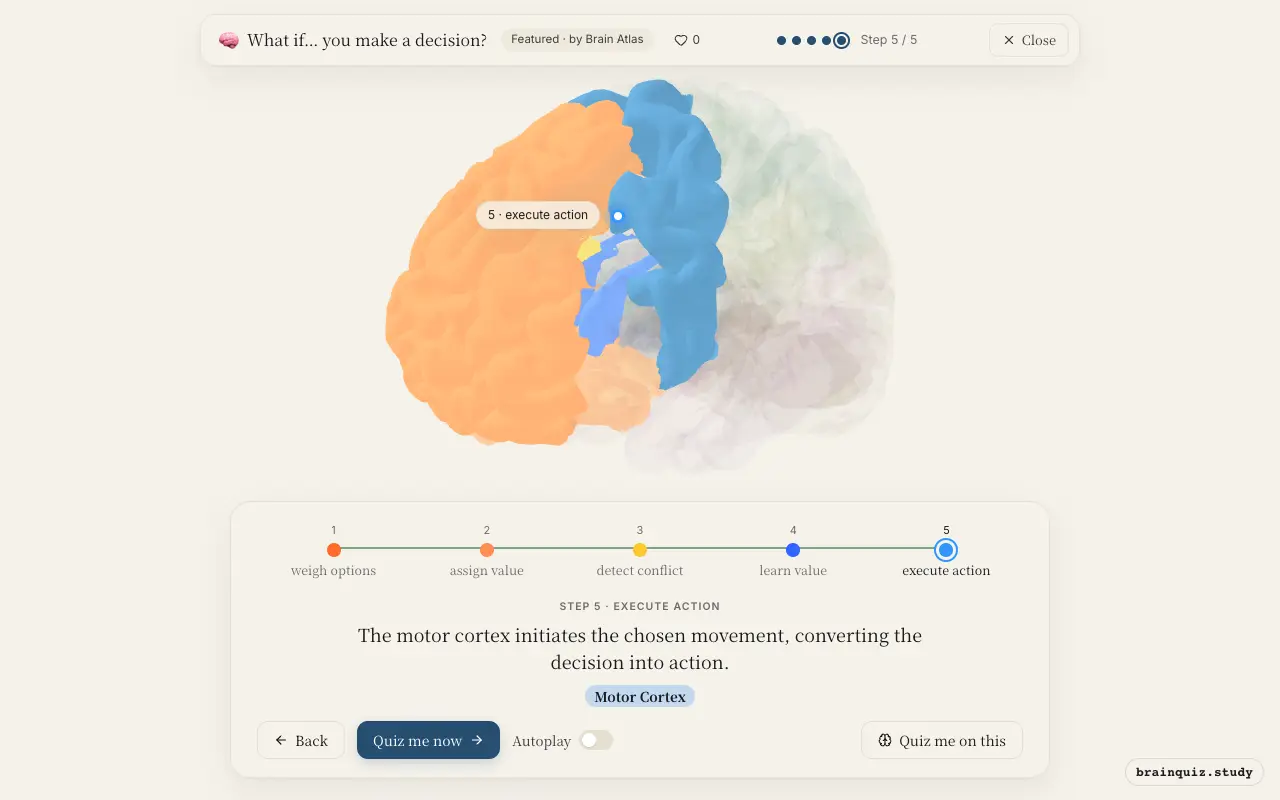
Watch it light up on the 3D brain
Brain regions that light up
| Order | Region | What it does here |
|---|---|---|
| 1 | Prefrontal Cortex | The prefrontal cortex holds possible choices in working memory and compares them against goals. |
| 2 | Orbitofrontal Cortex | The orbitofrontal cortex tags each option with an expected reward value. |
| 3 | Anterior Cingulate Cortex | The anterior cingulate monitors for conflicting options or errors to guide adjustments. |
| 4 | Caudate Nucleus | The caudate nucleus links choices to outcomes, reinforcing successful strategies. |
| 5 | Motor Cortex | The motor cortex initiates the chosen movement, converting the decision into action. |
1. Prefrontal Cortex: weigh options
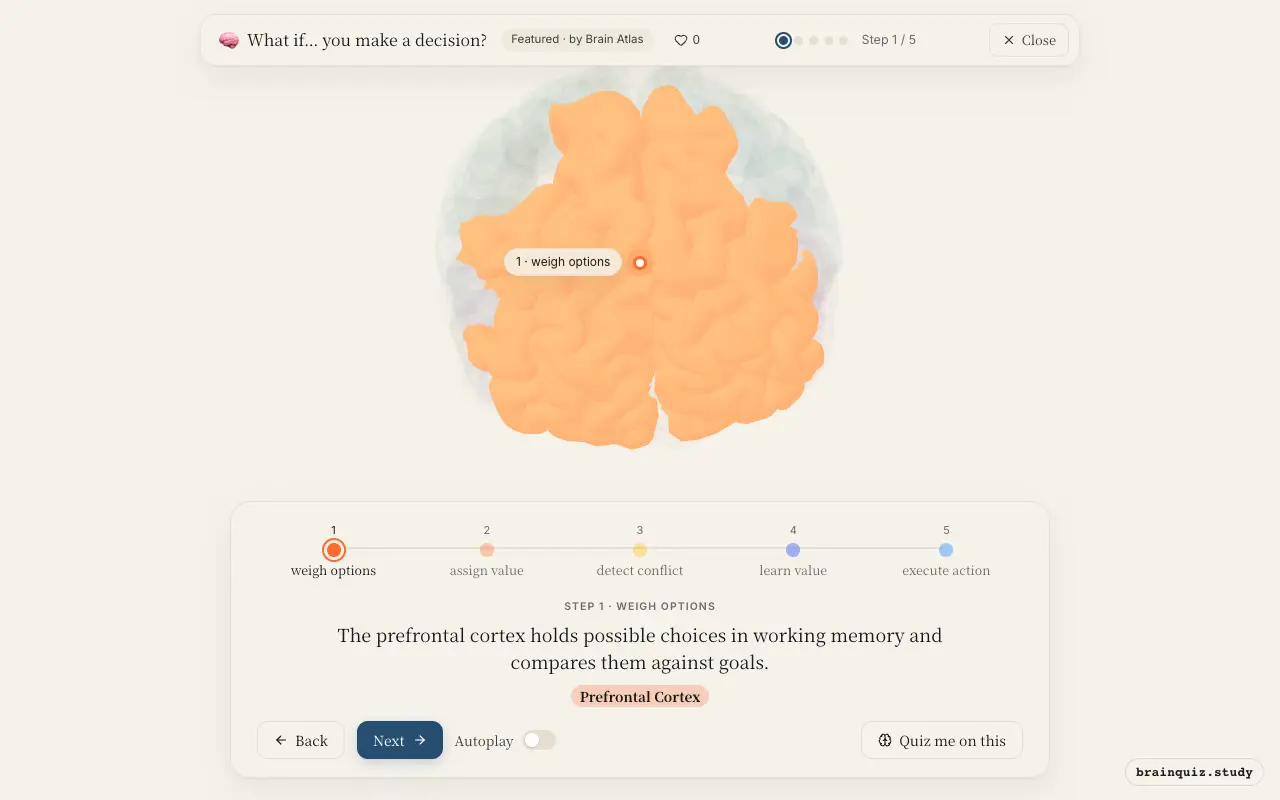
It maintains task-relevant information and suppresses irrelevant impulses, allowing deliberation. Executive functions such as planning and cost-benefit analysis originate here. Damage often leads to impulsive or disorganized choices, underscoring its central role.
2. Orbitofrontal Cortex: assign value
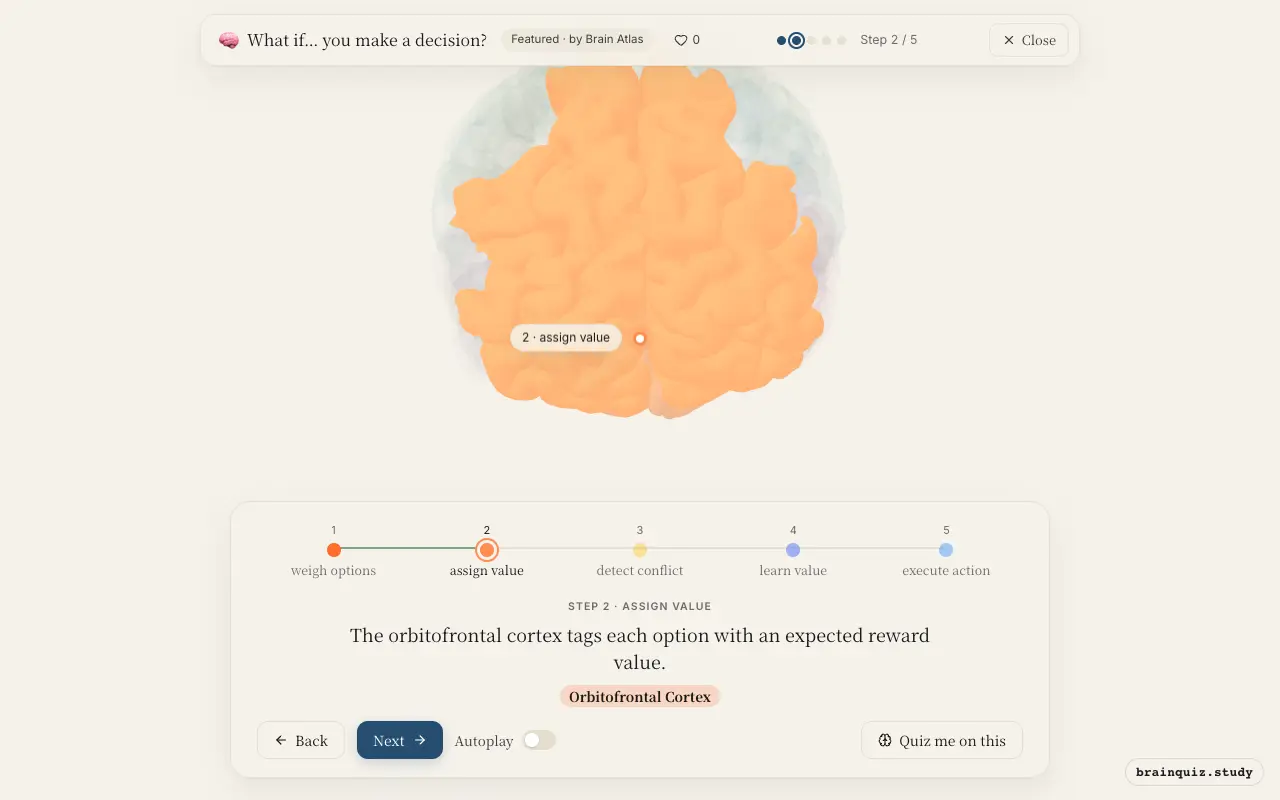
It integrates sensory and emotional cues to compute subjective worth, updating valuations based on recent outcomes. This region is critical for flexible, value-based decisions; lesions impair the ability to adapt choices when contingencies change.
3. Anterior Cingulate Cortex: detect conflict
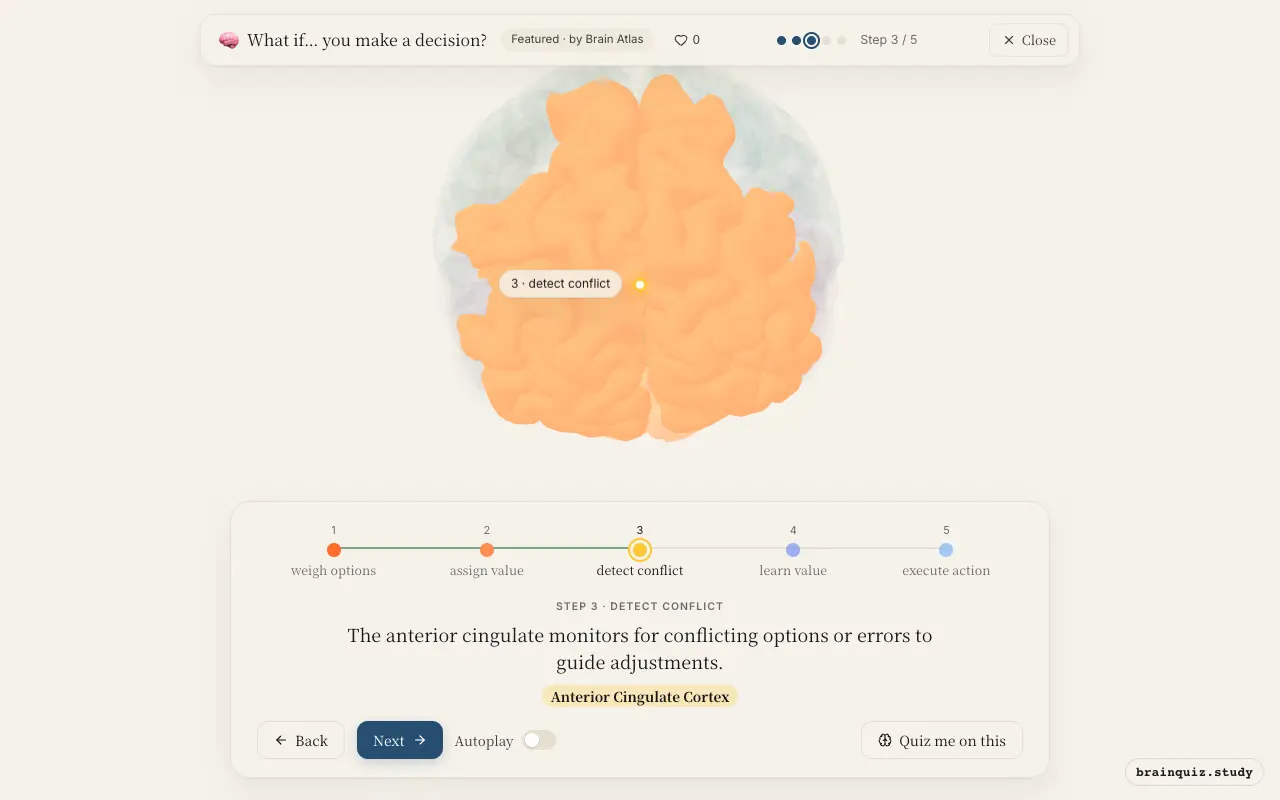
It signals when outcomes diverge from expectations, prompting the prefrontal cortex to re-evaluate. This conflict-monitoring function supports adaptive decision-making, especially in uncertain or high-stakes situations.
4. Caudate Nucleus: learn value
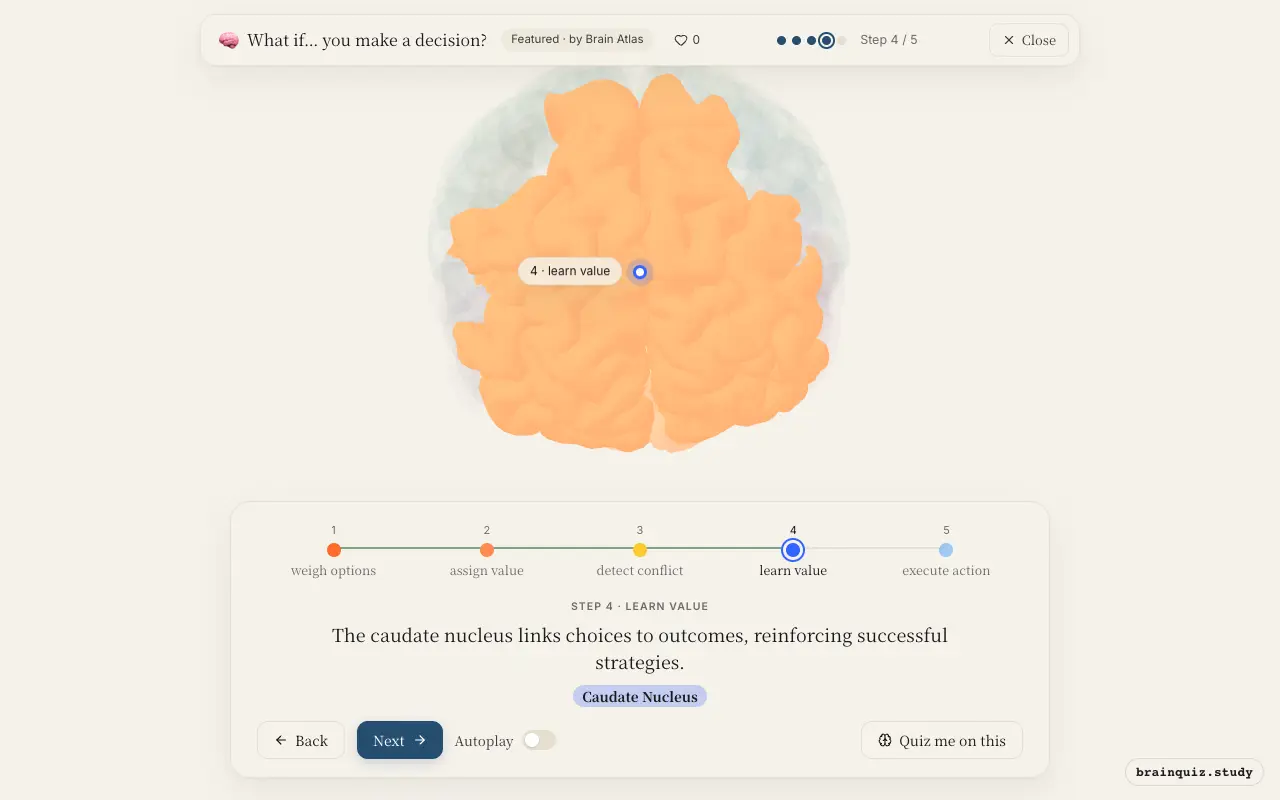
As part of the basal ganglia, it receives dopamine signals that encode reward prediction errors, shaping future behavior. Goal-directed decisions rely on this structure to update action-outcome associations and bias selection toward beneficial options.
5. Motor Cortex: execute action
Once the prefrontal cortex settles on a plan, motor and premotor areas translate that intention into specific muscle commands. This final step depends on adequate inhibition of competing actions by basal ganglia output.
Good to know
- Decision speed and accuracy improve with practice, as repeated choices strengthen corticostriatal pathways.
- Uncertainty increases anterior cingulate activity, reflecting effort to resolve conflict between options.
- The neurotransmitter dopamine in the caudate signals when outcomes are better or worse than expected.
Deliberate vs. Habitual Decisions
Deliberate decisions rely heavily on prefrontal and orbitofrontal cortices for flexible evaluation. Habitual decisions shift control to the putamen and sensorimotor circuits, with less prefrontal engagement. Chronic stress or dopamine dysfunction can bias toward habits, reducing cognitive flexibility.
Test yourself
Which region holds options in working memory during decision-making?
The orbitofrontal cortex is most important for:
What role does the anterior cingulate play in decisions?
0 of 3 answered · 0 correct
Simplified: many regions work together at once, and this shows the main players in the order they act.