What happens in your brain when you forget where you parked?
Updated
Distracted parking: the prefrontal cortex fails to direct attention, so the hippocampus and parahippocampal gyrus weakly encode the spot. Later, the posterior cingulate cortex cannot retrieve the faint memory.
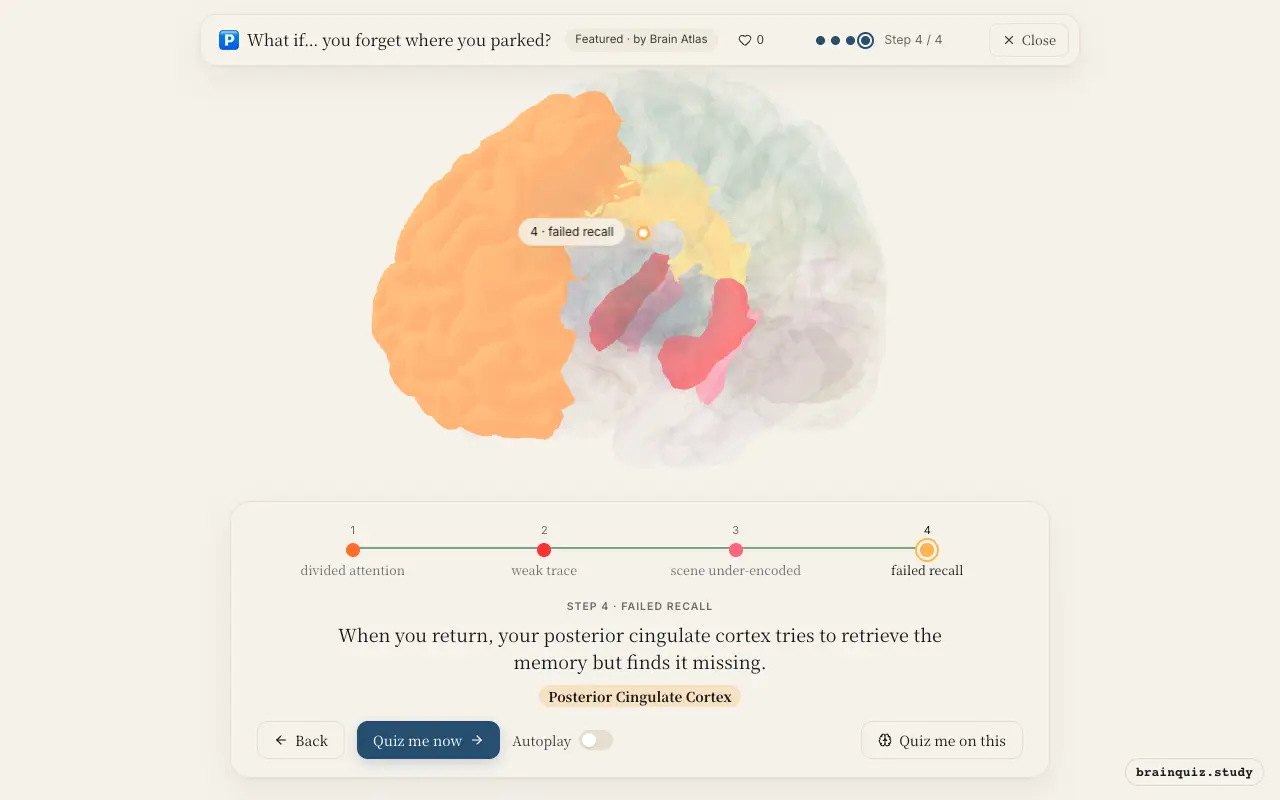
Watch it light up on the 3D brain
Brain regions that light up
| Order | Region | What it does here |
|---|---|---|
| 1 | Prefrontal Cortex | As you park, your prefrontal cortex is busy with other thoughts instead of noting the location. |
| 2 | Hippocampus | Without top-down attention, the hippocampus only weakly encodes the spatial context of the parking spot. |
| 3 | Parahippocampal Gyrus | The parahippocampal gyrus processes the visual scene but stores a shallow representation of the parking area. |
| 4 | Posterior Cingulate Cortex | When you return, your posterior cingulate cortex tries to retrieve the memory but finds it missing. |
1. Prefrontal Cortex: divided attention
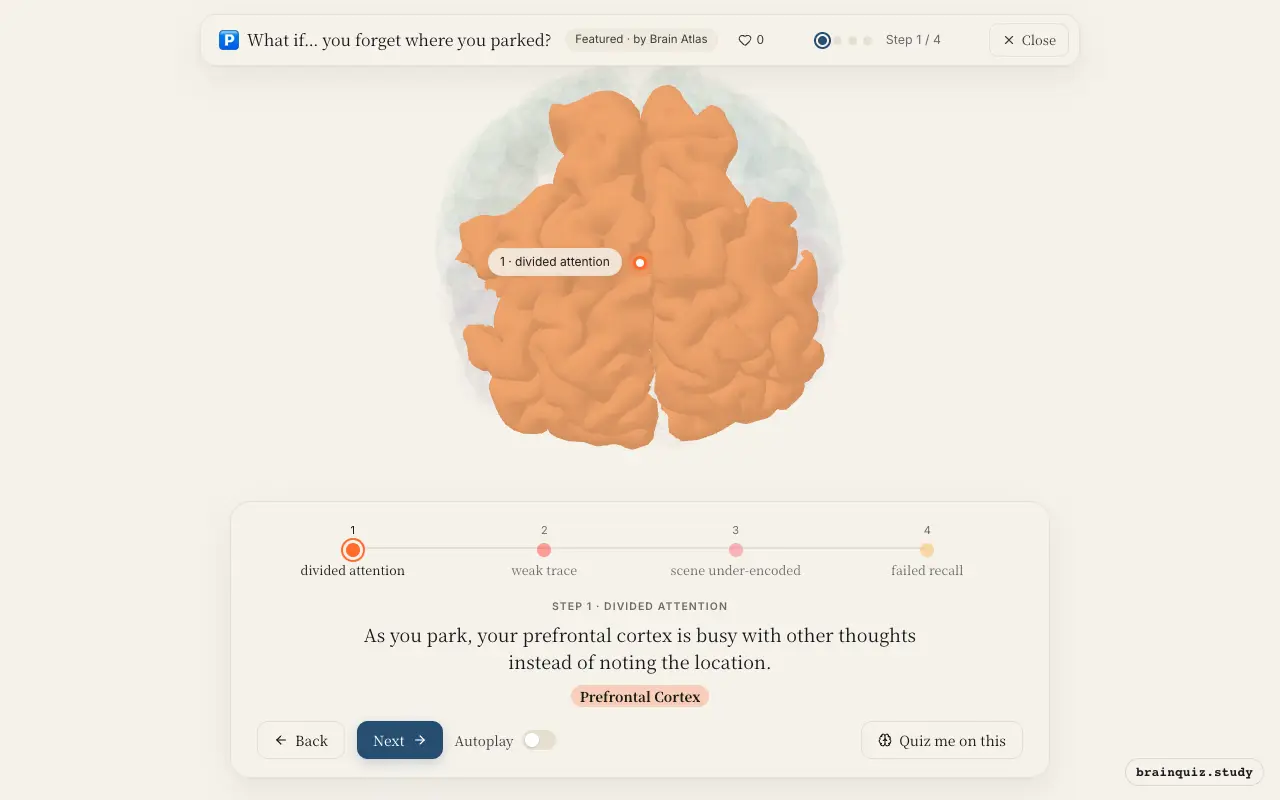
The prefrontal cortex normally directs attention to spatial details and holds them in working memory. When preoccupied, it fails to tag the parking spot as important, so the brain doesn't allocate resources to encode it.
2. Hippocampus: weak trace
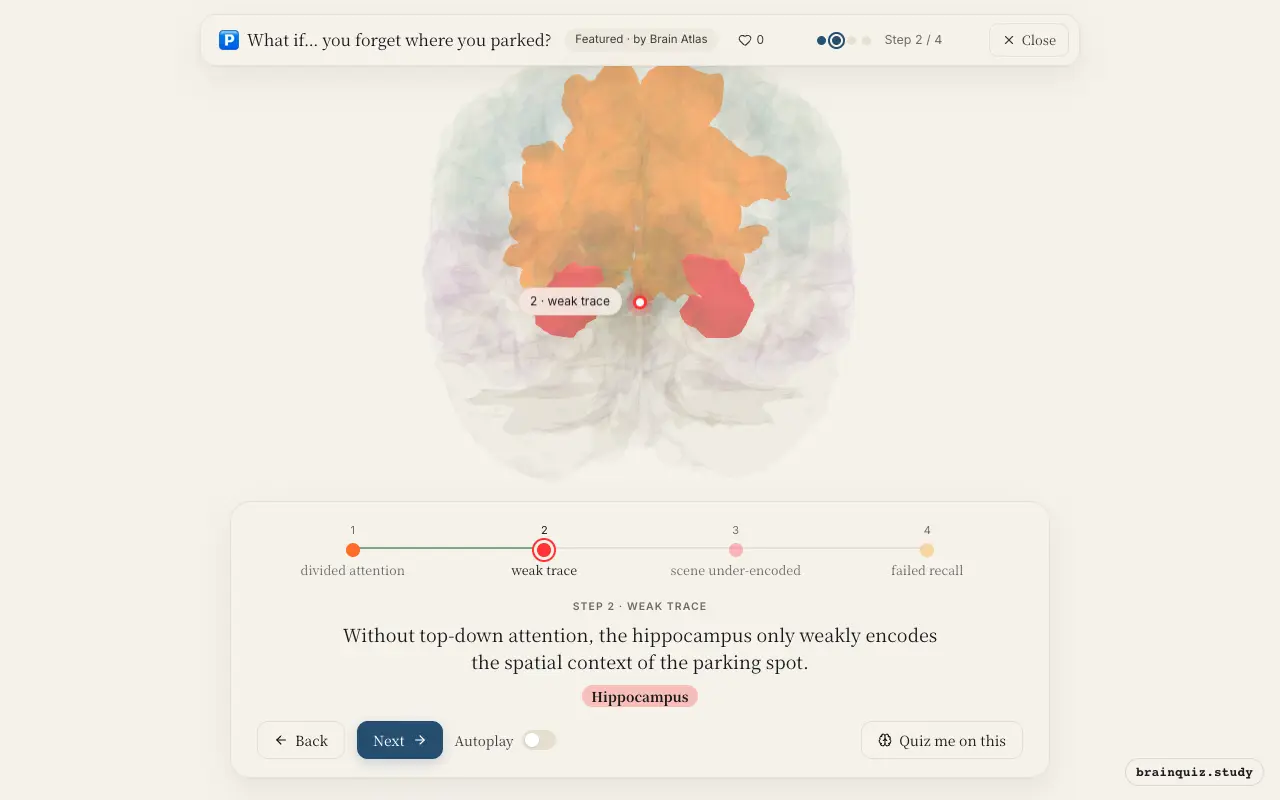
The hippocampus binds together the location, landmarks, and route into an episodic memory. With diminished input, it forms a fragile trace that is easily overwritten or not consolidated. This is why you may not recall the spot later.
3. Parahippocampal Gyrus: scene under-encoded
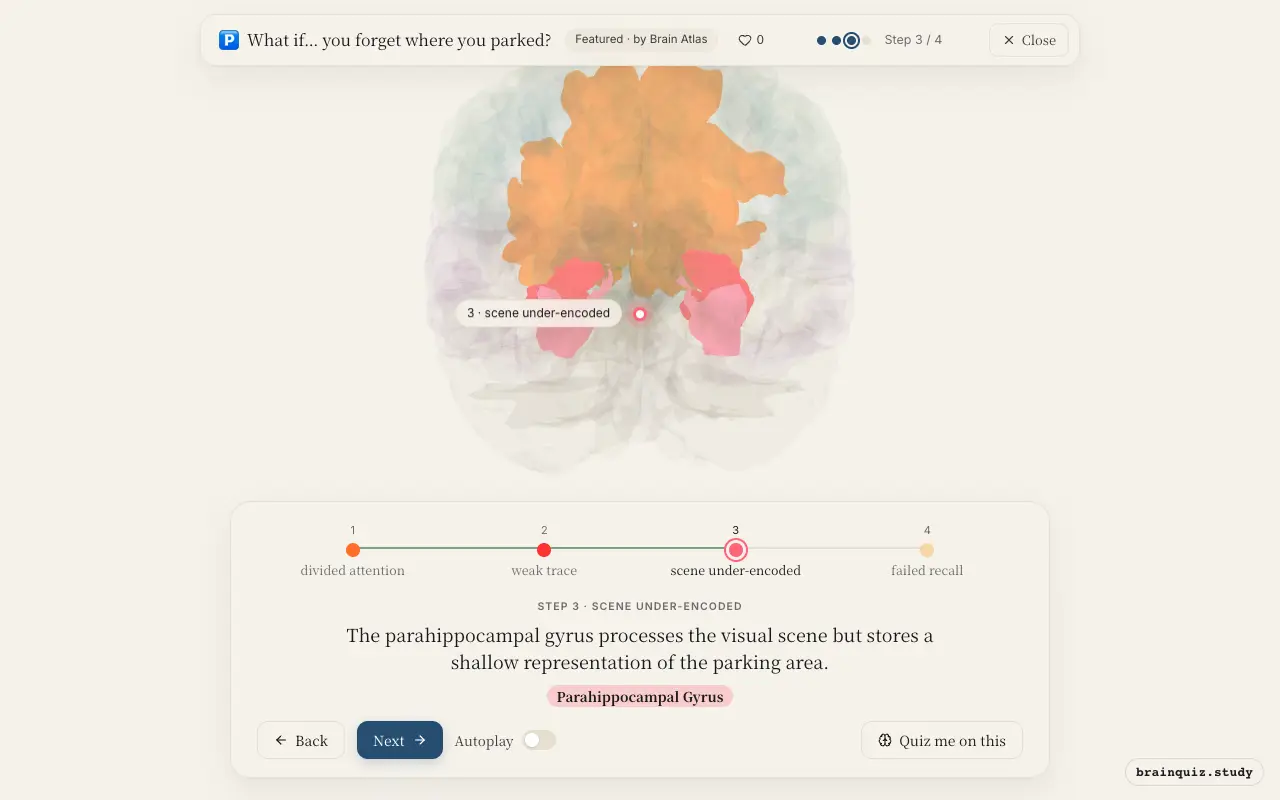
This region is critical for recognizing places and scenes. Because you weren't paying attention, it encodes only a generic 'parking garage' instead of the specific aisle or level. Later, this makes it hard to distinguish your location from similar ones.
4. Posterior Cingulate Cortex: failed recall
The posterior cingulate is part of the default mode network and involved in autobiographical memory retrieval. It searches for the spatial context, but because the trace is weak, it cannot reconstruct the parking spot, leaving you confused.
Good to know
- The hippocampus contains place cells that fire when you are in a specific location, forming a cognitive map.
- The parahippocampal place area responds strongly to images of scenes and landmarks, aiding spatial recognition.
- Divided attention during encoding is a common reason for everyday forgetting, as it impairs memory consolidation.
Forgetting your spot vs. forgetting a face
When you forget a face, the fusiform gyrus under-encodes facial features. Forgetting a parking spot instead involves weak hippocampal and parahippocampal encoding of spatial context. Both stem from encoding failure, but engage different brain regions.
Test yourself
Which brain region is most directly responsible for forming a spatial map of your parking spot?
Why did you forget where you parked?
When you try to remember your parking spot, which region is active but fails to retrieve it?
0 of 3 answered · 0 correct
Simplified: many regions work together at once, and this shows the main players in the order they act.