What happens in your brain when you get déjà vu?
Updated
During déjà vu, the parahippocampal gyrus triggers a sense of familiarity for the current scene, but the hippocampus fails to retrieve a matching memory. The prefrontal cortex is thought to detect this mismatch and generate the eerie feeling of having experienced it before.
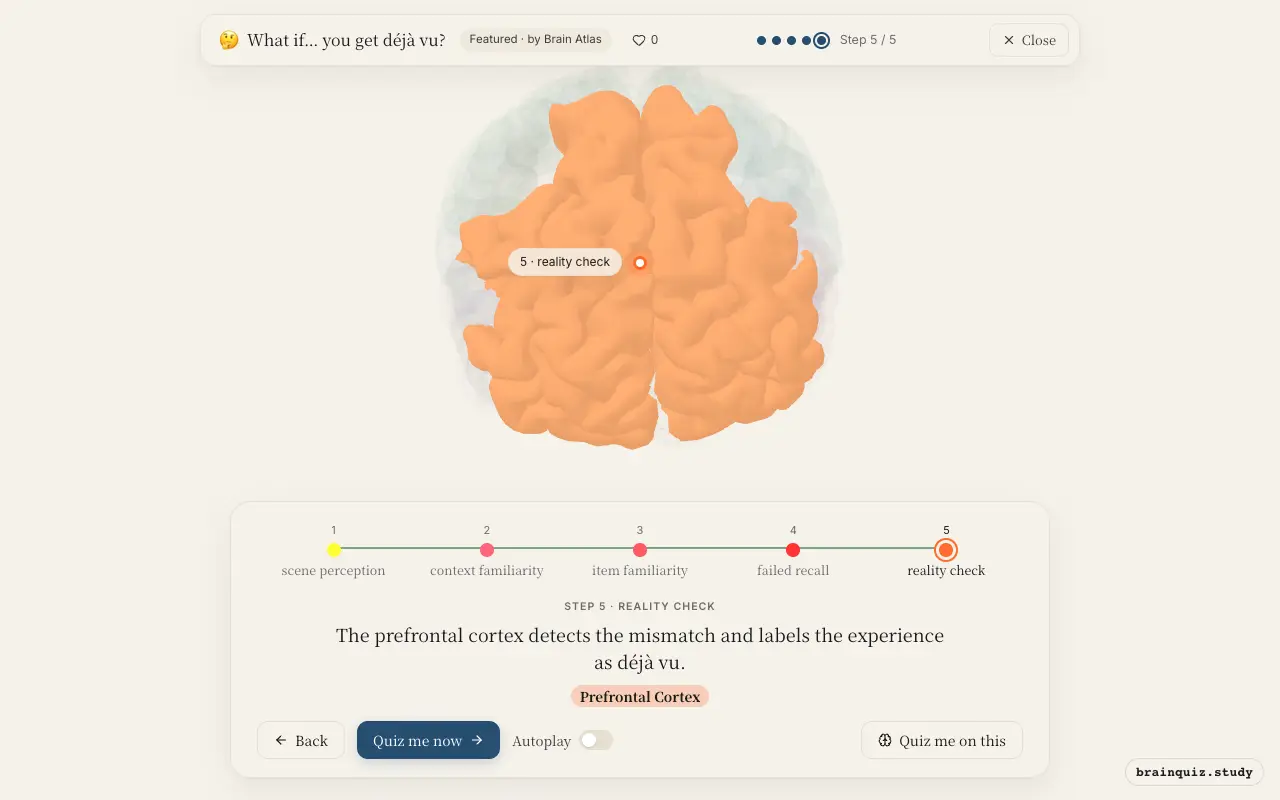
Watch it light up on the 3D brain
Brain regions that light up
| Order | Region | What it does here |
|---|---|---|
| 1 | Visual Cortex | The visual cortex processes the current scene, extracting basic features like edges and motion. |
| 2 | Parahippocampal Gyrus | The parahippocampal gyrus evaluates the spatial layout and triggers a sense of familiarity. |
| 3 | Perirhinal Cortex | The perirhinal cortex signals that individual objects in the scene feel familiar, even without recall. |
| 4 | Hippocampus | The hippocampus tries to retrieve the specific episode but finds no matching memory. |
| 5 | Prefrontal Cortex | The prefrontal cortex detects the mismatch and labels the experience as déjà vu. |
1. Visual Cortex: scene perception
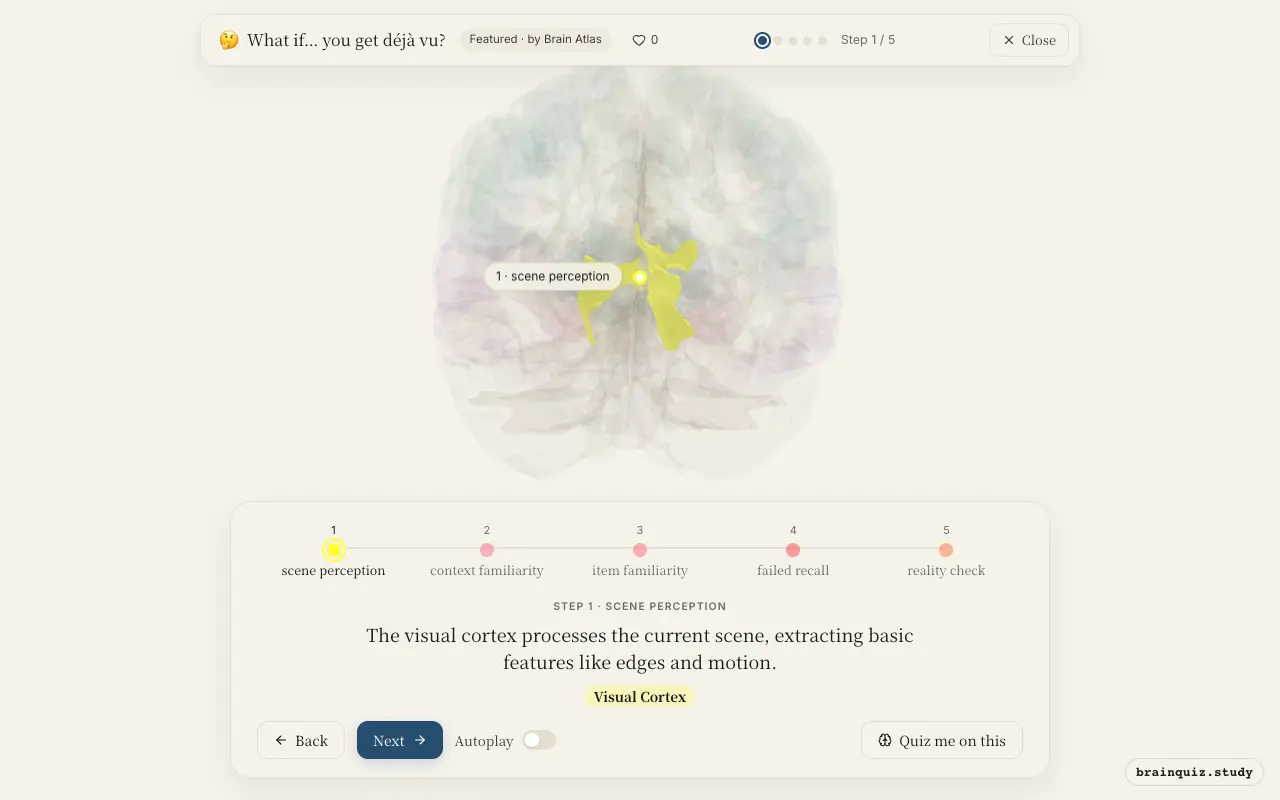
The visual cortex (V1) receives input from the eyes and begins analyzing the visual world. It sends information to higher visual areas for object recognition and scene parsing. This initial processing is rapid and automatic, setting the stage for memory comparison.
2. Parahippocampal Gyrus: context familiarity
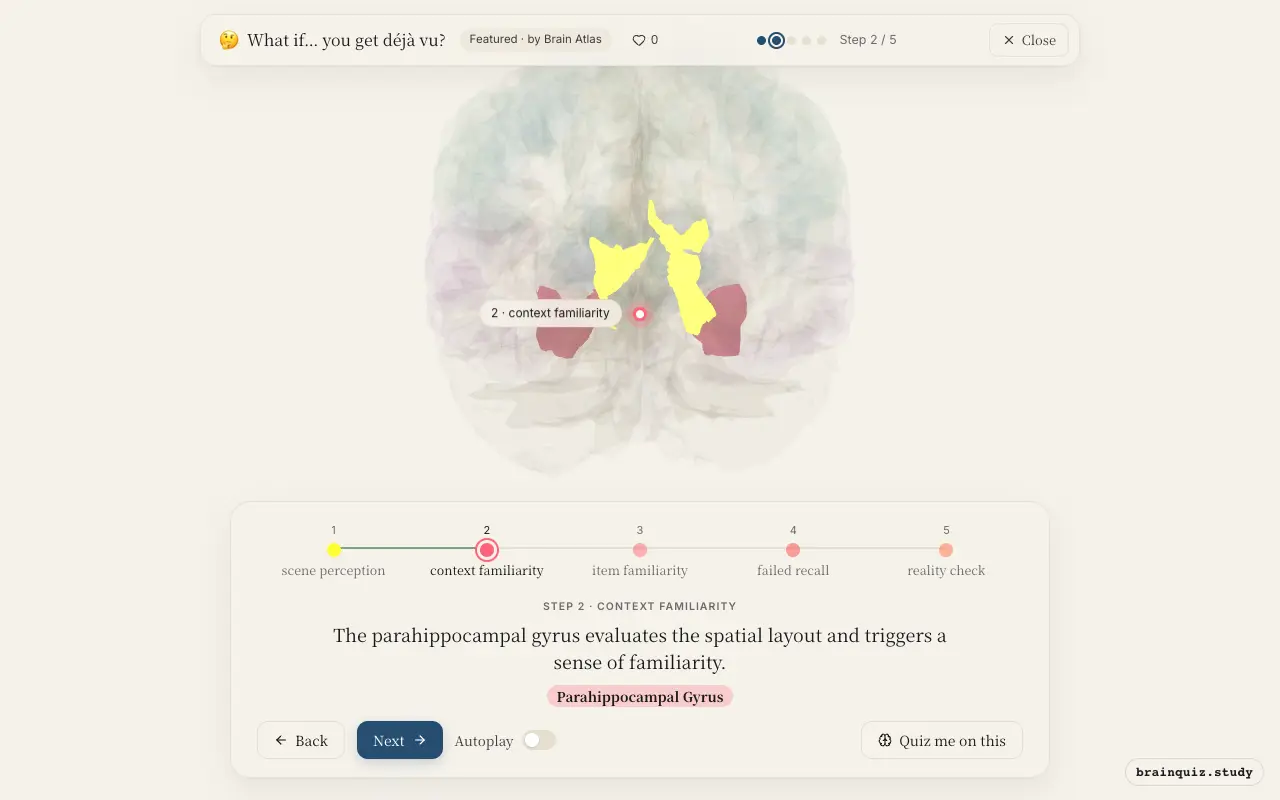
The parahippocampal gyrus is crucial for processing scenes and spatial context, comparing the current visual scene with stored representations of places. If the scene resembles a previously encountered environment, it sends a familiarity signal to the hippocampus and perirhinal cortex. This signal can sometimes be false, leading to déjà vu.
3. Perirhinal Cortex: item familiarity
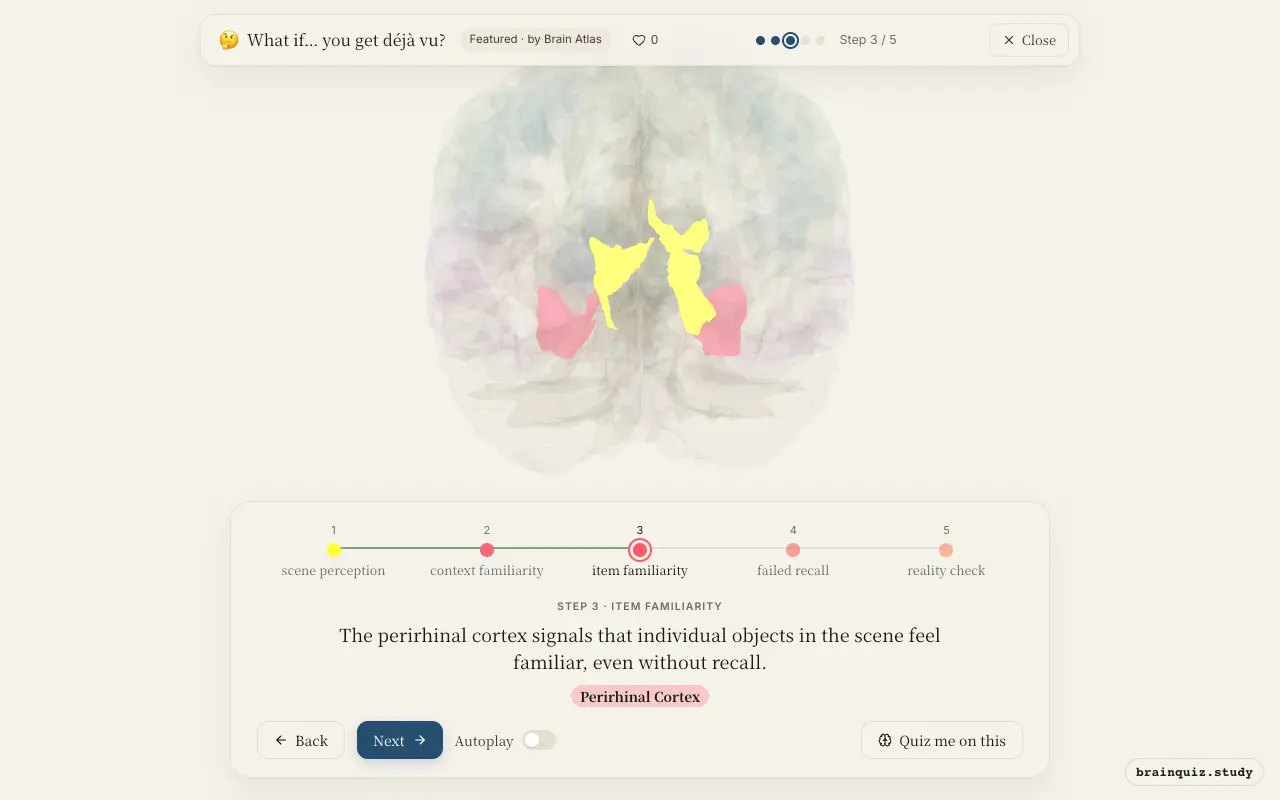
The perirhinal cortex is involved in item recognition and familiarity-based memory. It receives input from visual areas and signals whether an object is familiar, independent of contextual details. In déjà vu, it may send a strong familiarity signal for objects that are actually new, perhaps due to a slight delay in processing or overlapping neural representations.
4. Hippocampus: failed recall
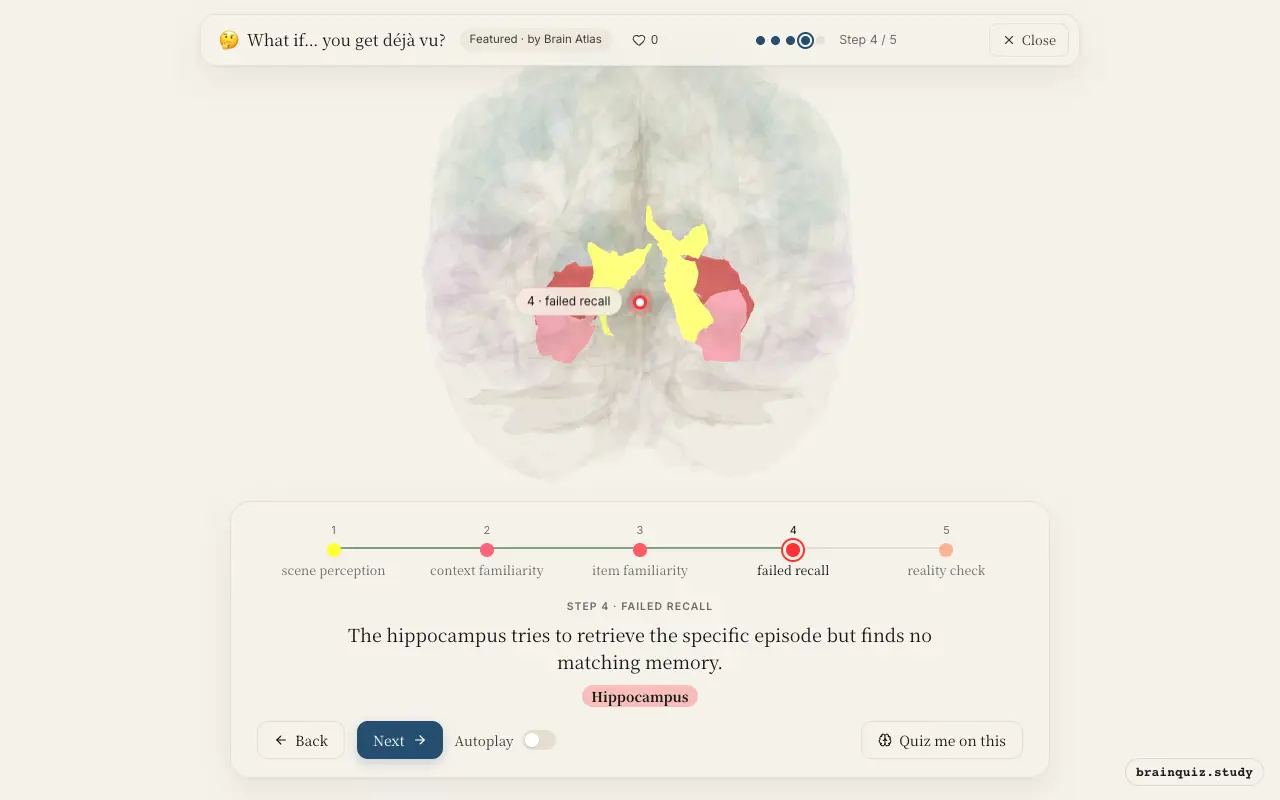
The hippocampus is essential for episodic memory and pattern separation. When the parahippocampal and perirhinal signals suggest familiarity, the hippocampus attempts to recall the specific context and time. If it fails to retrieve a coherent memory, this mismatch between familiarity and recollection contributes to the déjà vu experience.
5. Prefrontal Cortex: reality check
The prefrontal cortex monitors the consistency of cognitive processes and reality. It receives input from memory systems and evaluates whether the sense of familiarity is justified by actual recall. When it detects that familiarity is high but recollection is absent, it is thought to generate the conscious feeling that something is wrong, which we interpret as déjà vu.
Good to know
- Déjà vu occurs more frequently in younger adults and decreases with age.
- It is often triggered by fatigue or stress, suggesting a role for neuromodulators like dopamine or acetylcholine, though the exact mechanism is unclear.
- Some patients with temporal lobe epilepsy experience déjà vu as a warning sign before a seizure, implicating the medial temporal lobe.
Déjà vu vs Jamais vu
In déjà vu, familiar signals arise without a matching memory; in jamais vu, a familiar situation feels novel. Some brain imaging studies suggest that déjà vu involves overactivity in familiarity regions like the perirhinal cortex, while jamais vu may involve underactivity in the same areas or disrupted recognition processes.
Test yourself
Which brain region is primarily responsible for signaling familiarity with the current scene during déjà vu?
In déjà vu, the hippocampus is thought to:
Déjà vu is sometimes associated with which neurological condition?
0 of 3 answered · 0 correct
Simplified: many regions work together at once, and this shows the main players in the order they act.