What happens in your brain when you take ADHD medication?
Updated
Stimulant ADHD meds increase catecholamines: norepinephrine from the locus coeruleus and dopamine from the ventral tegmental area. This enhances prefrontal cortex executive function, caudate goal-directed focus, and anterior cingulate attention.
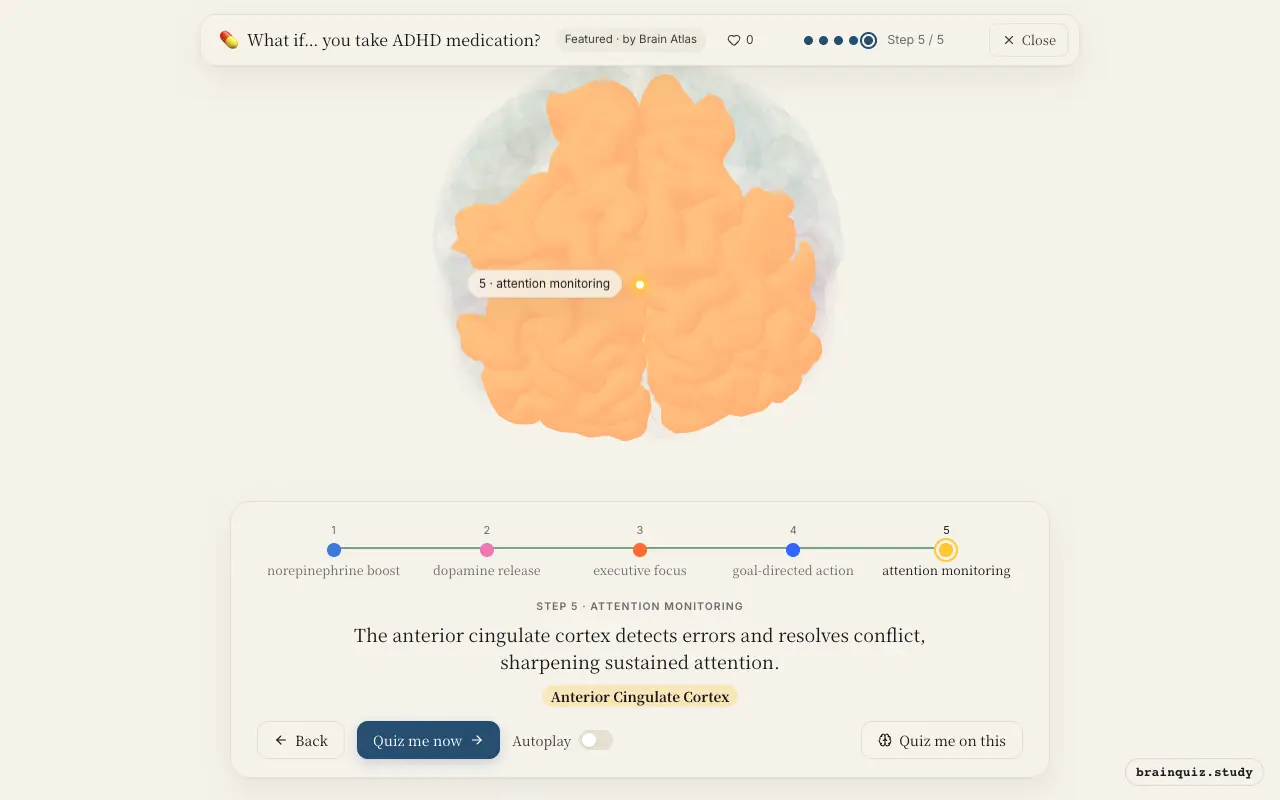
Watch it light up on the 3D brain
Brain regions that light up
| Order | Region | What it does here |
|---|---|---|
| 1 | Locus Coeruleus | The locus coeruleus releases norepinephrine, increasing arousal and alertness. |
| 2 | Ventral Tegmental Area | The ventral tegmental area sends dopamine to the prefrontal cortex and striatum. |
| 3 | Prefrontal Cortex | The prefrontal cortex uses the increased catecholamines to improve working memory and inhibition. |
| 4 | Caudate Nucleus | The caudate nucleus integrates dopamine signals to support goal-directed behavior and attention shifting. |
| 5 | Anterior Cingulate Cortex | The anterior cingulate cortex detects errors and resolves conflict, sharpening sustained attention. |
1. Locus Coeruleus: norepinephrine boost
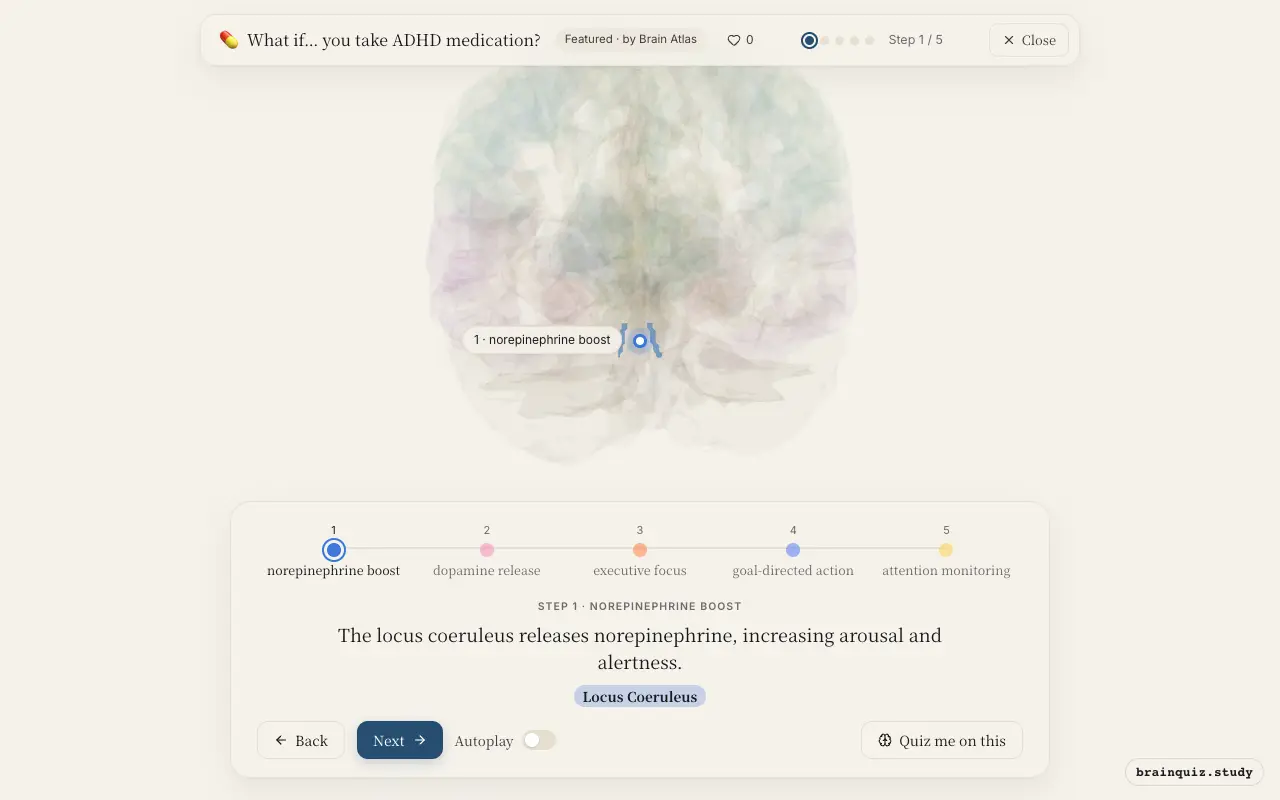
Stimulants block norepinephrine reuptake, raising synaptic levels. This enhances signal-to-noise in cortical circuits, promoting wakefulness and focused attention. The locus coeruleus projects widely to the prefrontal cortex, priming it for task engagement.
2. Ventral Tegmental Area: dopamine release
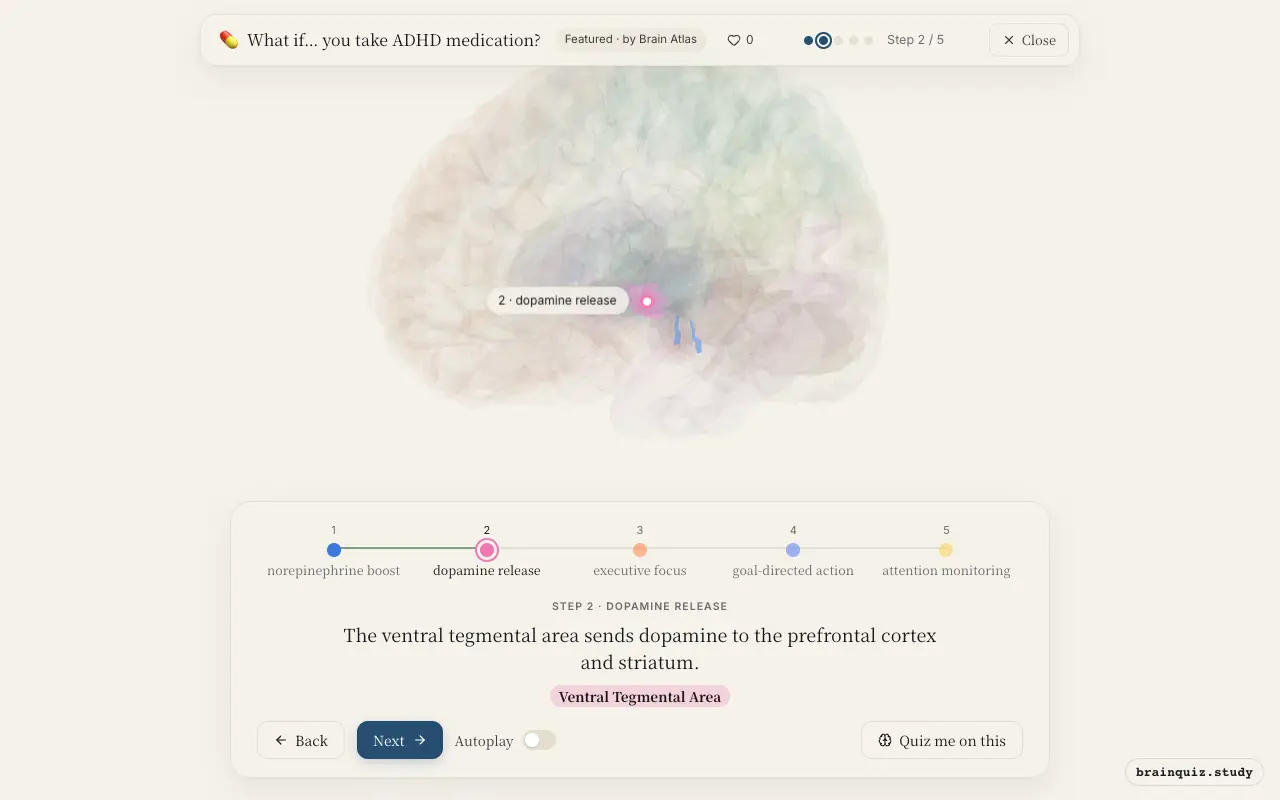
ADHD stimulants increase dopamine by blocking its transporter, so more remains in the synapse. This mesocortical and mesolimbic pathway boosts motivation and salience, making tasks feel rewarding. Enhanced dopamine signaling is thought to correct underactive reward circuits in ADHD.
3. Prefrontal Cortex: executive focus
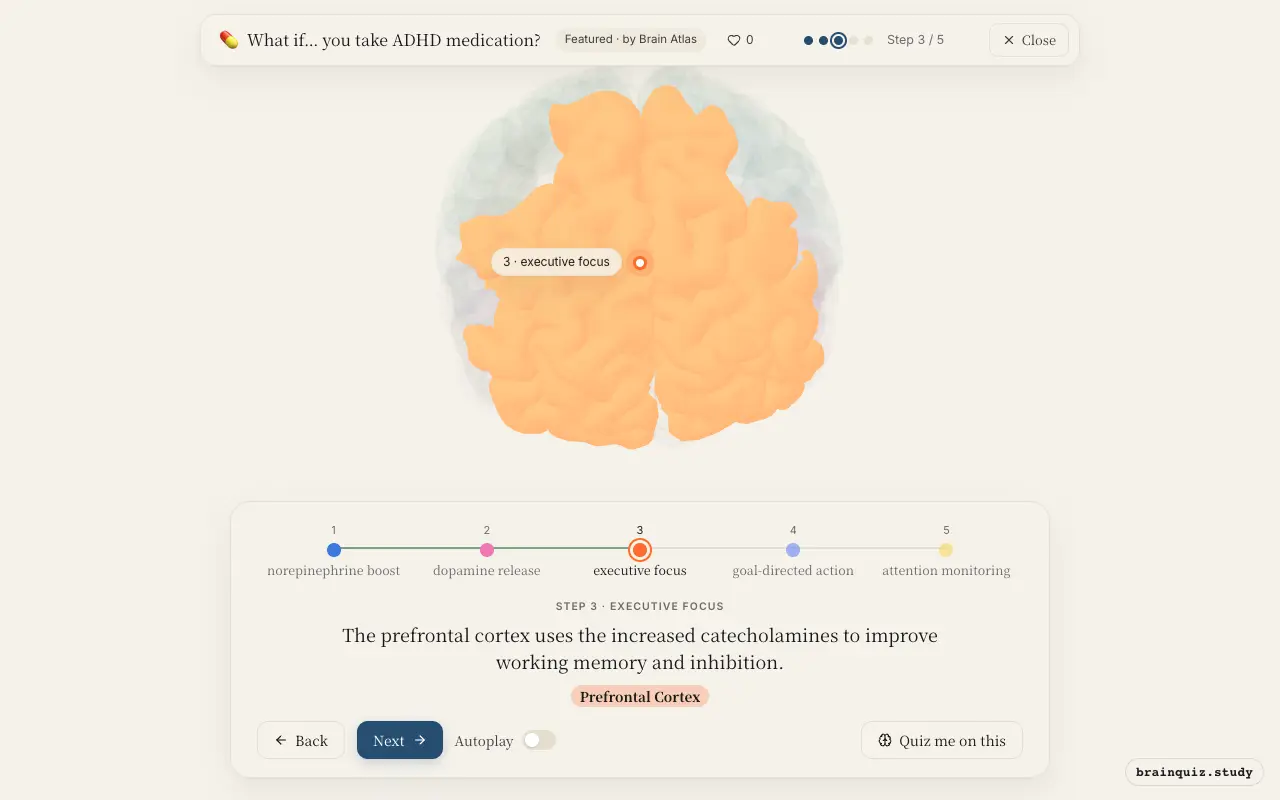
With more dopamine and norepinephrine, prefrontal neurons fire more consistently during tasks. This strengthens executive functions like planning, organizing, and suppressing distractions. Optimal levels are crucial: too little or too much catecholamine signaling can impair performance, so dosing matters.
4. Caudate Nucleus: goal-directed action
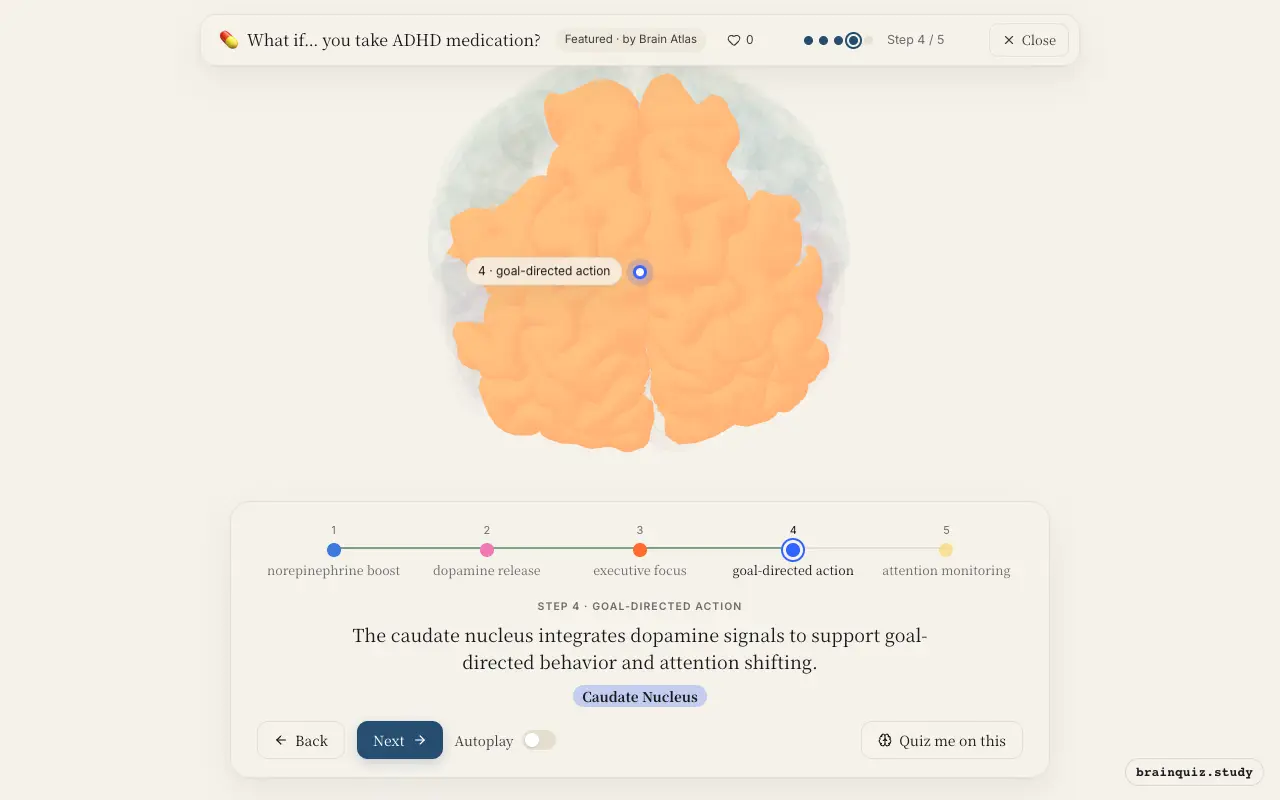
Dopamine in the caudate, part of the dorsal striatum, enhances the selection of appropriate actions and the suppression of impulsive responses. This improves cognitive flexibility and the ability to stay on task. Studies suggest ADHD involves dysfunction in this frontostriatal circuit.
5. Anterior Cingulate Cortex: attention monitoring
Enhanced catecholamines in the anterior cingulate improve its role in monitoring performance and signaling when adjustments are needed. This helps individuals with ADHD catch mistakes and redirect focus. It is thought that stimulants normalize underactivity in this region during attention tasks.
Good to know
- ADHD stimulants are thought to work primarily by blocking dopamine and norepinephrine transporters, increasing neurotransmitter levels in the synapse.
- Non-stimulant ADHD medications like atomoxetine selectively target norepinephrine reuptake.
- The therapeutic effect of stimulants is paradoxical: they reduce hyperactivity by enhancing inhibitory control.
Stimulants vs. caffeine: focus without the jitters
Both boost catecholamines, but ADHD stimulants act mainly on dopamine and norepinephrine transporters in prefrontal-striatal circuits. Caffeine blocks adenosine receptors, which indirectly increases arousal but less specifically targets attention networks.
Test yourself
Which brain region is a primary source of dopamine for the prefrontal cortex?
What is the main neurochemical effect of ADHD stimulants?
Which region is critical for error detection and conflict resolution during attention tasks?
0 of 3 answered · 0 correct
Simplified: many regions work together at once, and this shows the main players in the order they act. For learning only, not medical advice.