What happens in your brain when you form a new habit?
Updated
Forming a habit shifts control from prefrontal cortex and caudate to putamen as dopamine from substantia nigra reinforces the behavior.
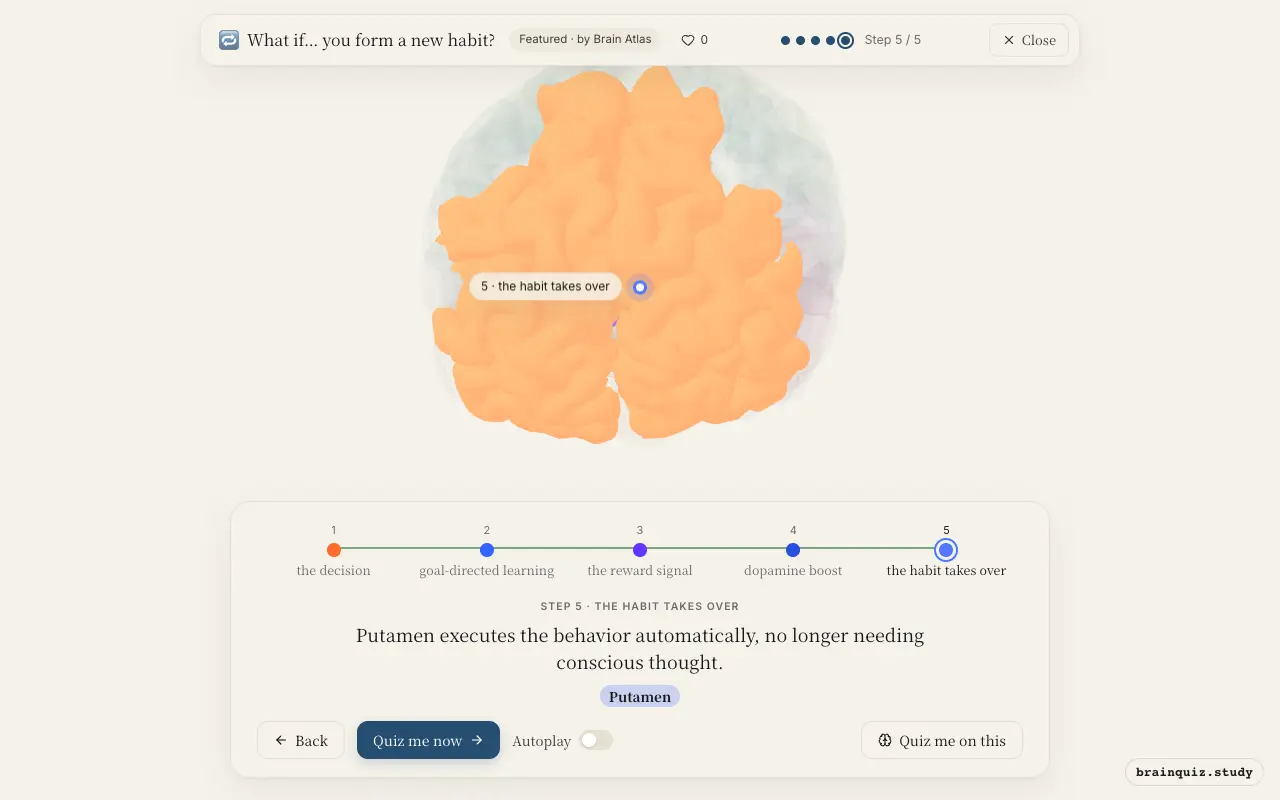
Watch it light up on the 3D brain
Brain regions that light up
| Order | Region | What it does here |
|---|---|---|
| 1 | Prefrontal Cortex | Prefrontal cortex evaluates context and initiates the new behavior. |
| 2 | Caudate Nucleus | Caudate nucleus links each action to its outcome, reinforcing deliberate repetition. |
| 3 | Nucleus Accumbens | Nucleus accumbens processes the rewarding feeling, motivating continued practice. |
| 4 | Substantia Nigra | Substantia nigra releases dopamine to strengthen the habit circuit. |
| 5 | Putamen | Putamen executes the behavior automatically, no longer needing conscious thought. |
1. Prefrontal Cortex: the decision
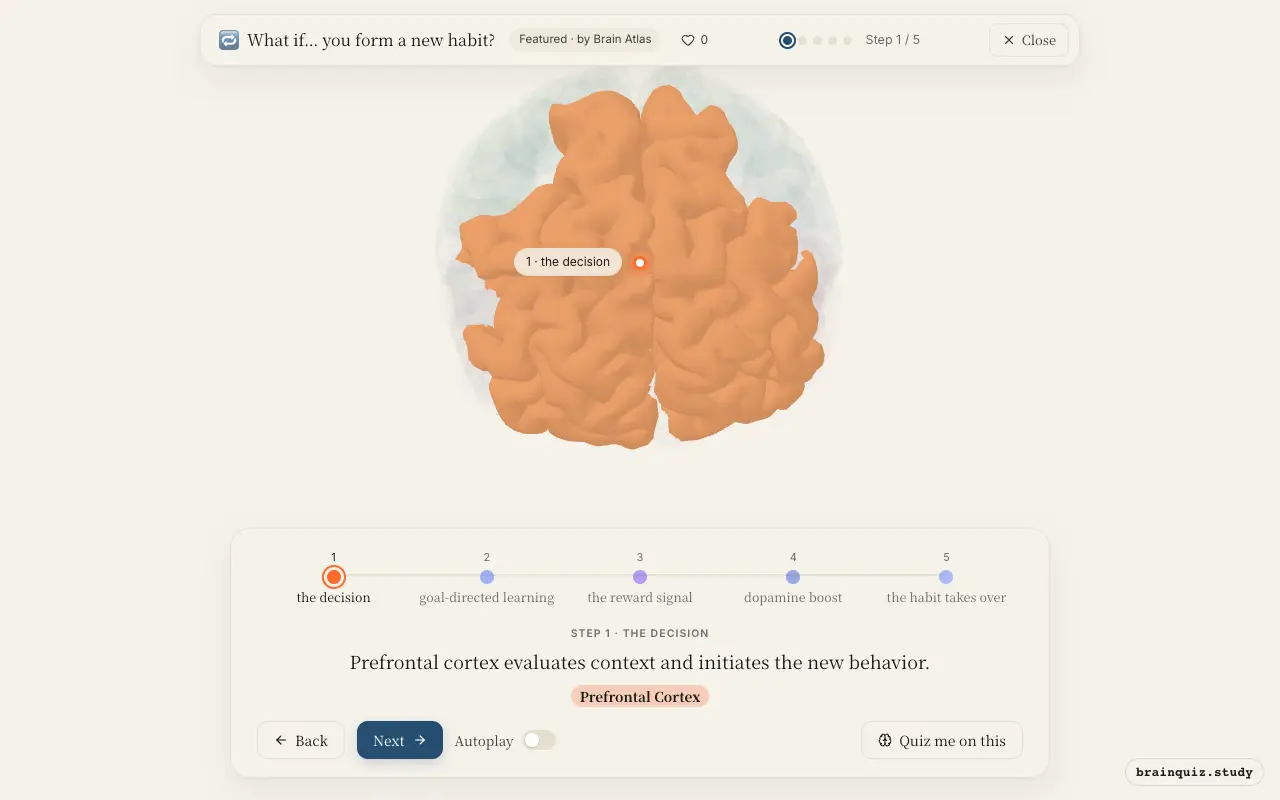
The prefrontal cortex, especially dorsolateral regions, holds the goal in working memory and plans the sequence of actions. It exerts top-down control, overriding automatic responses. Early in habit formation, this region is highly active as you consciously think through each step.
2. Caudate Nucleus: goal-directed learning
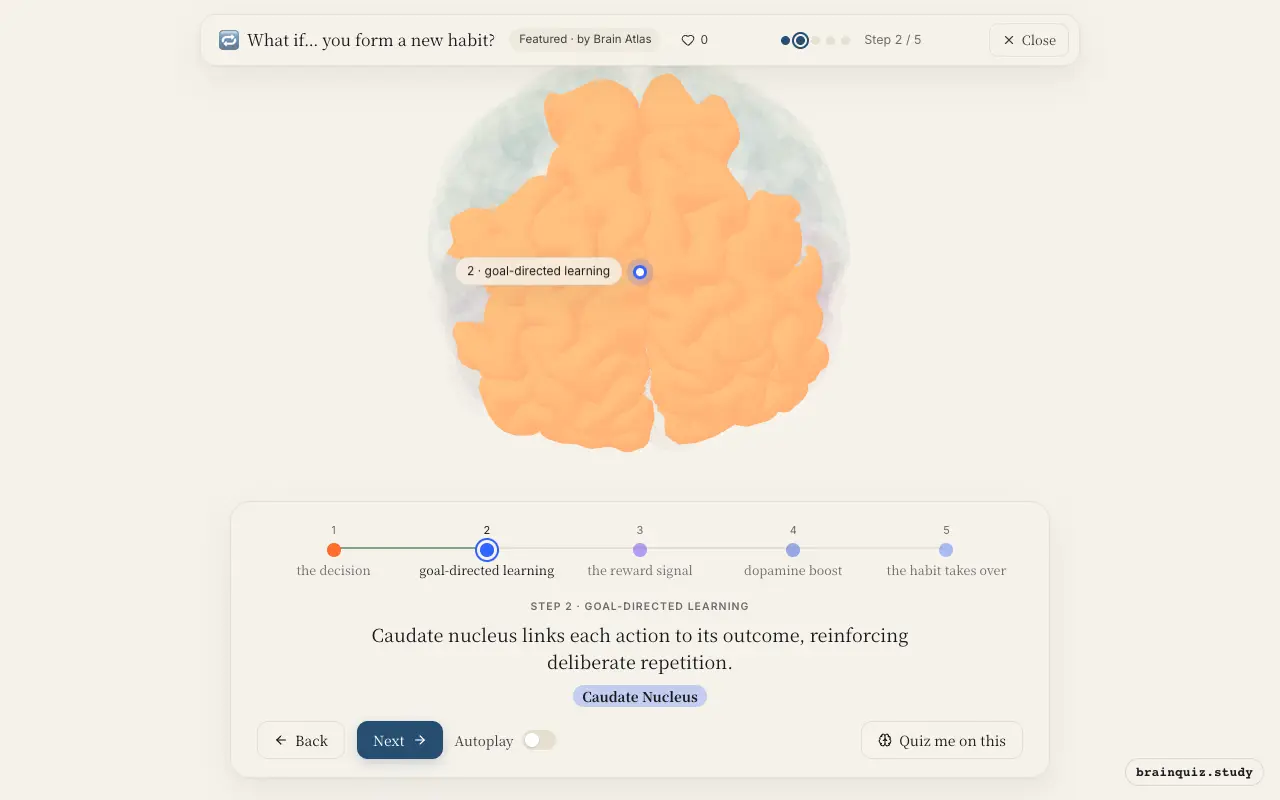
The caudate, part of the dorsal striatum, encodes action-outcome associations. It tracks whether the behavior leads to the desired reward. During initial learning, caudate activity guides you to repeat actions that work, using feedback to adjust.
3. Nucleus Accumbens: the reward signal
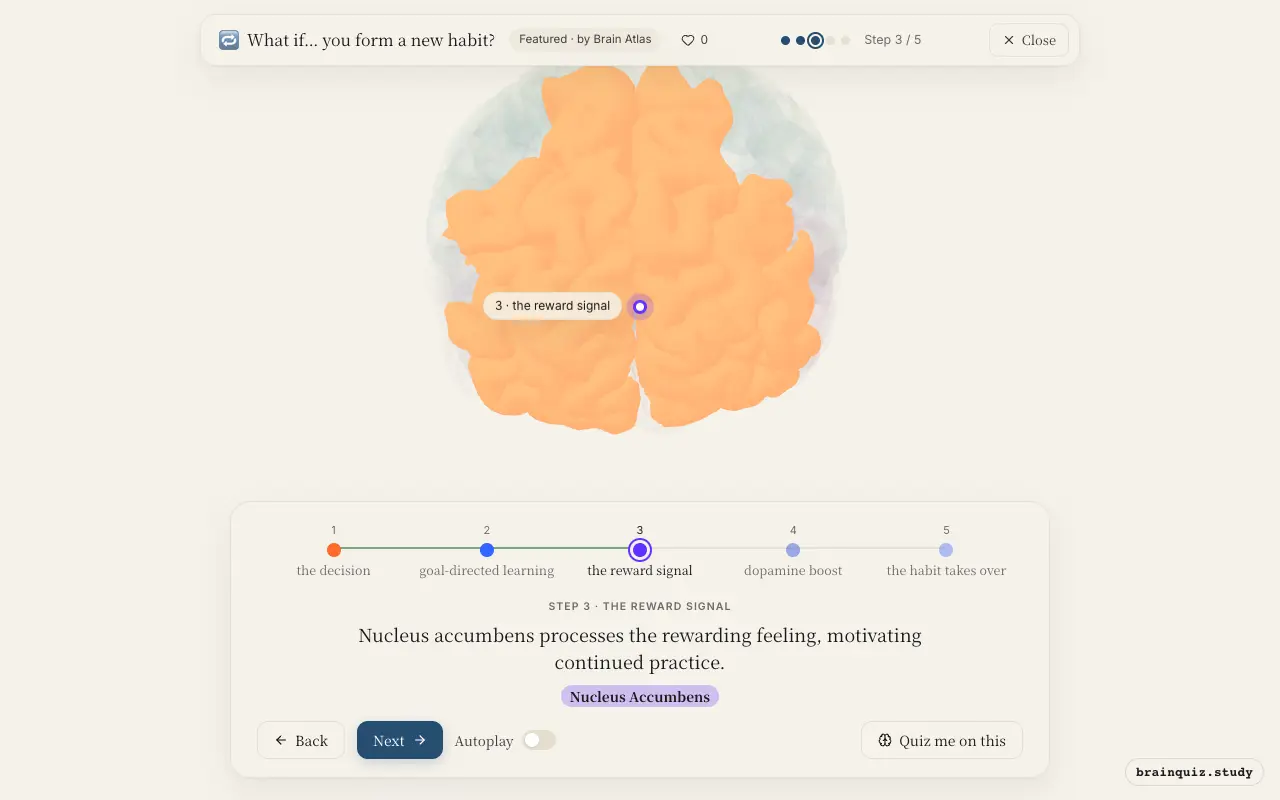
Receiving dopamine from the ventral tegmental area, the nucleus accumbens signals reward prediction and pleasure. This reinforces the behavior by making it feel good, encouraging you to do it again. Over time, the reward becomes less necessary for the behavior to occur automatically.
4. Substantia Nigra: dopamine boost
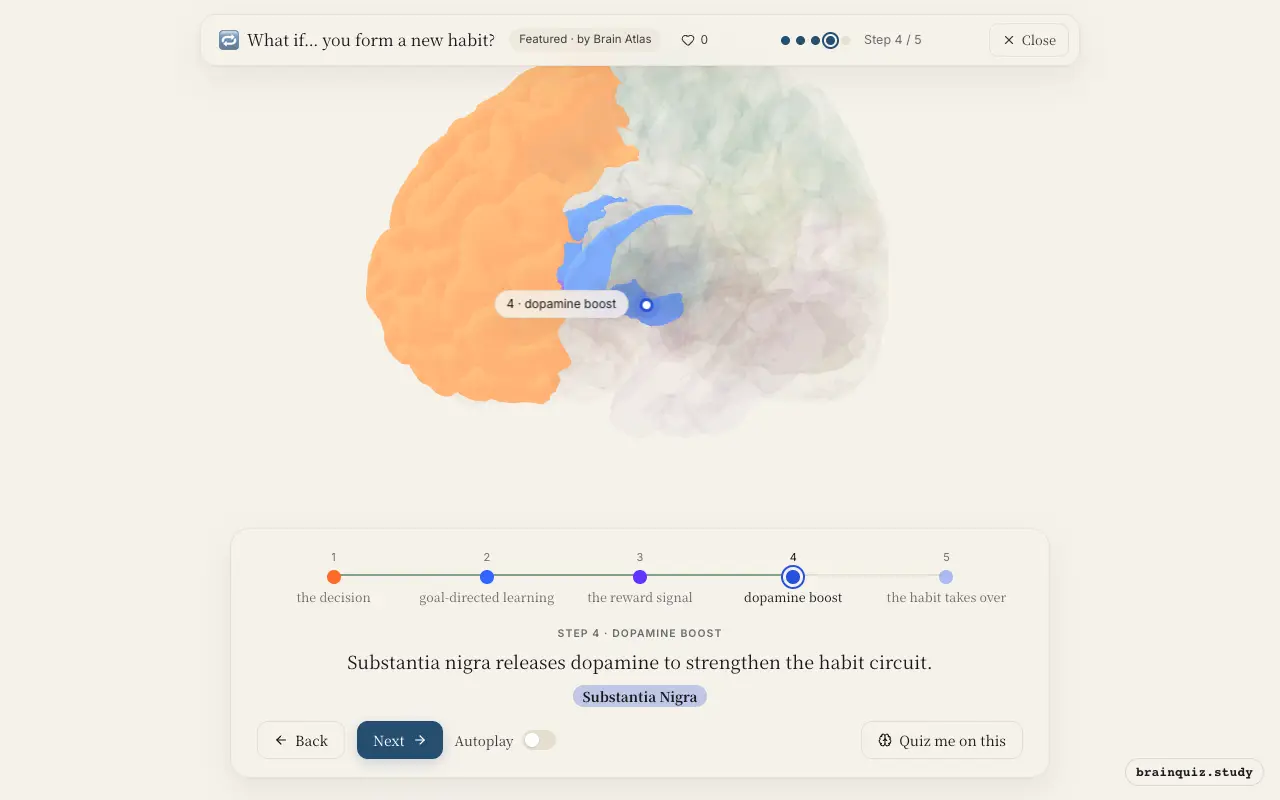
As the behavior is repeated, dopaminergic neurons in the substantia nigra pars compacta fire in response to cues predicting the action. This dopamine release potentiates synapses in the striatum, particularly shifting control from caudate to putamen. It cements the neural pathway.
5. Putamen: the habit takes over
Once established, the putamen, part of the dorsolateral striatum, takes over. Activity in the prefrontal cortex and caudate decreases while putamen firing becomes dominant. This allows the behavior to run off as a chunked sequence, triggered by cues, with minimal cognitive effort.
Good to know
- The basal ganglia, especially the putamen, are critical for storing stimulus-response habits.
- Dopamine from the substantia nigra is essential for habit formation; its loss in Parkinson's disease impairs automatic movements.
Early learning vs established habit
Early on, prefrontal cortex and caudate dominate as you deliberately plan and monitor outcomes. Once a habit forms, putamen activity increases while prefrontal engagement drops, making the behavior automatic and resistant to changes in reward value.
Test yourself
Which brain region becomes more active as a behavior becomes a well-learned habit?
What is the role of dopamine from the substantia nigra in habit formation?
Compared to early learning, what typically happens to prefrontal cortex activity once a habit is established?
0 of 3 answered · 0 correct
Simplified: many regions work together at once, and this shows the main players in the order they act.