What happens in your brain when you daydream?
Updated
Daydreaming shifts activity to the default mode network: the posterior cingulate cortex ties self-referential thought together, the hippocampus retrieves memories, the angular gyrus integrates sensory and semantic information, and the prefrontal cortex simulates possible scenarios.
Watch it light up on the 3D brain
Brain regions that light up
| Order | Region | What it does here |
|---|---|---|
| 1 | Posterior Cingulate Cortex | The posterior cingulate activates as the default mode network's hub for internal thought. |
| 2 | Hippocampus | The hippocampus retrieves episodic memories and constructs imagined scenarios. |
| 3 | Angular Gyrus | The angular gyrus integrates sensory details, language, and memory into a coherent narrative. |
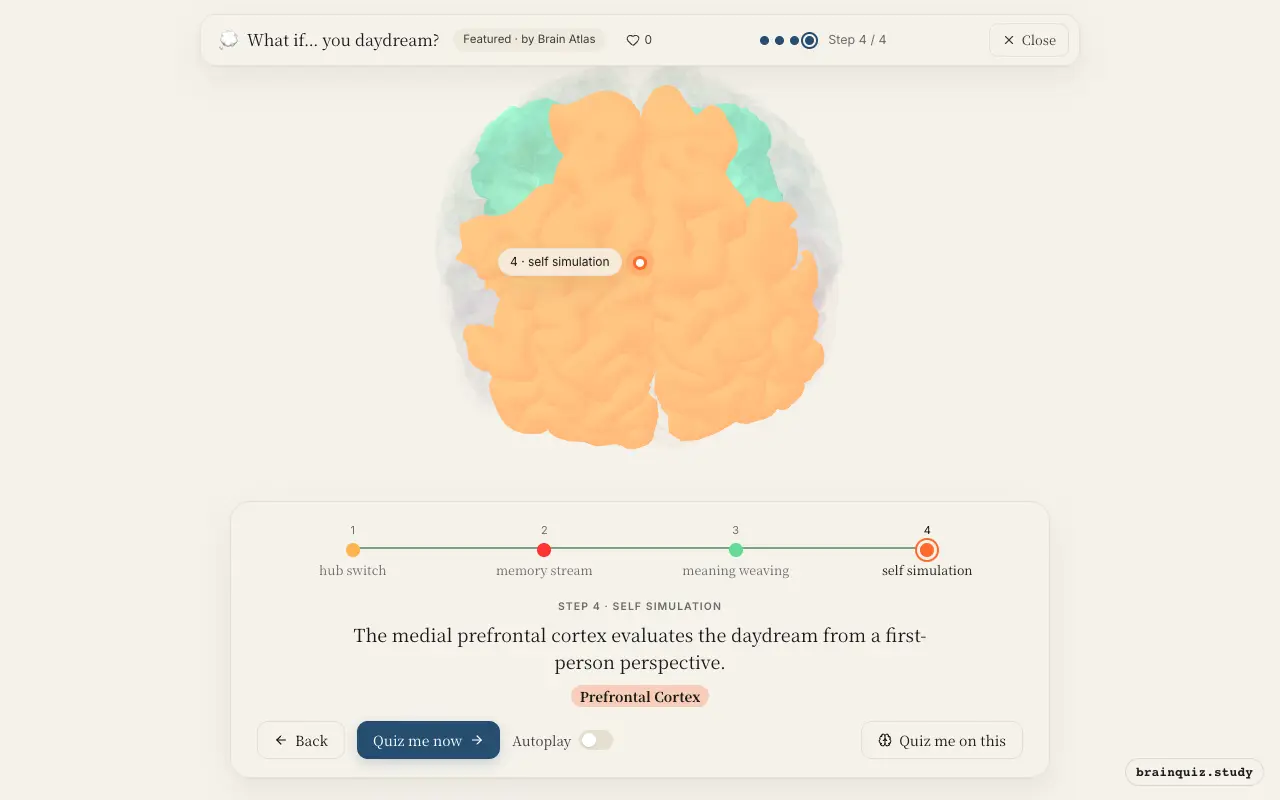
| 4 | Prefrontal Cortex | The medial prefrontal cortex evaluates the daydream from a first-person perspective. |
1. Posterior Cingulate Cortex: hub switch
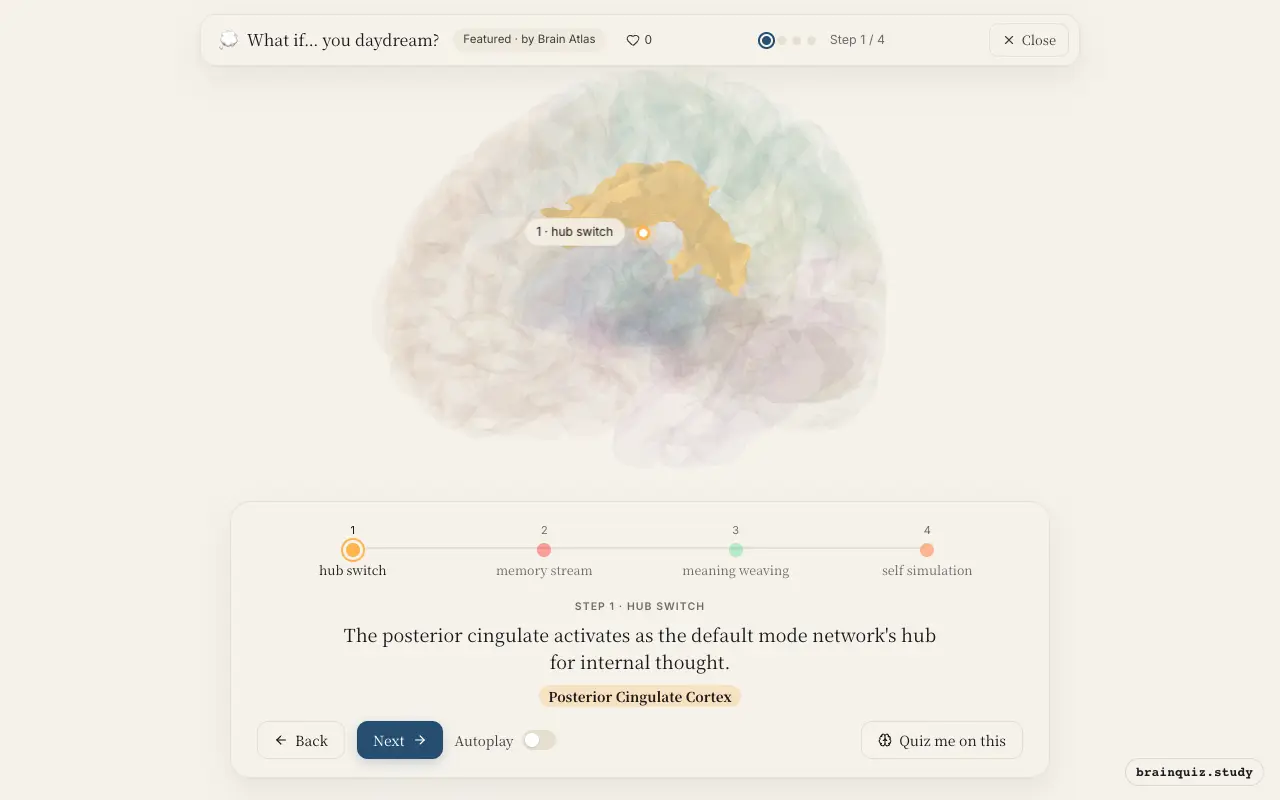
When external demands fade, the posterior cingulate increases its activity, linking autobiographical memories and self-referential thoughts. It is considered a core hub of the default mode network, coordinating other regions during internally directed cognition. Damage to this area or its connections may impair internally directed thought, but direct links to daydreaming frequency are less established.
2. Hippocampus: memory stream
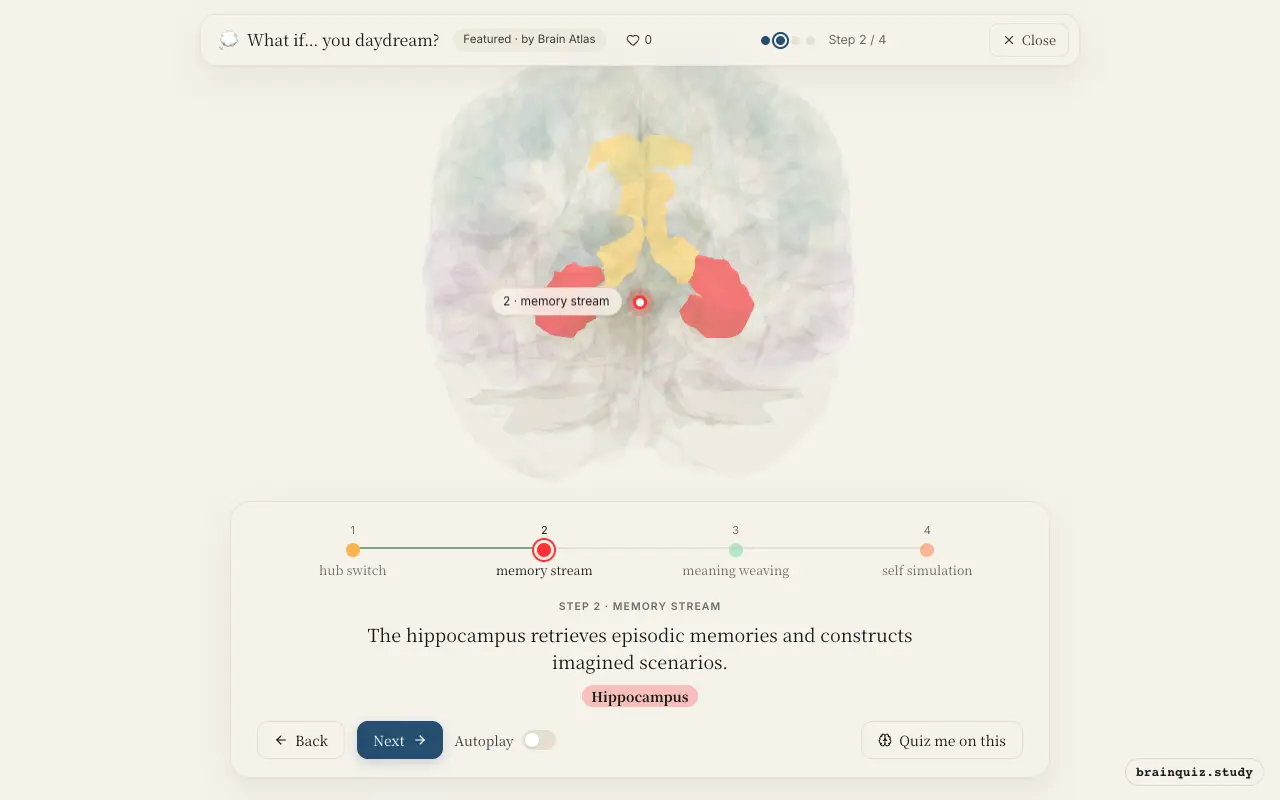
Daydreaming often replays past events or simulates future ones, and the hippocampus supports this by reactivating stored memory traces. It also combines elements from different experiences to create novel situations. This region supports the vivid, autobiographical content often found in mind wandering.
3. Angular Gyrus: meaning weaving
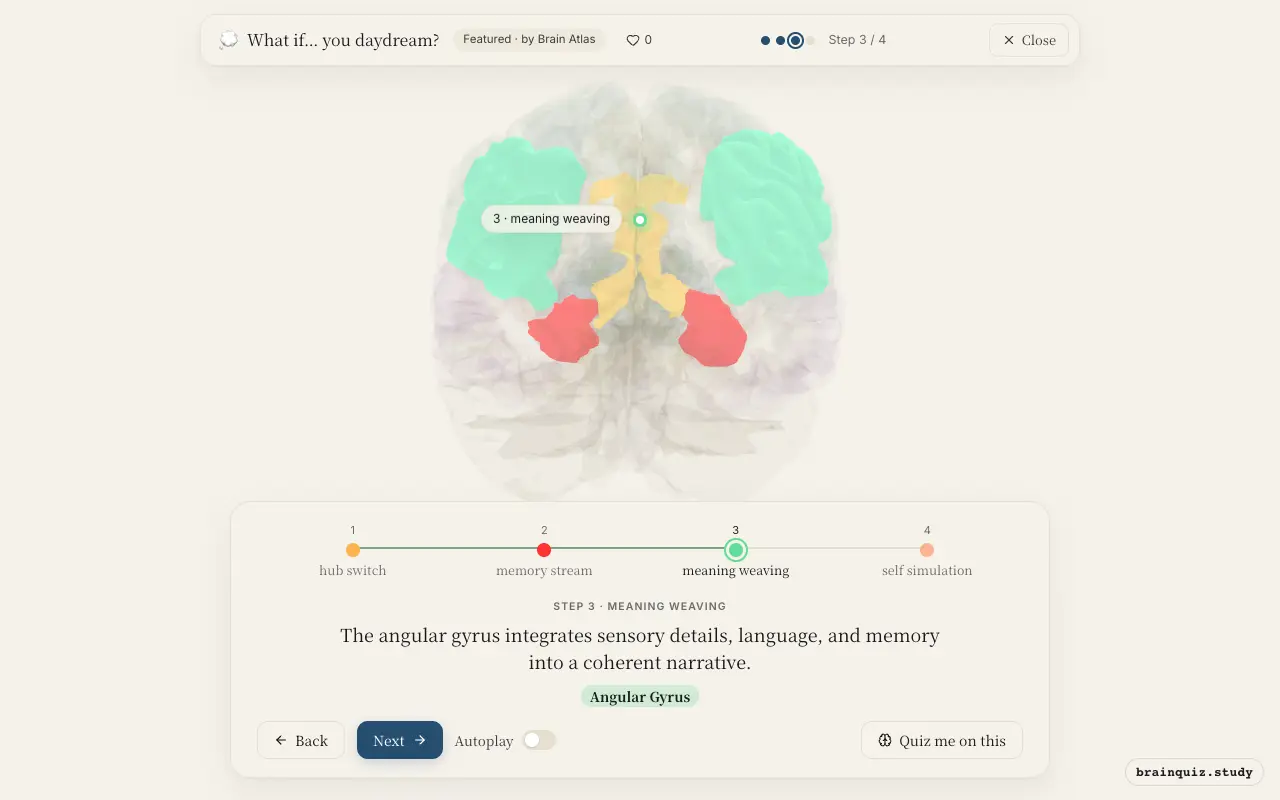
As daydreams become more elaborate, the angular gyrus binds semantic knowledge, spatial imagery, and past experiences. This region is active during many default mode tasks, including remembering, imagining, and language comprehension. Its role in daydreaming is thought to involve stitching together disparate mental content into a flowing story.
4. Prefrontal Cortex: self simulation
Part of the prefrontal cortex, especially its medial regions, simulates possible futures and judges their personal relevance. It contributes to the sense of a continuous self during mind wandering, allowing you to insert yourself into imagined scenarios. This region also helps decide when to return attention to the outside world.
Good to know
- The default mode network is more active during rest and internally directed thought than during focused external tasks.
- Daydreaming often involves episodic future thinking, which shares neural substrates with remembering the past.
- Mind wandering is associated with reduced activity in brain regions that support attention to the environment, such as the dorsal attention network.
Daydreaming vs Focused Attention
During focused attention, the dorsal attention network and executive control regions dominate, while the default mode network quiets. Daydreaming reverses this pattern: the posterior cingulate, angular gyrus, and medial prefrontal regions become more active as attention turns inward.
Test yourself
Which brain network is primarily active during daydreaming?
Which region is most critical for retrieving episodic memories during a daydream?
What typically happens to external attention during daydreaming?
0 of 3 answered · 0 correct
Simplified: many regions work together at once, and this shows the main players in the order they act.