What happens in your brain when you imagine the future?
Updated
Imagining the future engages the hippocampus to construct scenes, the prefrontal cortex to plan and evaluate, and the posterior cingulate cortex for self-referential simulation. These regions interact within the default mode network.
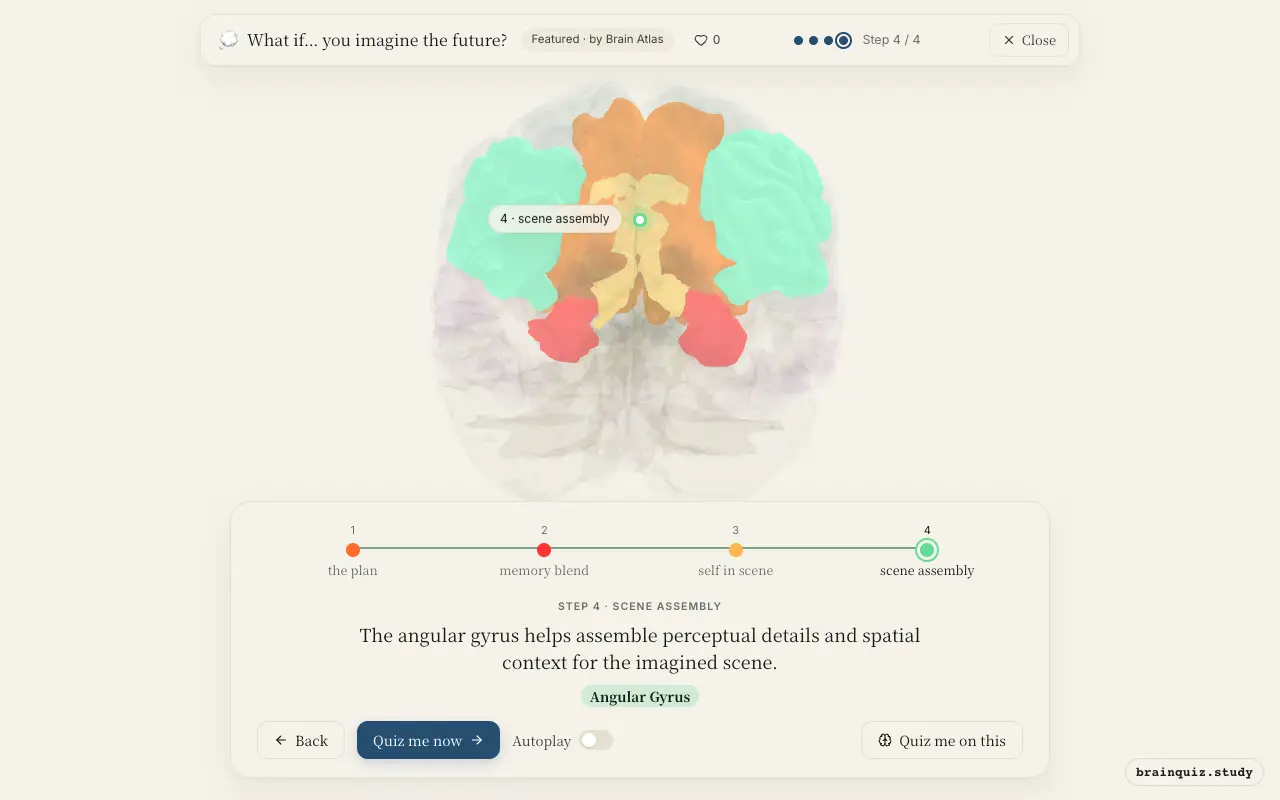
Watch it light up on the 3D brain
Brain regions that light up
| Order | Region | What it does here |
|---|---|---|
| 1 | Prefrontal Cortex | The prefrontal cortex initiates the simulation, setting goals and selecting relevant memories. |
| 2 | Hippocampus | The hippocampus retrieves past experiences and recombines them into a novel future scenario. |
| 3 | Posterior Cingulate Cortex | The posterior cingulate cortex integrates the imagined event with self-referential and emotional processing. |
| 4 | Angular Gyrus | The angular gyrus helps assemble perceptual details and spatial context for the imagined scene. |
1. Prefrontal Cortex: the plan
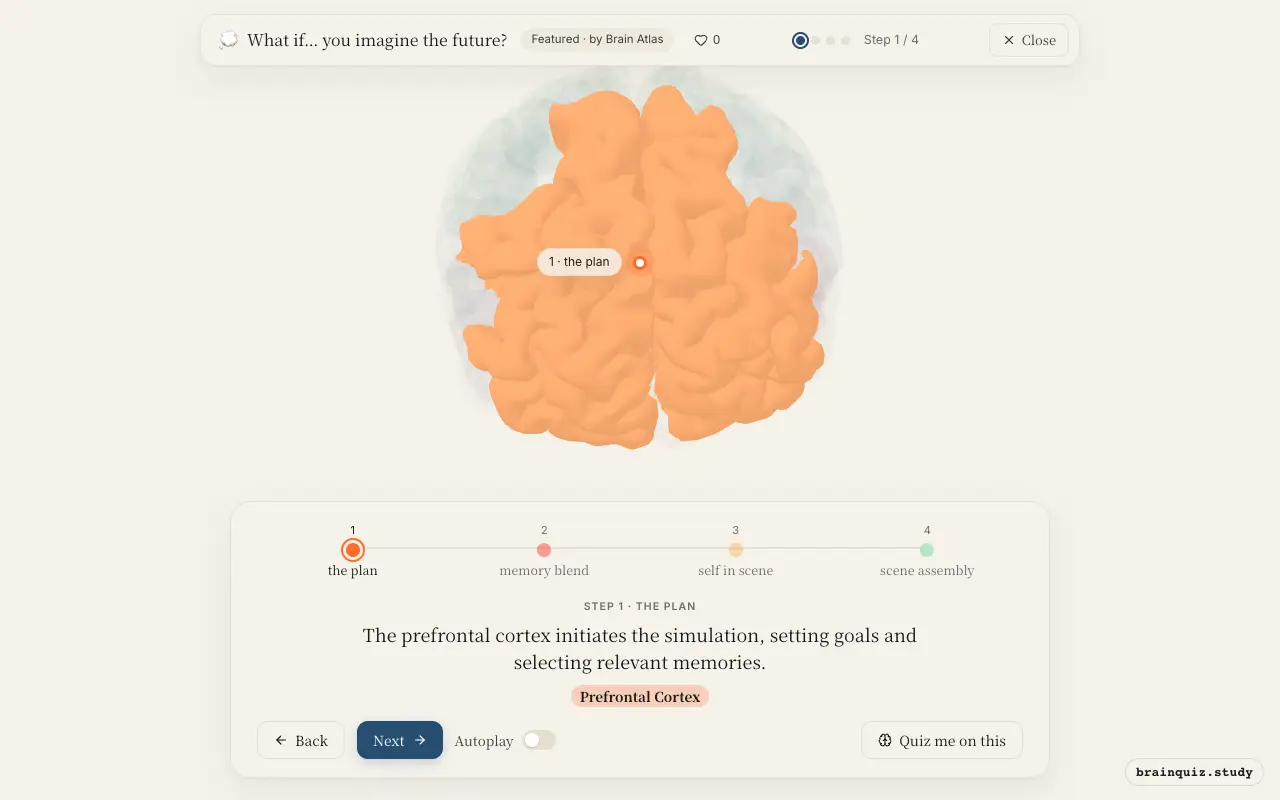
The prefrontal cortex, especially its medial and dorsolateral parts, orchestrates future thinking by holding goals in working memory and directing attention to relevant information. It evaluates potential outcomes and aids in decision-making, ensuring the imagined future is plausible and useful for planning.
2. Hippocampus: memory blend
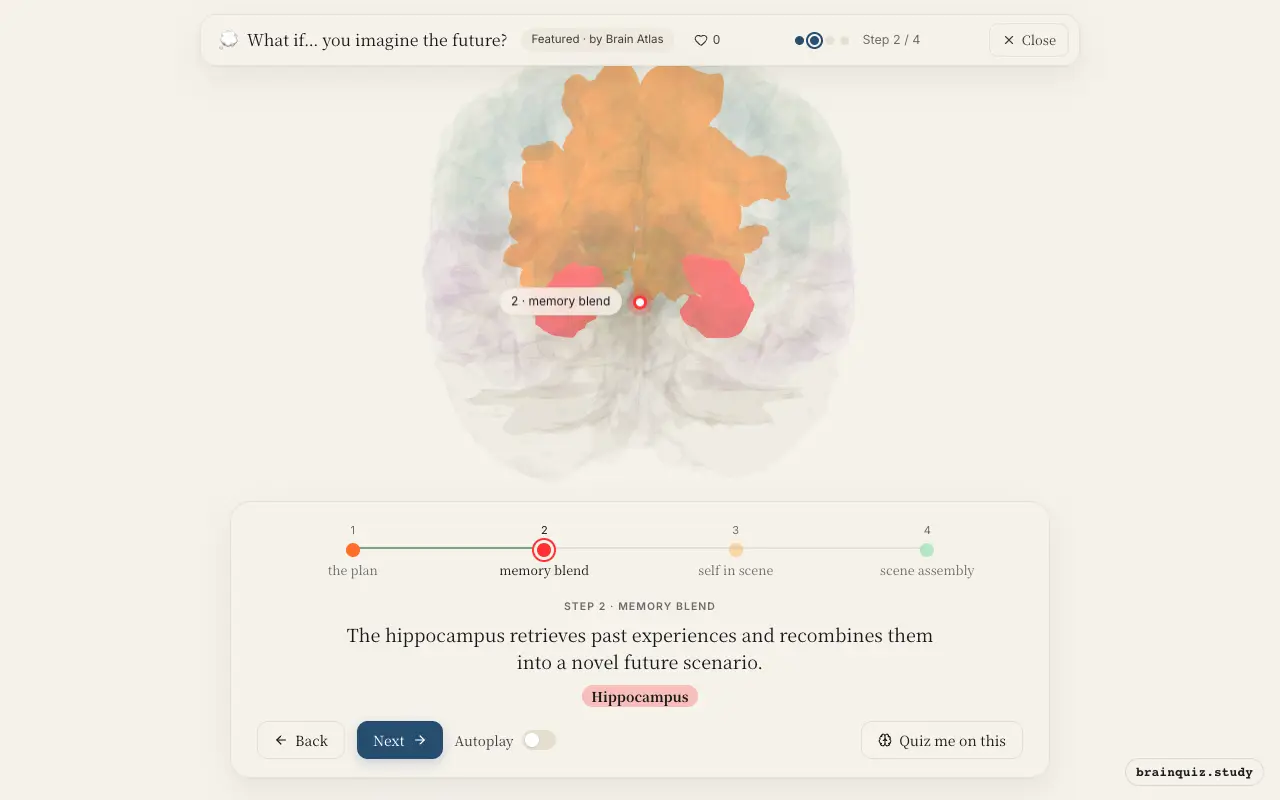
The hippocampus is crucial for episodic memory and is thought to support the construction of future events by flexibly recombining details from past experiences. This process, known as episodic simulation, allows the brain to create coherent scenes that have not actually occurred.
3. Posterior Cingulate Cortex: self in scene
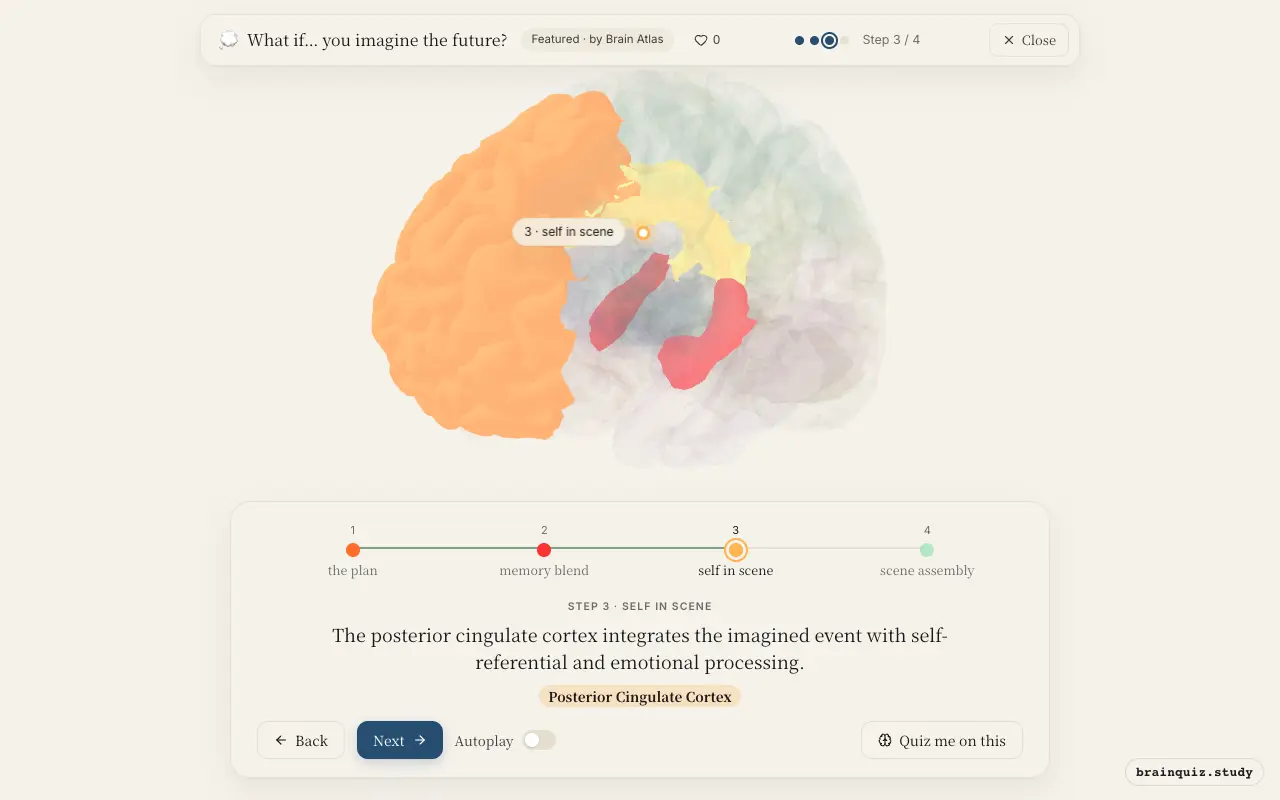
The posterior cingulate cortex is a core node of the default mode network, active during self-referential thought and mental time travel. It helps assess the personal significance of the imagined future, linking the scenario to one's identity, values, and emotional state.
4. Angular Gyrus: scene assembly
The angular gyrus contributes to scene construction by integrating multimodal information from memory and sensory cortices. It supports the vividness of imagined events, including spatial layout and object details, and is implicated in episodic simulation and semantic processing.
Good to know
- The default mode network, which includes the medial prefrontal cortex, posterior cingulate cortex, and angular gyrus, shows increased activity during future thinking.
- Patients with hippocampal damage often have difficulty imagining detailed future events, a condition known as episodic future thinking impairment.
- Imagining positive future events activates reward-related regions such as the ventral striatum, linking optimism to motivation.
Imagining vs Remembering
Imagining the future and remembering the past both engage the default mode network and hippocampus, but future thinking recruits additional prefrontal regions for planning and novelty detection. Remembering relies more on retrieval of stored details, while imagining requires recombination and construction.
Test yourself
Which brain region is essential for recombining memories into novel future scenarios?
The default mode network is most active during which mental activity?
Damage to which region is most likely to impair the ability to imagine detailed future events?
0 of 3 answered · 0 correct
Simplified: many regions work together at once, and this shows the main players in the order they act.