What happens in your brain when you get distracted while studying?
Updated
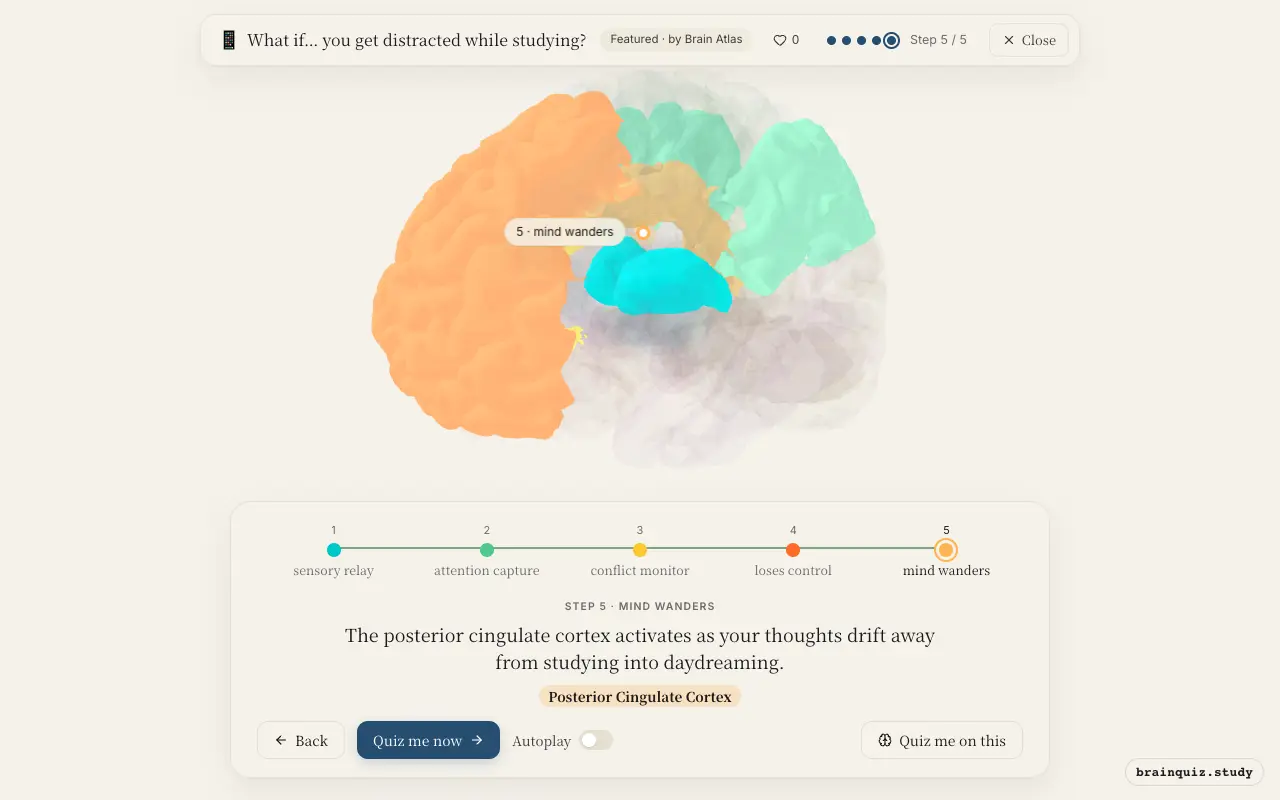
First the thalamus relays the distracting stimulus, then the ventral posterior parietal cortex captures attention bottom-up. The anterior cingulate detects conflict, the prefrontal cortex loses control, and the posterior cingulate lets your mind wander.
Watch it light up on the 3D brain
Brain regions that light up
| Order | Region | What it does here |
|---|---|---|
| 1 | Thalamus | The thalamus forwards the distracting stimulus to cortical areas, kicking off the shift in attention. |
| 2 | Ventral Posterior Parietal Cortex | The ventral posterior parietal cortex detects the salient stimulus and triggers a bottom-up shift of attention. |
| 3 | Anterior Cingulate Cortex | The anterior cingulate cortex flags the conflict between studying and the distracting stimulus. |
| 4 | Prefrontal Cortex | The prefrontal cortex tries to suppress the distraction but fails, allowing attention to shift. |
| 5 | Posterior Cingulate Cortex | The posterior cingulate cortex activates as your thoughts drift away from studying into daydreaming. |
1. Thalamus: sensory relay
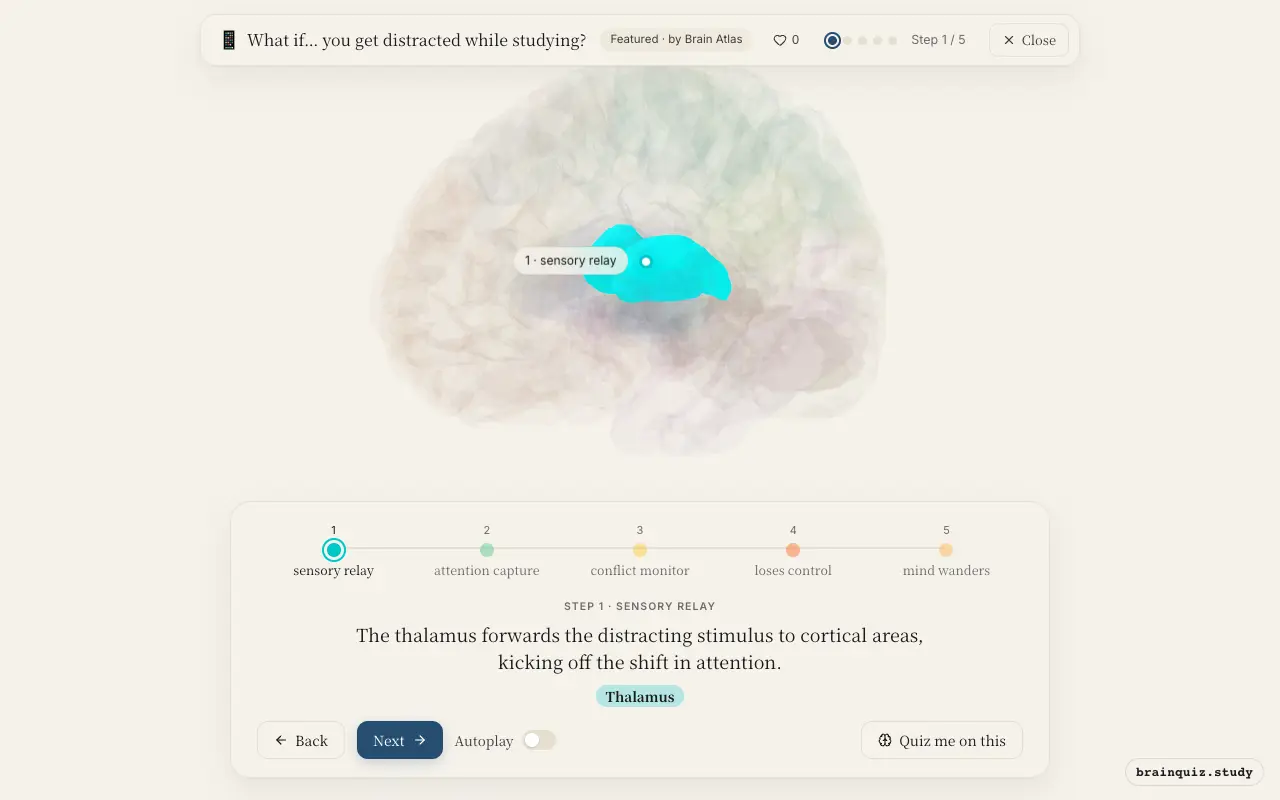
As the brain's central relay station, the thalamus receives sensory information from all modalities and sends it to the appropriate cortical regions. In distraction, a sudden sound or vibration is rapidly routed to auditory or somatosensory cortex, but the thalamus also influences overall arousal and attention. Its activity ensures the stimulus reaches higher-order areas before you are even consciously aware.
2. Ventral Posterior Parietal Cortex: attention capture
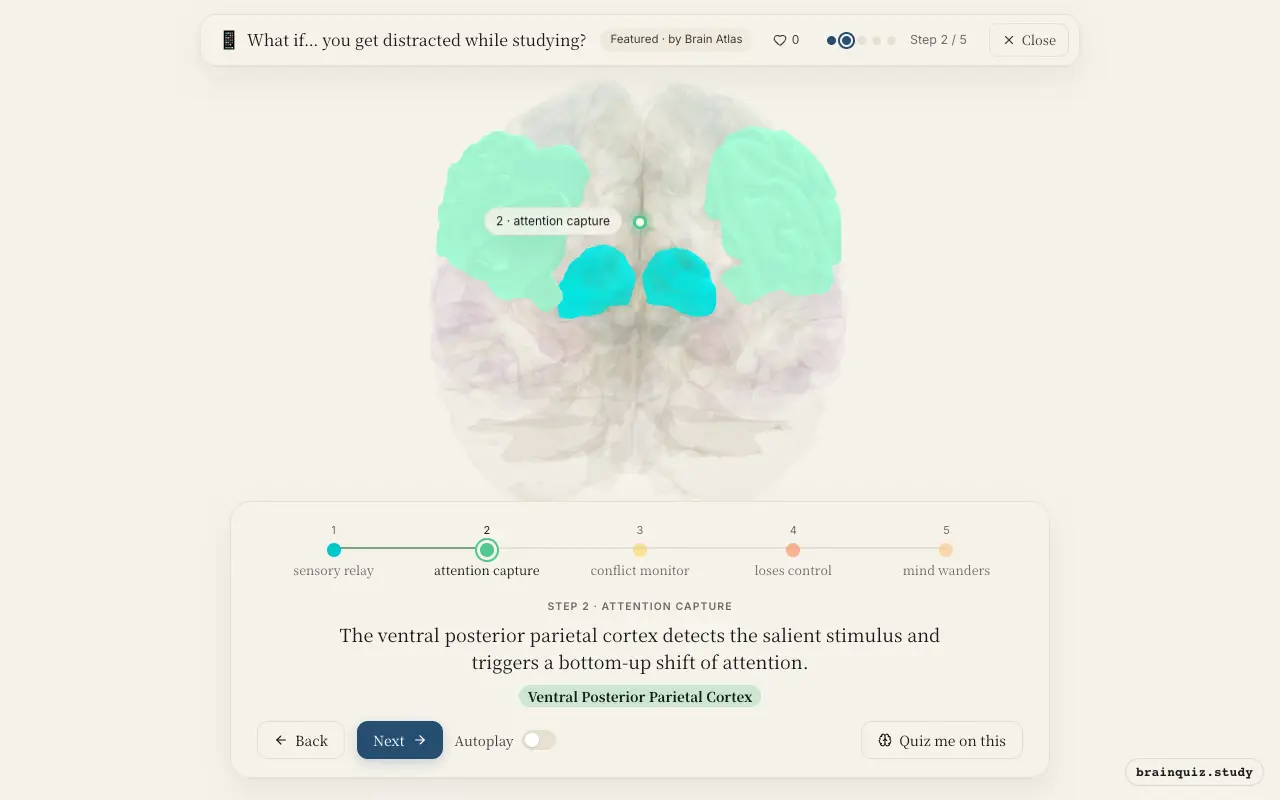
This region is part of the brain's 'orienting system' that responds to unexpected or behaviorally relevant stimuli, even when you are focused elsewhere. It generates a signal that says 'something important is happening' and interrupts ongoing cognitive processes. Activity here is thought to be automatic, capturing attention without conscious intention.
3. Anterior Cingulate Cortex: conflict monitor
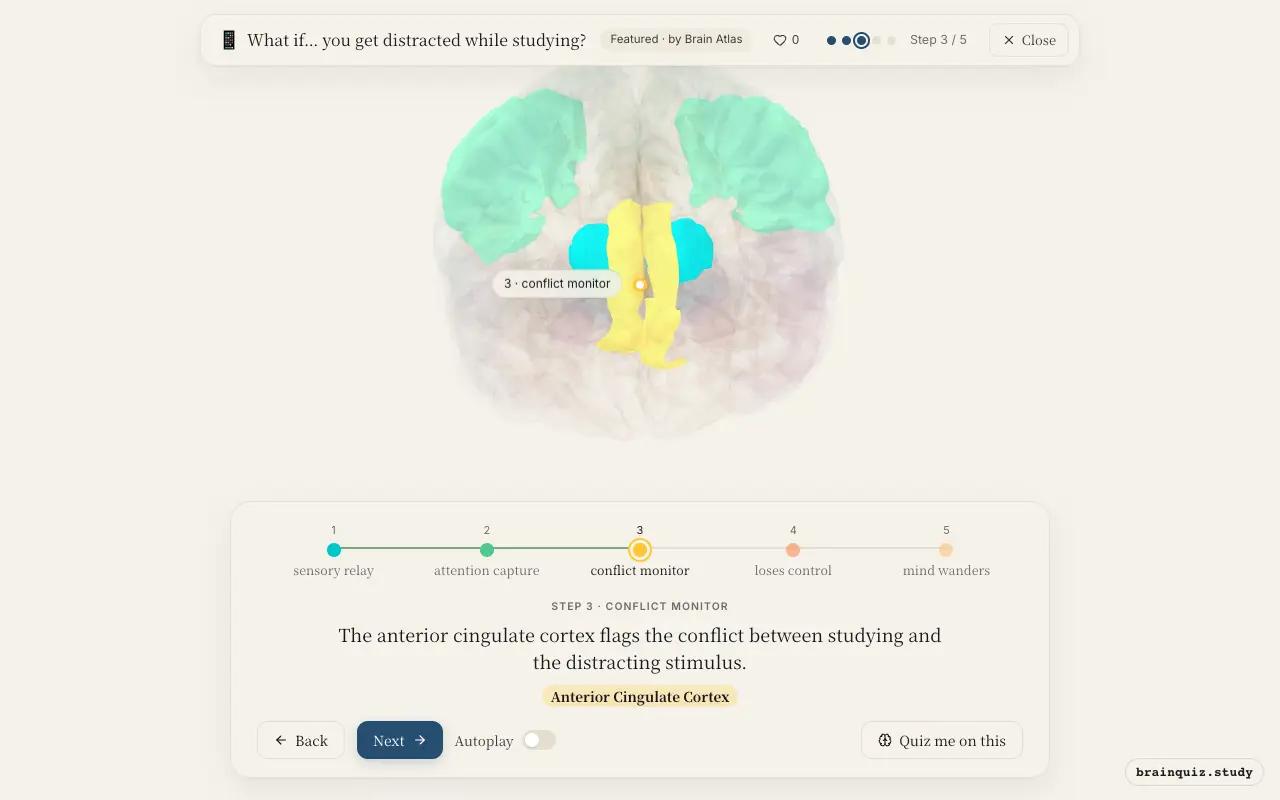
The anterior cingulate cortex (ACC) is well-known for detecting conflicts between competing demands, such as the need to keep studying versus the urge to check the distraction. When a mismatch occurs between your goal and the incoming stimulus, the ACC increases activity, signaling that cognitive control is needed. This 'error signal' is crucial for alerting the prefrontal cortex to intervene.
4. Prefrontal Cortex: loses control
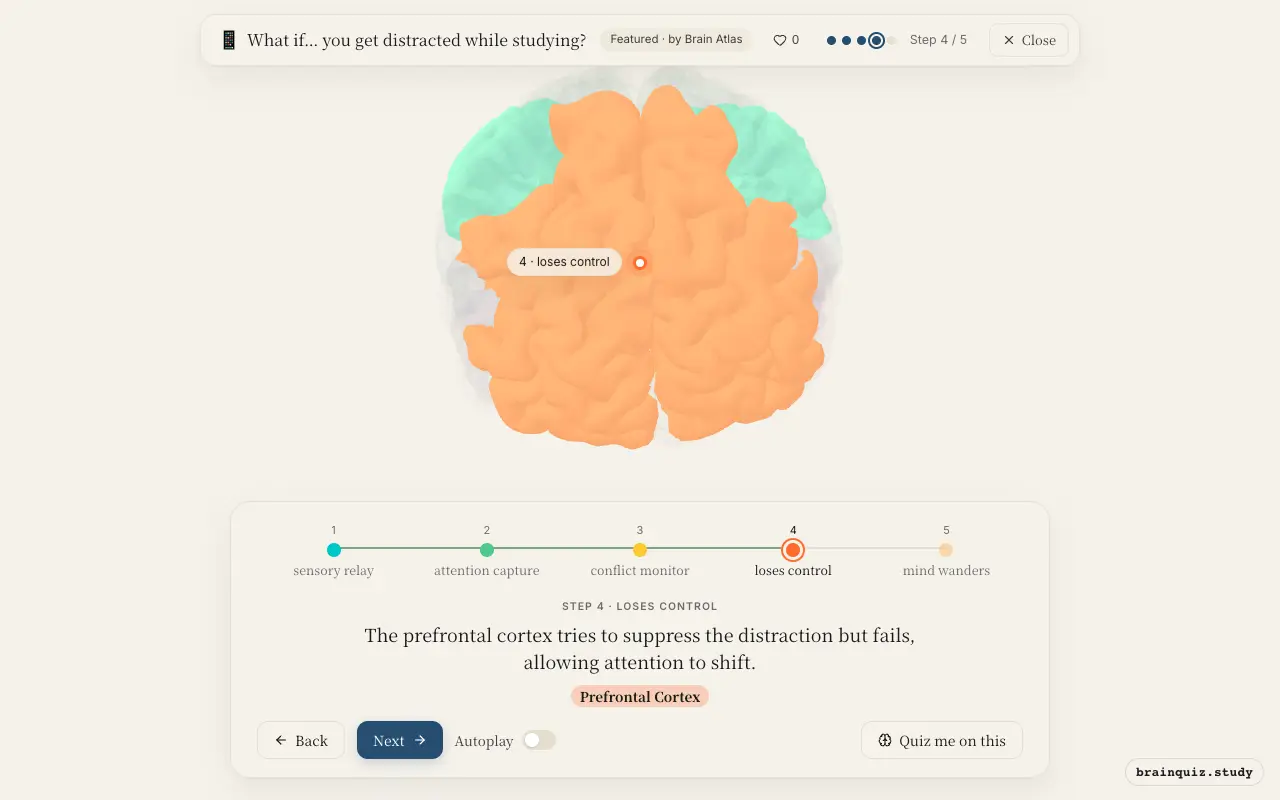
As the seat of executive function, the prefrontal cortex normally maintains focus on the study material and inhibits irrelevant information. However, under distraction—especially if the stimulus is rewarding or emotionally salient—its top-down control is overwhelmed. Studies suggest that weakened prefrontal activity and connectivity with attention networks contribute to the inability to stay on task.
5. Posterior Cingulate Cortex: mind wanders
The posterior cingulate cortex is a core hub of the default mode network, which becomes active when the brain is not engaged in a focused external task. Once attention is lost, this region supports self-referential thought, memory retrieval, and future planning—hallmarks of mind-wandering. Its increased activity marks the transition from effortful study to internal reverie.
Good to know
- The default mode network, including the posterior cingulate, is more active during mind-wandering and less active during focused tasks.
- Attention capture by salient stimuli can occur rapidly, often before conscious awareness.
- The anterior cingulate cortex also plays a role in error detection and adjusting behavior after mistakes.
Focused vs distracted studying
During focused studying, the prefrontal cortex strongly engages and the posterior cingulate is suppressed. In distraction, this pattern flips: prefrontal control weakens while default mode activity rises. This shift reflects the brain's reallocation of resources from external goal-directed attention to internal self-generated thought.
Test yourself
Which region acts first when a distracting stimulus appears?
What does the ventral posterior parietal cortex do in distraction?
Which region shows increased activity when the mind wanders after distraction?
0 of 3 answered · 0 correct
Simplified: many regions work together at once, and this shows the main players in the order they act.