What happens in your brain when you see colours?
Updated
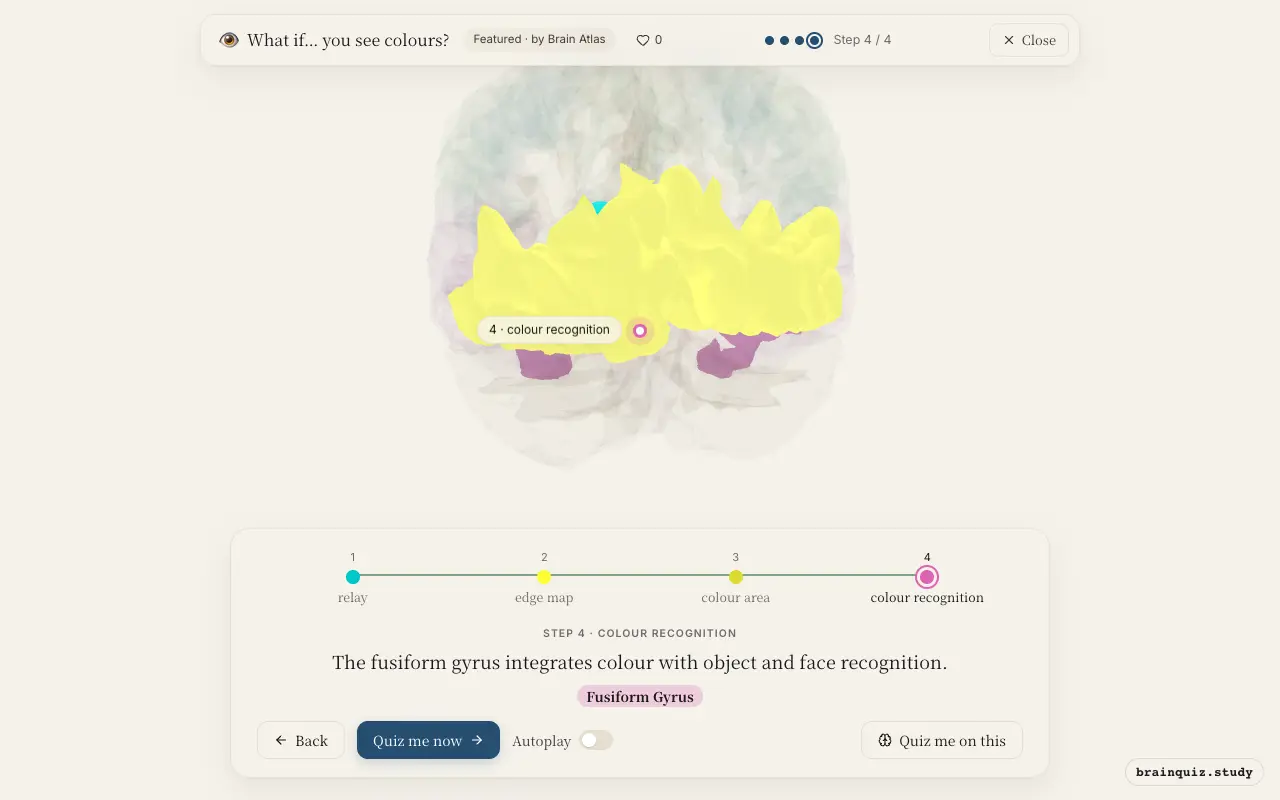
Seeing colours starts with the thalamus relaying retinal signals to the visual cortex, which extracts basic features. The occipital cortex (V4) then processes colour, and the fusiform gyrus integrates it with object recognition.
Watch it light up on the 3D brain
Brain regions that light up
| Order | Region | What it does here |
|---|---|---|
| 1 | Thalamus | The thalamus routes visual signals from the retina to the visual cortex. |
| 2 | Visual Cortex | The visual cortex processes basic features such as orientation and edges. |
| 3 | Occipital Cortex | The occipital cortex, particularly area V4, processes colour information. |
| 4 | Fusiform Gyrus | The fusiform gyrus integrates colour with object and face recognition. |
1. Thalamus: relay
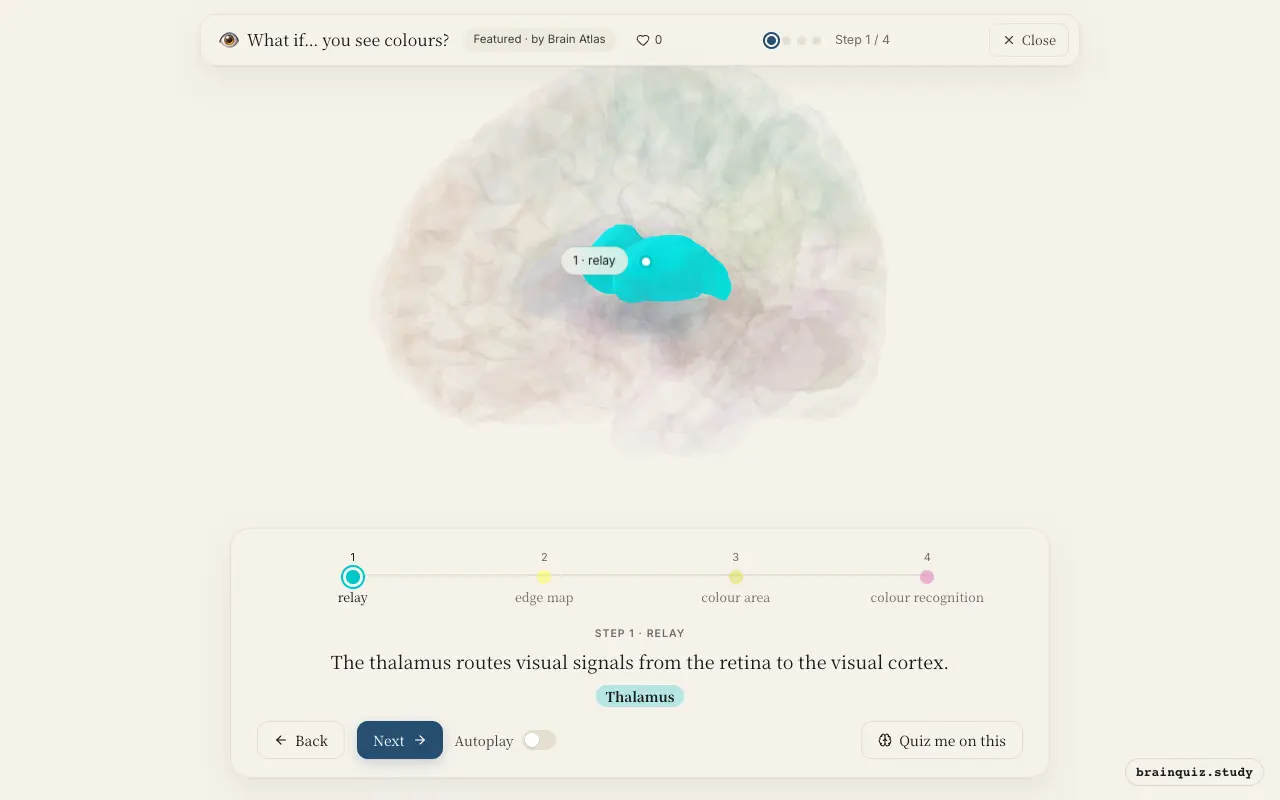
The lateral geniculate nucleus of the thalamus receives input from retinal ganglion cells and relays it to the primary visual cortex. This relay preserves spatial and colour information but does not yet interpret colour.
2. Visual Cortex: edge map
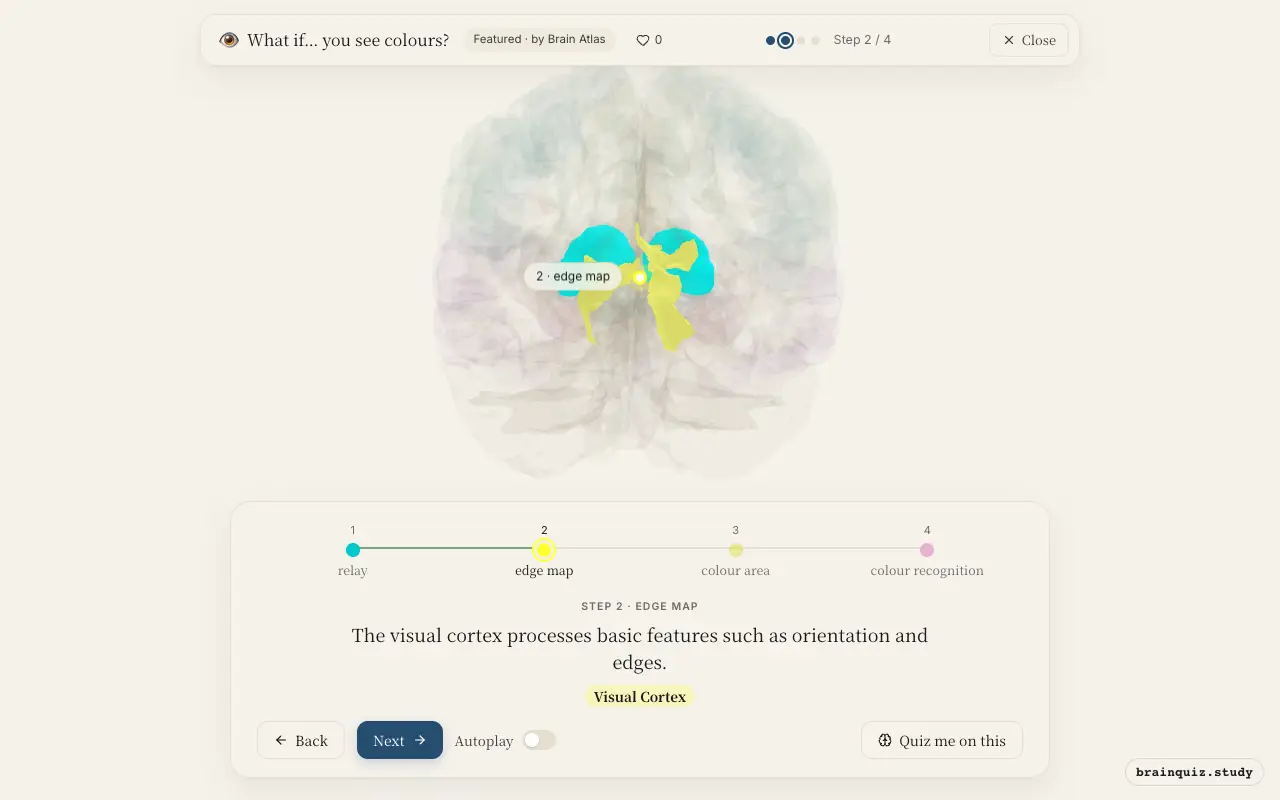
The primary visual cortex (V1) analyses simple visual attributes, including edges, orientation, and contrast. Colour information is passed through but not fully processed here; it is a prerequisite for later colour analysis.
3. Occipital Cortex: colour area
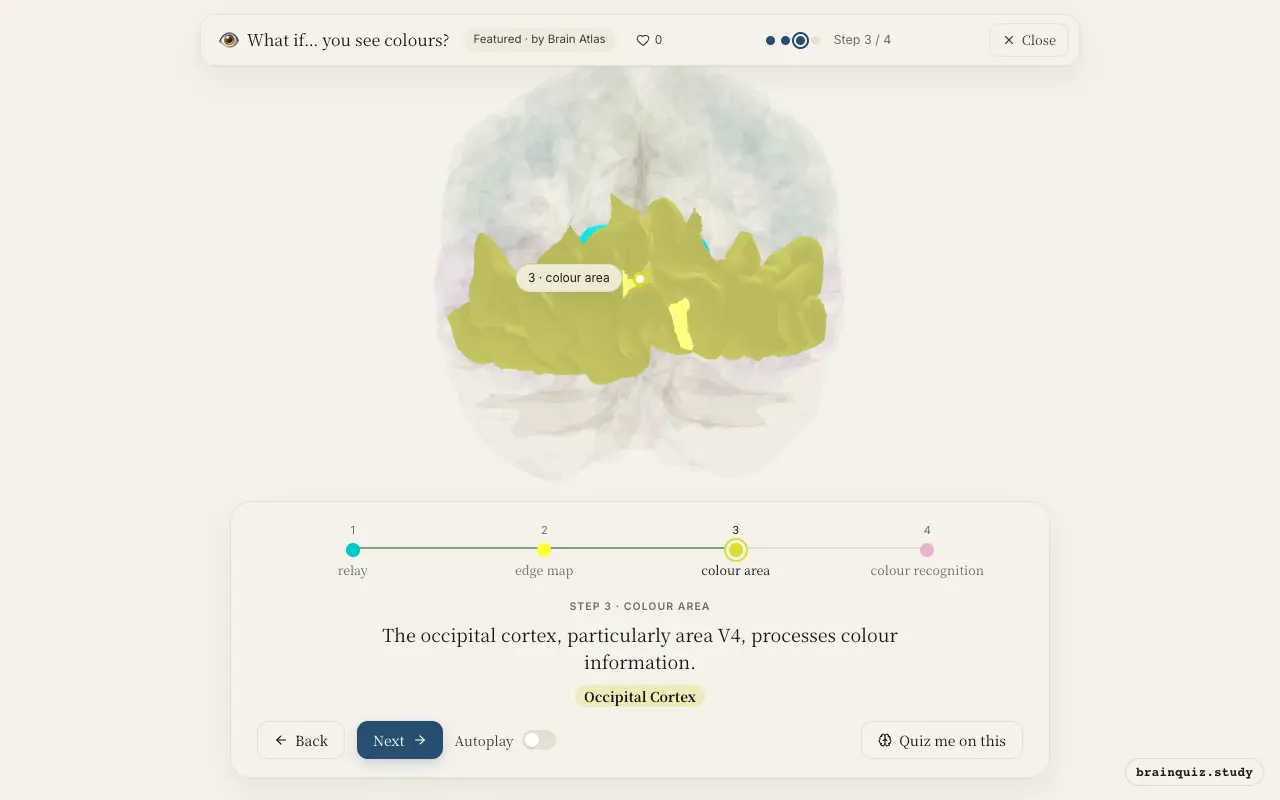
Area V4 in the occipital cortex is specialised for colour perception. Neurons here respond to specific hues and contribute to colour constancy, allowing colours to appear stable under different lighting.
4. Fusiform Gyrus: colour recognition
The fusiform gyrus, especially its posterior part, is involved in higher-level colour processing and links colour to meaningful objects. Damage here can cause achromatopsia, the inability to perceive colours.
Good to know
- Colour vision relies on three types of cone photoreceptors in the retina, which are sensitive to short, medium, and long wavelengths.
- Area V4 was first identified in macaque monkeys as a colour-selective region, and homologous areas exist in humans.
- Some individuals with damage to the fusiform gyrus lose the ability to see colours but can still see shapes and motion.
Colour vs Face Perception
Both colour and face processing involve the fusiform gyrus, but different subregions. Face perception activates the fusiform face area, while colour perception activates a more posterior part. Damage can selectively impair one function while sparing the other, showing functional segregation.
Test yourself
Which brain region is the primary relay station for visual information on its way to the cortex?
Area V4, critical for colour perception, is located in which lobe?
Damage to which region can cause achromatopsia, the inability to perceive colours?
0 of 3 answered · 0 correct
Simplified: many regions work together at once, and this shows the main players in the order they act.