What happens in your brain when you recognise a voice on the phone?
Updated
Your auditory cortex first decodes the sound, your temporal cortex identifies it as a familiar voice, your hippocampus retrieves who the voice belongs to, and your amygdala adds emotional meaning if it's someone you know.
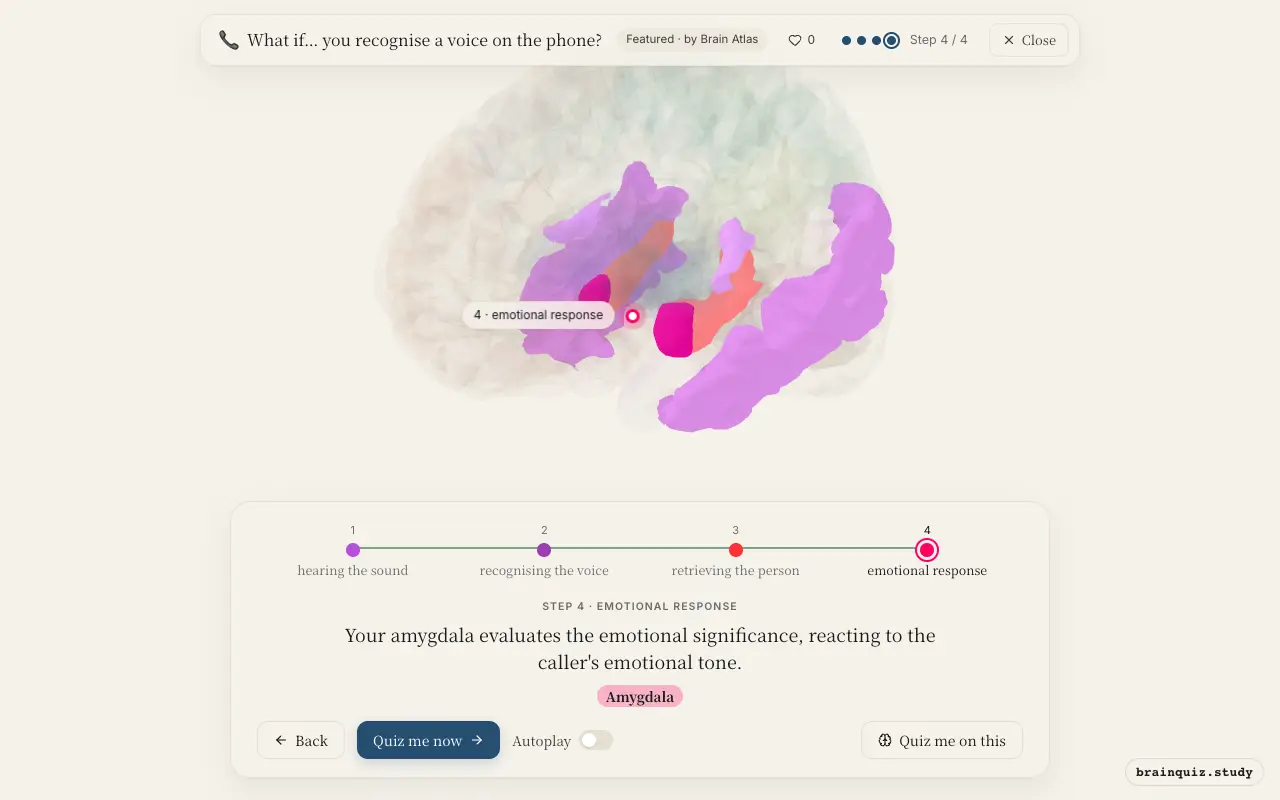
Watch it light up on the 3D brain
Brain regions that light up
| Order | Region | What it does here |
|---|---|---|
| 1 | Auditory Cortex | Your auditory cortex breaks down the acoustic features of the voice, like pitch and rhythm. |
| 2 | Temporal Cortex | Your temporal cortex compares the sound to stored voice templates, identifying it as familiar. |
| 3 | Hippocampus | Your hippocampus recalls who the voice belongs to, pulling up associated memories. |
| 4 | Amygdala | Your amygdala evaluates the emotional significance, reacting to the caller's emotional tone. |
1. Auditory Cortex: hearing the sound
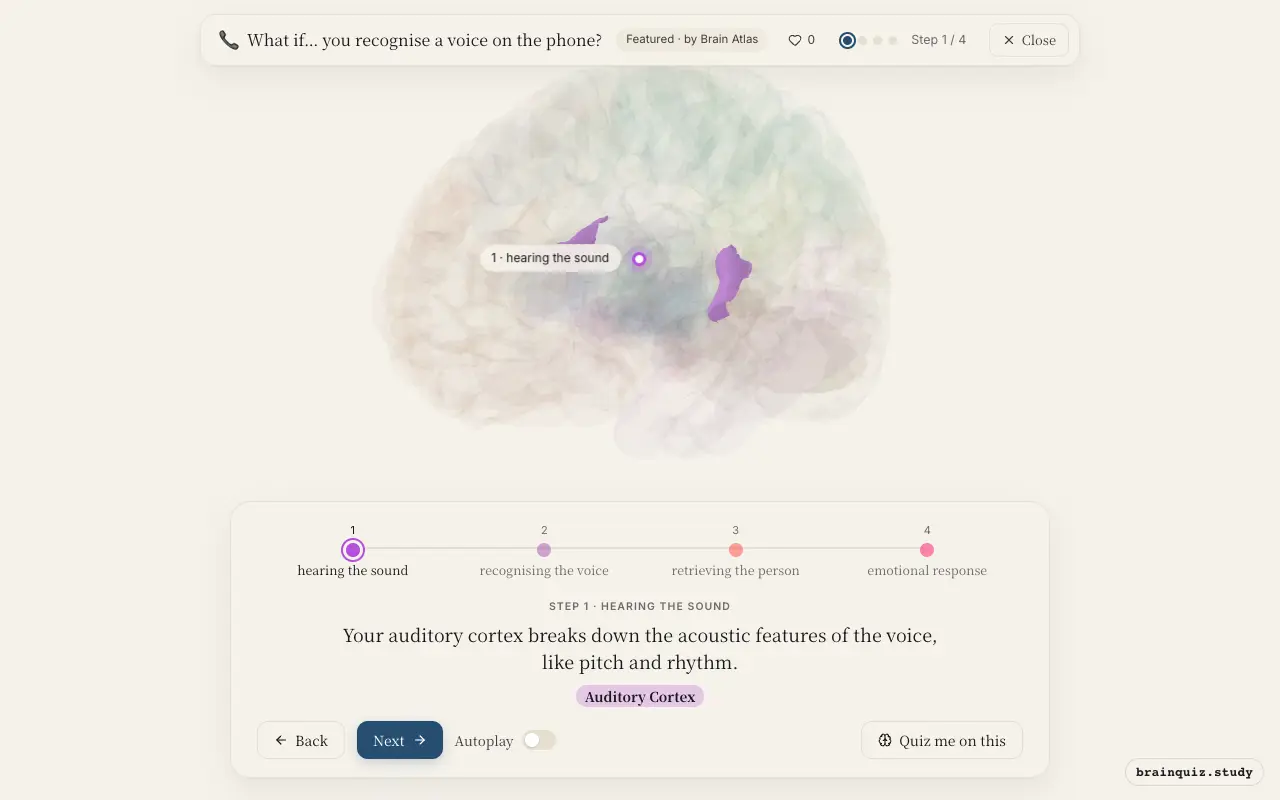
The primary auditory cortex in the temporal lobe receives the sound from your ear via the thalamus. It maps frequency, timing, and intensity, extracting basic features that let the brain distinguish a human voice from other sounds. This early processing is essential before voice identity can be recognised.
2. Temporal Cortex: recognising the voice
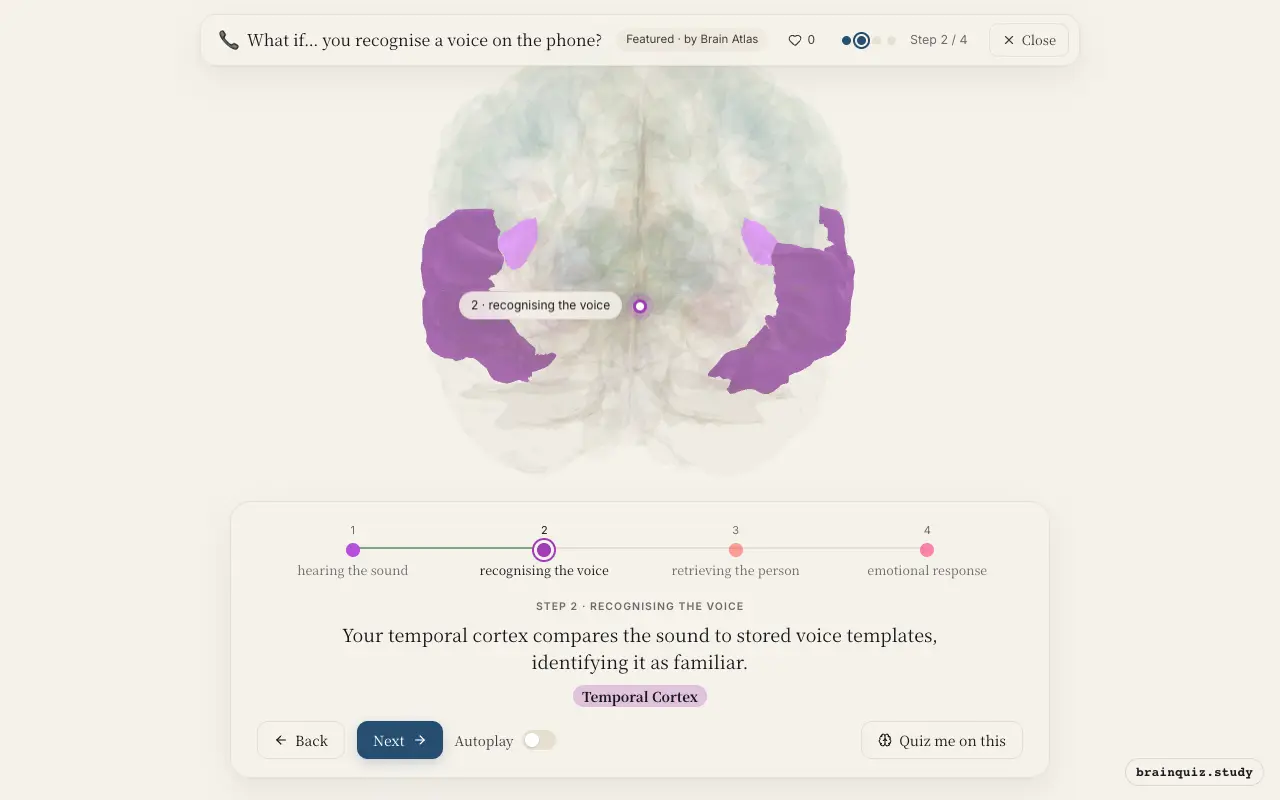
Regions in the temporal lobe, particularly around the superior temporal sulcus, are thought to process voice identity. They analyse vocal characteristics like timbre and prosody and match them against memories of voices you have heard before. This step determines whether the voice belongs to someone you know.
3. Hippocampus: retrieving the person
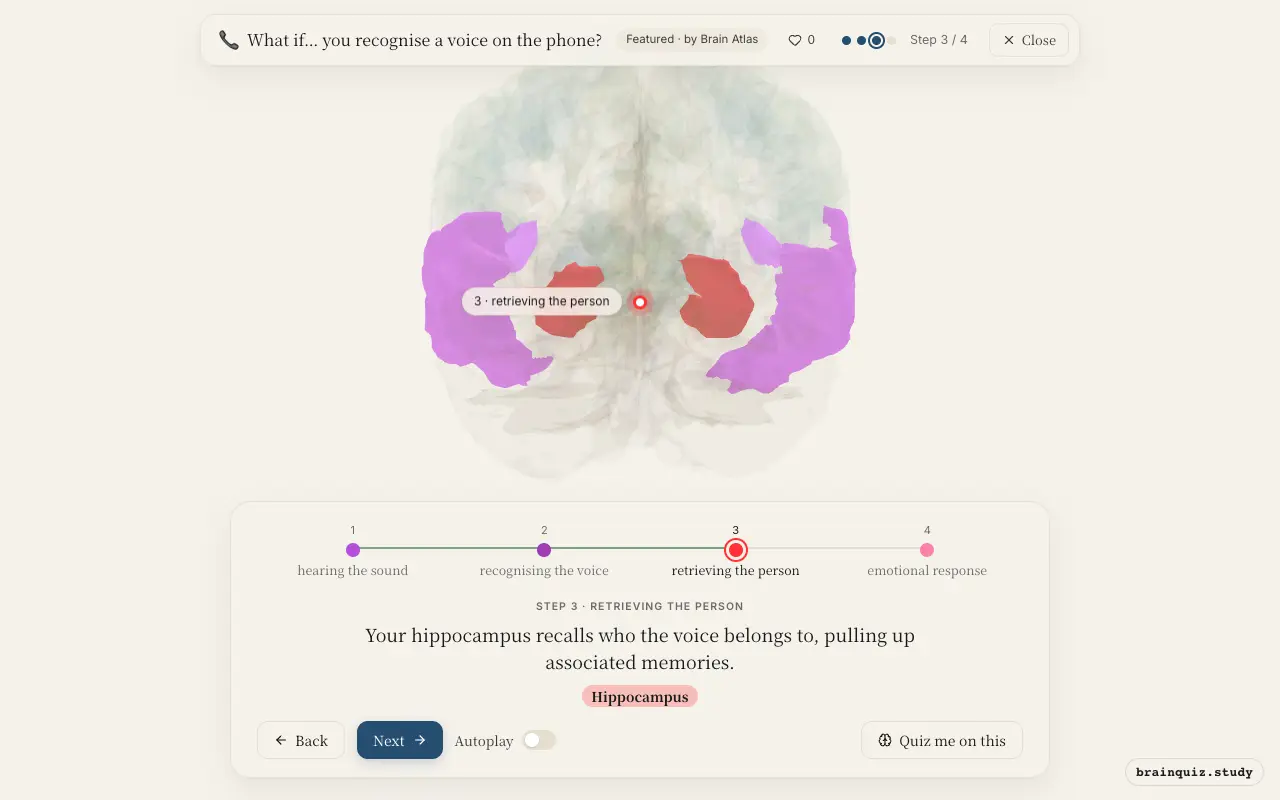
The hippocampus acts as a memory index, linking the recognised voice to autobiographical facts about the person, such as their name, face, and shared experiences. Without it, you might find the voice familiar but be unable to place who it is. This retrieval binds the auditory perception to a personal identity.
4. Amygdala: emotional response
The amygdala rapidly assesses whether the recognised person is emotionally important, triggering feelings of warmth, excitement, or concern. It can also prepare your body for a social interaction by influencing arousal. If the caller is a stranger or someone you dislike, the response may differ.
Good to know
- Studies suggest the right temporal lobe is especially important for recognising familiar voices.
- The amygdala can respond to familiar voices even before conscious recognition, showing the emotional salience of voices.
- The hippocampus links sensory information to episodic memories, enabling you to recall personal details about the speaker.
Familiar vs Unfamiliar Voice
When you hear an unfamiliar voice, the auditory cortex works harder to analyse its features, while the temporal cortex finds no matching template. In contrast, a familiar voice triggers the hippocampus to retrieve personal memories and the amygdala to generate an emotional response. Unfamiliar voices may instead activate prefrontal regions for updating attention.
Test yourself
Which brain region is primarily responsible for decoding the acoustic features of a voice?
After the auditory cortex, which region is most crucial for identifying the voice as belonging to a specific person?
Why might a familiar voice trigger an emotional reaction even before you consciously recognise the caller?
0 of 3 answered · 0 correct
Simplified: many regions work together at once, and this shows the main players in the order they act.