What happens in your brain when you jerk awake as you fall asleep?
Updated
As you fall asleep, your brainstem may fire a sudden motor signal down your spinal cord, jerking your limbs. The unexpected movement sends strong sensory feedback to your thalamus, which jolts your cortex awake.
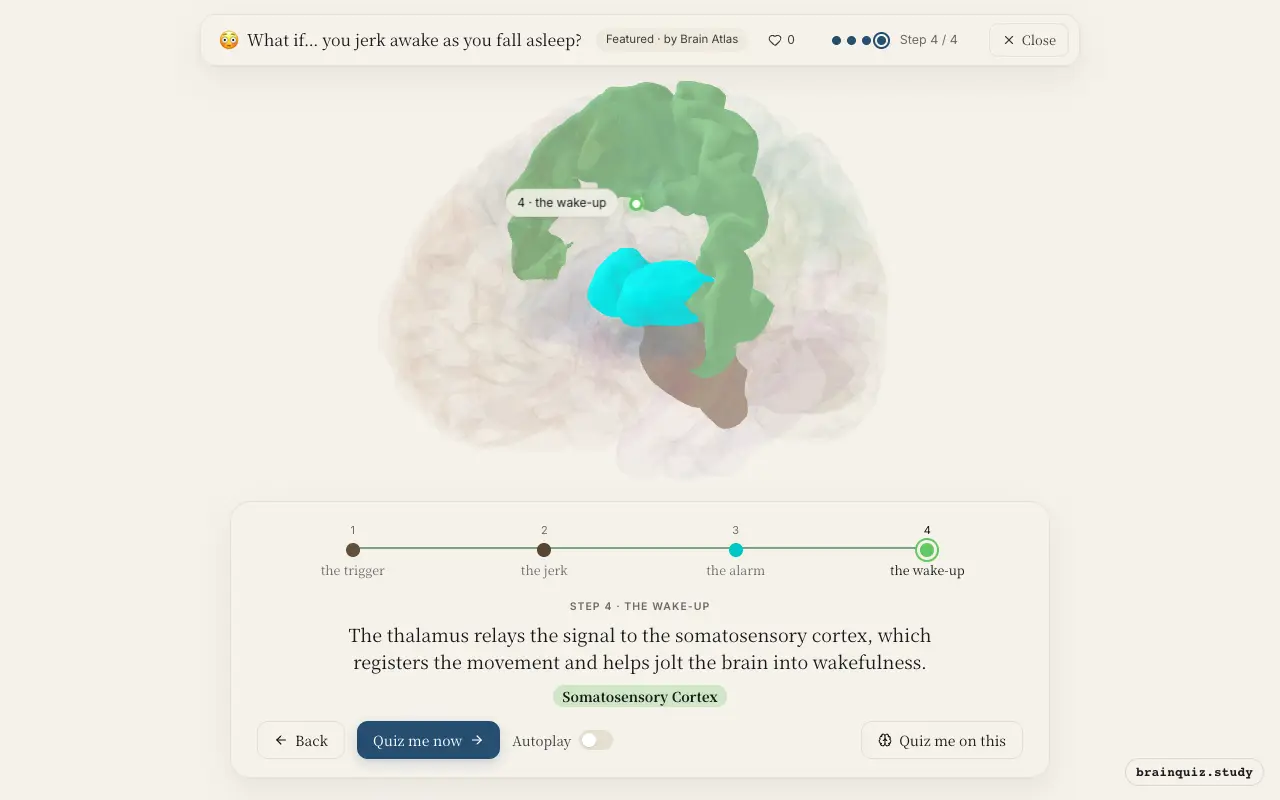
Watch it light up on the 3D brain
Brain regions that light up
| Order | Region | What it does here |
|---|---|---|
| 1 | Brainstem | As sleep begins, a sudden burst in the brainstem's reticular formation may send a myoclonic motor command down the spinal cord. |
| 2 | Spinal Cord | The command reaches lower motor neurons in the spinal cord, causing your limbs to twitch suddenly. |
| 3 | Thalamus | The sudden muscle movement generates strong sensory feedback that travels up to the thalamus, the brain's relay station. |
| 4 | Somatosensory Cortex | The thalamus relays the signal to the somatosensory cortex, which registers the movement and helps jolt the brain into wakefulness. |
1. Brainstem: the trigger
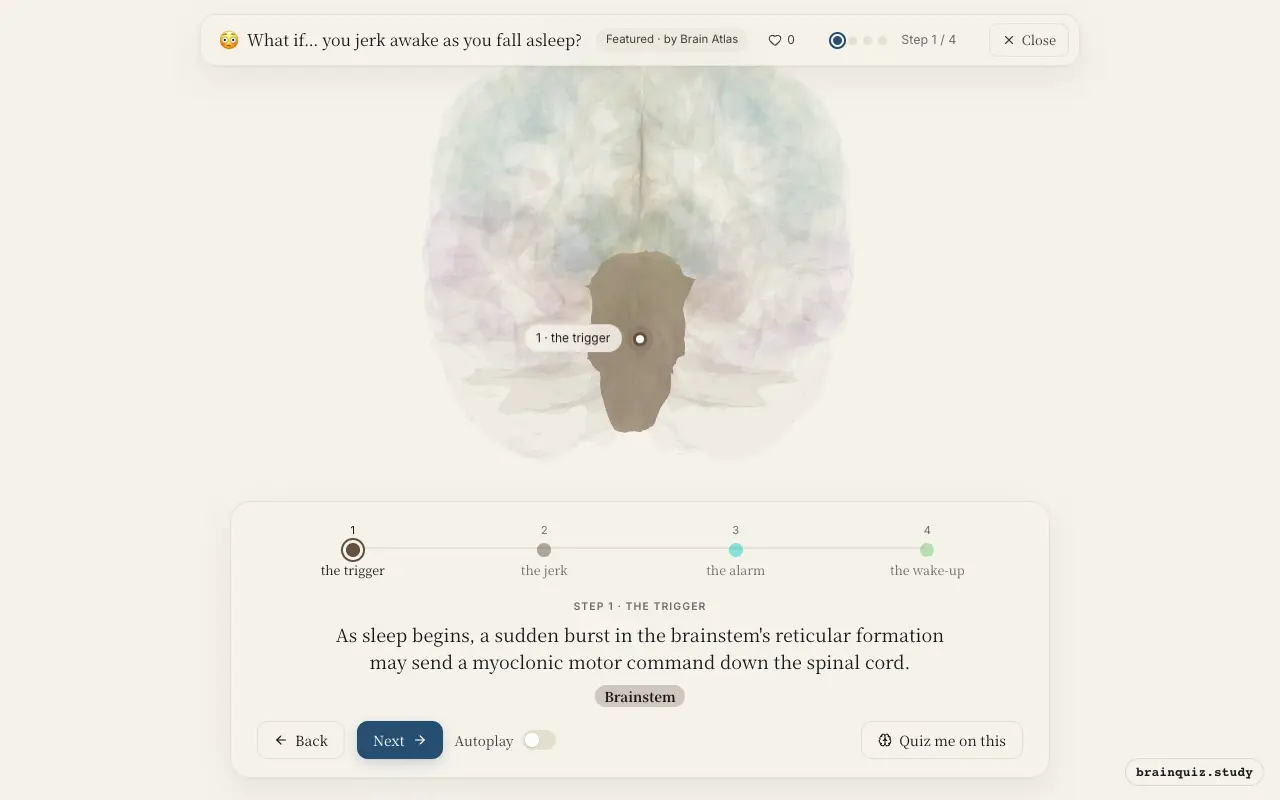
The brainstem normally reduces muscle tone and arousal as you transition to sleep, but occasionally a brief, spontaneous discharge occurs in the reticular formation. This burst activates reticulospinal pathways, initiating an involuntary muscle jerk. It is thought to reflect momentary instability in the sleep-wake switch.
2. Spinal Cord: the jerk
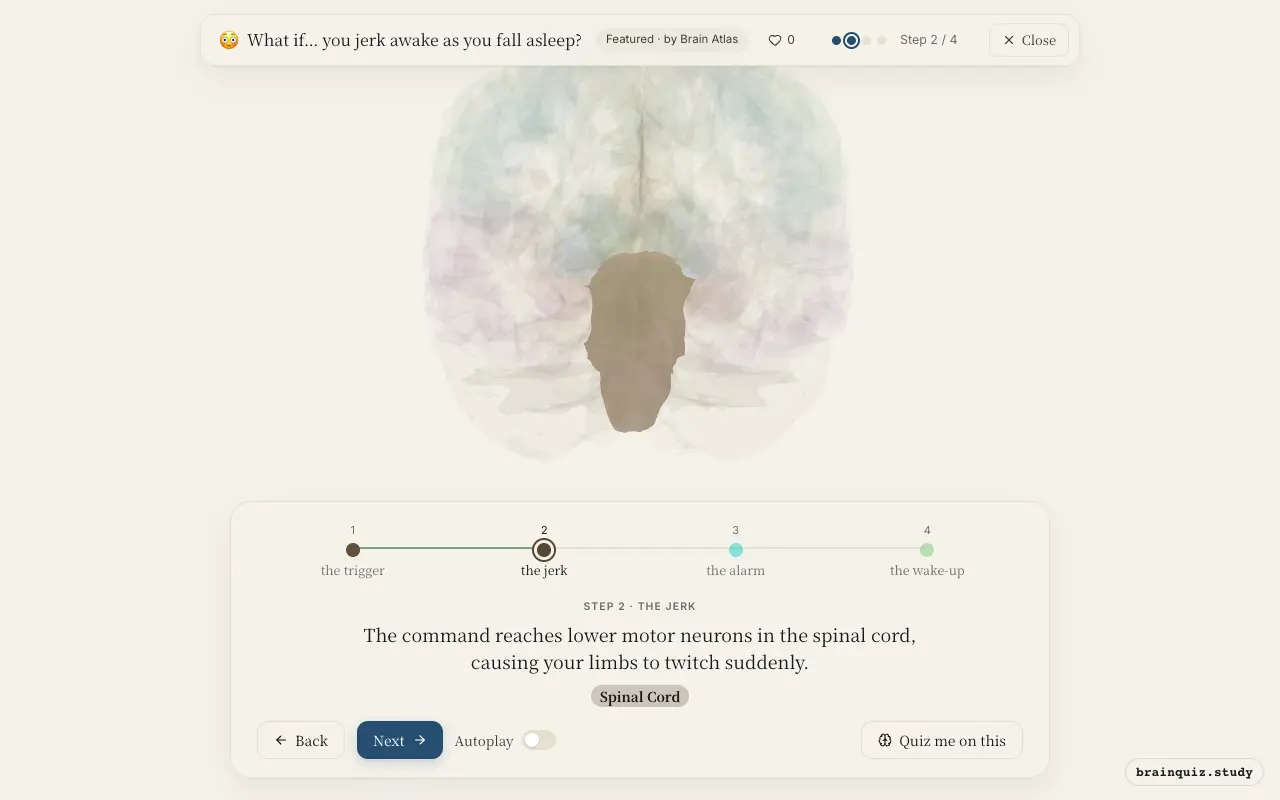
The reticulospinal tract synapses on alpha motor neurons in the ventral horn of the spinal cord, which directly stimulate muscle fibers. This produces a rapid, simultaneous contraction of muscles, often in the legs or arms. The entire event lasts only a fraction of a second, but the movement is strong enough to be felt.
3. Thalamus: the alarm
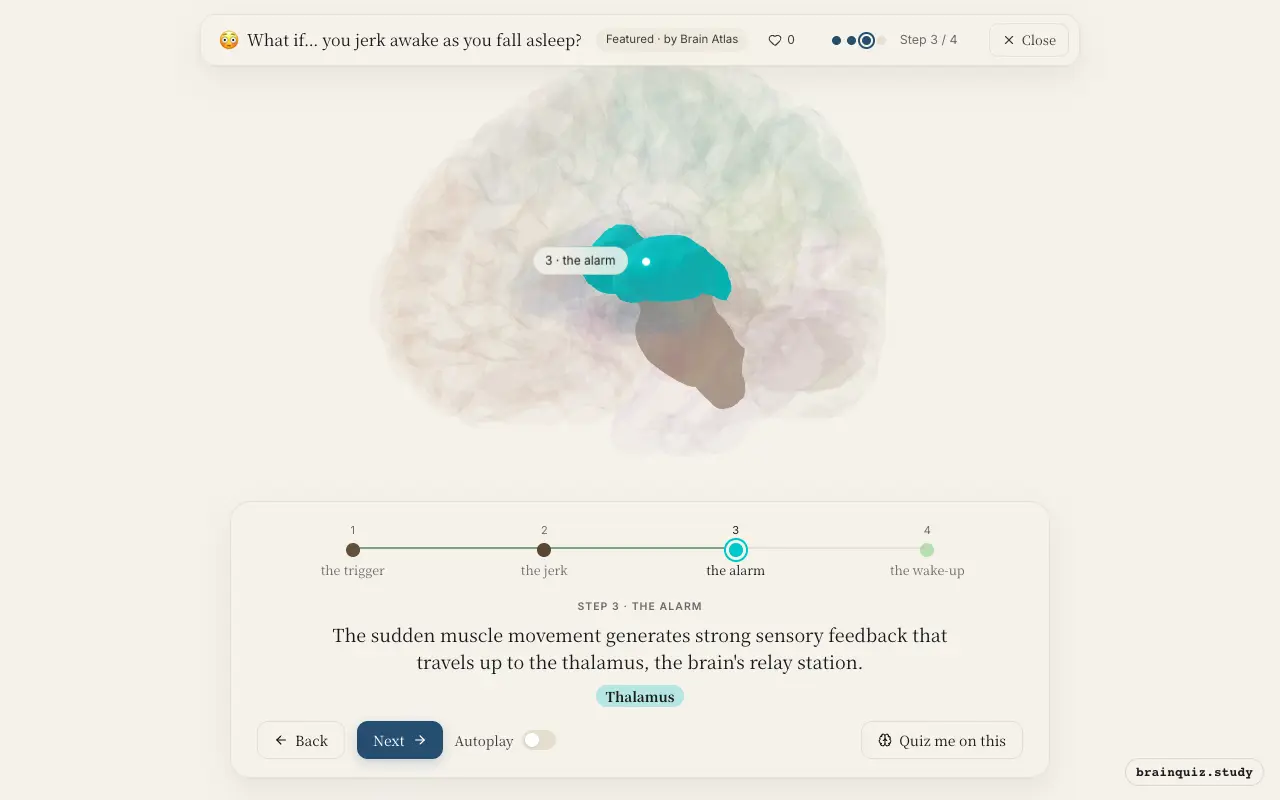
Proprioceptors in muscles and joints detect the unexpected stretch and fire intensely. These signals ascend via the dorsal column-medial lemniscus pathway to the thalamus. The thalamus, especially its intralaminar nuclei, also receives collateral input from the brainstem arousal system, amplifying the alerting signal.
4. Somatosensory Cortex: the wake-up
The primary somatosensory cortex processes the proprioceptive information, creating a conscious sensation of the jerk. Simultaneously, diffuse thalamocortical projections activate widespread cortical areas, lifting you from the brink of sleep. You awaken briefly, often with a startle, before drifting off again.
Good to know
- Hypnic jerks are a type of myoclonus, a brief, involuntary muscle twitch.
- They occur most often during the transition from wakefulness to NREM stage 1 sleep.
- Stress, caffeine, and sleep deprivation can increase their frequency.
Hypnic jerk vs sleep paralysis
Both happen at sleep-wake transitions. A hypnic jerk is a sudden muscle contraction as you fall asleep, while sleep paralysis is an inability to move upon waking due to lingering muscle atonia. In the jerk, brainstem motor signals fire unexpectedly; in sleep paralysis, inhibitory signals persist too long.
Test yourself
Which brain region is most likely responsible for generating the motor burst that causes a hypnic jerk?
At what point in the sleep cycle do hypnic jerks typically occur?
Why does a hypnic jerk often cause you to wake up?
0 of 3 answered · 0 correct
Simplified: many regions work together at once, and this shows the main players in the order they act.