What happens in your brain when you sweat in the heat?
Updated
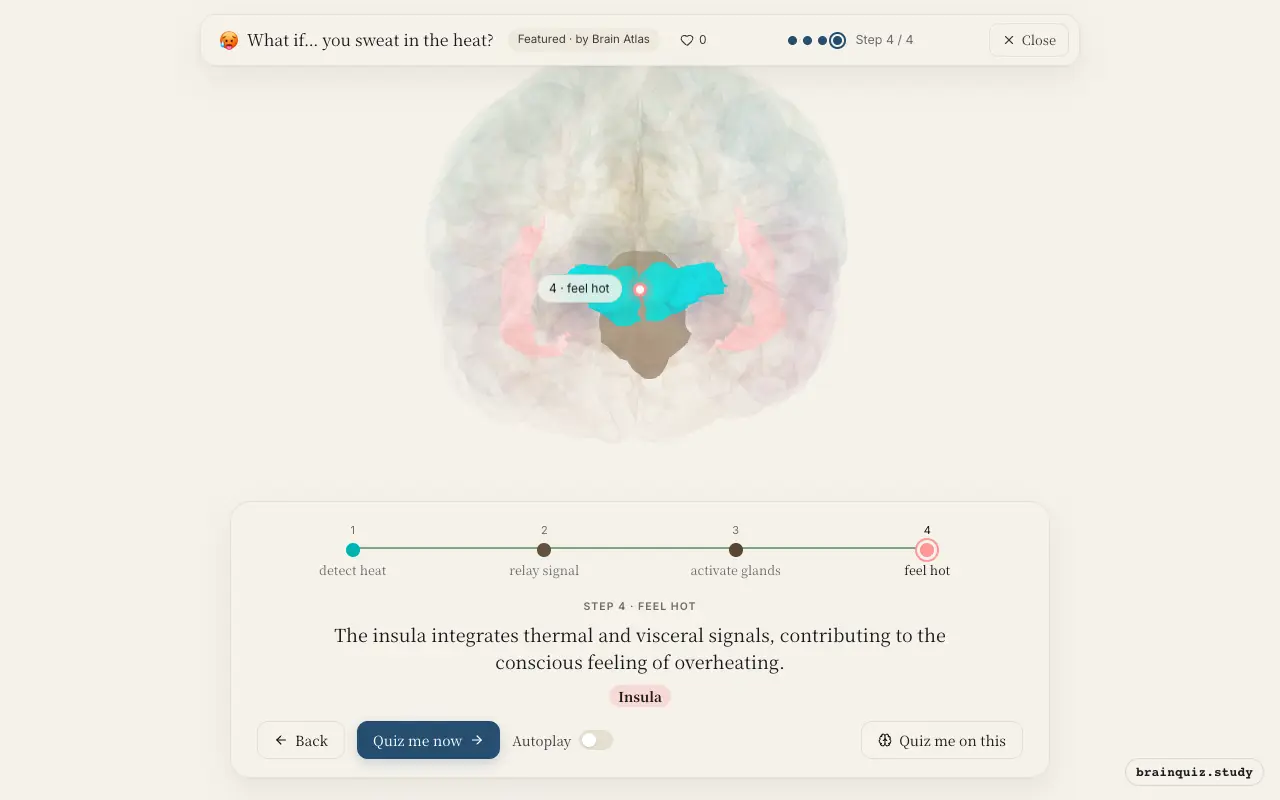
Your hypothalamus senses rising blood temperature and triggers cooling. It sends signals through the brainstem and spinal cord to activate sweat glands. The insula contributes to the conscious feeling of being hot and damp.
Watch it light up on the 3D brain
Brain regions that light up
| Order | Region | What it does here |
|---|---|---|
| 1 | Hypothalamus | Thermosensitive neurons in the hypothalamus sense the rise in blood temperature. |
| 2 | Brainstem | The hypothalamus sends descending signals through the brainstem to the spinal cord. |
| 3 | Spinal Cord | Sympathetic preganglionic neurons in the spinal cord send signals that lead to cholinergic activation of sweat glands. |
| 4 | Insula | The insula integrates thermal and visceral signals, contributing to the conscious feeling of overheating. |
1. Hypothalamus: detect heat
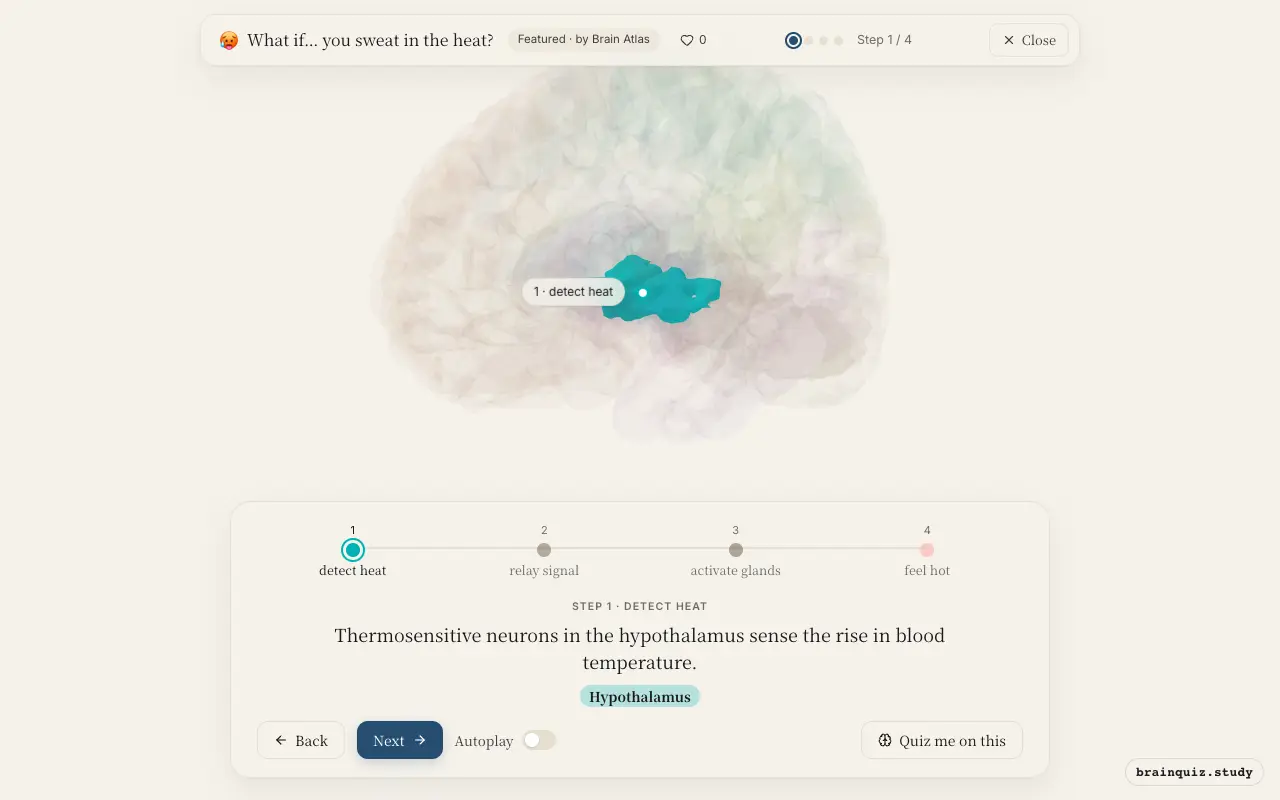
The preoptic area of the hypothalamus contains warm-sensitive neurons that increase firing as core temperature climbs. This region integrates thermal information and initiates autonomic cooling responses, including sweating and vasodilation.
2. Brainstem: relay signal
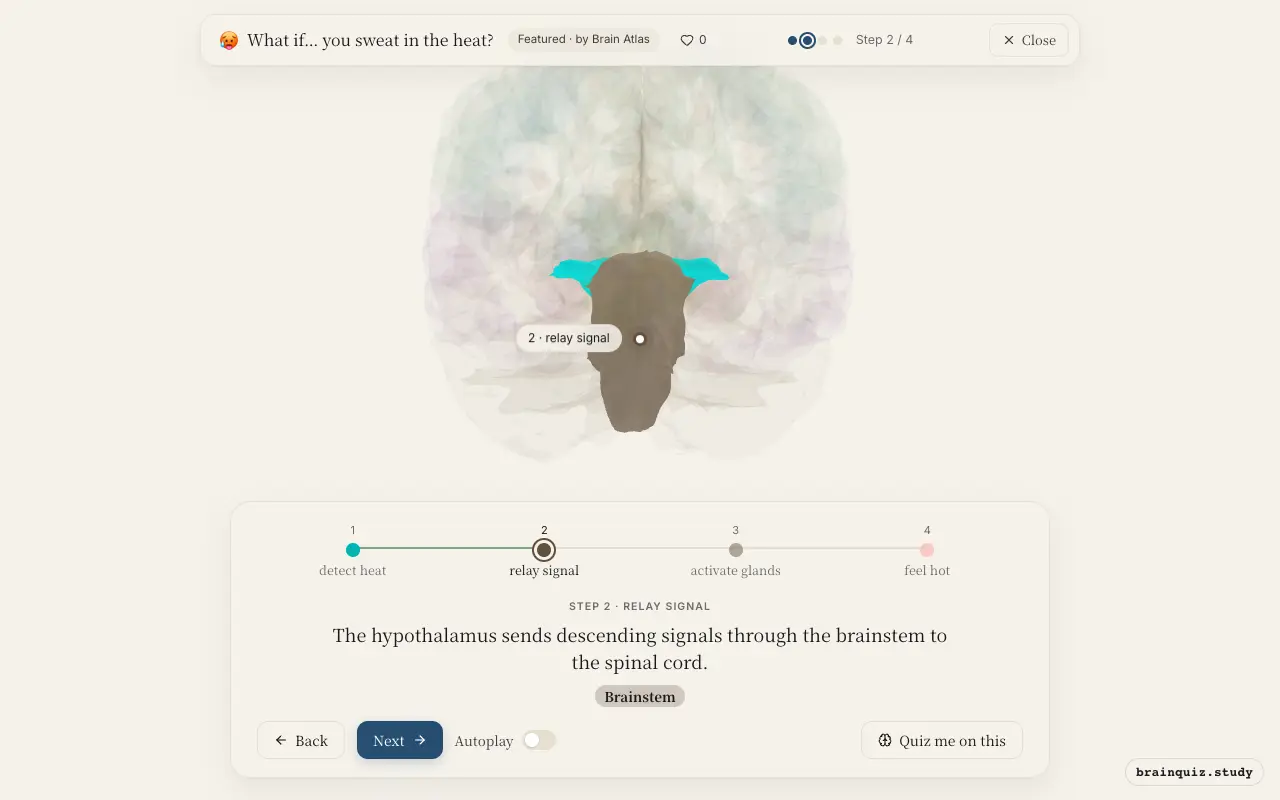
Autonomic pathways from the hypothalamus synapse in brainstem nuclei before continuing to the spinal cord. The brainstem coordinates the sympathetic outflow that will activate sweat glands throughout the body.
3. Spinal Cord: activate glands
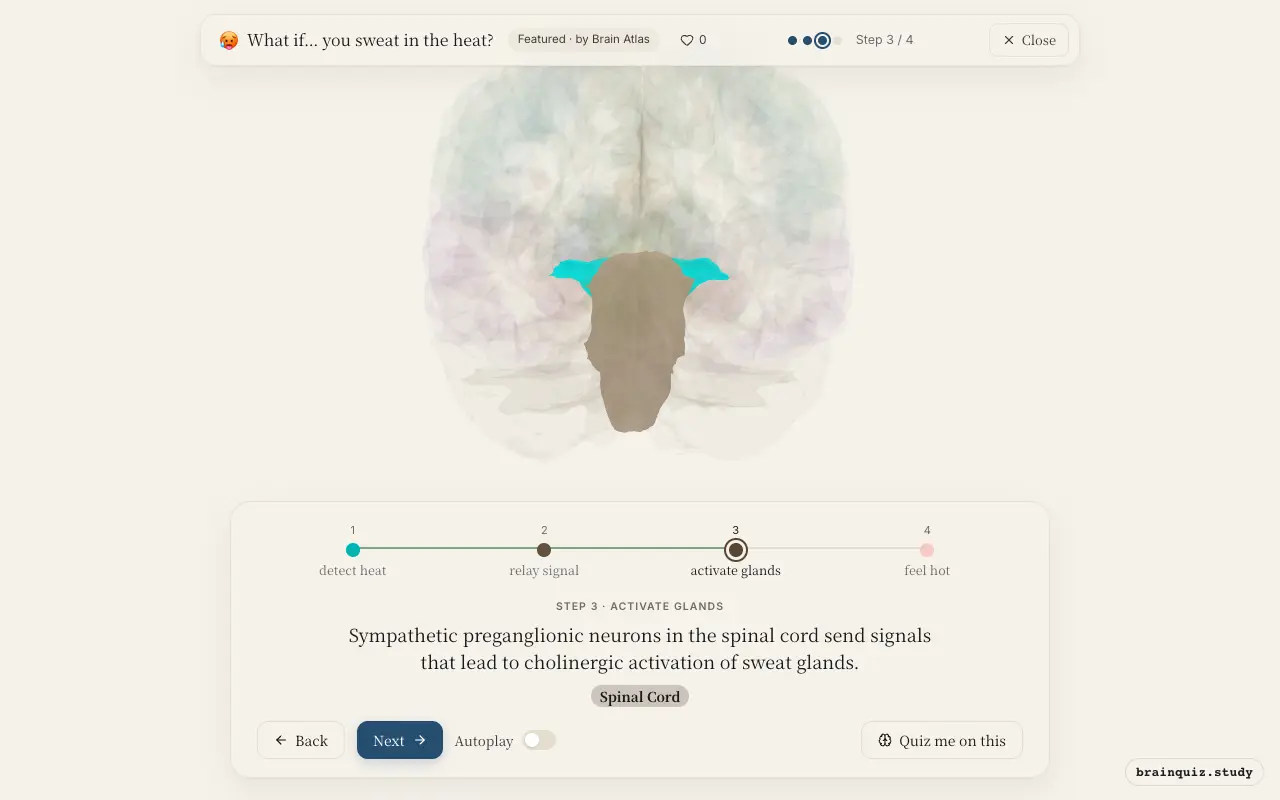
Preganglionic sympathetic neurons in the intermediolateral cell column of the spinal cord project to sympathetic ganglia. Postganglionic fibers release acetylcholine onto sweat glands, stimulating secretion and evaporative cooling.
4. Insula: feel hot
The insula receives input from thermoreceptors and interoceptive pathways, building a sense of body state. It contributes to the awareness of being hot and sweating, and may motivate behaviors like seeking shade.
Good to know
- The preoptic area of the hypothalamus contains warm-sensitive neurons that increase firing rate as blood temperature rises.
- Sweat glands are innervated by sympathetic cholinergic fibers, an exception to the usual adrenergic sympathetic signaling.
- The insula is part of the interoceptive network, integrating signals about body temperature, pain, and visceral state.
Heat Sweating vs Stress Sweating
In heat, the hypothalamus drives sweating via brainstem and spinal cord, and the insula contributes to the feeling of warmth. In stress, the amygdala and prefrontal cortex activate the sympathetic nervous system directly, often causing palmar sweating without a core temperature change.
Test yourself
Which brain region is primarily responsible for detecting elevated body temperature?
What neurotransmitter is released at the sweat gland to stimulate sweating?
Which pathway is correct for heat-induced sweating?
0 of 3 answered · 0 correct
Simplified: many regions work together at once, and this shows the main players in the order they act.