What happens in your brain when you yawn?
Updated
Yawning is driven by the brainstem's yawning center, regulated by the hypothalamus, executed by brainstem motor circuits' jaw and respiratory muscle commands, and perceived through the insula's interoceptive signals.
Watch it light up on the 3D brain
Brain regions that light up
| Order | Region | What it does here |
|---|---|---|
| 1 | Brainstem | The brainstem's reticular formation triggers the yawning reflex. |
| 2 | Hypothalamus | The hypothalamus modulates yawning frequency and context. |
| 3 | Motor Cortex | Brainstem motor circuits command jaw, face, and respiratory muscles to produce the yawn. |
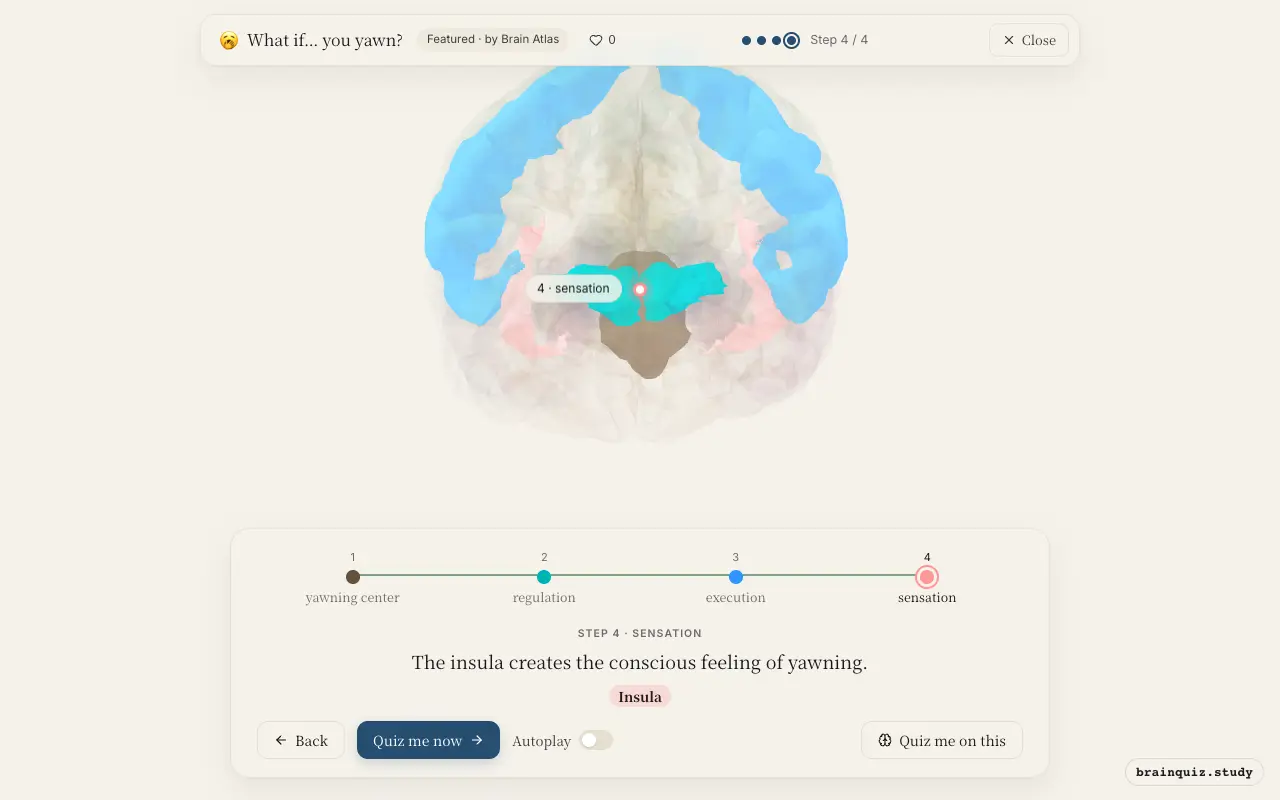
| 4 | Insula | The insula creates the conscious feeling of yawning. |
1. Brainstem: yawning center
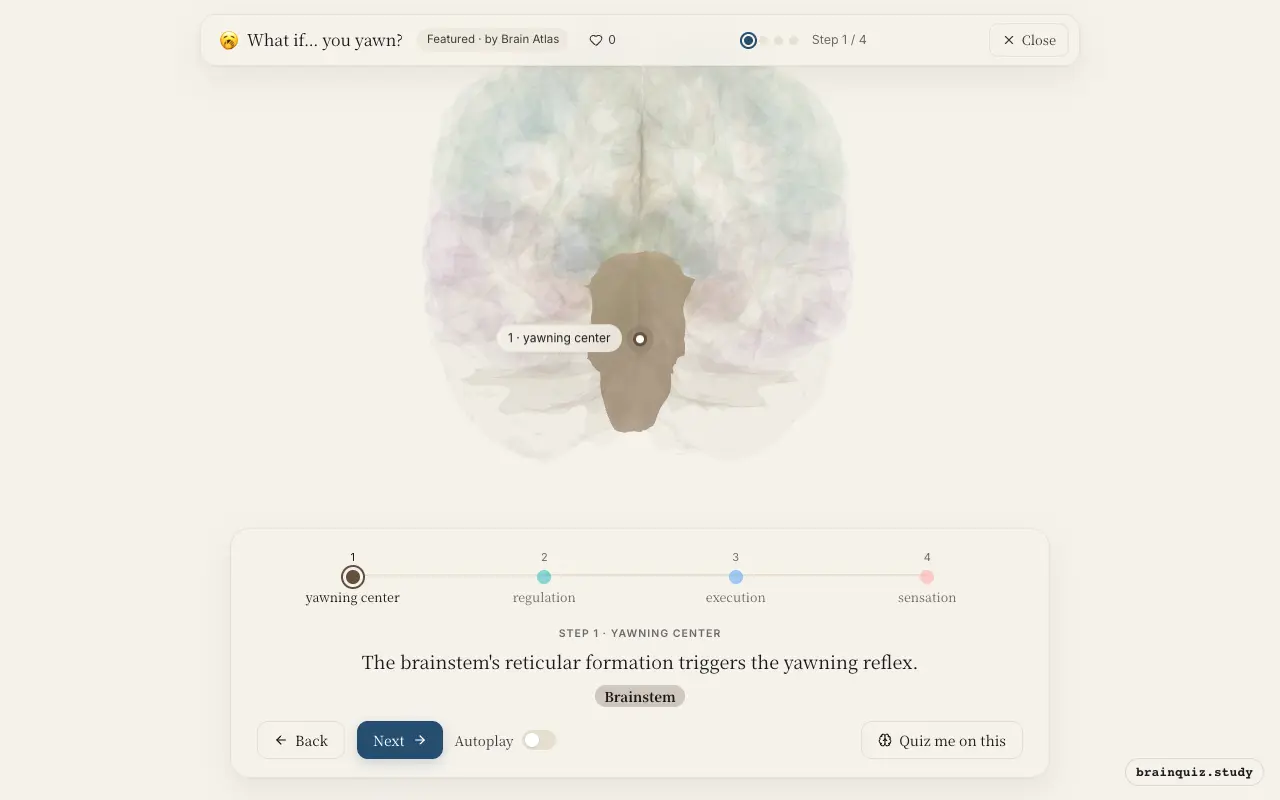
The brainstem contains a yawning center, likely in the reticular formation and cranial nerve nuclei, that initiates the sequence. It receives inputs about arousal and homeostatic state. When triggered, it sends signals to respiratory and facial muscles.
2. Hypothalamus: regulation
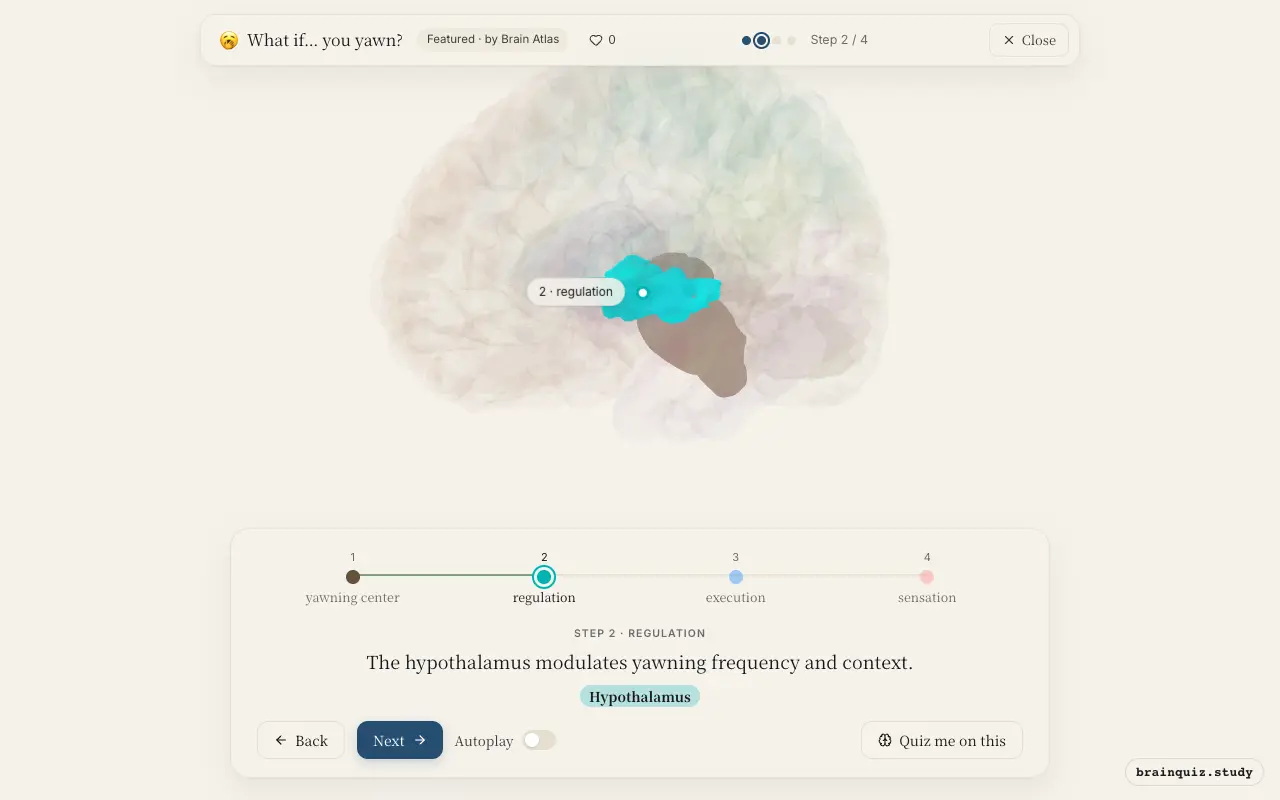
The hypothalamus, especially the paraventricular nucleus, releases oxytocin and other neuromodulators that influence yawning. It integrates circadian, thermal, and social cues to decide when yawning is appropriate. This regulation explains why yawning occurs more when tired or bored.
3. Motor Cortex: execution
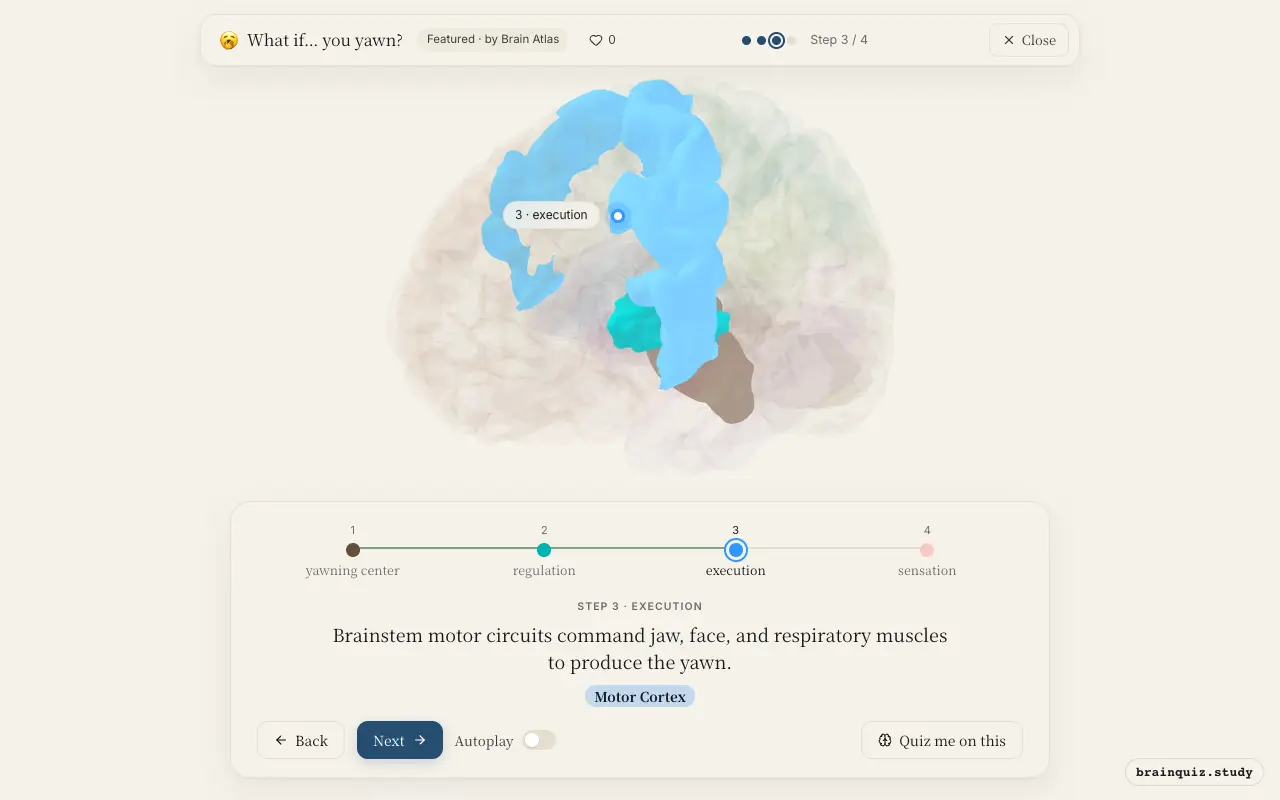
The primary motor cortex sends descending signals via the corticobulbar and corticospinal tracts to motor neurons controlling the jaw, larynx, and diaphragm. The wide mouth opening and deep inhalation are executed in a coordinated pattern. This step transforms the urge into physical action.
4. Insula: sensation
The insula integrates interoceptive signals from the stretching jaw, chest, and airways, producing the subjective experience of yawning. It also monitors internal state, contributing to the sense of relief or satisfaction after a yawn. This awareness closes the loop.
Good to know
- Yawning is a highly stereotyped behavior conserved across vertebrates, suggesting an ancient brainstem origin.
- Contagious yawning, seen in humans and some social animals, involves cortical areas like the prefrontal cortex and mirror neuron system, but spontaneous yawning is primarily brainstem-driven.
- Dopamine and oxytocin in the hypothalamus can increase yawning frequency, while opioid peptides may inhibit it.
Spontaneous vs contagious yawning
Spontaneous yawning arises from brainstem and hypothalamic activity without external triggers. Contagious yawning, triggered by seeing or hearing others yawn, activates social brain networks including the prefrontal cortex and mirror neuron regions. The insula and anterior cingulate are also more engaged during contagious yawning.
Test yourself
Which brain region is considered the primary generator of yawning?
What role does the hypothalamus play in yawning?
Contagious yawning, compared to spontaneous yawning, involves additional activation in which areas?
0 of 3 answered · 0 correct
Simplified: many regions work together at once, and this shows the main players in the order they act.