What happens in your brain when you shiver in the cold?
Updated
Cold signals travel through the thalamus to the somatosensory cortex, making you feel cold. The hypothalamus senses the drop in core temperature and sends signals via the brainstem to the spinal cord, triggering shivering.
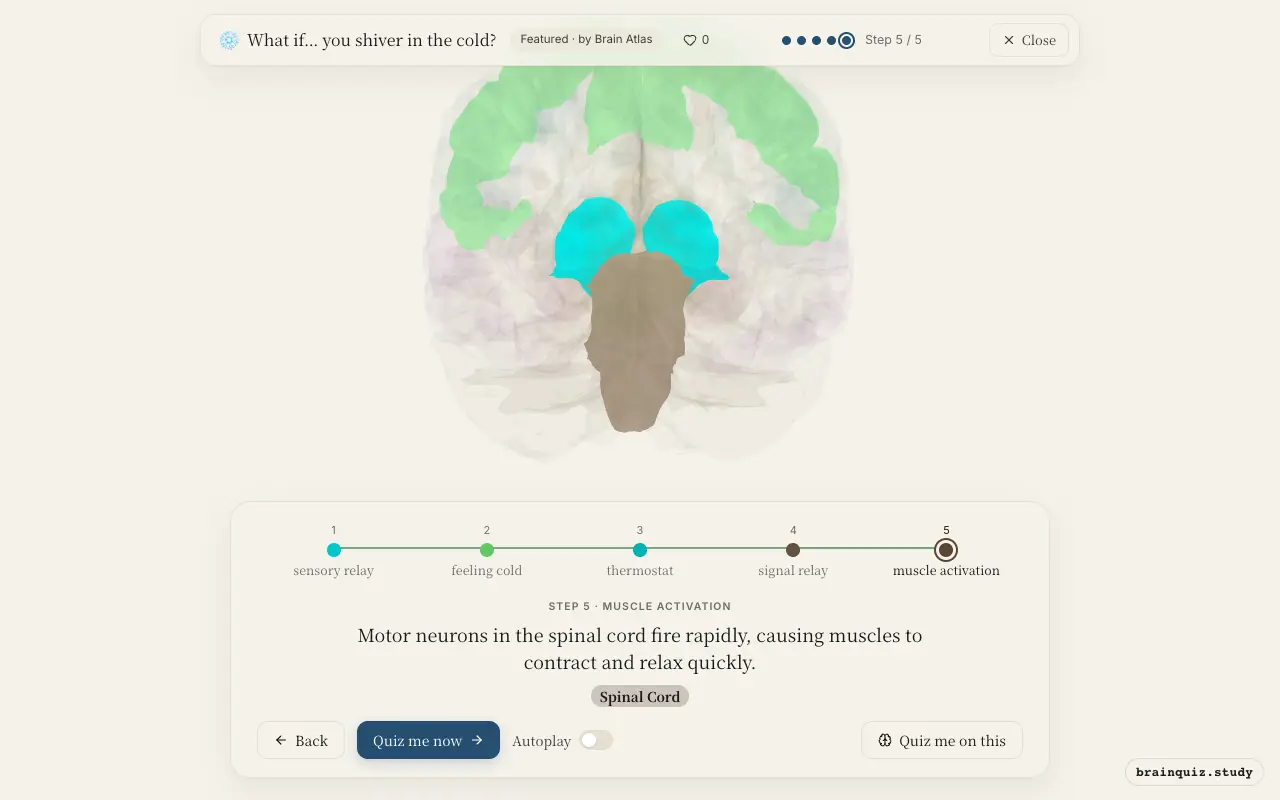
Watch it light up on the 3D brain
Brain regions that light up
| Order | Region | What it does here |
|---|---|---|
| 1 | Thalamus | Cold signals from skin reach the thalamus, the brain's sensory switchboard. |
| 2 | Somatosensory Cortex | You consciously feel the cold as the somatosensory cortex processes the temperature signal. |
| 3 | Hypothalamus | The hypothalamus detects a drop in core body temperature and initiates the shivering response. |
| 4 | Brainstem | The hypothalamus sends commands through the brainstem to the spinal cord. |
| 5 | Spinal Cord | Motor neurons in the spinal cord fire rapidly, causing muscles to contract and relax quickly. |
1. Thalamus: sensory relay
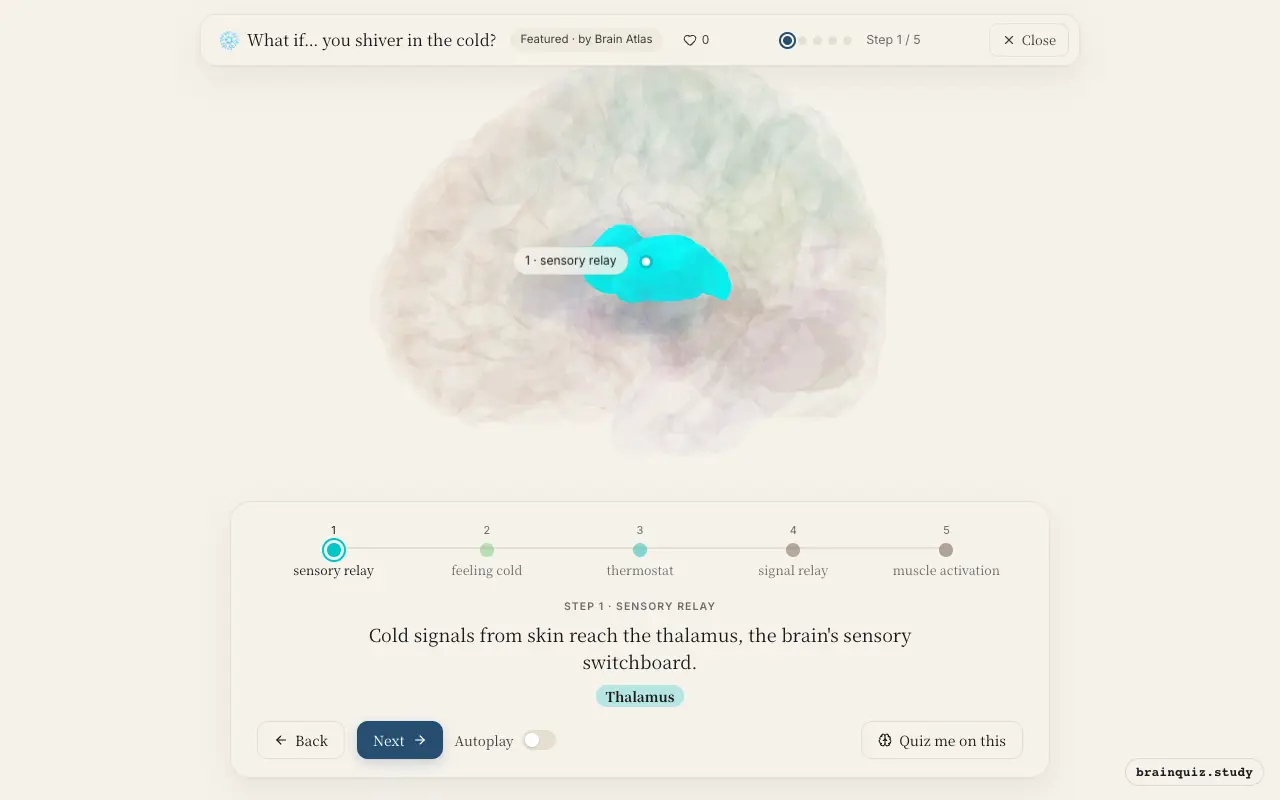
The thalamus receives input from peripheral thermoreceptors via the spinal cord and relays it to the somatosensory cortex. It acts as a gateway, filtering and directing sensory information to the appropriate cortical areas for conscious awareness.
2. Somatosensory Cortex: feeling cold
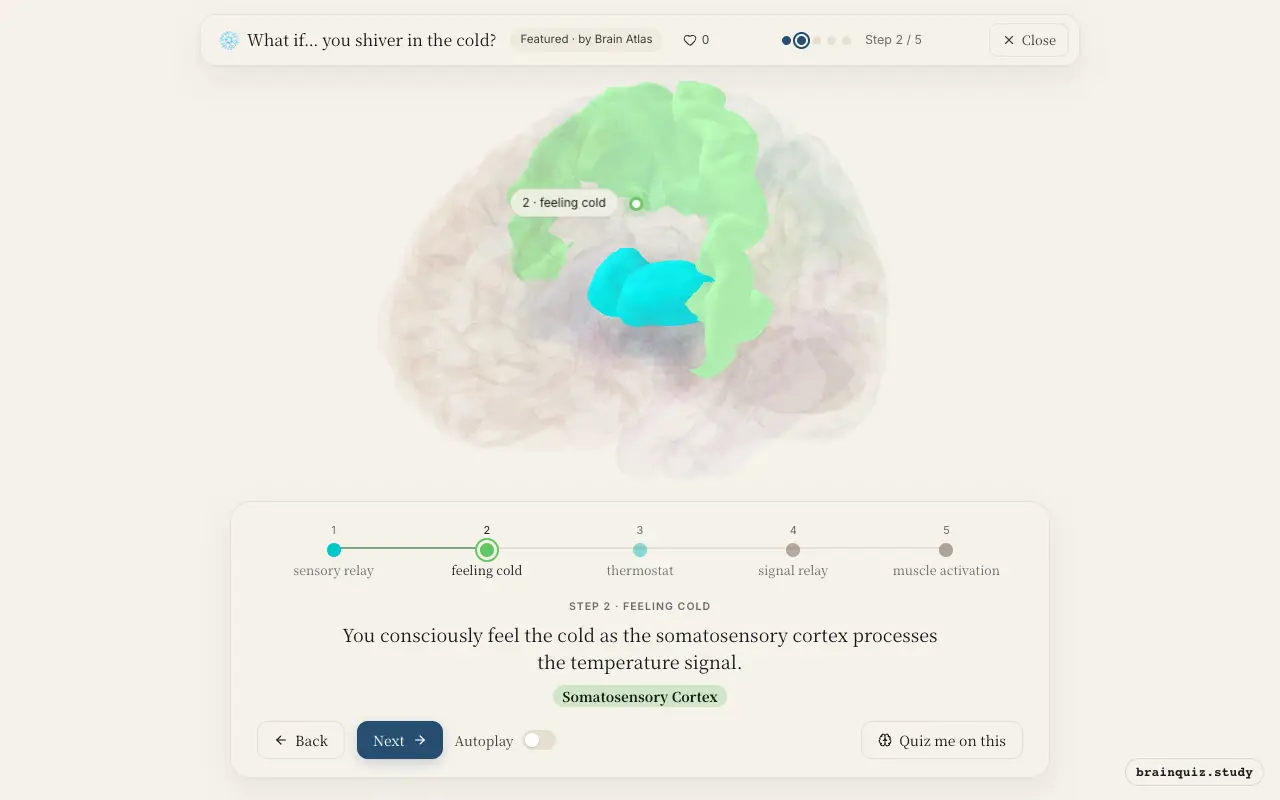
The primary somatosensory cortex, located in the postcentral gyrus, maps the body's surface and interprets the cold sensation. This conscious perception allows you to recognize the environmental chill and potentially seek warmth.
3. Hypothalamus: thermostat
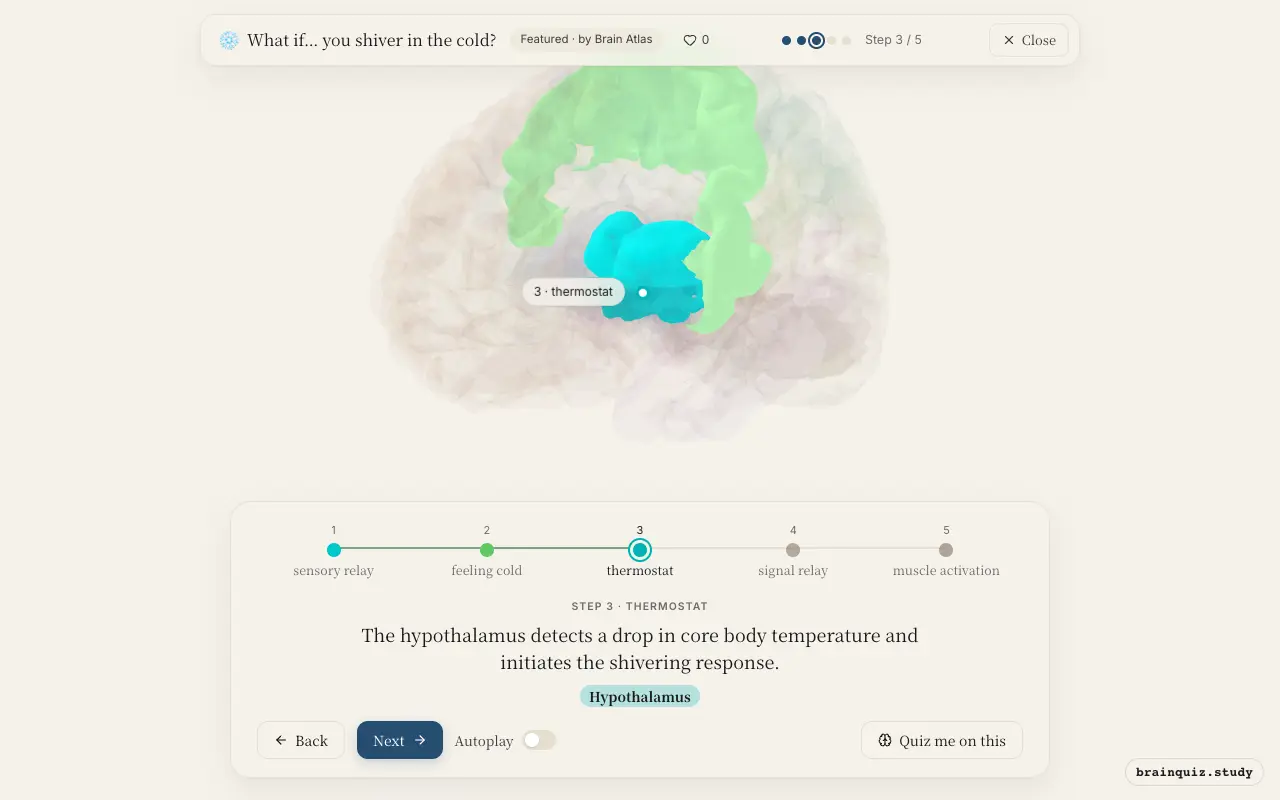
The preoptic area of the hypothalamus contains warm-sensitive neurons that monitor blood temperature. When core temperature falls below the set point, it activates heat production mechanisms, including shivering, a key thermoregulatory reflex.
4. Brainstem: signal relay
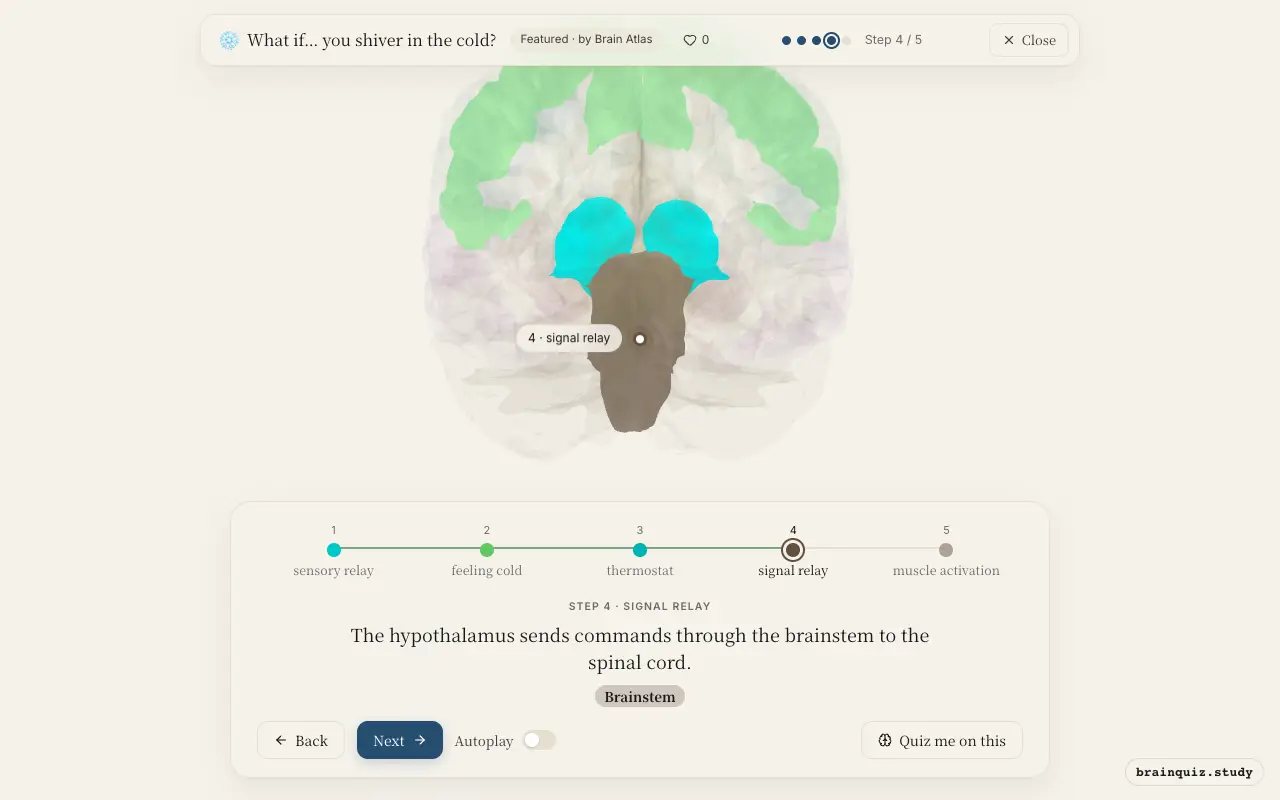
Descending pathways from the hypothalamus project to brainstem nuclei, such as the rostral ventromedial medulla, which then convey the shivering signal down the spinal cord. The brainstem acts as a relay station for involuntary motor commands.
5. Spinal Cord: muscle activation
Alpha motor neurons in the anterior horn of the spinal cord receive the shivering signal and activate skeletal muscles in a rhythmic pattern, typically at 10-20 Hz. These rapid contractions generate heat to raise core temperature, which is the essence of shivering.
Good to know
- Shivering can increase metabolic heat production up to five times the resting rate.
- The hypothalamus maintains a core temperature set point around 37°C (98.6°F).
- Shivering is mediated by the same motor neurons used for voluntary movement, but activated by brainstem reflexes rather than cortical commands.
Shivering vs Sweating
In cold, the hypothalamus triggers shivering to produce heat; in heat, it triggers sweating and vasodilation to lose heat. Both are hypothalamic thermoregulatory responses but engage different effector pathways: shivering uses skeletal muscle via brainstem and spinal cord, while sweating uses autonomic nerves to sweat glands.
Test yourself
Which brain region is considered the body's thermostat, primarily responsible for initiating shivering?
Shivering involves rapid, involuntary muscle contractions. Which part of the nervous system directly activates the muscles?
What is the role of the thalamus in the shivering response?
0 of 3 answered · 0 correct
Simplified: many regions work together at once, and this shows the main players in the order they act.