What happens in your brain when you take a penalty kick under pressure?
Updated
The visual cortex sees the goal, the amygdala flags the pressure, the prefrontal cortex plans the shot, the premotor cortex prepares the kick, the motor cortex executes it, and the cerebellum fine-tunes timing and balance.
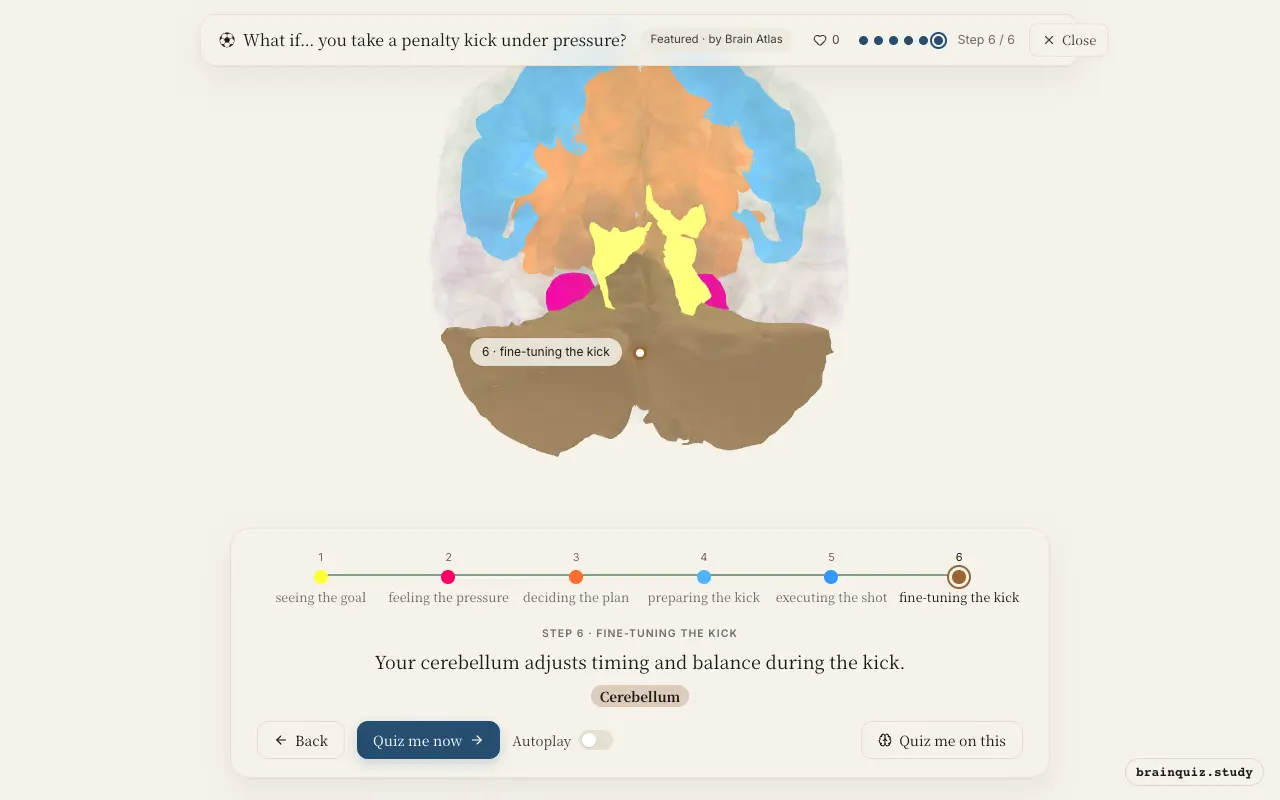
Watch it light up on the 3D brain
Brain regions that light up
| Order | Region | What it does here |
|---|---|---|
| 1 | Visual Cortex | Your visual cortex processes the goal, ball, and goalkeeper's position. |
| 2 | Amygdala | Your amygdala detects the high-stakes situation and triggers a stress response. |
| 3 | Prefrontal Cortex | Your prefrontal cortex weighs options and selects a target corner. |
| 4 | Premotor Cortex | Your premotor cortex sequences the muscle movements for the run-up and kick. |
| 5 | Motor Cortex | Your motor cortex sends commands to your leg muscles to strike the ball. |
| 6 | Cerebellum | Your cerebellum adjusts timing and balance during the kick. |
1. Visual Cortex: seeing the goal
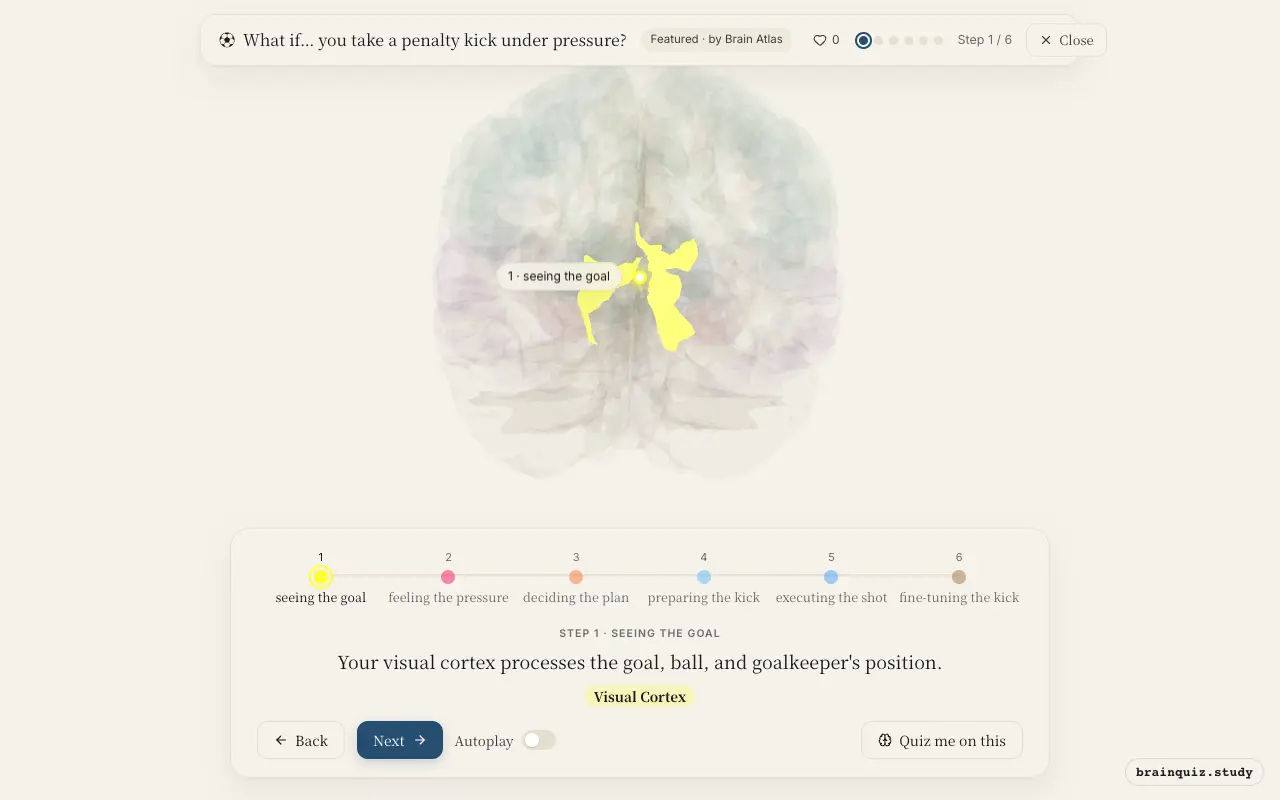
The primary visual cortex in the occipital lobe receives raw visual input from the eyes, detecting edges, orientation, and motion. Higher visual areas like the occipital cortex integrate this into a coherent scene, identifying the goal frame, the ball, and the goalkeeper's stance. This rapid processing provides the spatial information needed to aim the shot.
2. Amygdala: feeling the pressure
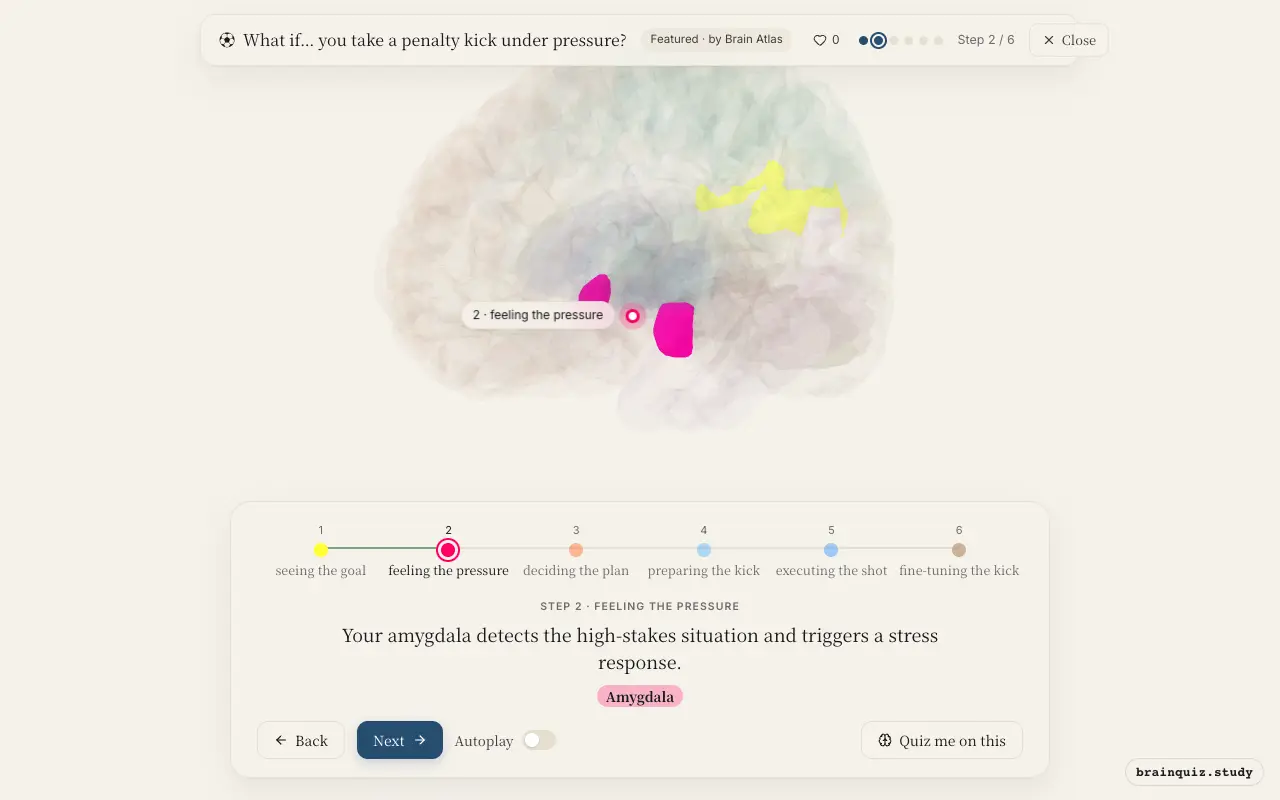
The amygdala evaluates the emotional significance of the moment—crowd noise, importance of the kick—and signals threat or pressure. It activates the hypothalamus and brainstem, which trigger the release of stress hormones like adrenaline and cortisol. This heightens arousal and focuses attention, but too much activation can impair fine motor control.
3. Prefrontal Cortex: deciding the plan
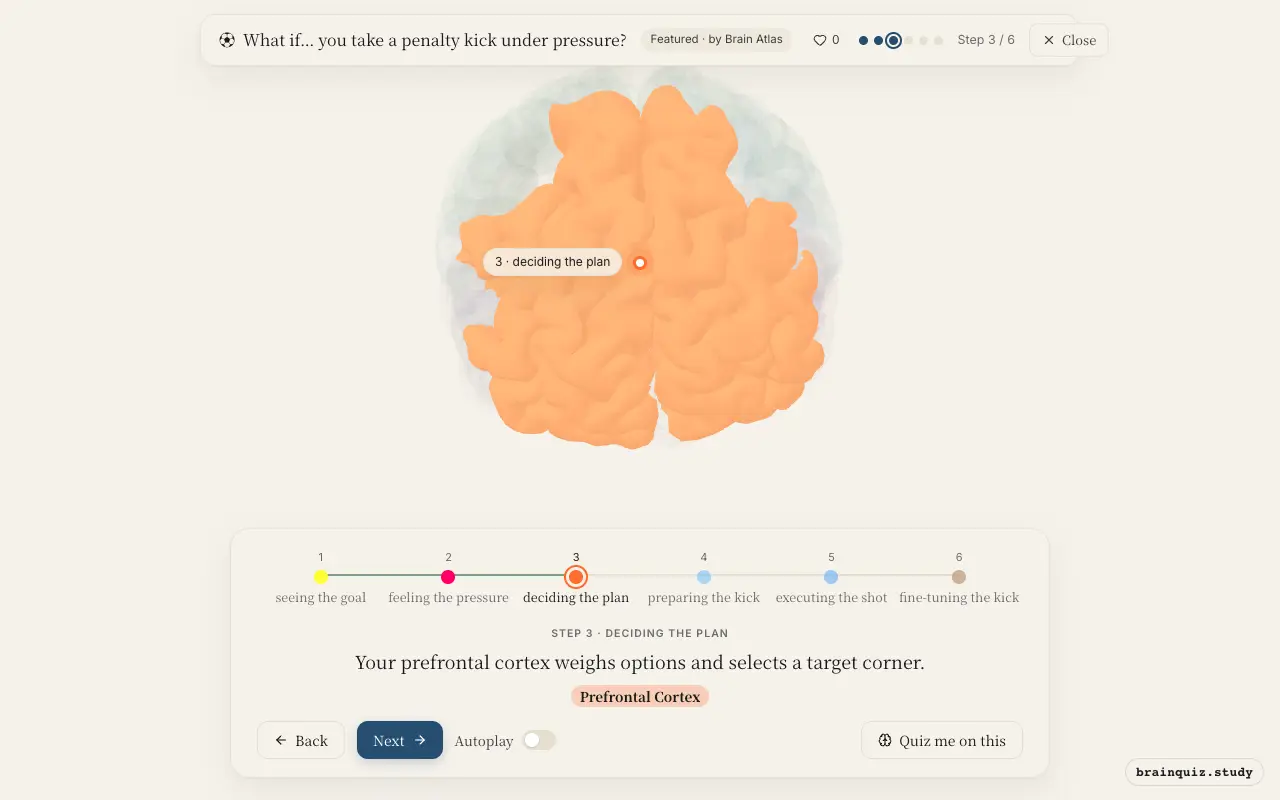
The dorsolateral prefrontal cortex integrates information from visual and emotional systems to make an executive decision. It holds the chosen target in working memory, suppresses impulsive reactions, and overrides the amygdala's alarm to maintain focus. This region is crucial for executing a pre-planned strategy under pressure.
4. Premotor Cortex: preparing the kick
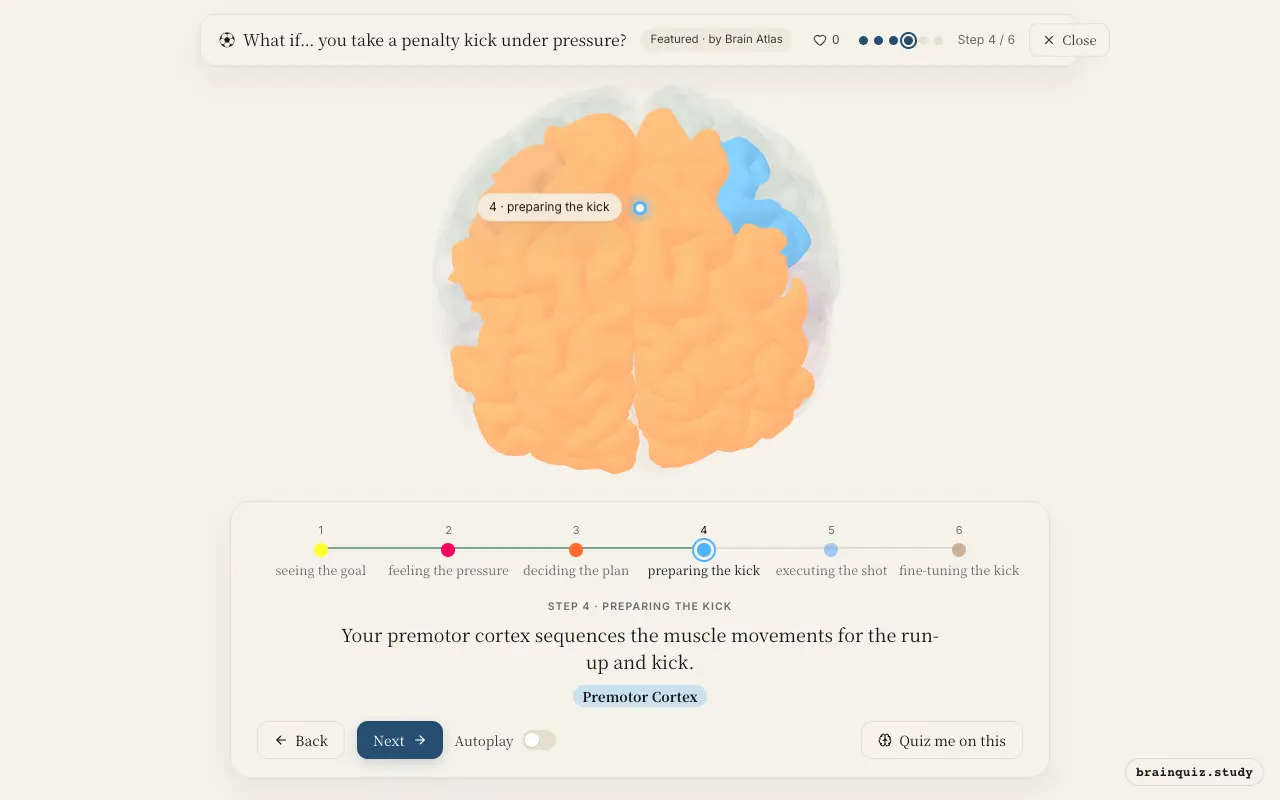
The premotor cortex, located anterior to the primary motor cortex, organizes the temporal sequence of actions: approaching the ball, planting the non-kicking foot, and swinging the kicking leg. It receives input from the prefrontal cortex about the chosen target and sends a motor plan to the motor cortex, ensuring the correct order of movements.
5. Motor Cortex: executing the shot
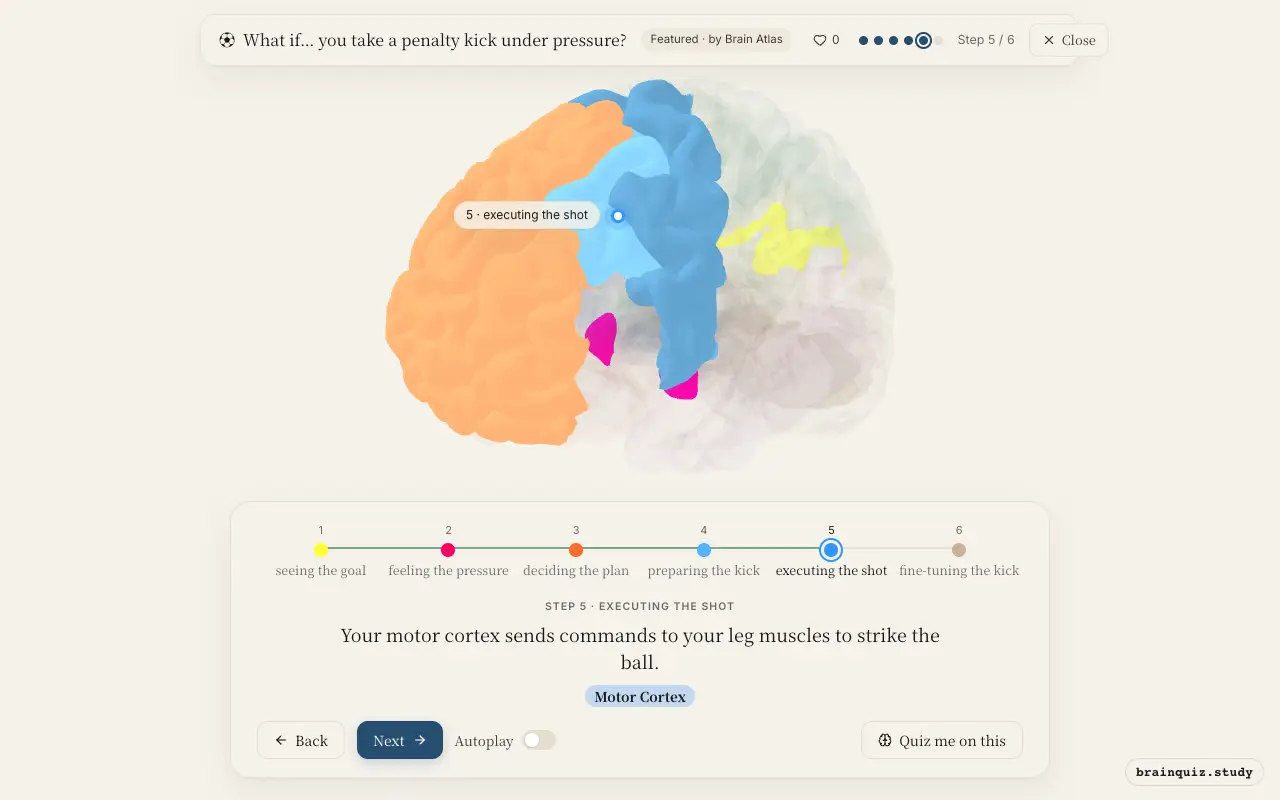
The primary motor cortex in the precentral gyrus sends signals down the corticospinal tract to lower motor neurons in the spinal cord, which directly activate leg and foot muscles. The precise force and direction of the kick depend on the population activity of motor cortex neurons, tuned to the intended movement trajectory.
6. Cerebellum: fine-tuning the kick
The cerebellum receives a copy of the motor command and sensory feedback from proprioceptors in muscles and joints. It compares intended and actual movement, making real-time corrections to ensure smooth coordination and accurate ball contact. This is essential for the precise timing and balance required in a penalty kick.
Good to know
- The basal ganglia help select and initiate the learned motor program for kicking, acting in parallel with the cortex.
- The anterior cingulate cortex monitors conflict between the urge to score and fear of missing, increasing activation under pressure.
- Stress from the amygdala can disrupt prefrontal cortex function, leading to 'choking' when pressure is extreme.
Penalty kick vs. practice kick
Under pressure, the amygdala and anterior cingulate show higher activity, while the prefrontal cortex may become less efficient due to stress hormones. In practice, motor planning and execution rely more on the basal ganglia and cerebellum with less emotional interference.
Test yourself
Which brain region first processes the visual scene of the goal and goalkeeper?
The amygdala's role in a pressured penalty kick is primarily to:
Which region sends the final motor command to the spinal cord to move the kicking leg?
0 of 3 answered · 0 correct
Simplified: many regions work together at once, and this shows the main players in the order they act.