What happens in your brain when you swim?
Updated
Premotor cortex plans the stroke sequence; motor cortex executes commands; cerebellum coordinates rhythm and balance; somatosensory cortex processes body position; brainstem regulates breathing.
Watch it light up on the 3D brain
Brain regions that light up
| Order | Region | What it does here |
|---|---|---|
| 1 | Premotor Cortex | Premotor cortex plans the sequence of arm and leg movements for each stroke. |
| 2 | Motor Cortex | Motor cortex sends signals down the spinal cord to contract swimming muscles. |
| 3 | Cerebellum | Cerebellum fine-tunes muscle timing to keep strokes smooth and balanced. |
| 4 | Somatosensory Cortex | Somatosensory cortex processes touch, pressure, and body position in the water. |
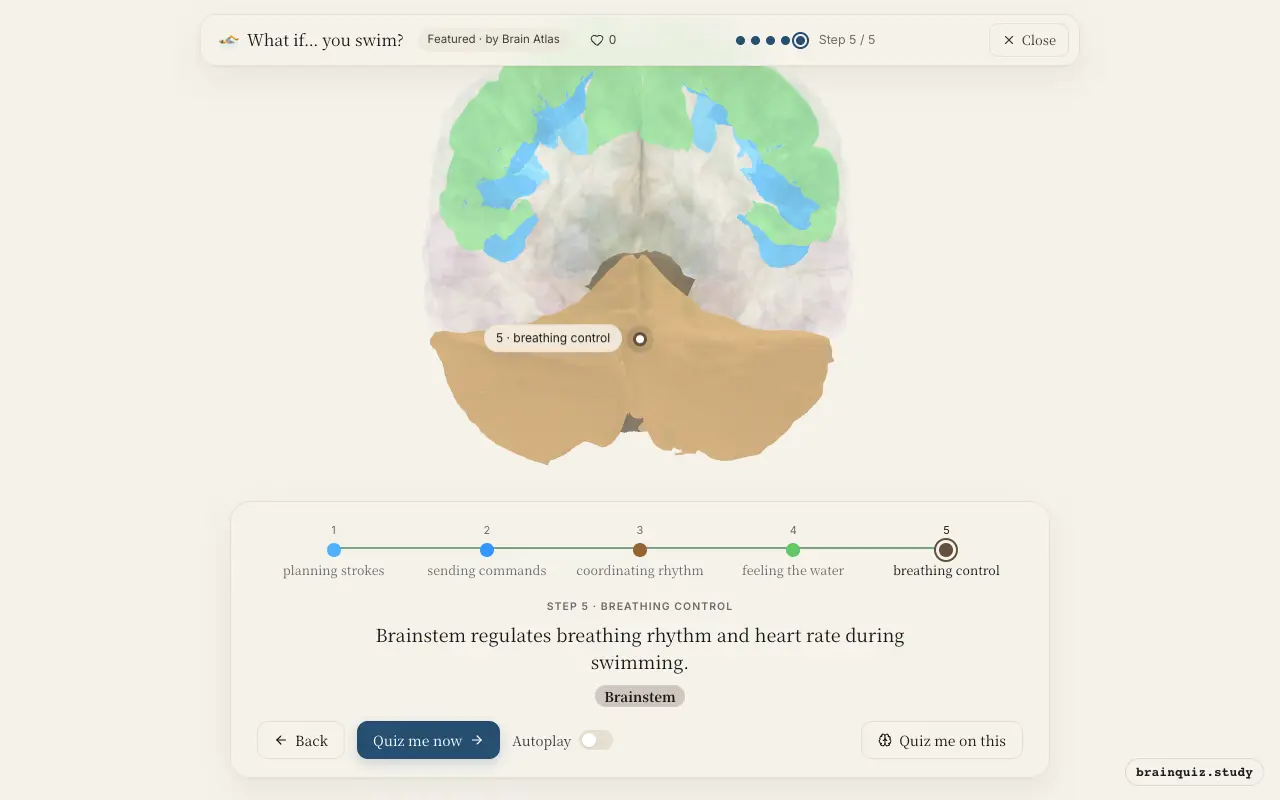
| 5 | Brainstem | Brainstem regulates breathing rhythm and heart rate during swimming. |
1. Premotor Cortex: planning strokes
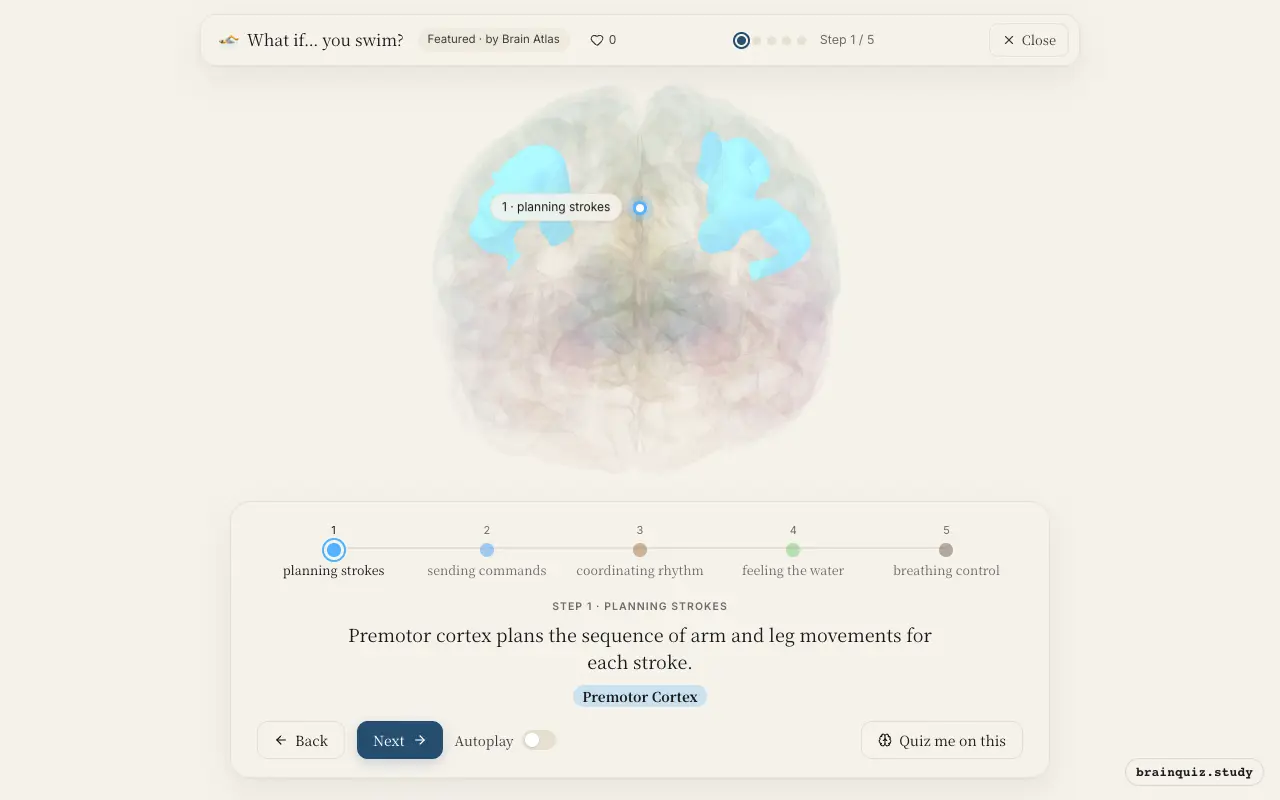
The premotor cortex is active before movement begins, organizing the motor program for the chosen swimming stroke. It integrates information from other areas to sequence muscle activations in the correct order. This planning is crucial for smooth, coordinated swimming.
2. Motor Cortex: sending commands
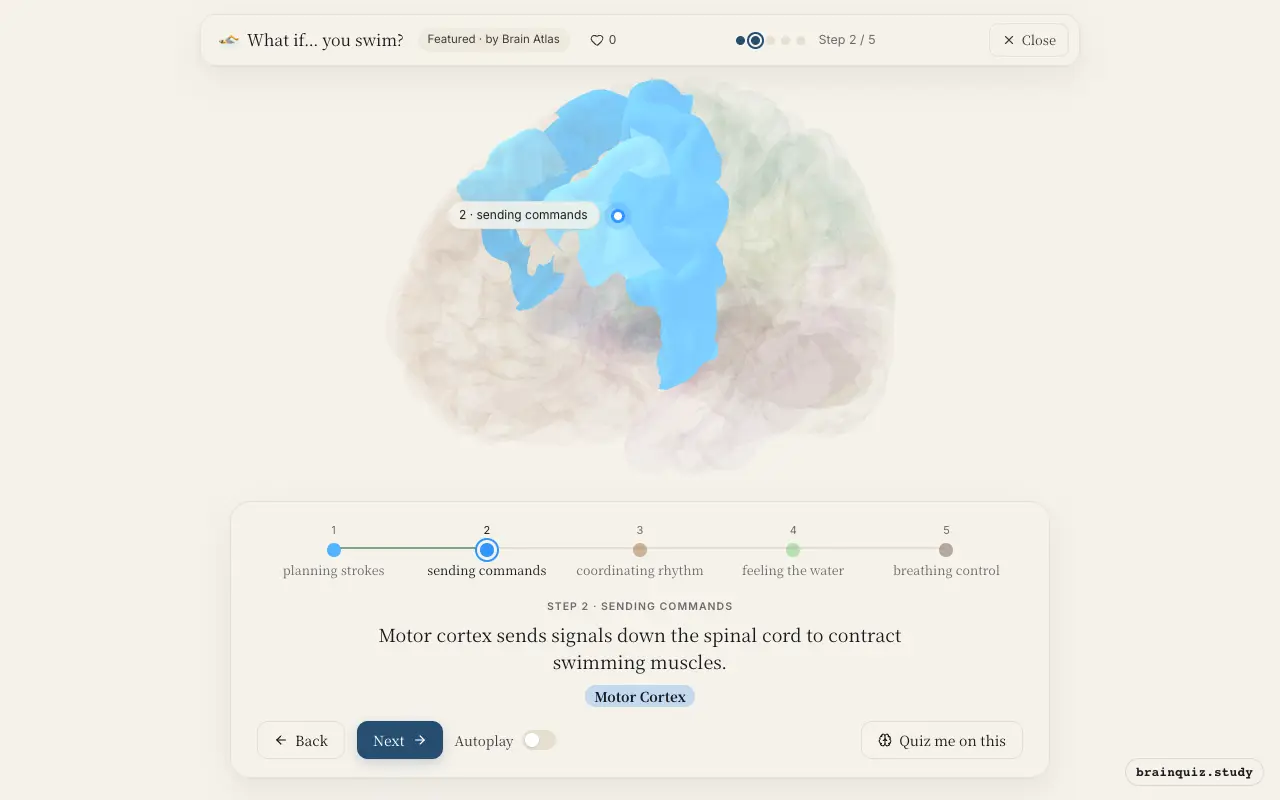
The primary motor cortex executes the planned movements by sending action potentials via the corticospinal tract to lower motor neurons. These neurons directly stimulate muscles in the arms, legs, and trunk. The motor cortex is highly active throughout swimming, adjusting force and direction.
3. Cerebellum: coordinating rhythm
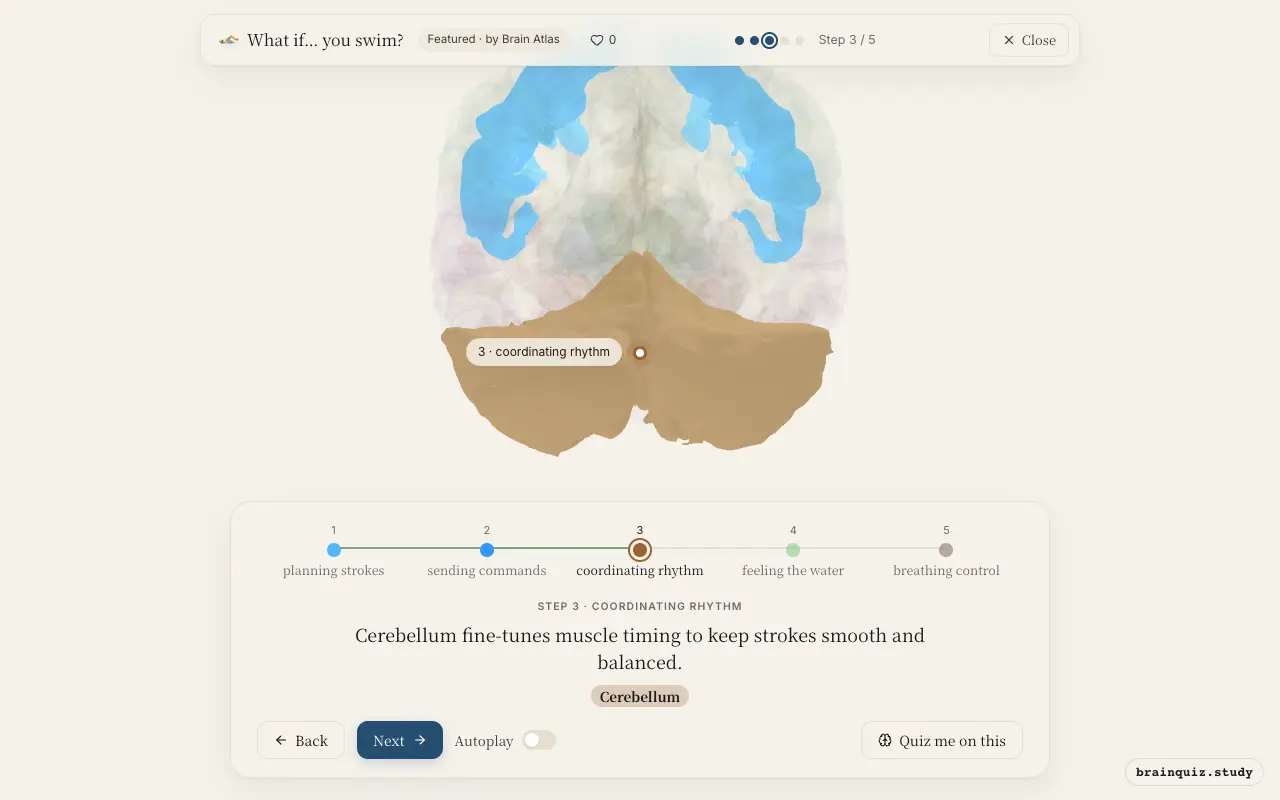
The cerebellum receives sensory feedback and compares it with the intended movement, making real-time corrections. It ensures that alternating arm and leg movements are properly timed and that the body remains streamlined. Damage to the cerebellum leads to uncoordinated, jerky movements.
4. Somatosensory Cortex: feeling the water
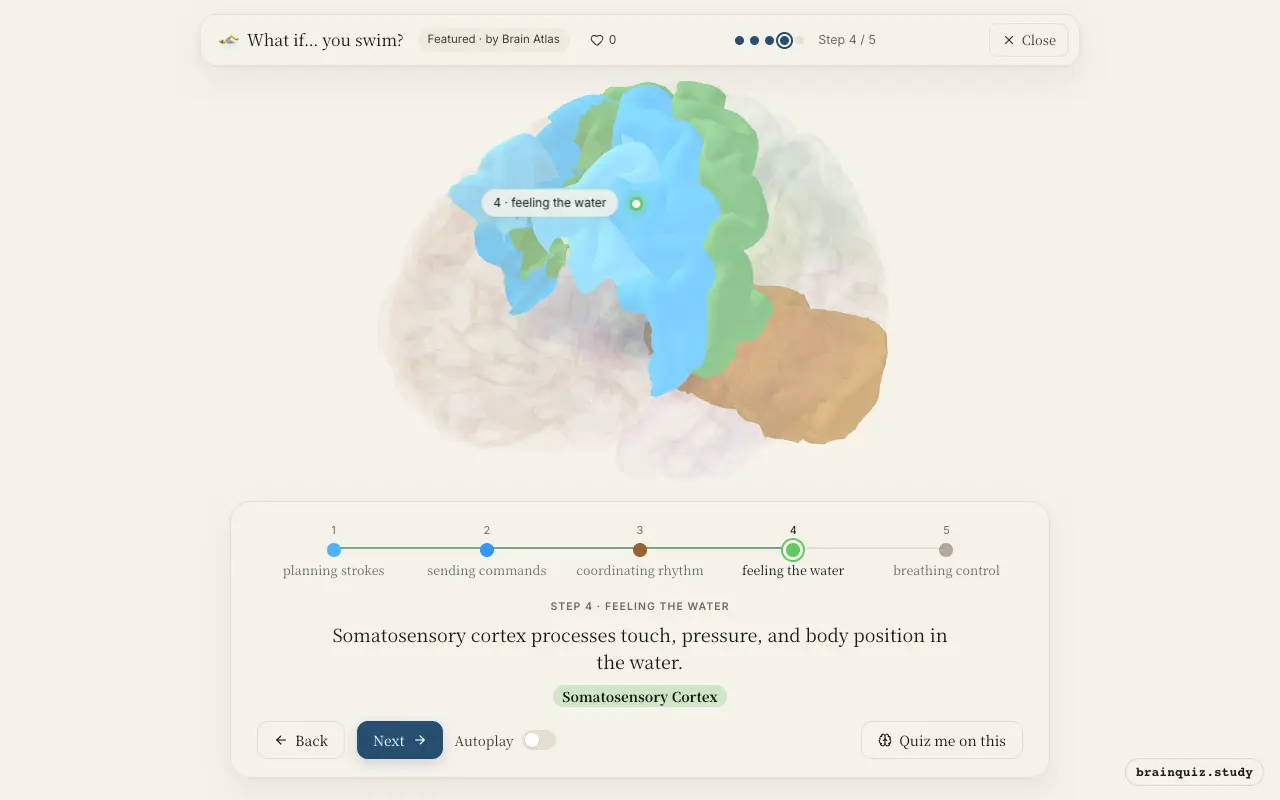
Proprioceptors in muscles and joints, along with skin receptors sensing water flow, send signals to the somatosensory cortex. This area constructs a body map, allowing the swimmer to know where limbs are without looking. It helps adjust stroke technique based on water resistance.
5. Brainstem: breathing control
The brainstem contains central pattern generators that control the basic rhythm of breathing. Swimmers must synchronize inhalation and exhalation with stroke cycles, a coordination task managed by brainstem nuclei. It also adjusts cardiovascular responses to meet the oxygen demands of exercise.
Good to know
- Swimming engages almost every major muscle group, making it a full-body workout that requires extensive motor coordination.
- The cerebellum is particularly important for learning new swimming strokes and refining technique.
- Sensory feedback from water resistance is processed in the somatosensory cortex to adjust stroke efficiency.
Swimming vs Running
Running on land allows free breathing, but swimming requires breath holding and exhalation into water, engaging brainstem breathing centers more intensely. Swimming also adds constant water resistance, demanding greater somatosensory processing compared to running.
Test yourself
Which brain region is primarily responsible for coordinating the rhythmic movements of swimming?
What is the role of the somatosensory cortex during swimming?
The brainstem contributes to swimming by:
0 of 3 answered · 0 correct
Simplified: many regions work together at once, and this shows the main players in the order they act.