What happens in your brain when you play a video game?
Updated
Visual cortex decodes the scene, parietal cortex directs attention, prefrontal cortex plans and decides, motor cortex executes button presses, and nucleus accumbens processes reward, driving continued play.
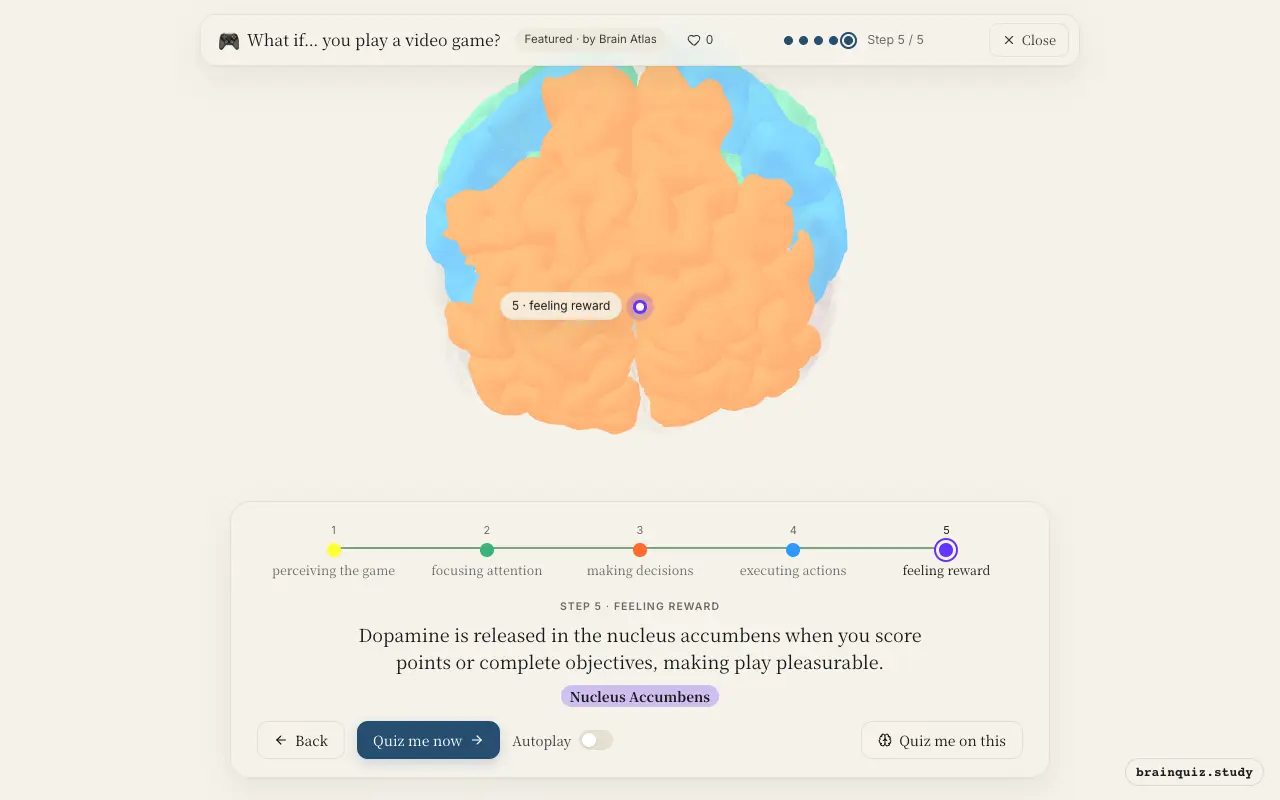
Watch it light up on the 3D brain
Brain regions that light up
| Order | Region | What it does here |
|---|---|---|
| 1 | Visual Cortex | The visual cortex processes the game's moving images, colors, and edges. |
| 2 | Parietal Cortex | The parietal cortex integrates visual and spatial info, guiding attention to important game elements. |
| 3 | Prefrontal Cortex | The prefrontal cortex evaluates options, formulates strategies, and holds goals in working memory. |
| 4 | Motor Cortex | The motor cortex sends commands to muscles to press buttons or move the controller. |
| 5 | Nucleus Accumbens | Dopamine is released in the nucleus accumbens when you score points or complete objectives, making play pleasurable. |
1. Visual Cortex: perceiving the game
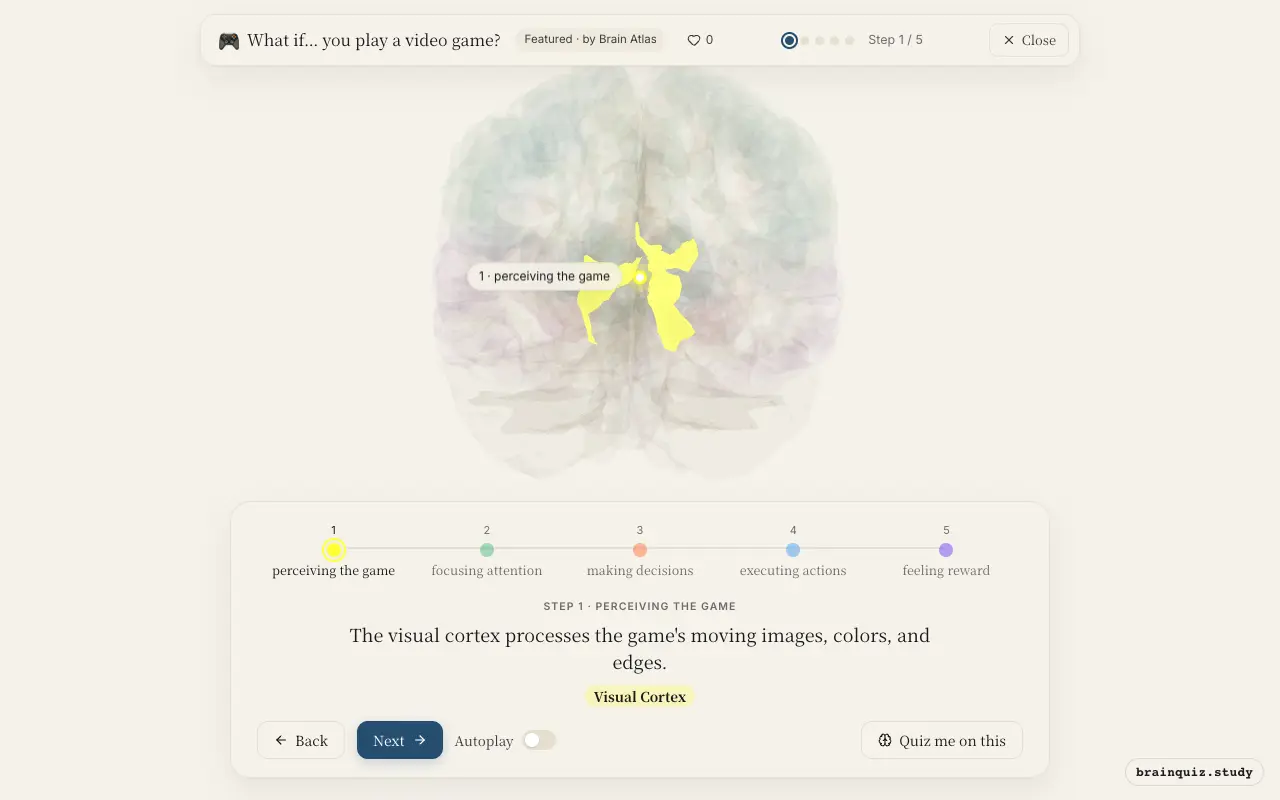
The primary visual cortex (V1) receives input from the eyes and extracts basic features like orientation and motion. Higher visual areas then interpret objects and characters. This is the first step in making sense of the game world.
2. Parietal Cortex: focusing attention
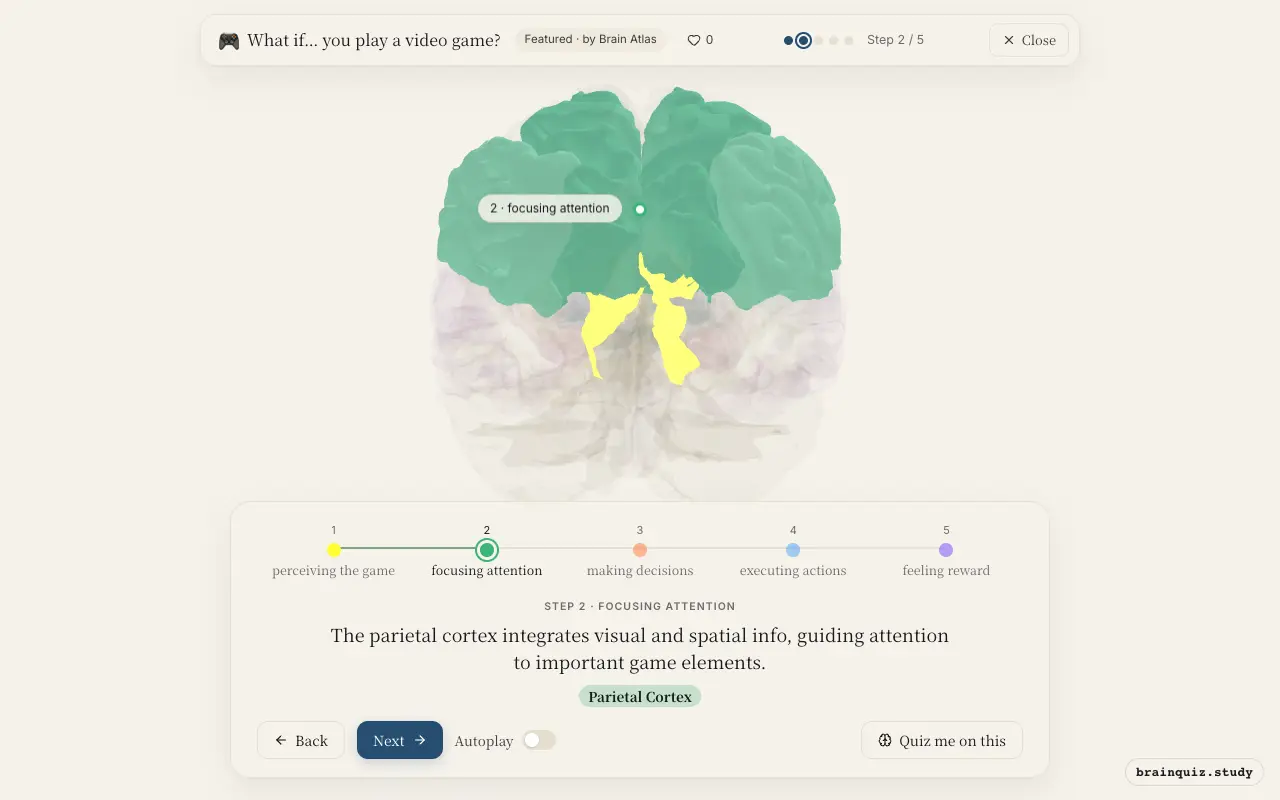
The posterior parietal cortex constructs a spatial map of the game environment and highlights salient targets. It helps you track moving enemies or navigate complex scenes. Without it, you would be overwhelmed by irrelevant details.
3. Prefrontal Cortex: making decisions
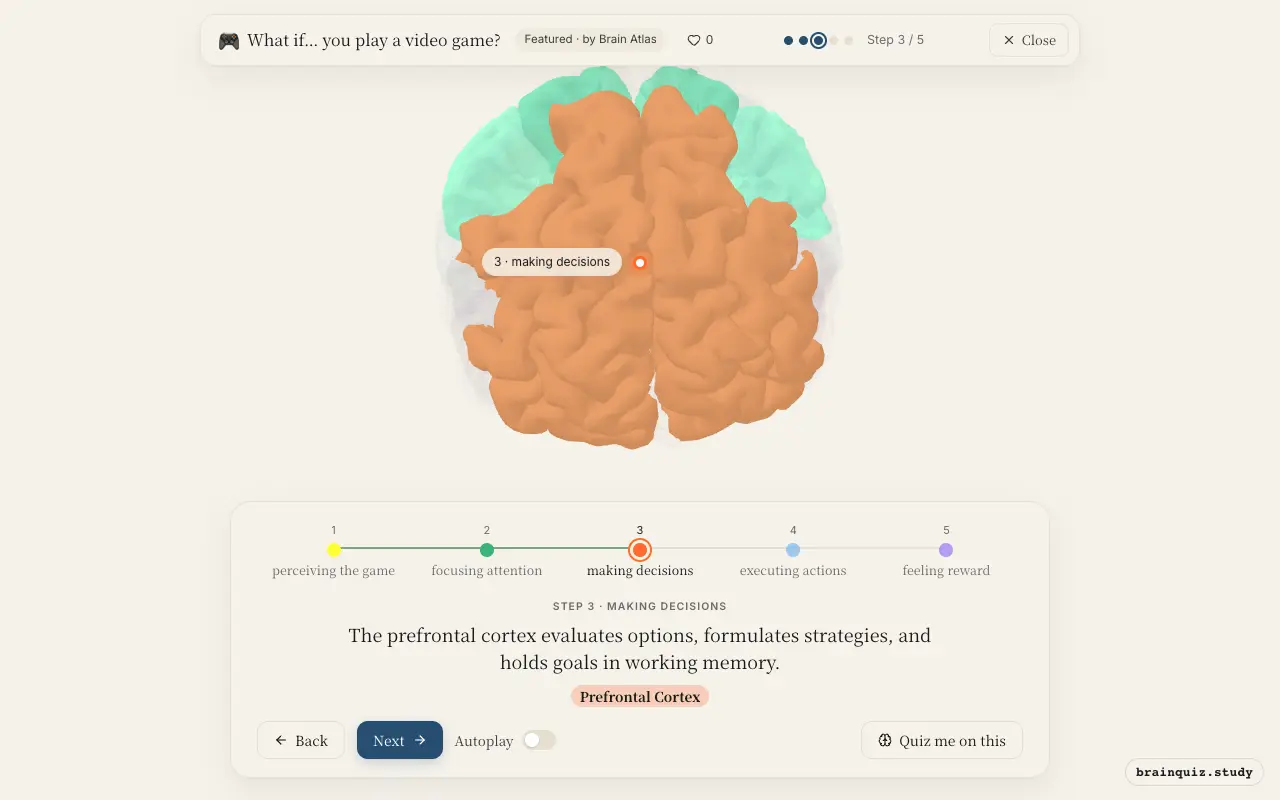
The dorsolateral prefrontal cortex is crucial for executive functions: planning the next move, deciding which item to pick up, or switching tactics when the game changes. It also inhibits impulsive actions. This region is heavily engaged in complex games.
4. Motor Cortex: executing actions
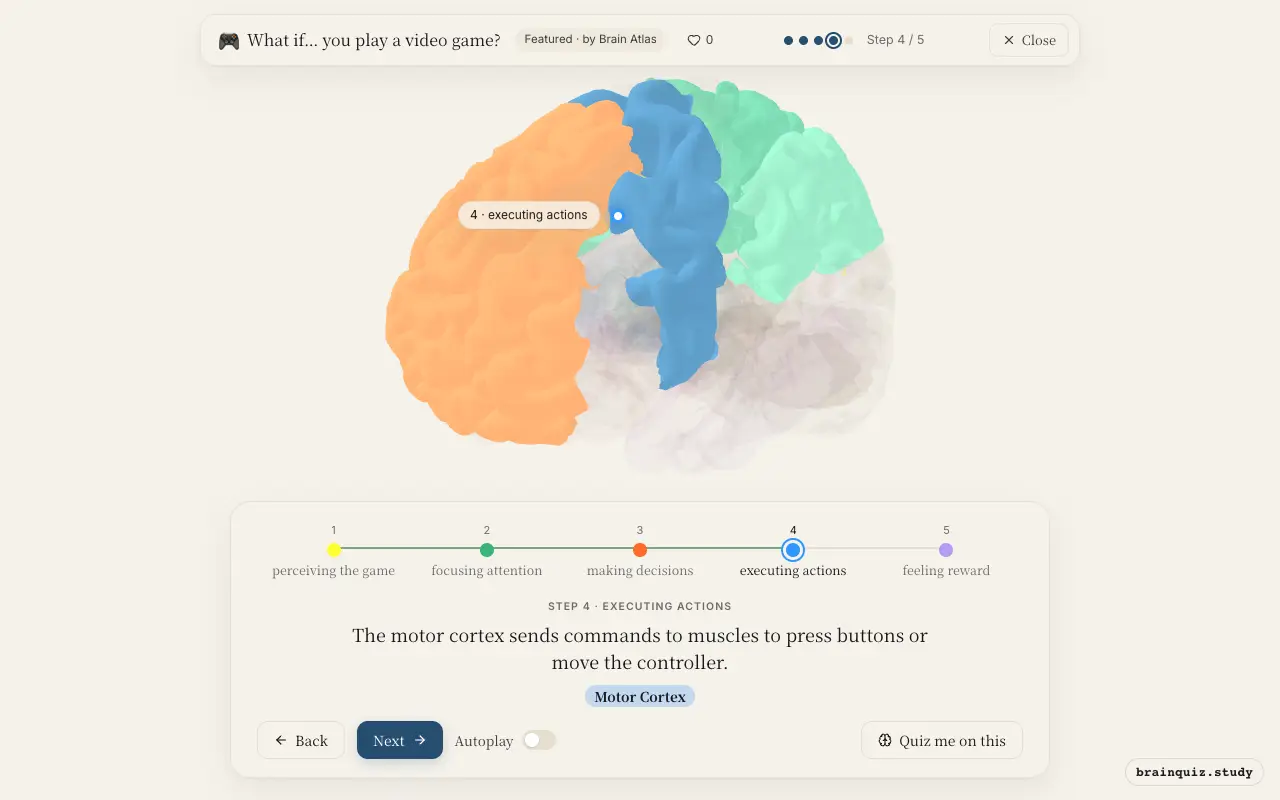
The primary motor cortex (M1) generates the neural signals that produce voluntary movements. It works with the premotor cortex to sequence button presses and joystick movements. Practice leads to more efficient motor programs, allowing faster reactions.
5. Nucleus Accumbens: feeling reward
The nucleus accumbens is a key part of the brain's reward circuit. When you achieve a goal, dopamine is released here, creating a sense of pleasure and motivation. This reinforcement drives you to keep playing and improves learning of game skills.
Good to know
- Some studies suggest action video games may improve visual attention and spatial resolution.
- The cerebellum is active during gaming to fine-tune movements and timing.
- Dopamine release in the striatum during gaming is similar to that seen with other rewarding activities.
Playing vs Watching
Playing a video game activates motor and premotor cortices to execute actions, while watching requires less motor output but still engages visual and reward areas. The prefrontal cortex may be more active during play due to decision-making demands.
Test yourself
Which brain region is primarily responsible for processing the visual details of the game?
What is the main role of the nucleus accumbens during gaming?
If a player is planning a complex strategy in a strategy game, which region is most active?
0 of 3 answered · 0 correct
Simplified: many regions work together at once, and this shows the main players in the order they act.