What happens in your brain when you multitask?
Updated
When you multitask, your brain rapidly switches attention between tasks. The prefrontal cortex directs the switch, the parietal cortex reallocates attention, and the anterior cingulate detects conflicts. This juggling reduces efficiency and increases errors.
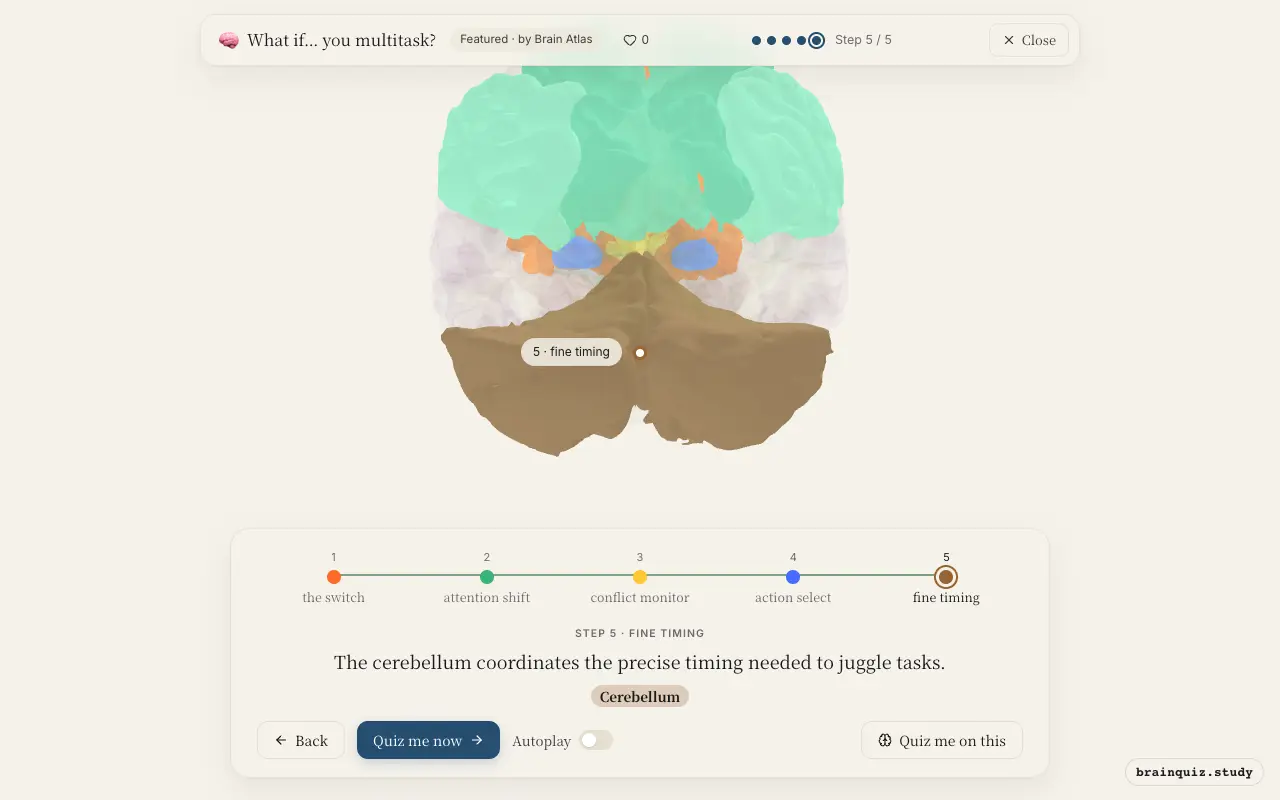
Watch it light up on the 3D brain
Brain regions that light up
| Order | Region | What it does here |
|---|---|---|
| 1 | Prefrontal Cortex | The prefrontal cortex decides to shift focus from one task to the other. |
| 2 | Parietal Cortex | The parietal cortex shifts attentional resources to the new task. |
| 3 | Anterior Cingulate Cortex | The anterior cingulate detects conflict between the two tasks. |
| 4 | Basal Ganglia | The basal ganglia help select the appropriate action sequence for the new task. |
| 5 | Cerebellum | The cerebellum coordinates the precise timing needed to juggle tasks. |
1. Prefrontal Cortex: the switch
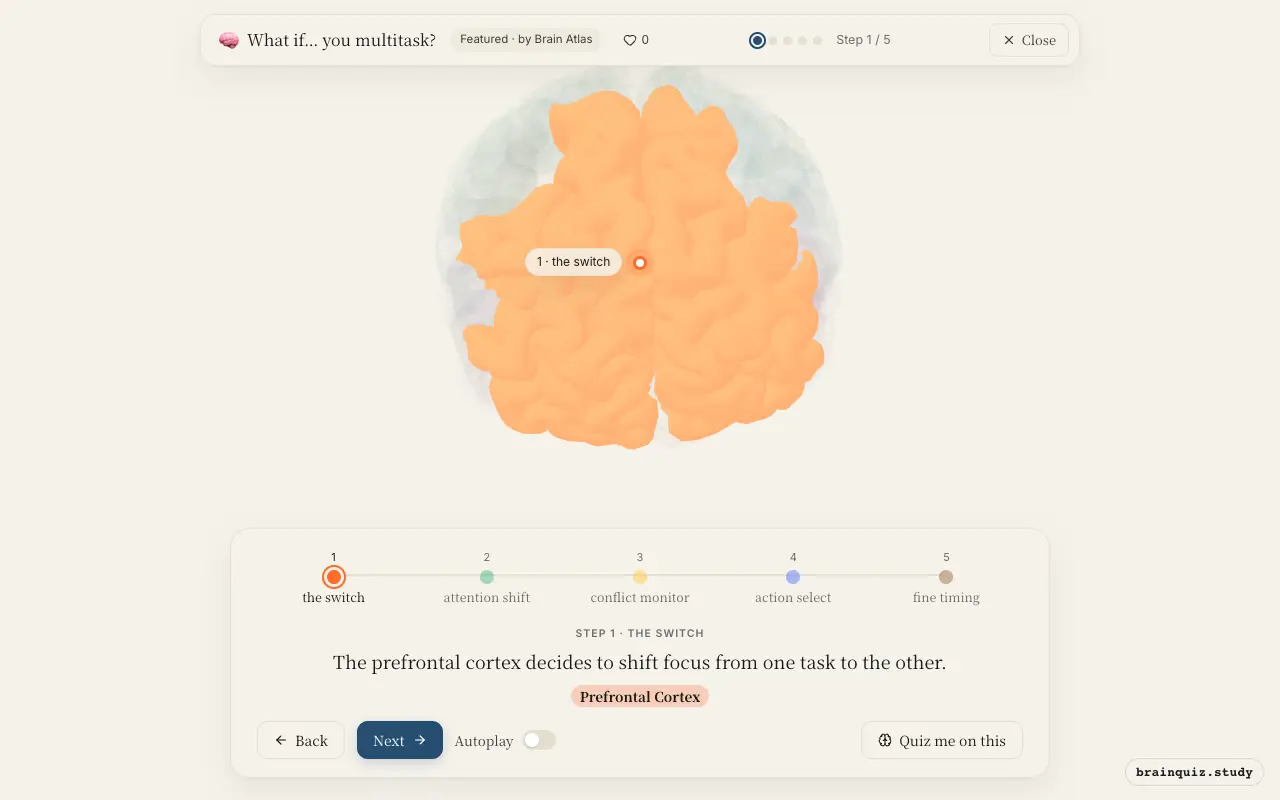
As the brain's executive control center, the prefrontal cortex maintains your current goal and initiates a switch when you decide to attend to another task. It holds both tasks in working memory and suppresses the first task's representation while activating the second. This region is heavily taxed during multitasking because it must constantly update priorities and inhibit irrelevant information, which is why true parallel processing of complex tasks is nearly impossible.
2. Parietal Cortex: attention shift
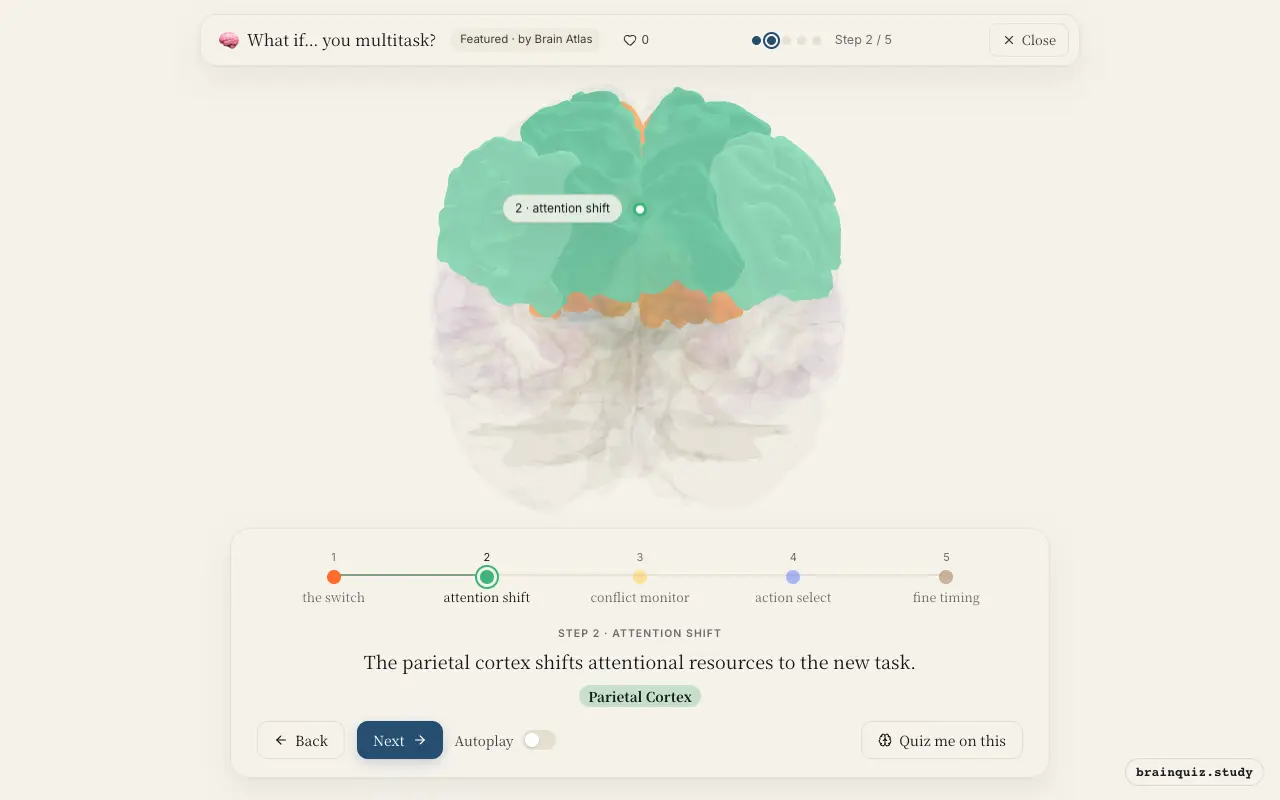
The parietal cortex, especially the posterior parietal areas, acts as an attentional hub that reallocates processing resources. When you switch tasks, it disengages from the first task's spatial or object-related features and reorients to the second task's demands. This region helps filter out distractions from the abandoned task and enhances processing of the current target. Frequent shifting causes a temporary reduction in attentional capacity, where you are less responsive to new stimuli immediately after a switch.
3. Anterior Cingulate Cortex: conflict monitor
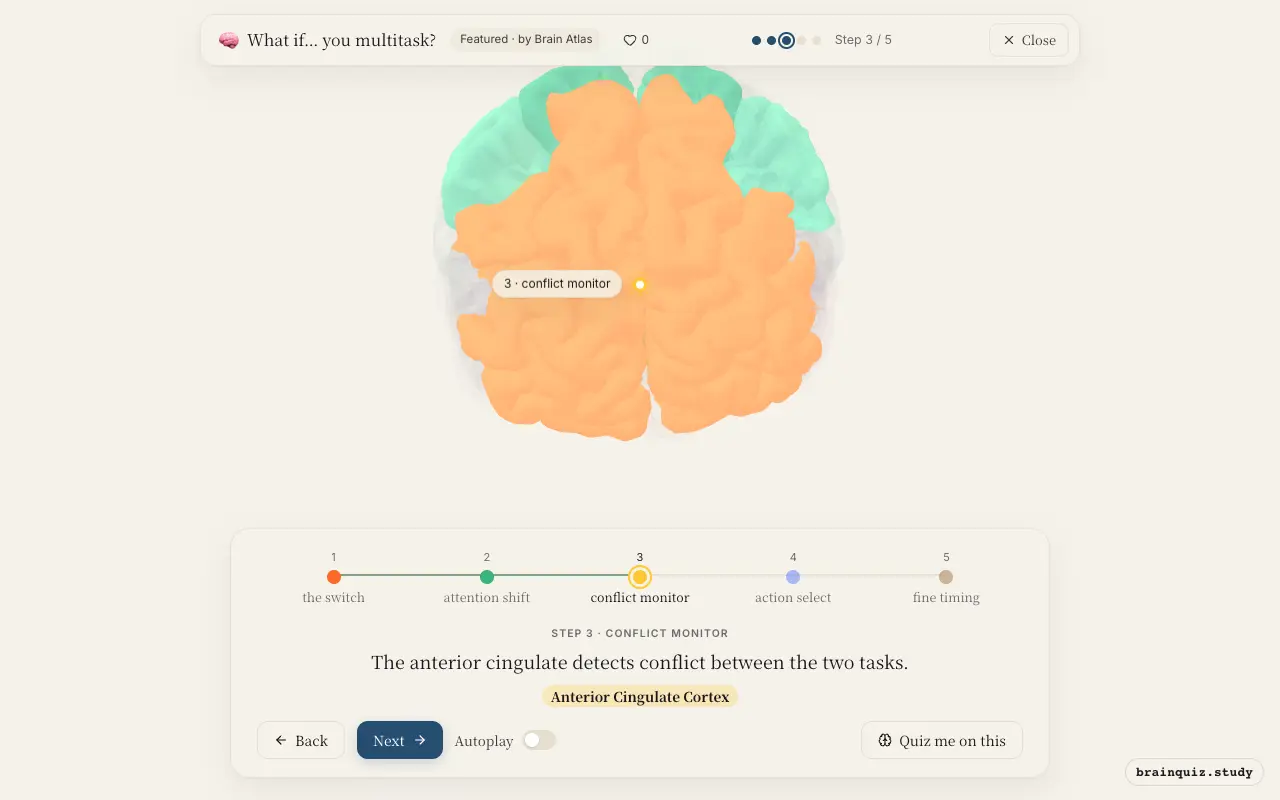
The anterior cingulate cortex continuously monitors for response conflicts—situations where competing task rules or motor plans clash. During multitasking, when remnants of the first task interfere with the second, the ACC signals the prefrontal cortex that increased control is needed. This conflict signal triggers adjustments in attention and strategy. Studies suggest that individuals with higher ACC activity during task switching tend to make fewer errors, as this region helps recruit additional cognitive resources to resolve interference.
4. Basal Ganglia: action select
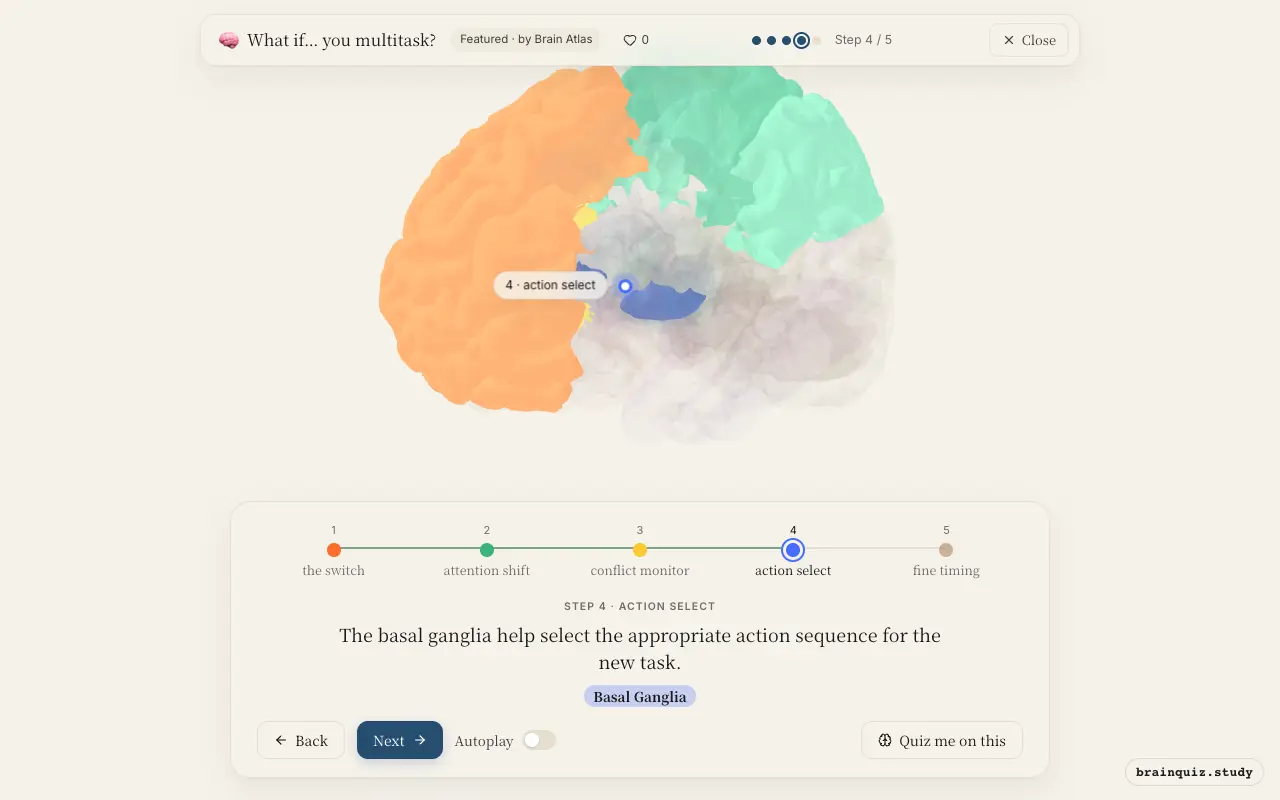
The basal ganglia, particularly the striatum, play a key role in action selection and habit formation. When you switch tasks, they facilitate the inhibition of the previously active motor or cognitive program and promote the initiation of the new one. This process is thought to rely on dopamine signaling from the substantia nigra, which modulates the balance between direct and indirect pathways. Without efficient basal ganglia function, switching becomes slow and error-prone, as seen in disorders like Parkinson's disease.
5. Cerebellum: fine timing
Although traditionally linked to motor coordination, the cerebellum also contributes to cognitive timing and prediction. During multitasking, it helps maintain the temporal order of task components and smooths transitions between them. For example, if you are alternating between reading and responding to messages, the cerebellum may predict when to pause one activity and resume the other. Studies suggest cerebellar activation increases during task switching, supporting its role in error-based adjustment and timing of cognitive operations.
Good to know
- True parallel processing of two attention-demanding tasks is nearly impossible; the brain switches rapidly, costing time and accuracy.
- Functional MRI studies show that the prefrontal cortex and parietal cortex are consistently activated during task switching, and their activity may decrease with practice as the basal ganglia become more involved.
- Heavy media multitaskers often perform worse on tests of sustained attention and working memory, suggesting that chronic switching may impair cognitive control.
Multitasking vs. Task Switching
Multitasking implies simultaneous processing, but the brain actually switches between tasks serially. In task switching, there is a measurable 'switch cost'—slower responses and more errors immediately after a switch. The prefrontal cortex and anterior cingulate show higher activity during switches, whereas sustained attention to a single task relies more on a stable frontoparietal network without rapid reconfiguration.
Test yourself
Which brain region is primarily responsible for initiating a task switch during multitasking?
What role does the anterior cingulate cortex play in multitasking?
Why does multitasking often lead to more errors?
0 of 3 answered · 0 correct
Simplified: many regions work together at once, and this shows the main players in the order they act.