What happens in your brain when you talk to yourself?
Updated
Prefrontal cortex initiates and monitors self-talk. Broca's area generates language; premotor cortex plans articulation; Wernicke's area comprehends the inner voice; posterior cingulate integrates self-referential meaning.
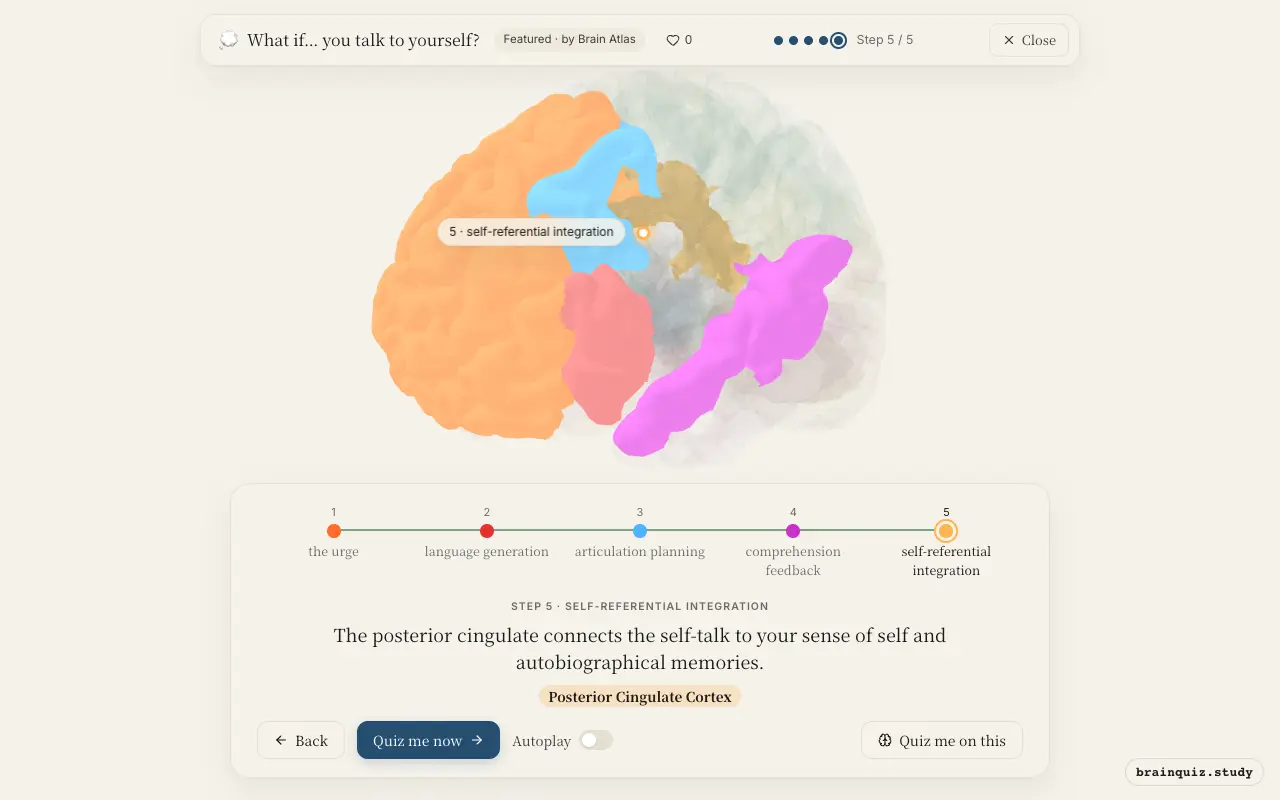
Watch it light up on the 3D brain
Brain regions that light up
| Order | Region | What it does here |
|---|---|---|
| 1 | Prefrontal Cortex | You decide to think through something, and your prefrontal cortex sets the goal and monitors the output. |
| 2 | Broca's Area | Broca's area constructs the linguistic message, selecting words and grammatical structure. |
| 3 | Premotor Cortex | The premotor cortex plans the muscle movements needed to articulate the words, even if you don't speak aloud. |
| 4 | Wernicke's Area | Wernicke's area processes the 'sound' of your inner voice to ensure the message makes sense. |
| 5 | Posterior Cingulate Cortex | The posterior cingulate connects the self-talk to your sense of self and autobiographical memories. |
1. Prefrontal Cortex: the urge
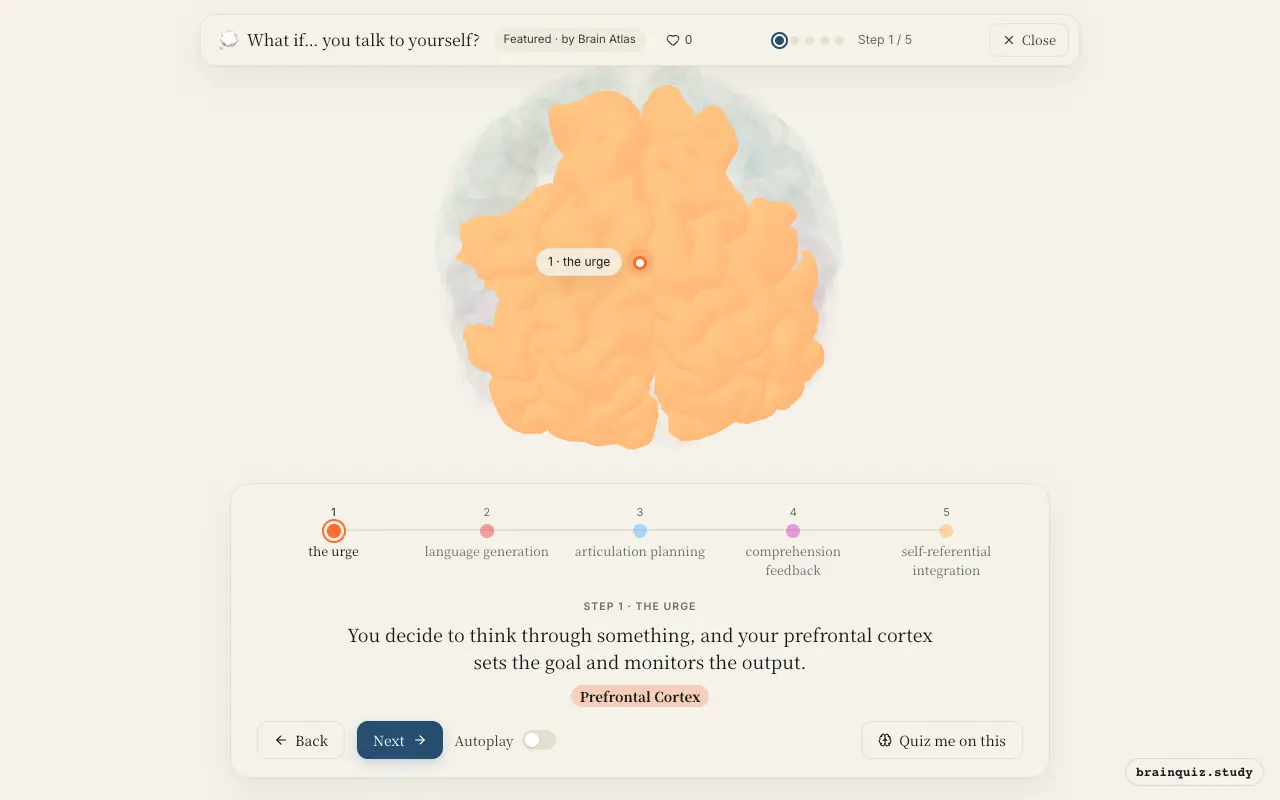
This region maintains the intention to talk to yourself, selects relevant information from working memory, and evaluates the appropriateness of the self-directed speech. It also suppresses irrelevant distractions.
2. Broca's Area: language generation
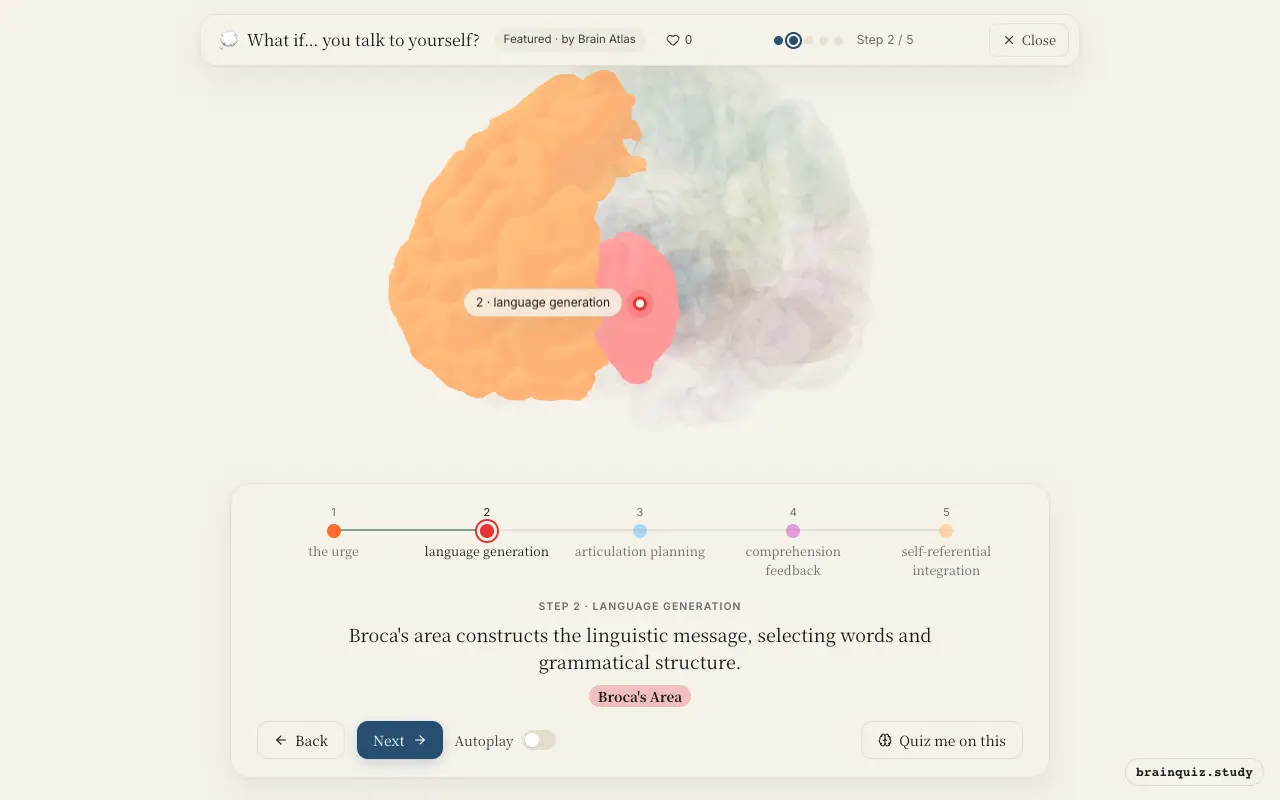
Located in the left frontal lobe, Broca's area is crucial for speech production and inner speech. It transforms thoughts into a linear sequence of words with correct syntax.
3. Premotor Cortex: articulation planning
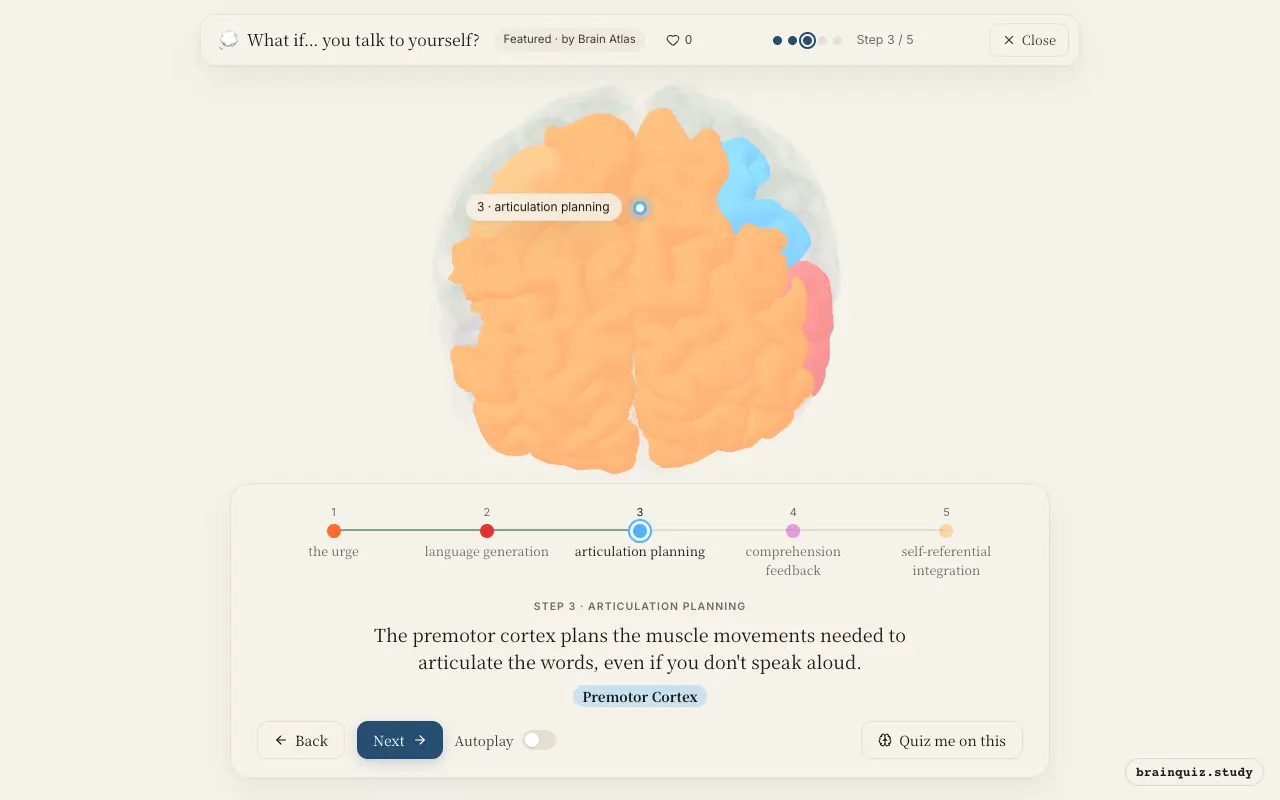
This area prepares the motor programs for the mouth, tongue, and vocal cords. For silent self-talk, the motor plan is generated but not executed, revealing the close link between thought and action.
4. Wernicke's Area: comprehension feedback
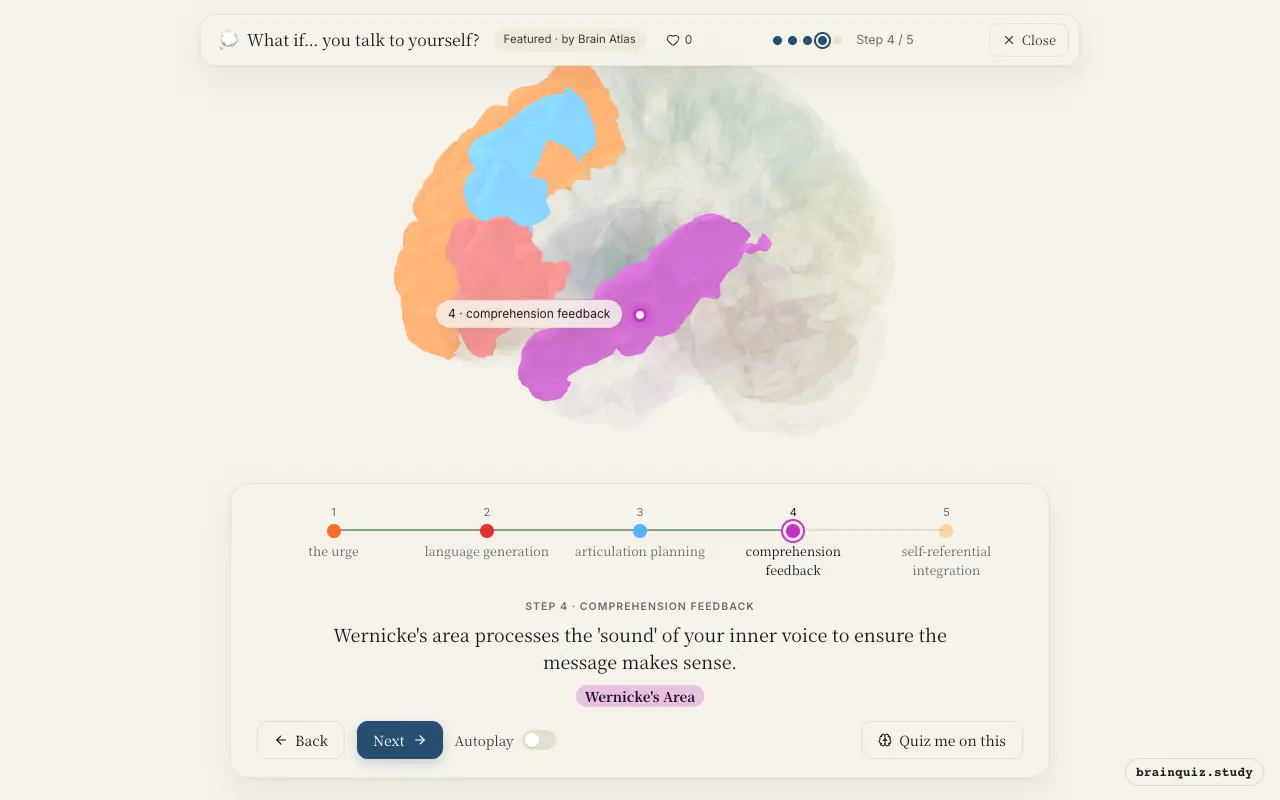
This region in the temporal lobe is involved in understanding language. During self-talk, it acts as a monitor, checking the linguistic output for coherence and meaning.
5. Posterior Cingulate Cortex: self-referential integration
As part of the default mode network, this area is active during self-referential thinking. It links the content of your self-talk to personal experiences and emotions, giving it subjective meaning.
Good to know
- Inner speech activates many of the same brain regions as overt speech, but with less motor and auditory activity.
- People with damage to Broca's area often have impaired inner speech, a symptom of aphasia.
- The default mode network, including the posterior cingulate, is more active when the brain is at rest and thinking about oneself.
Inner Speech vs. Overt Self-Talk
When you talk to yourself out loud, the motor cortex and auditory cortex are more strongly activated because you move your mouth and hear your voice. In silent self-talk, these regions are only weakly active, but prefrontal and language areas show similar patterns.
Test yourself
Which brain region is most responsible for generating the words in self-talk?
What role does the posterior cingulate cortex play during self-talk?
How does premotor cortex activity differ between silent and spoken self-talk?
0 of 3 answered · 0 correct
Simplified: many regions work together at once, and this shows the main players in the order they act.