What happens in your brain when you go rock climbing?
Updated
Visual cortex processes the route; premotor cortex plans the sequence of moves; motor cortex executes the movements; cerebellum coordinates balance and timing; somatosensory cortex monitors grip and body position.
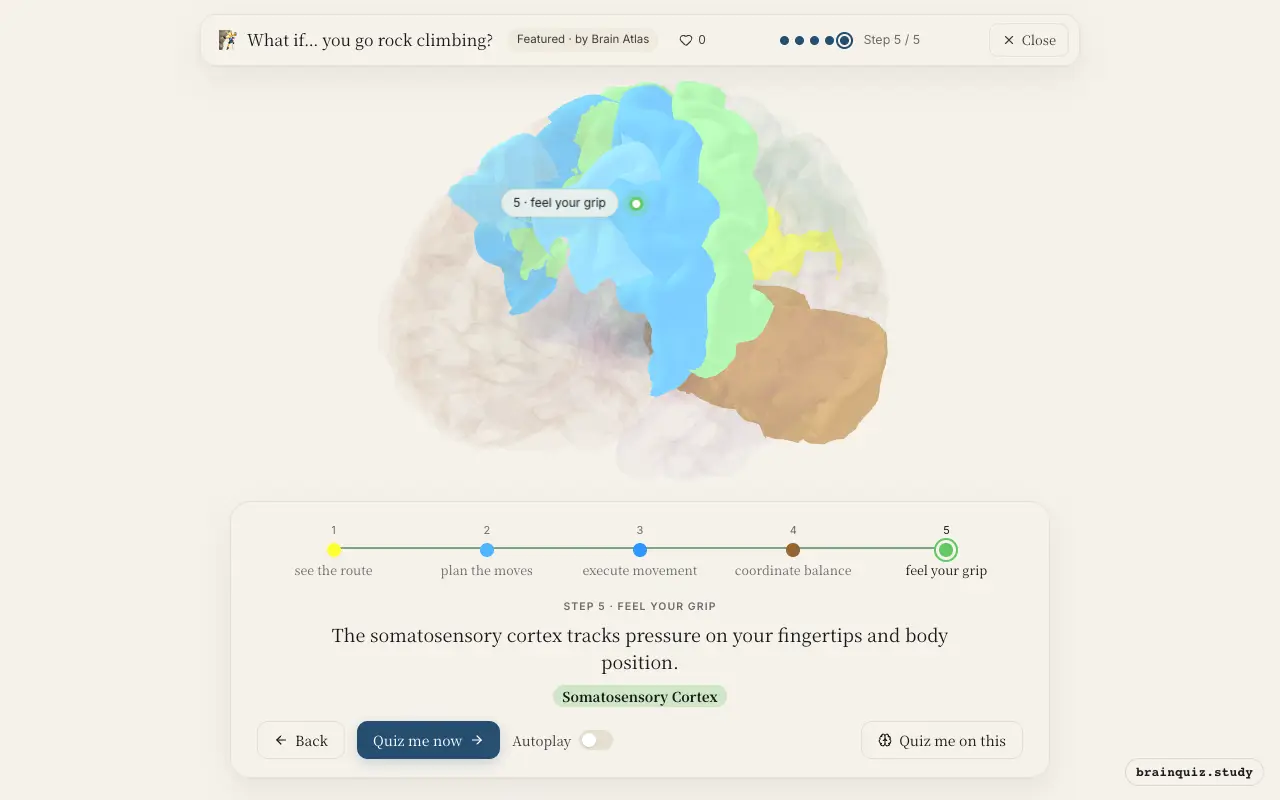
Watch it light up on the 3D brain
Brain regions that light up
| Order | Region | What it does here |
|---|---|---|
| 1 | Visual Cortex | Your visual cortex processes the holds and the path up the wall. |
| 2 | Premotor Cortex | The premotor cortex sequences your next moves based on the visual map. |
| 3 | Motor Cortex | The motor cortex sends commands to your muscles to reach, grip, and pull. |
| 4 | Cerebellum | Your cerebellum fine-tunes balance and smooths each movement as you climb. |
| 5 | Somatosensory Cortex | The somatosensory cortex tracks pressure on your fingertips and body position. |
1. Visual Cortex: see the route
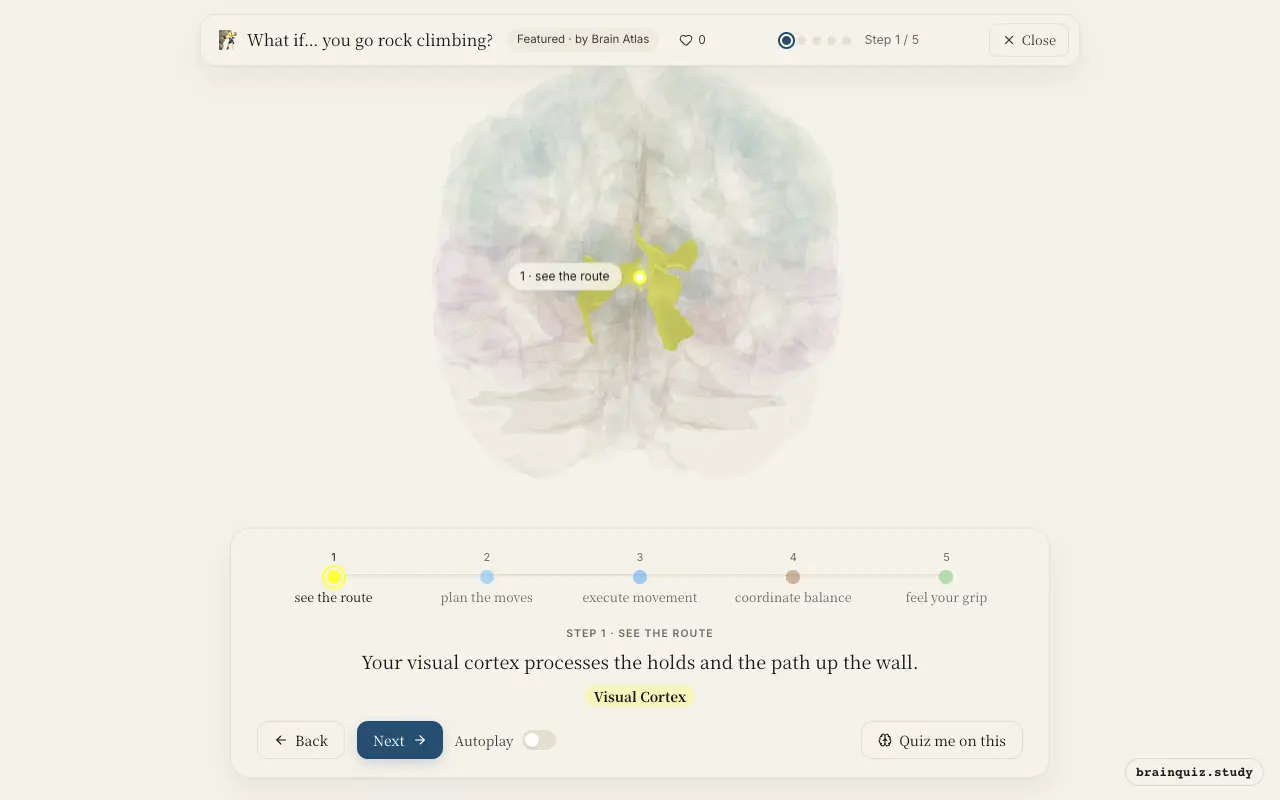
The visual cortex in the occipital lobe decodes the edges, orientations, and colors of climbing holds and the rock surface. It sends this processed visual information forward to the parietal cortex for spatial analysis and to the premotor cortex for movement planning. This early visual processing is critical for spotting potential handholds and foot placements from a distance.
2. Premotor Cortex: plan the moves
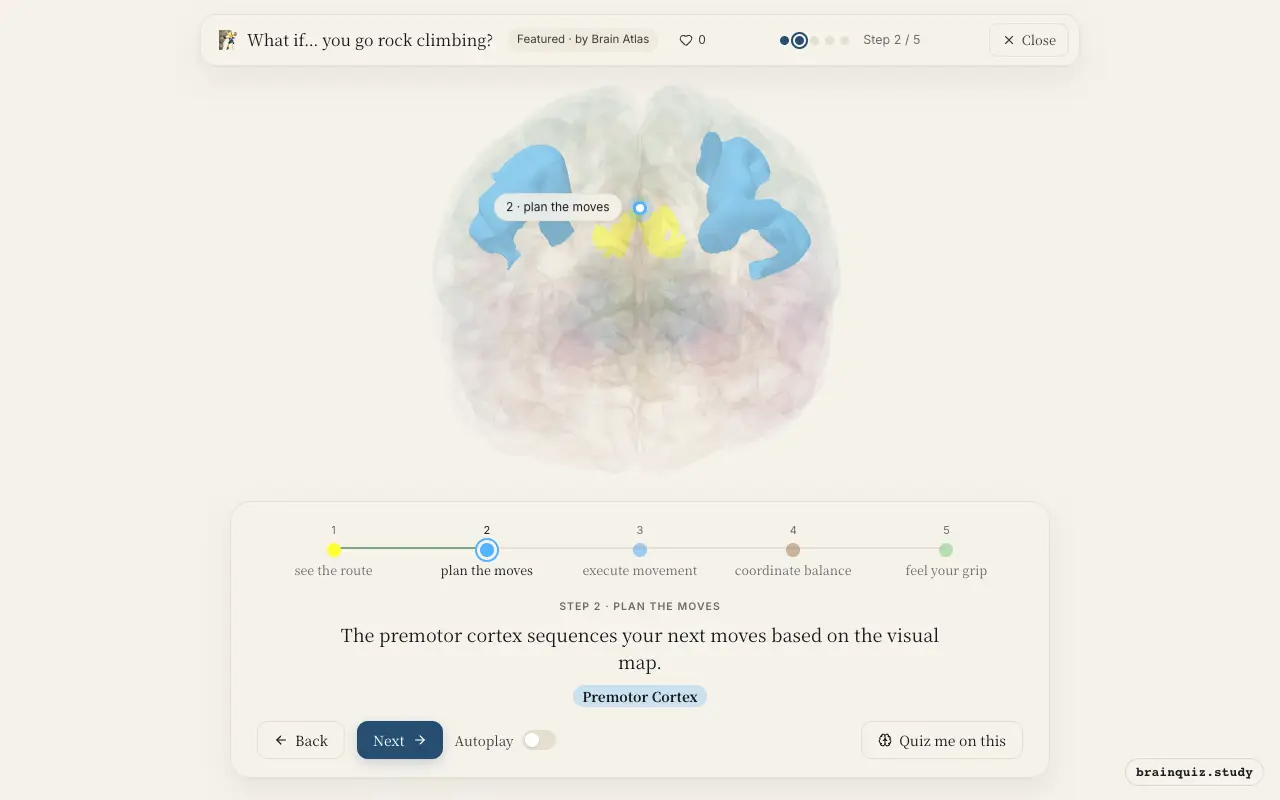
The premotor cortex uses the visual information about the route to prepare a motor program: which limb to move, in what order, and with what force. It holds this sequence in working memory, often in collaboration with the prefrontal cortex. Without this planning, movements would be uncoordinated and inefficient.
3. Motor Cortex: execute movement
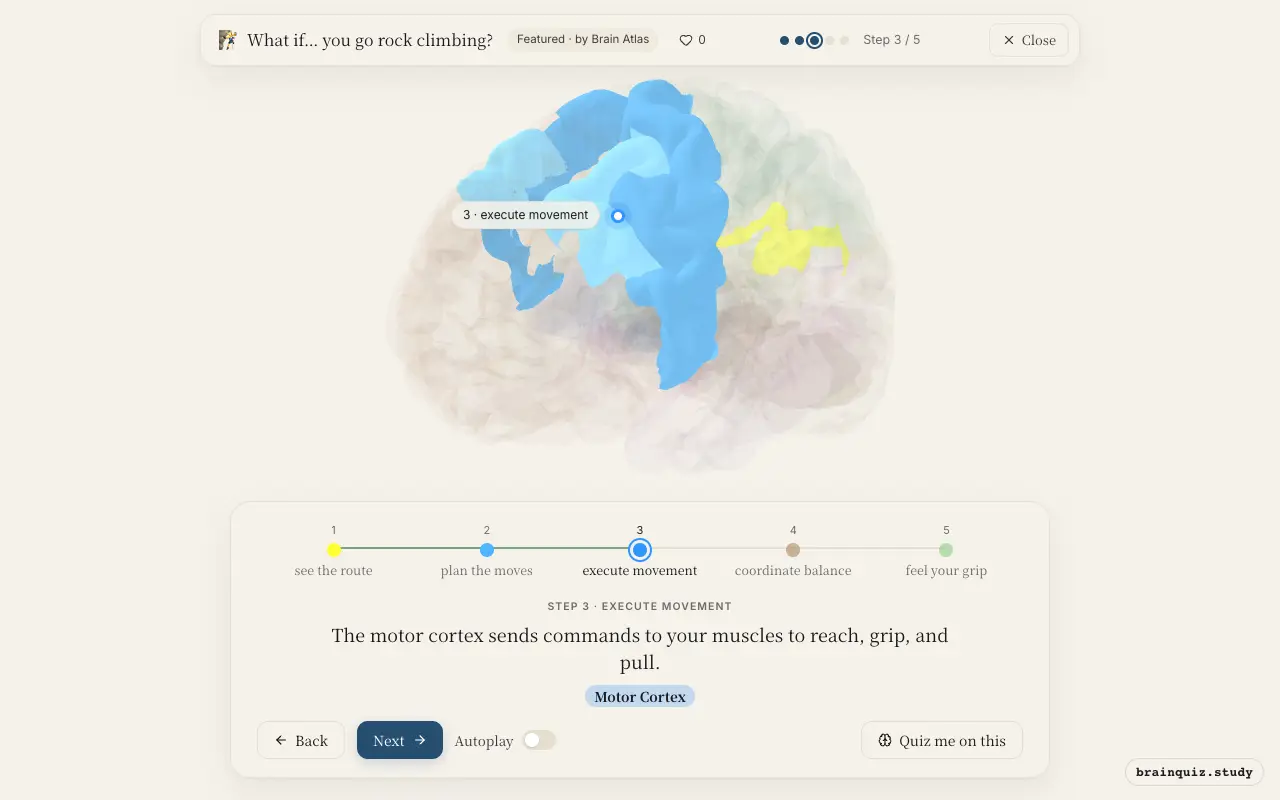
The primary motor cortex, located in the precentral gyrus, generates neural signals that travel down the corticospinal tract to activate the specific muscles needed for reaching, gripping, and pulling. It encodes the precise force and timing of each muscle contraction, adjusting in real time as the climb progresses. This region is a major cortical source for voluntary movement.
4. Cerebellum: coordinate balance
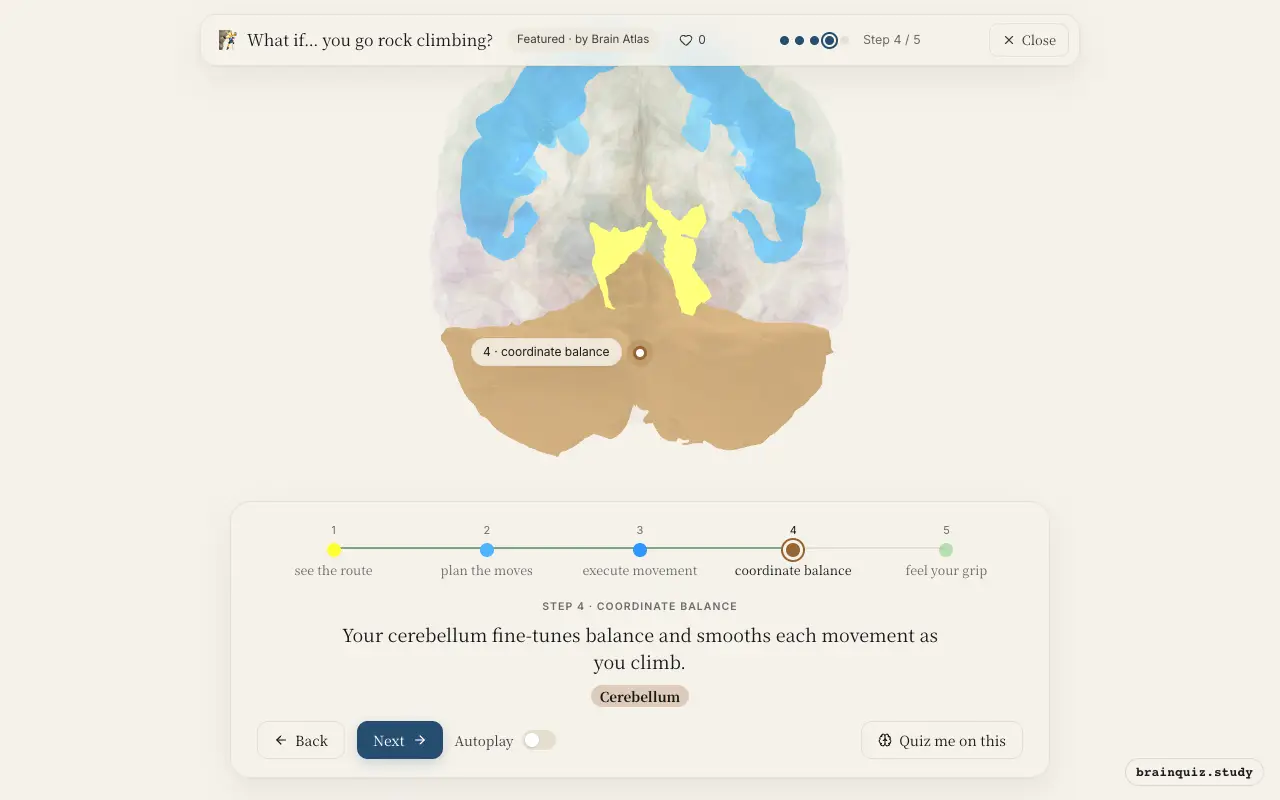
The cerebellum receives continuous feedback from the inner ear, muscles, and joints about body position and movement. It compares the intended movement plan from the motor cortex with the actual movement being executed, detecting errors and sending corrective signals back. This process is essential for maintaining balance on small footholds and for smooth, coordinated limb movements.
5. Somatosensory Cortex: feel your grip
Sensory receptors in the skin of your fingers, palms, and feet send information about pressure, texture, and stretch to the somatosensory cortex. This region creates a real-time map of your body's position and the forces acting on it, allowing you to adjust your grip strength without looking. It is crucial for fine motor control and preventing slips.
Good to know
- The basal ganglia help automate well-practiced climbing movements, reducing the need for conscious cortical control.
- The amygdala may become active if a climb feels risky, triggering a stress response that heightens alertness.
- Dopamine release in the nucleus accumbens is thought to underlie the rewarding feeling after completing a climb.
Rock climbing vs. walking on a flat path
Rock climbing demands intense visual-spatial processing and balance control, engaging the cerebellum and parietal cortex far more than walking on flat ground. Walking relies on spinal pattern generators with less cortical involvement, while climbing requires constant planning and adaptation.
Test yourself
Which brain region is primarily responsible for sequencing the order of hand and foot movements during rock climbing?
Damage to which region would most impair your ability to maintain balance while climbing?
After completing a climb, the feeling of reward is mainly associated with dopamine release in which region?
0 of 3 answered · 0 correct
Simplified: many regions work together at once, and this shows the main players in the order they act.