What happens in your brain when you feel embarrassed?
Updated
When embarrassed, your amygdala flags the social threat, your anterior cingulate detects the social error, your insula drives blushing and physical discomfort, and your orbitofrontal cortex steps in to regulate the feeling.
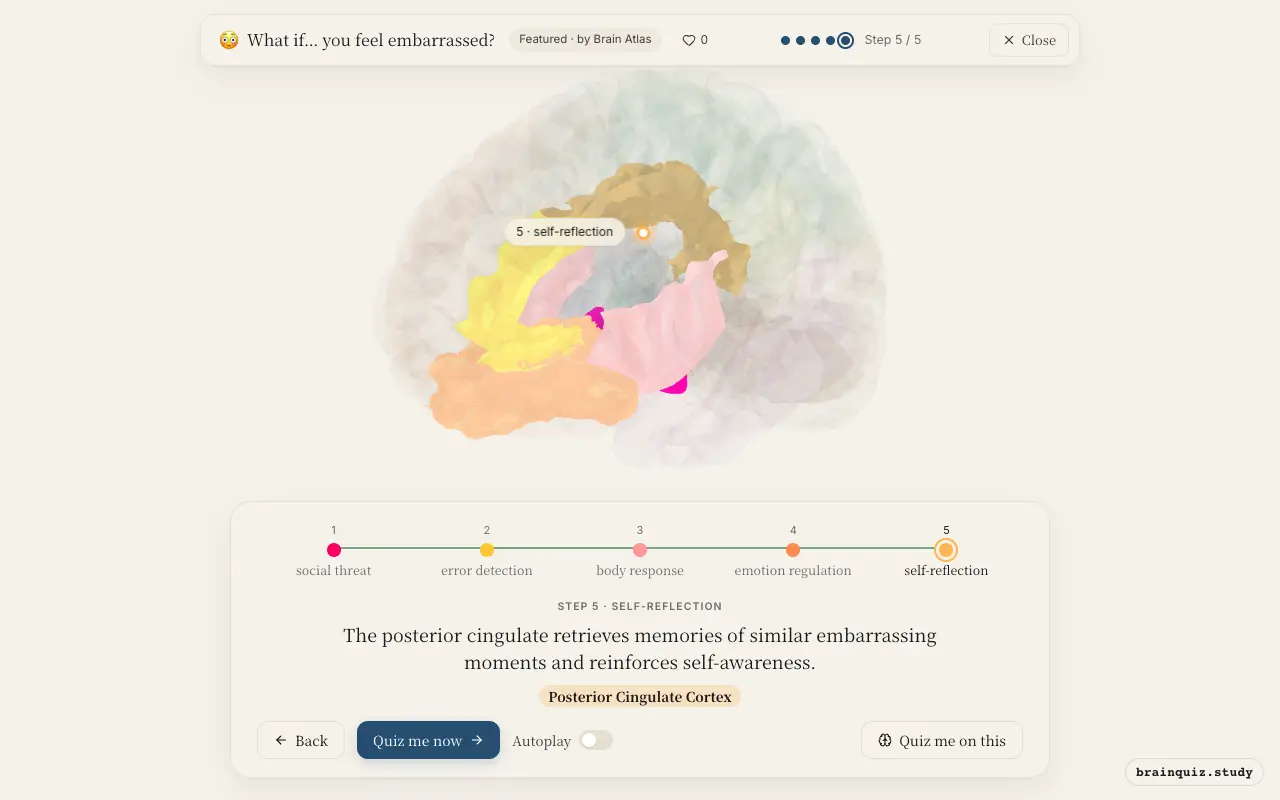
Watch it light up on the 3D brain
Brain regions that light up
| Order | Region | What it does here |
|---|---|---|
| 1 | Amygdala | Your amygdala reacts instantly, signaling that others are evaluating you negatively. |
| 2 | Anterior Cingulate Cortex | The anterior cingulate flags the mismatch between your action and social norms. |
| 3 | Insula | Your insula generates the physical sensations of embarrassment, like blushing and a racing heart. |
| 4 | Orbitofrontal Cortex | The orbitofrontal cortex evaluates the social context and tries to dampen your distress. |
| 5 | Posterior Cingulate Cortex | The posterior cingulate retrieves memories of similar embarrassing moments and reinforces self-awareness. |
1. Amygdala: social threat
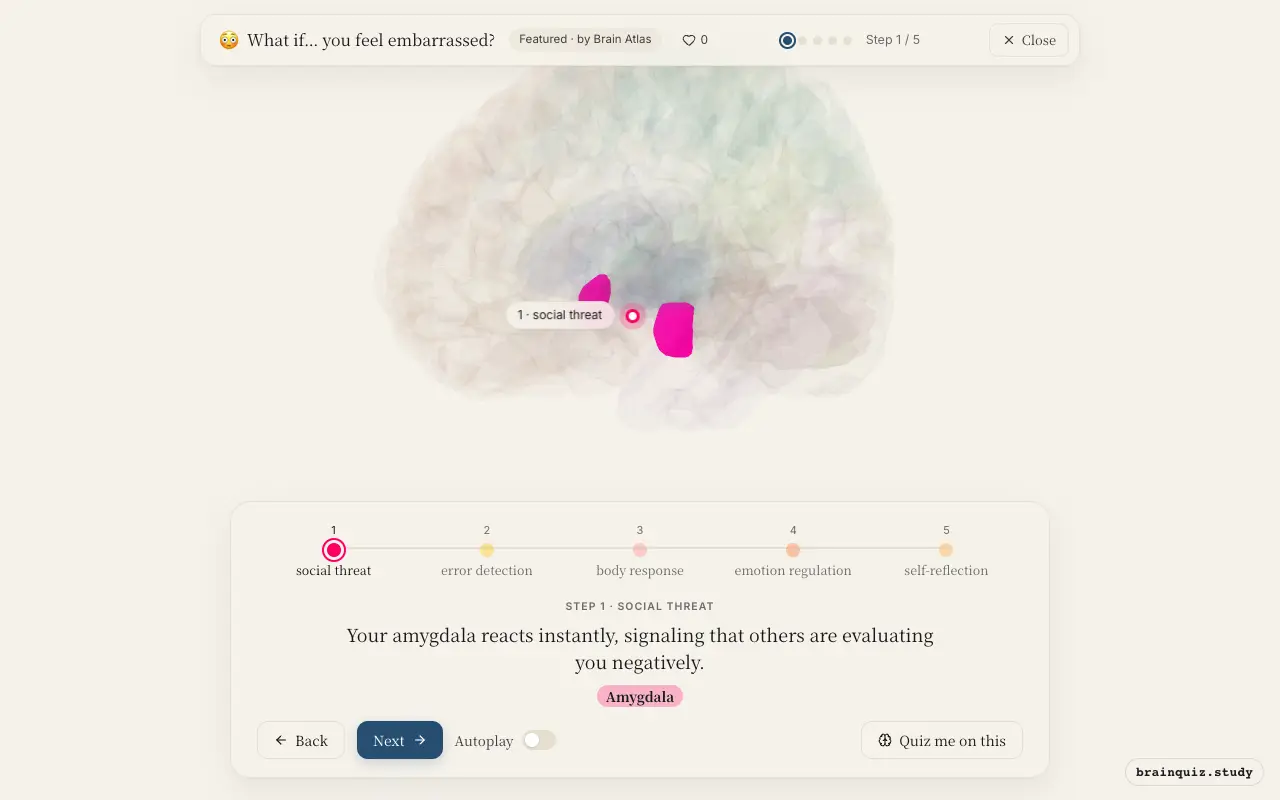
The amygdala is highly responsive to social stimuli, especially threats like rejection or negative evaluation. Studies suggest it activates within milliseconds when you realize you've made a mistake in front of others, preparing your body to respond.
2. Anterior Cingulate Cortex: error detection
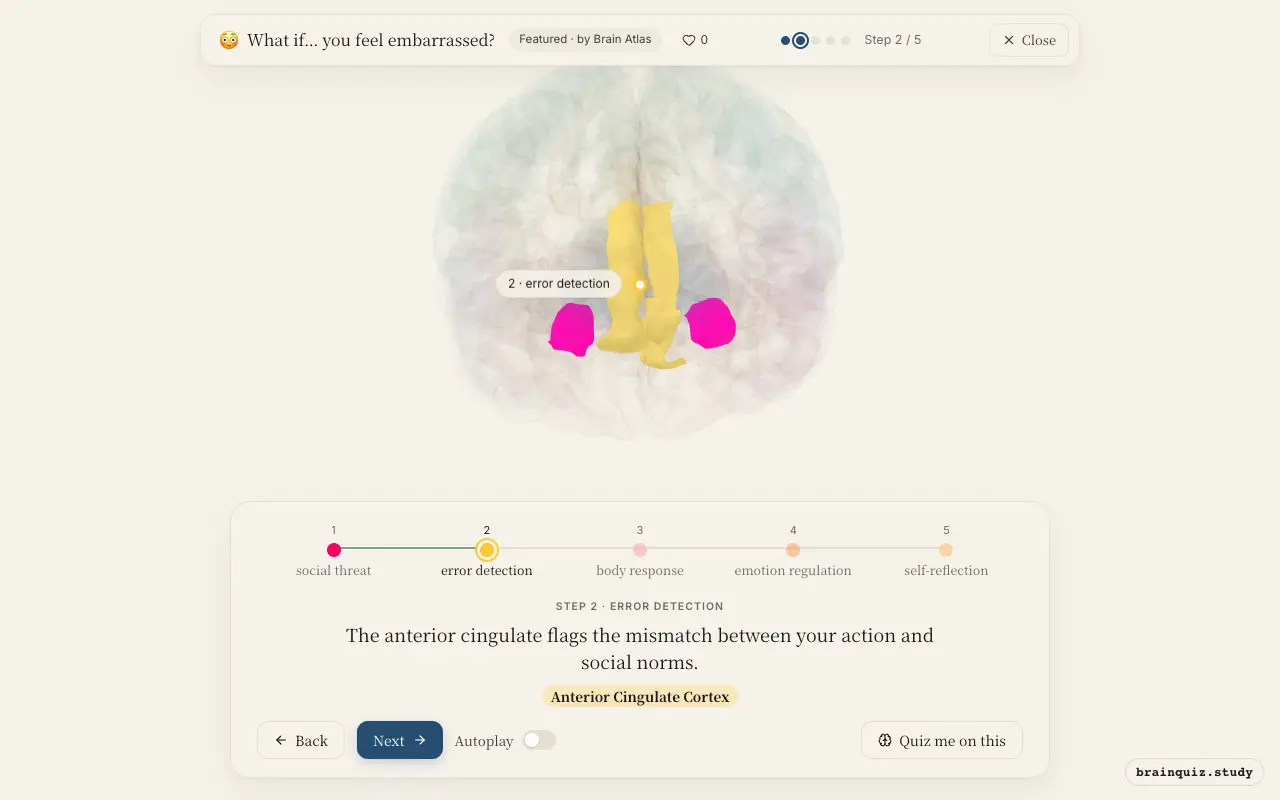
The anterior cingulate cortex monitors conflicts and errors, including social errors. When you are embarrassed, it detects the discrepancy between what you did and what was expected, generating a signal that amplifies the emotional response.
3. Insula: body response
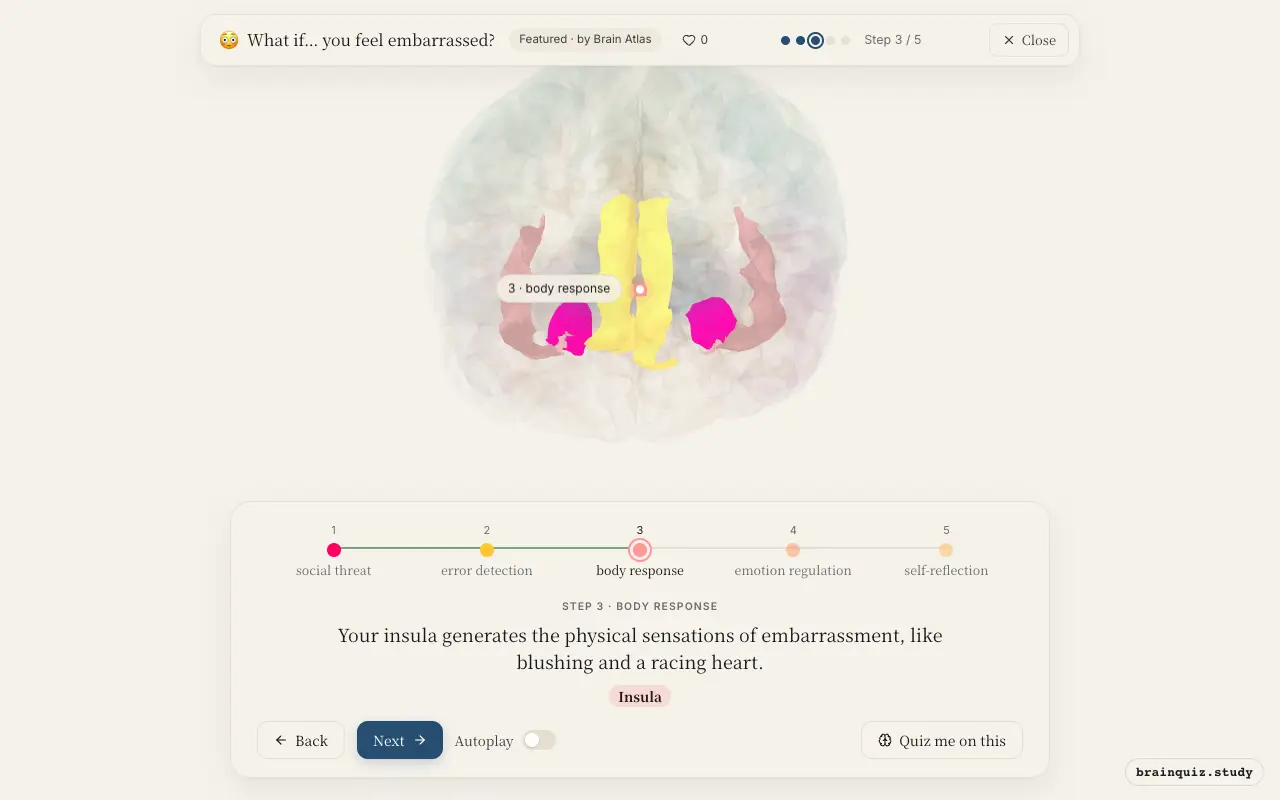
The insula maps internal body states and is highly active during embarrassment. It triggers autonomic changes such as facial blushing and increased heart rate, making you acutely aware of your body's reaction to the social situation.
4. Orbitofrontal Cortex: emotion regulation
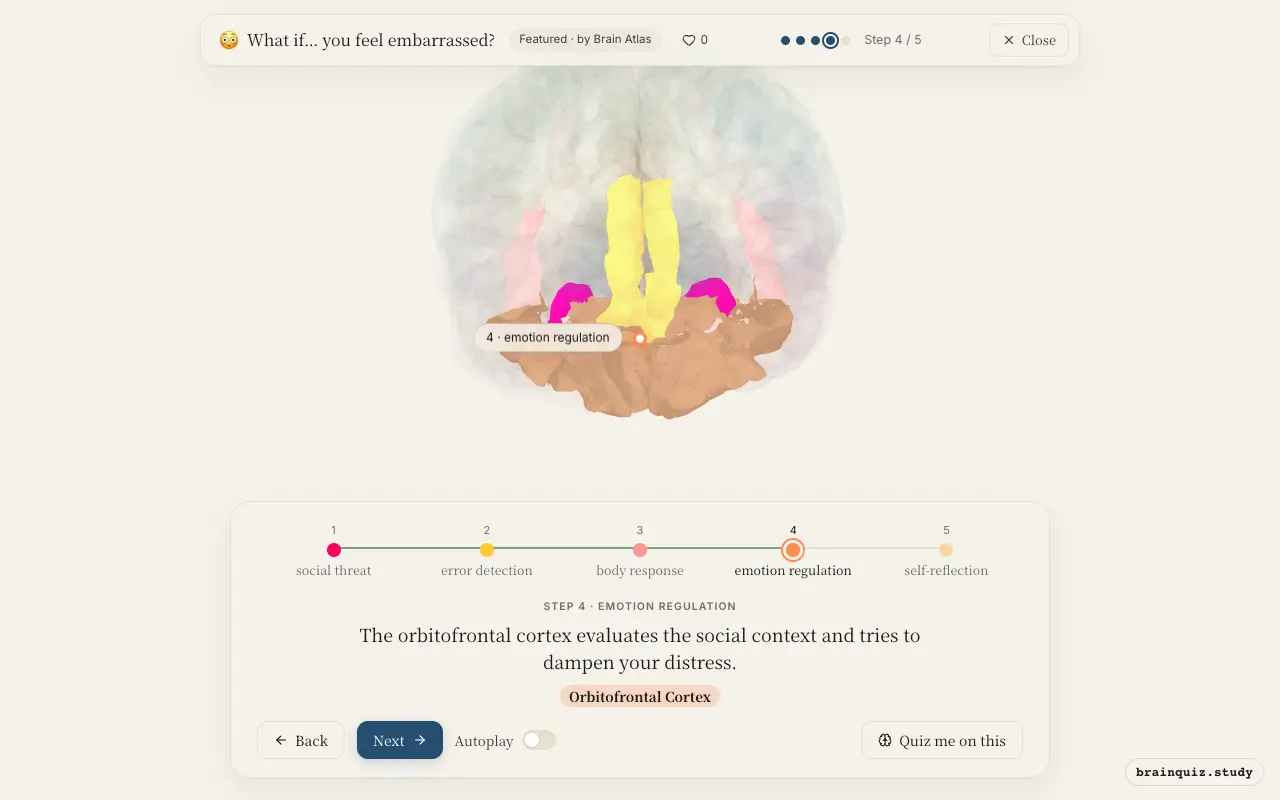
The orbitofrontal cortex integrates social information and regulates emotions based on context. During embarrassment, it helps you assess the severity of the social misstep and may suppress an overblown reaction, guiding you to recover composure.
5. Posterior Cingulate Cortex: self-reflection
The posterior cingulate is part of the default mode network and supports self-referential thinking. During embarrassment, it may retrieve autobiographical memories of past embarrassments, deepening the sense of self-consciousness.
Good to know
- Embarrassment recruits brain regions that overlap with physical pain, such as the anterior cingulate and insula.
- The blush response is unique because it is caused by vasodilation of facial blood vessels, unlike typical fight-or-flight vasoconstriction.
- Self-conscious emotions like embarrassment require a sense of self, which develops around age 2 to 3.
Embarrassment vs. Shame
Both involve the anterior cingulate and insula, but shame is tied to a global negative self-evaluation, engaging more prefrontal and posterior cingulate regions. Embarrassment is more about immediate social exposure and often includes a stronger amygdala response.
Test yourself
Which brain region is most directly responsible for detecting the social error that triggers embarrassment?
The physical sensations of embarrassment, like blushing, are primarily driven by activity in which region?
Why is embarrassment considered a self-conscious emotion?
0 of 3 answered · 0 correct
Simplified: many regions work together at once, and this shows the main players in the order they act.