Facial Nucleus — Function, Location & Quiz
The facial nucleus contains the lower motor neurons that drive facial expression, but it receives more than one kind of command. Voluntary movement descends from cortex, while spontaneous emotional expression reaches it through a partly separate subcortical route.
Forehead innervation is the localization clue. The upper face receives bilateral cortical input, so a unilateral cortical stroke tends to spare forehead movement; a peripheral facial lesion affects the upper and lower face together on the same side.
Test this anatomy in the Lesion Localization Quiz: 15 Clinical Questions or explore it on the interactive 3D brain.
Where is the Facial Nucleus located?
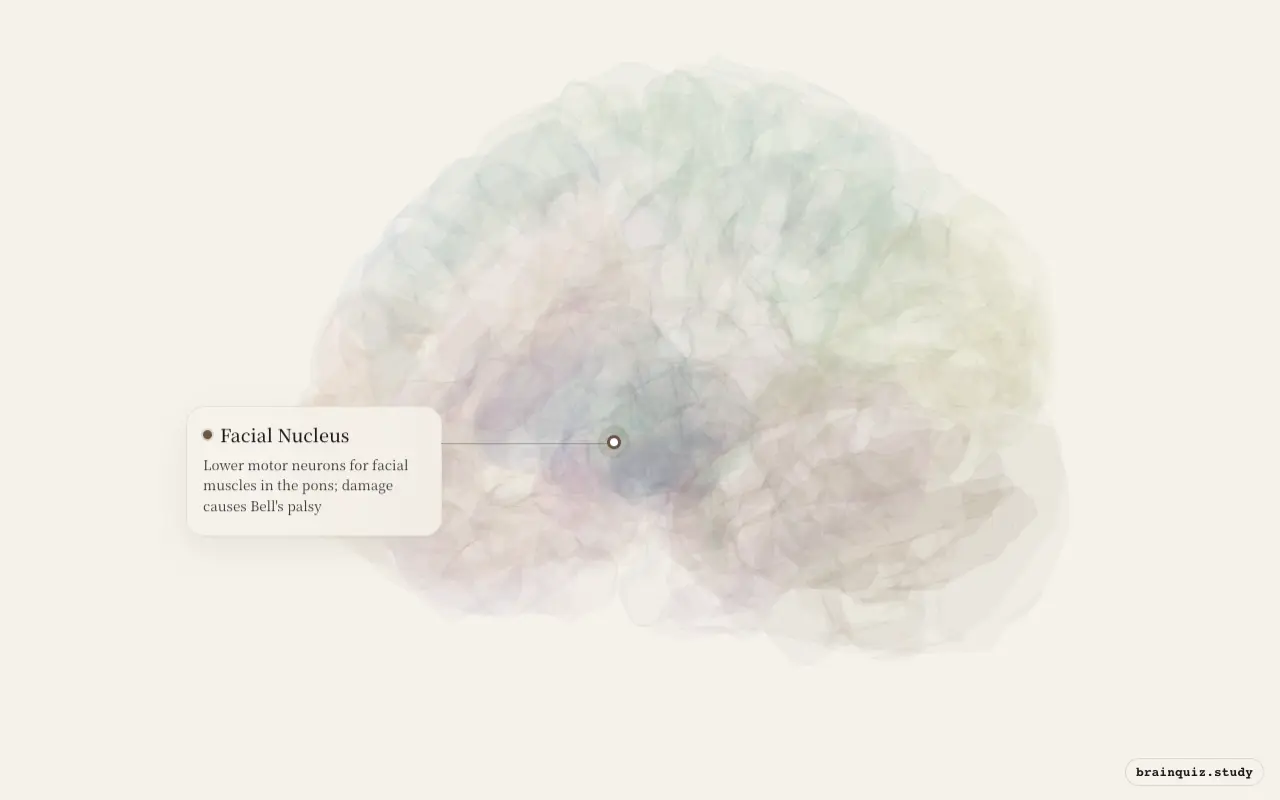
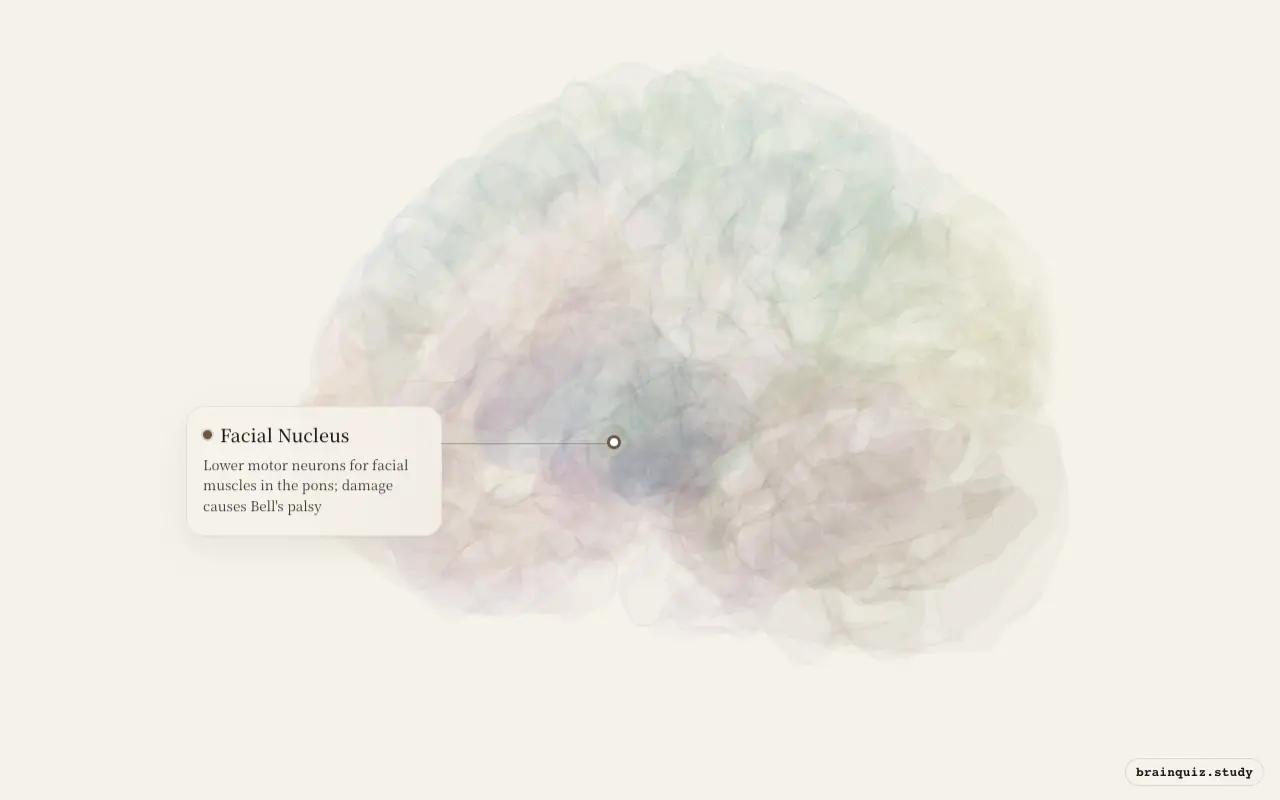
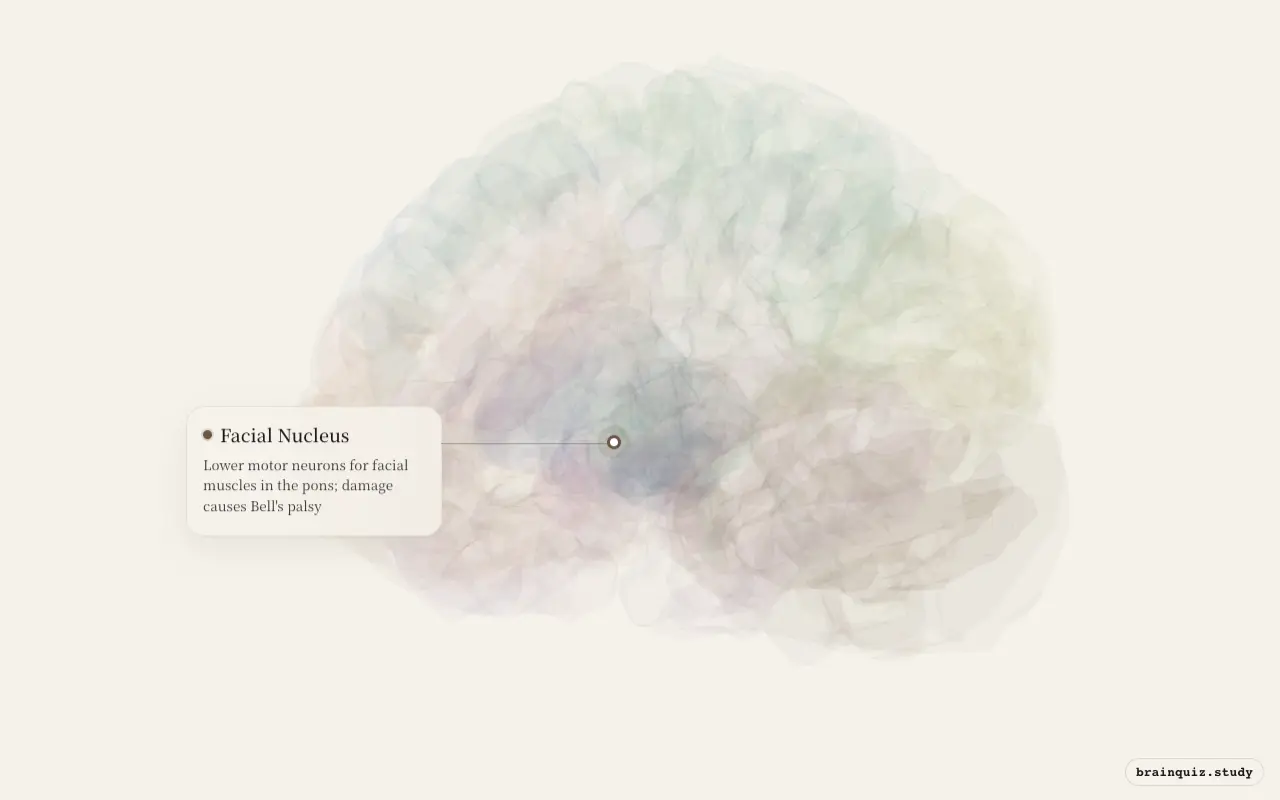
Lower motor neurons for facial muscles in the pons; damage causes Bell's palsy.
What does the Facial Nucleus do?
- Lower motor neurons for facial muscles
- Receives TWO separate pathways: voluntary (cortical) and emotional (subcortical)
- Upper face: bilateral cortical innervation. Lower face: contralateral only
Facial Nucleus pathways and connections
- Motor cortex → Facial nucleus (voluntary pathway — contralateral for lower face, bilateral for upper face)
- Premotor/BG → Facial nucleus via hypothalamus/brainstem (emotional pathway — spontaneous expressions)
What happens when the Facial Nucleus is damaged?
- Bell's palsy (peripheral lesion): complete unilateral facial paralysis — upper AND lower face
- Cortical lesion (UMN): only contralateral LOWER face affected — forehead spared (bilateral innervation)
- Double dissociation: voluntary pathway damage = can't smile on command but CAN smile spontaneously
- Emotional pathway damage = CAN smile on command but CAN'T smile spontaneously
Facial Nucleus key facts
Atlas category: brainstem.
- Duchenne smile = genuine (zygomatic major + orbicularis oculi = crinkles eyes). Fake smile = zygomatic only
- Upper face bilateral innervation explains why cortical stroke spares forehead but Bell's palsy does not
- Double dissociation between voluntary and emotional facial pathways is a classic exam question
Facial Nucleus exam tip
Upper face = bilateral control, lower face = contralateral only. This explains why cortical lesions spare the forehead but Bell's palsy doesn't.
Common questions
What does the facial nucleus control?
It provides lower-motor-neuron output to muscles of facial expression and receives separate descending influences for voluntary and spontaneous emotional movement.
Why is the forehead spared in many cortical strokes?
Upper-face motor neurons receive bilateral cortical input, so the intact hemisphere can still drive the forehead. Lower-face input is predominantly contralateral.
How does Bell’s palsy differ from a cortical facial weakness?
Bell’s palsy is a peripheral lesion causing ipsilateral upper- and lower-face paralysis. A unilateral cortical lesion usually weakens only the contralateral lower face.