Subthalamic Nucleus — Function, Location & Quiz
The subthalamic nucleus is the unusual excitatory component of the basal ganglia. By exciting pallidal output it strengthens inhibition of the thalamus, and the hyperdirect cortical route can recruit it rapidly when an action must stop.
A unilateral lesion weakens that brake and can produce violent contralateral flinging movements called hemiballismus. The same strategic position makes the nucleus a target for deep brain stimulation in advanced Parkinson’s disease.
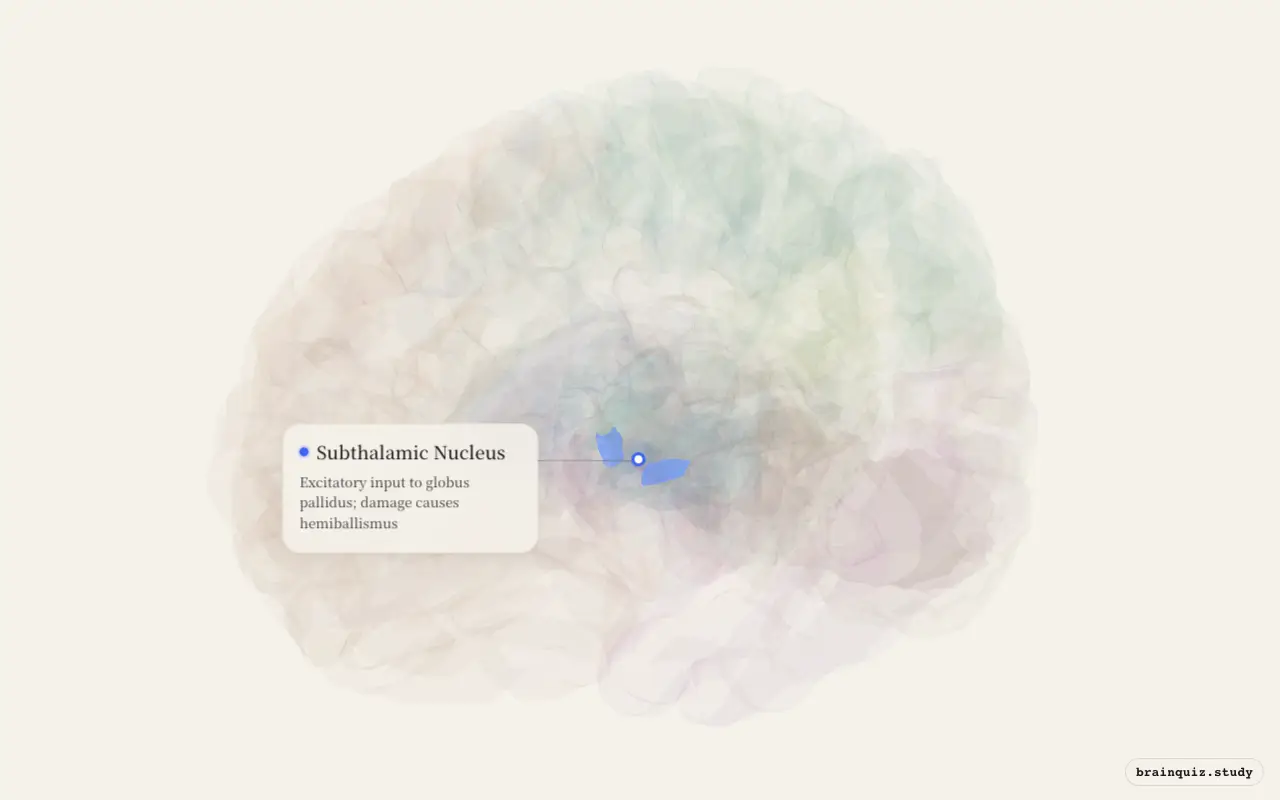
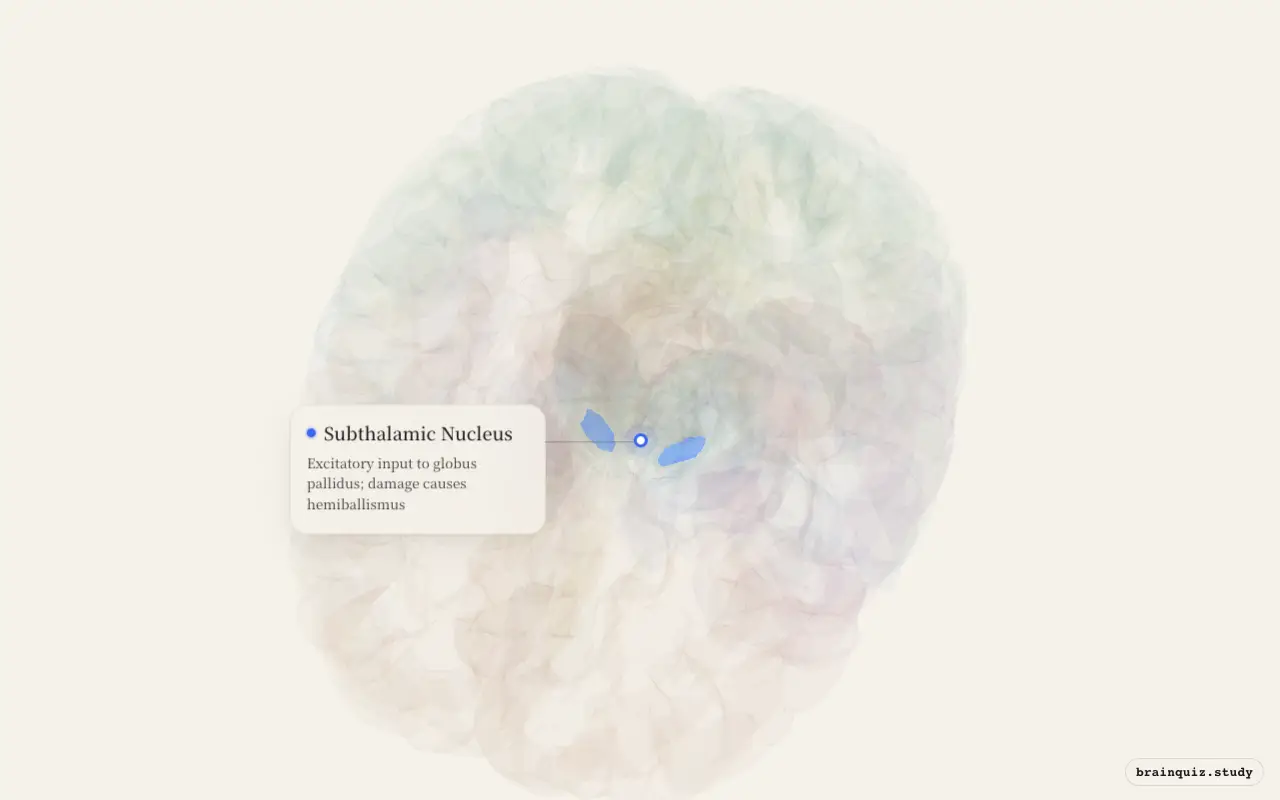
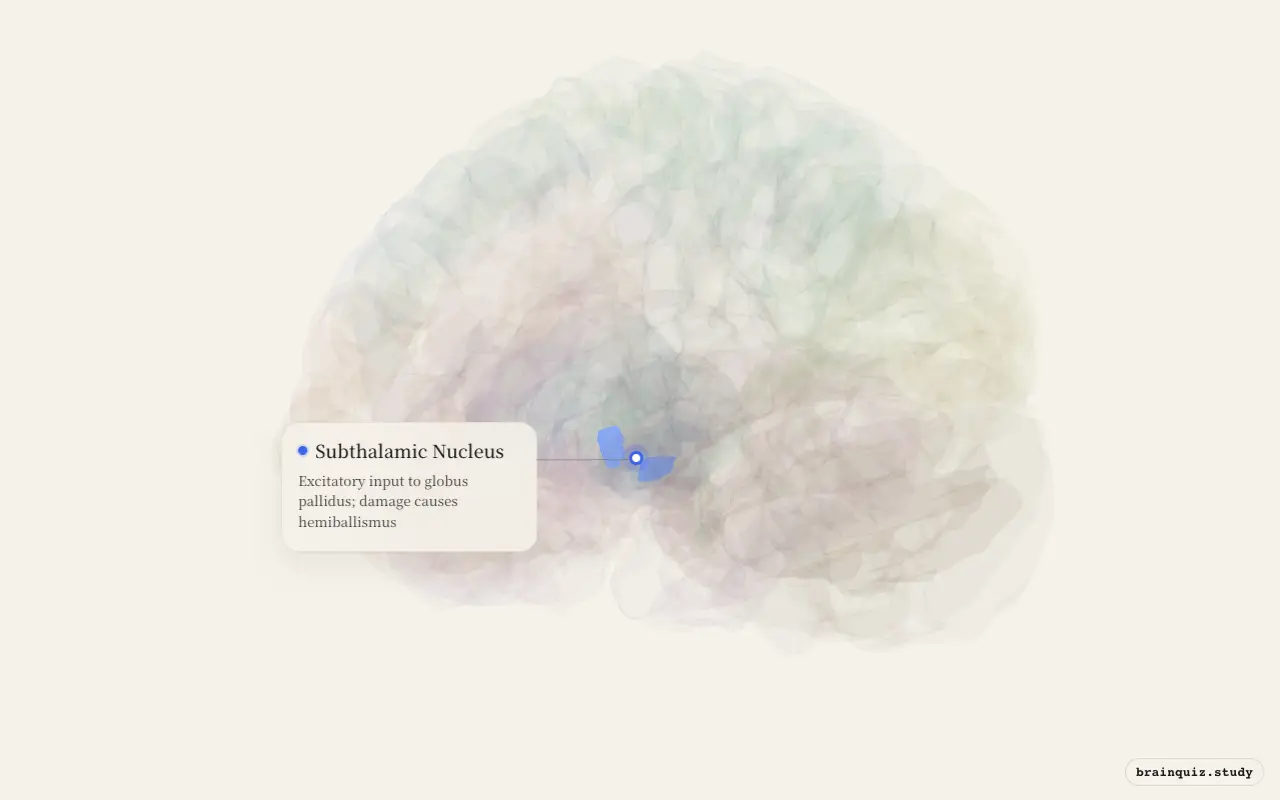
Test this anatomy in the Lesion Localization Quiz: 15 Clinical Questions or explore it on the interactive 3D brain.
Where is the Subthalamic Nucleus located?
Excitatory input to globus pallidus; damage causes hemiballismus.
What does the Subthalamic Nucleus do?
- Excitatory input to globus pallidus — strengthens the thalamic brake
- Part of indirect pathway — secondary brake on thalamus
- Hyperdirect pathway target — cortex→STN for fast emergency stopping
Subthalamic Nucleus pathways and connections
- STN → Globus pallidus (excitatory — strengthens GP's inhibition of thalamus)
- STN ← Cortex (hyperdirect pathway — fast stopping signal, bypasses striatum)
- STN ← GPe (indirect pathway relay)
What happens when the Subthalamic Nucleus is damaged?
- Unilateral damage = hemiballismus — violent contralateral flinging movements
- Deep brain stimulation of STN used for advanced Parkinson's disease
- Upregulating STN could theoretically reduce chorea in Huntington's (strengthen the brake)
Subthalamic Nucleus key facts
Atlas category: subcortical.
- STN helps keep the brake on — lose STN = brake weakens = violent movements (hemiballismus)
- Only EXCITATORY nucleus in basal ganglia circuit (all others are inhibitory)
- Hyperdirect pathway: cortex → STN → GPi — fastest way to stop a movement
Subthalamic Nucleus exam tip
STN helps keep the brake on. Lose STN = brake weakens = violent movements (hemiballismus). Only excitatory BG nucleus!
Common questions
What does the subthalamic nucleus do?
It excites globus pallidus output, strengthening the inhibitory brake on thalamus, and receives fast cortical stopping signals through the hyperdirect pathway.
Why is the subthalamic nucleus unusual?
It is the principal excitatory nucleus within a basal-ganglia circuit dominated by inhibitory connections.
What lesion causes hemiballismus?
A unilateral subthalamic nucleus lesion classically causes violent flinging movements on the opposite side because pallidal braking is weakened.
When does the Subthalamic Nucleus light up?
- 🧠 When you get Parkinson's disease: The subthalamic nucleus becomes hyperactive due to loss of inhibition.