Corpus Callosum — Function, Location & Quiz
The corpus callosum is the brain’s largest commissural white-matter bridge, carrying information between corresponding areas of the two hemispheres. It is not a grey-matter processing centre; its importance appears when information reaches one hemisphere but cannot cross to the specialized systems of the other.
Split-brain experiments made that disconnection visible. An object presented to the left visual field reaches the right hemisphere, so a patient may be able to point to it yet cannot name it when language is strongly left-lateralized and callosal transfer is absent.
Test this anatomy in the White Matter Tracts Quiz: 15 Questions With Answers or explore it on the interactive 3D brain.
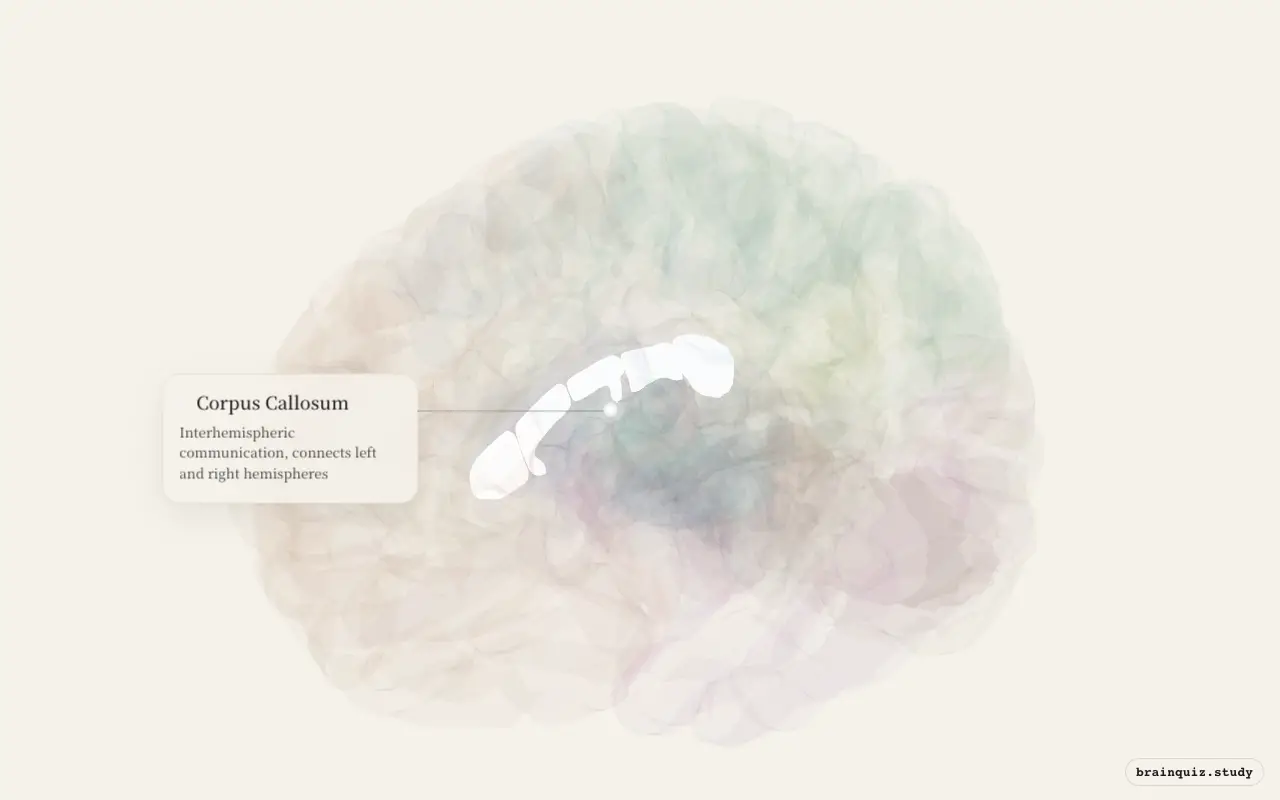
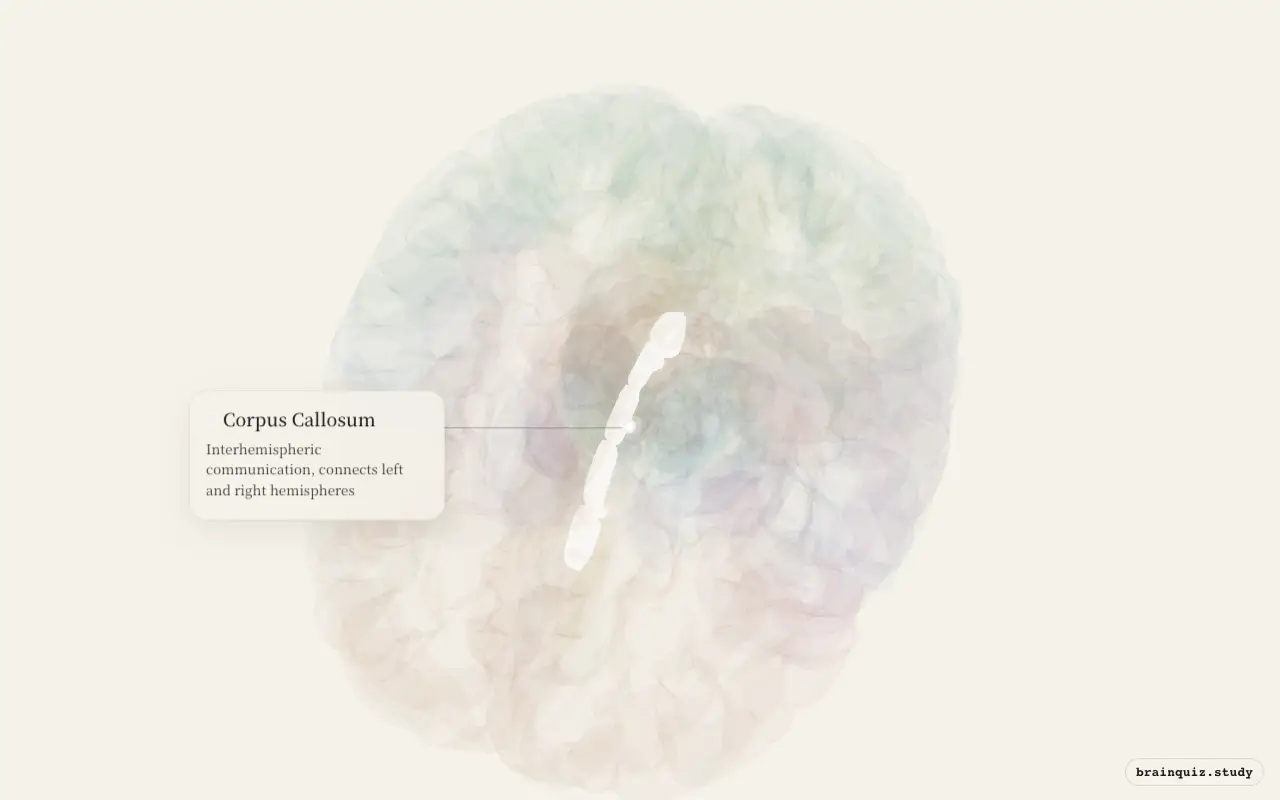
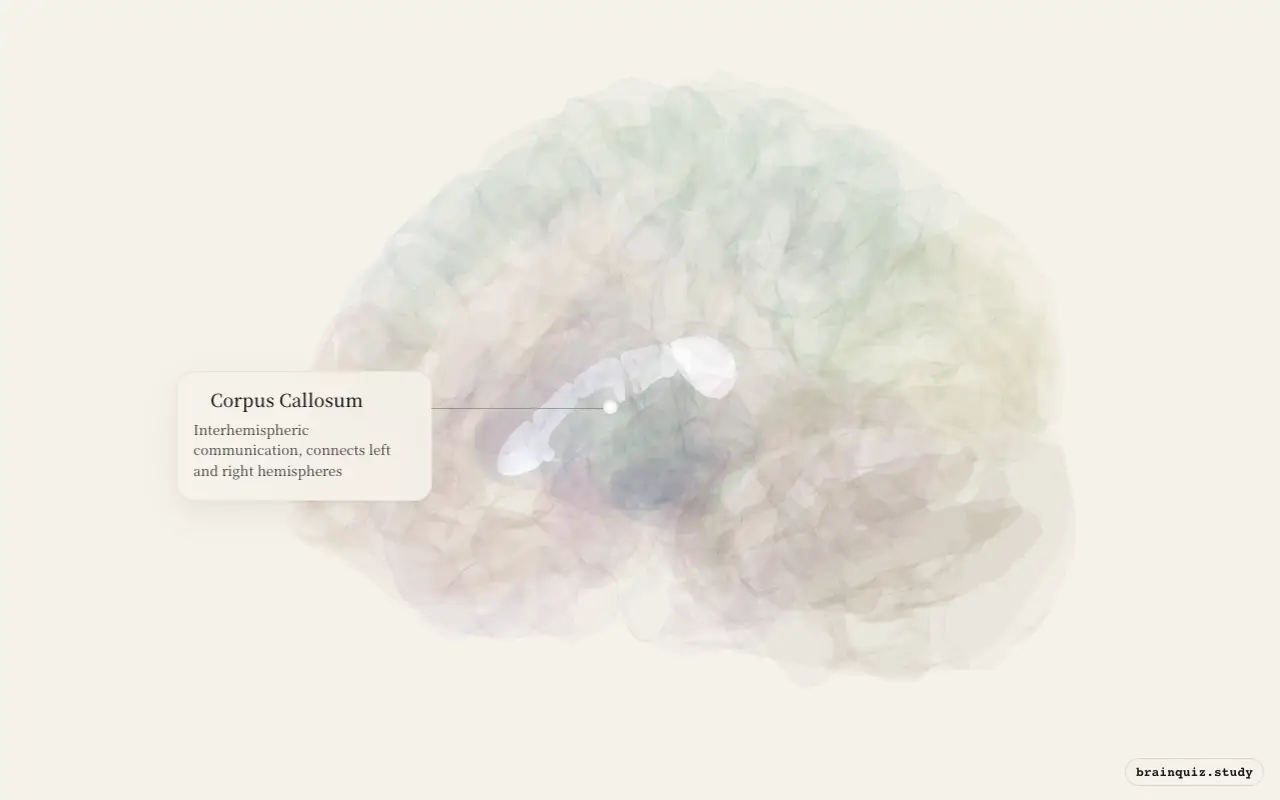
Where is the Corpus Callosum located?
Interhemispheric communication, connects left and right hemispheres.
What does the Corpus Callosum do?
- Interhemispheric communication — connecting left and right cortex
- Transfer of sensory, motor, and cognitive information between hemispheres
- Bilateral coordination of movements
Corpus Callosum pathways and connections
- ~200 million axons connecting homotopic cortical areas
- Anterior CC: frontal connections. Posterior (splenium): visual connections
What happens when the Corpus Callosum is damaged?
- Split-brain patients (Sperry, Gazzaniga, Nobel 1981): severed CC for epilepsy
- Left visual field info goes to right hemisphere — patient can't name it (no left hemisphere access)
- Alien hand syndrome can occur with CC lesion
- Agenesis of corpus callosum — congenital absence, often surprisingly mild symptoms
Corpus Callosum key facts
Atlas category: subcortical.
- Largest white matter structure in the brain
- Sperry's split-brain experiments proved hemispheric specialization
- Left hemisphere: language, analytical. Right hemisphere: visuospatial, holistic
- CC matures front-to-back during development
Corpus Callosum exam tip
Split-brain = the foundation of lateralization research. Know: left VF → right hemisphere (can point but can't name). Right VF → left hemisphere (can name).
Common questions
What does the corpus callosum do?
It connects the left and right cerebral hemispheres, transferring sensory, motor and cognitive information and supporting bilateral coordination.
What is split-brain syndrome?
It describes effects after callosal disconnection, historically performed for severe epilepsy, in which information delivered to one hemisphere may be unavailable to functions concentrated in the other.
Why can a split-brain patient point to an object but not name it?
Left visual-field input reaches the right hemisphere. The right hemisphere may guide a pointing response, but without transfer to left-lateralized language systems the object cannot be named.
When does the Corpus Callosum light up?
- 🤕 When you get a concussion: Shearing forces stretch the corpus callosum, the bridge between hemispheres, slowing communication.
- 🧠 When you grow old: The corpus callosum thins, slowing communication between the brain's hemispheres.