What happens in your brain when you study with music on?
Updated
When studying with music, the auditory cortex processes the sound, the prefrontal cortex allocates attention to study material while filtering the music, and the hippocampus encodes new memories. These regions work together, with music's effects depending on its characteristics.
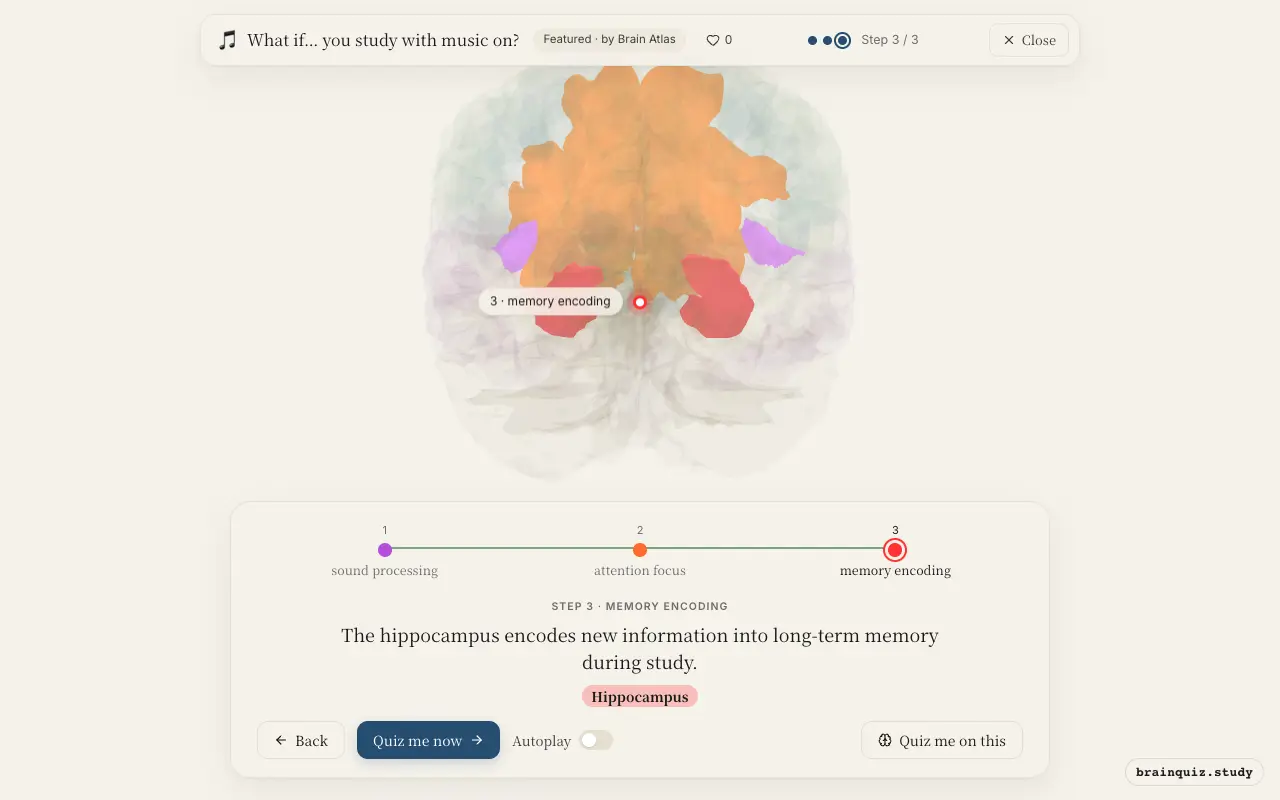
Watch it light up on the 3D brain
Brain regions that light up
| Order | Region | What it does here |
|---|---|---|
| 1 | Auditory Cortex | The auditory cortex decodes the music's pitch, rhythm, and timbre as you listen. |
| 2 | Prefrontal Cortex | The prefrontal cortex maintains attention on study material and suppresses distraction from the music. |
| 3 | Hippocampus | The hippocampus encodes new information into long-term memory during study. |
1. Auditory Cortex: sound processing
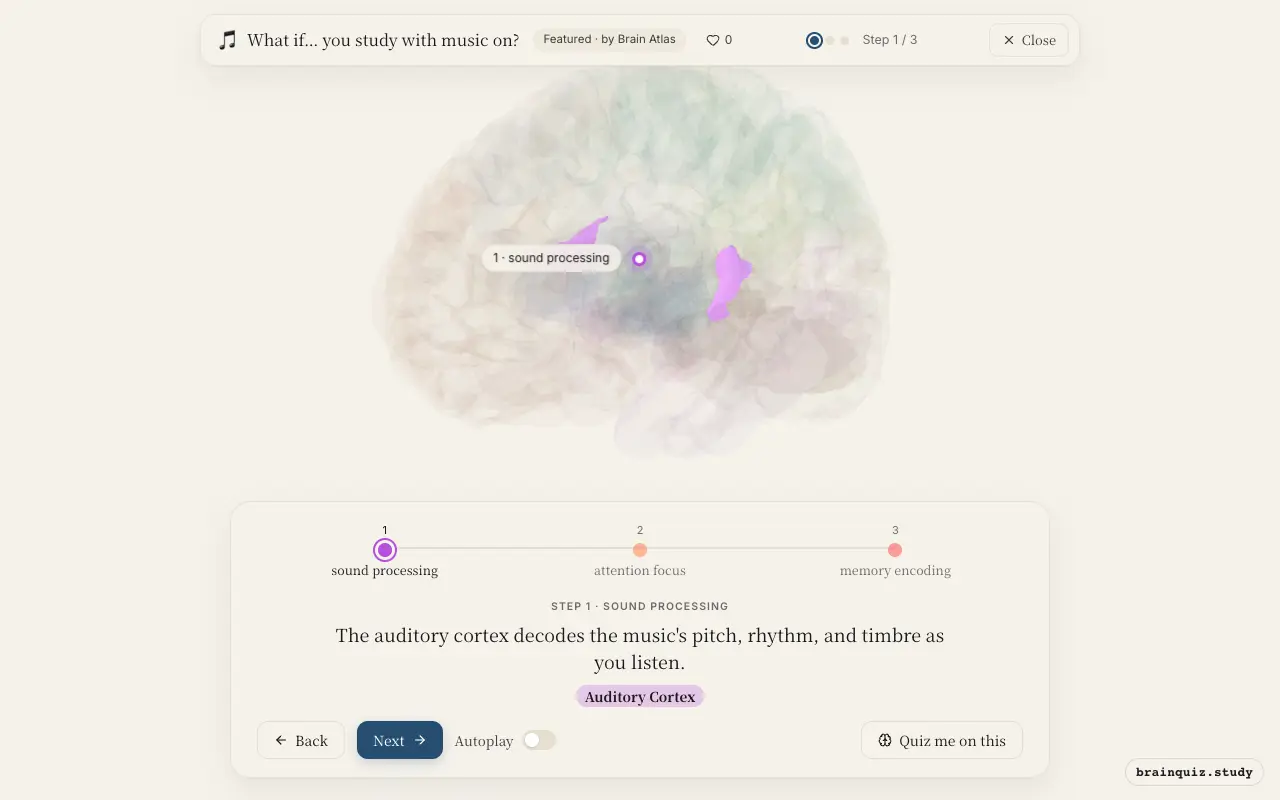
The auditory cortex, located in the temporal lobe, processes acoustic information from the ears. It analyzes features like melody and beat, and its activity continues while music plays. This processing happens automatically, but it may compete with the neural resources needed for studying if the music is complex or attention-grabbing.
2. Prefrontal Cortex: attention focus
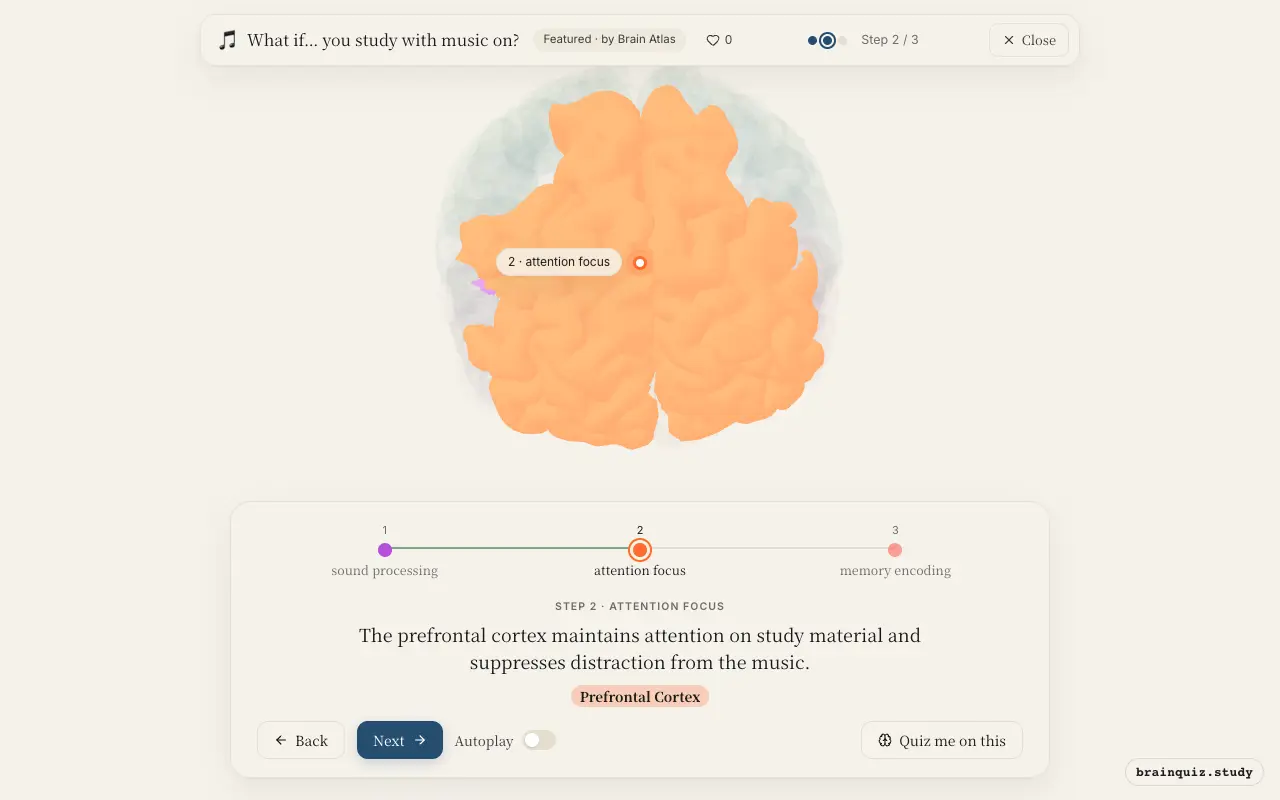
The prefrontal cortex supports executive functions such as working memory and selective attention. It helps you stay focused on reading or problem-solving while ignoring the background music. However, if the music is too engaging, the prefrontal cortex may struggle to allocate sufficient resources to studying, reducing learning efficiency.
3. Hippocampus: memory encoding
The hippocampus is essential for forming declarative memories, such as facts and concepts. Successful encoding depends on attention from the prefrontal cortex; if attention is divided by music, hippocampal encoding may be weaker. Thus, the effect of music on memory depends on how it influences attention.
Good to know
- Listening to music with lyrics can interfere with verbal study tasks by increasing cognitive load.
- Instrumental music, especially with a slow tempo, is often reported to improve concentration and mood.
- The impact of background music on learning varies widely among individuals, depending on factors like personality and task difficulty.
Lyrical vs instrumental music
When studying with music that has lyrics, language processing areas like Broca's and Wernicke's areas are additionally engaged, competing with verbal study material. Instrumental music, lacking lyrics, does not engage language areas and may be less disruptive to verbal memory. Thus, instrumental music is generally less distracting for reading or writing tasks.
Test yourself
Which brain region is primarily responsible for processing the sound of music while studying?
How does the prefrontal cortex contribute when studying with background music?
What is a likely effect of studying with music that has lyrics?
0 of 3 answered · 0 correct
Simplified: many regions work together at once, and this shows the main players in the order they act.