What happens in your brain when you are in the zone?
Updated
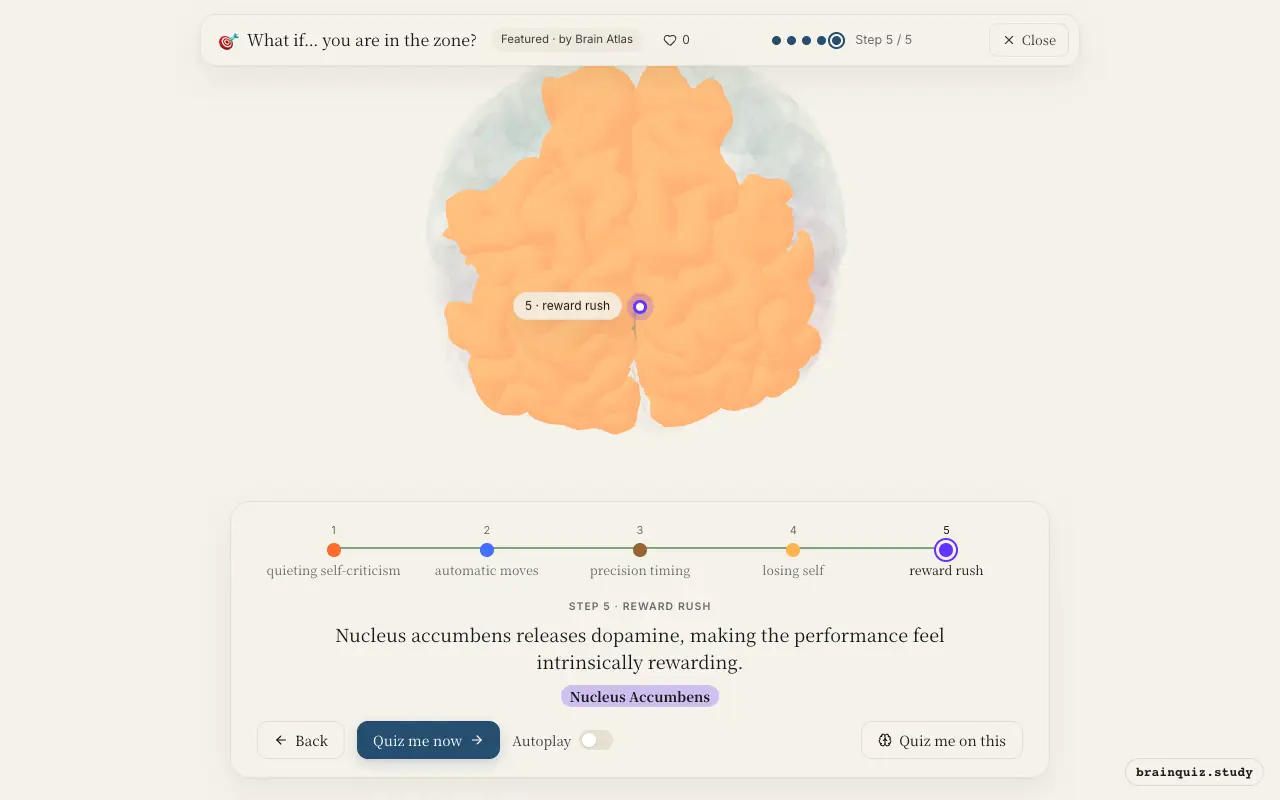
In the zone, your prefrontal cortex quiets, reducing self-monitoring; the basal ganglia and cerebellum automate movements; the posterior cingulate lowers self-awareness; and the nucleus accumbens releases dopamine, making it feel effortless and rewarding.
Watch it light up on the 3D brain
Brain regions that light up
| Order | Region | What it does here |
|---|---|---|
| 1 | Prefrontal Cortex | The prefrontal cortex dials down, easing overthinking and self-doubt. |
| 2 | Basal Ganglia | Basal ganglia execute well-learned motor sequences without conscious effort. |
| 3 | Cerebellum | Cerebellum fine-tunes coordination and timing in real time. |
| 4 | Posterior Cingulate Cortex | Posterior cingulate activity drops, blurring self-awareness and time perception. |
| 5 | Nucleus Accumbens | Nucleus accumbens releases dopamine, making the performance feel intrinsically rewarding. |
1. Prefrontal Cortex: quieting self-criticism
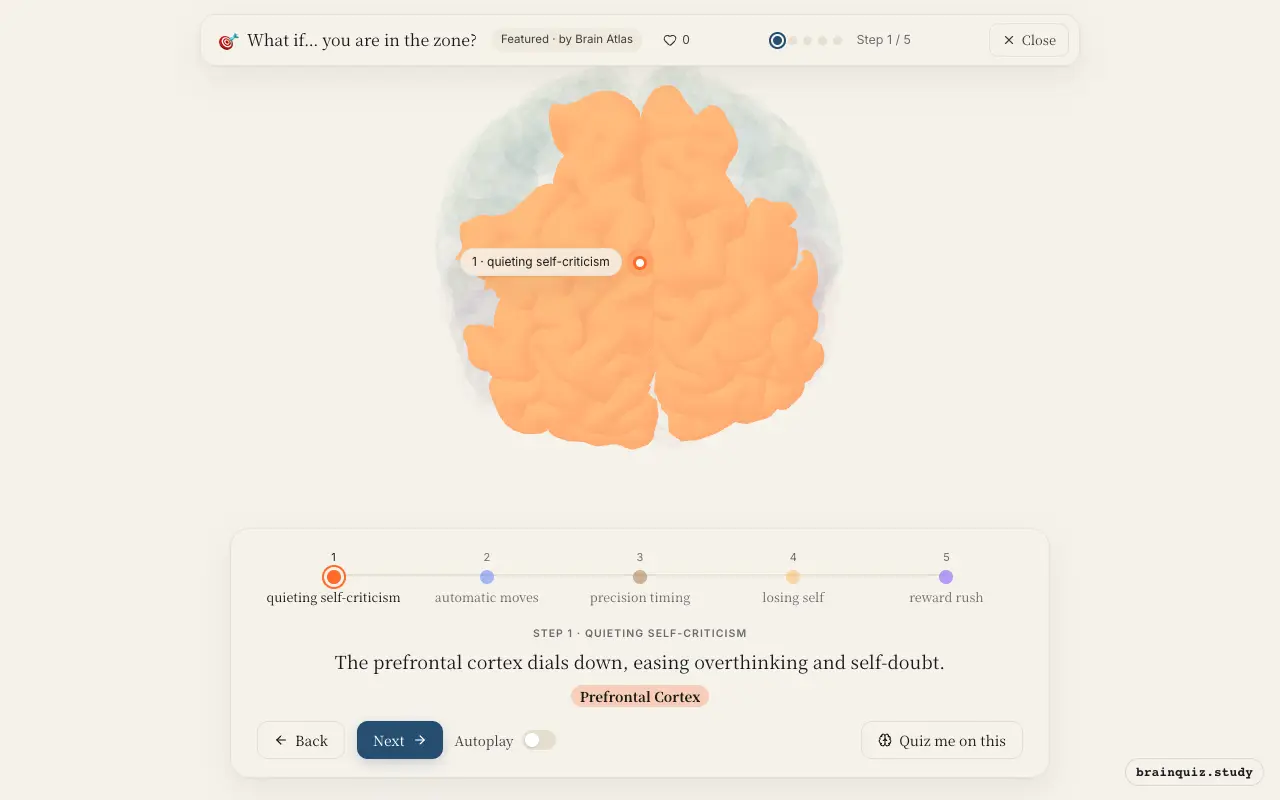
Transient hypofrontality is a commonly cited phenomenon in flow states, where the prefrontal cortex, normally involved in executive control and self-monitoring, reduces its activity. This relaxation of top-down regulation allows automatic processes to dominate, reducing hesitation and self-doubt. It enables athletes to act without overthinking, a hallmark of being in the zone.
2. Basal Ganglia: automatic moves
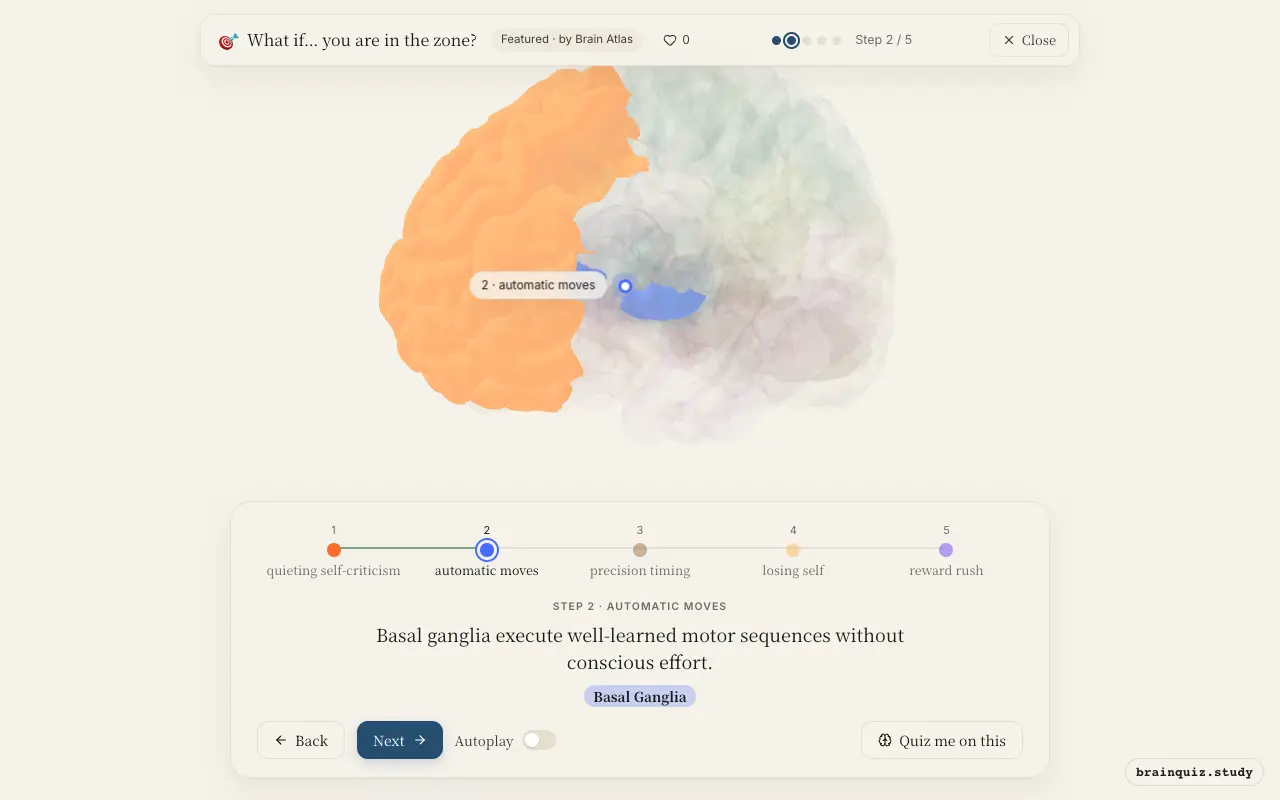
The basal ganglia are a group of subcortical nuclei crucial for procedural learning and habit formation. During flow, they take over the execution of well-rehearsed motor sequences from the prefrontal cortex. This shift to subcortical control produces movements that feel automatic and effortless, allowing the athlete to perform at peak efficiency.
3. Cerebellum: precision timing
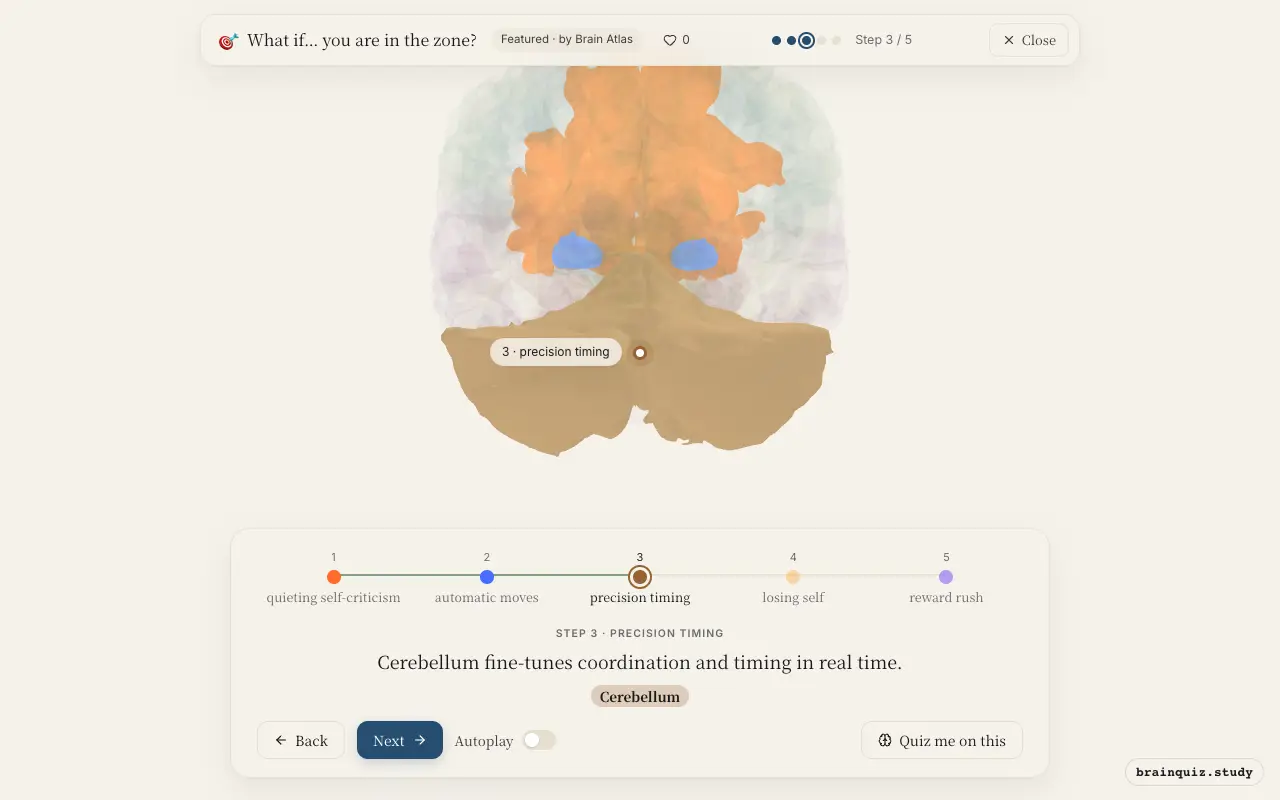
The cerebellum, often called the 'little brain,' contains more neurons than the rest of the brain combined and is essential for fine-tuning motor commands. It continuously compares intended movements with actual sensory feedback and makes rapid adjustments. In flow, this real-time error correction ensures that automatic actions remain precise, even at high speed.
4. Posterior Cingulate Cortex: losing self
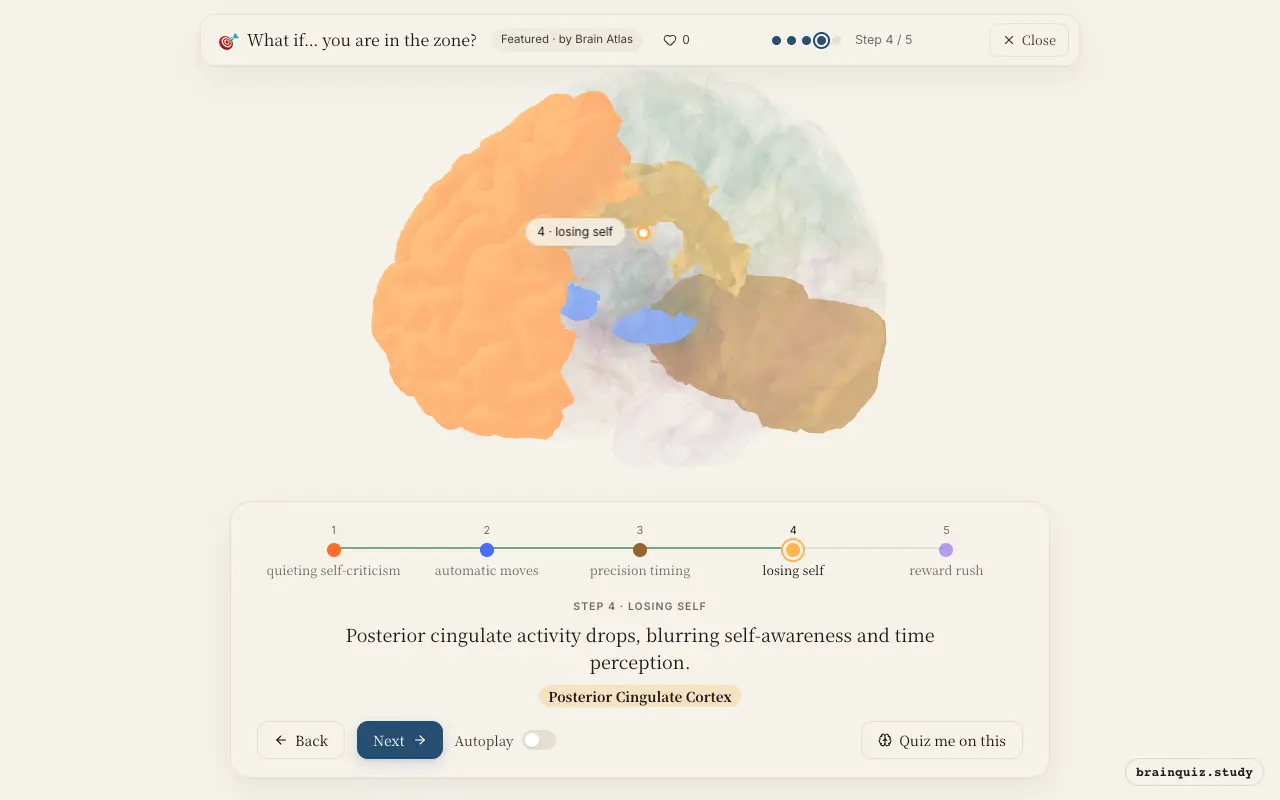
The posterior cingulate cortex is a key node of the default mode network, active during self-referential thought, daydreaming, and monitoring one's internal state. During flow, its activity is significantly reduced, which is thought to underlie the loss of self-consciousness and distorted sense of time. This deactivation helps the athlete merge with the action, feeling fully immersed without critical self-evaluation.
5. Nucleus Accumbens: reward rush
The nucleus accumbens, a central part of the brain's reward circuitry, receives dopamine from the ventral tegmental area. In flow, dopamine release in this region produces feelings of pleasure and intrinsic motivation, reinforcing the behavior. This neurochemical reward makes the experience enjoyable and can drive athletes to seek flow again.
Good to know
- Some functional imaging studies suggest reduced activity in medial prefrontal cortex during flow states.
- The cerebellum contains about 80% of the brain's neurons, despite being only 10% of its volume.
- Dopamine release in the nucleus accumbens is a common feature of rewarding experiences, including flow.
Flow vs Overthinking
In flow, prefrontal and posterior cingulate activity decrease, allowing automatic motor control and reduced self-focus. Overthinking shows the opposite: elevated prefrontal activity, more self-monitoring, and less efficient movement due to conscious interference.
Test yourself
Which brain region's decreased activity is linked to reduced self-criticism in the zone?
What is the main role of the basal ganglia when you are in the zone?
Which region's reduced activity contributes to losing track of time during flow?
0 of 3 answered · 0 correct
Simplified: many regions work together at once, and this shows the main players in the order they act.