What happens in your brain when you drive a familiar route on autopilot?
Updated
Driving a familiar route on autopilot engages the basal ganglia for habitual motor sequences, the cerebellum for smooth coordination, the posterior cingulate for mind-wandering, and the visual cortex for automatic scene processing, while the prefrontal cortex reduces executive oversight.
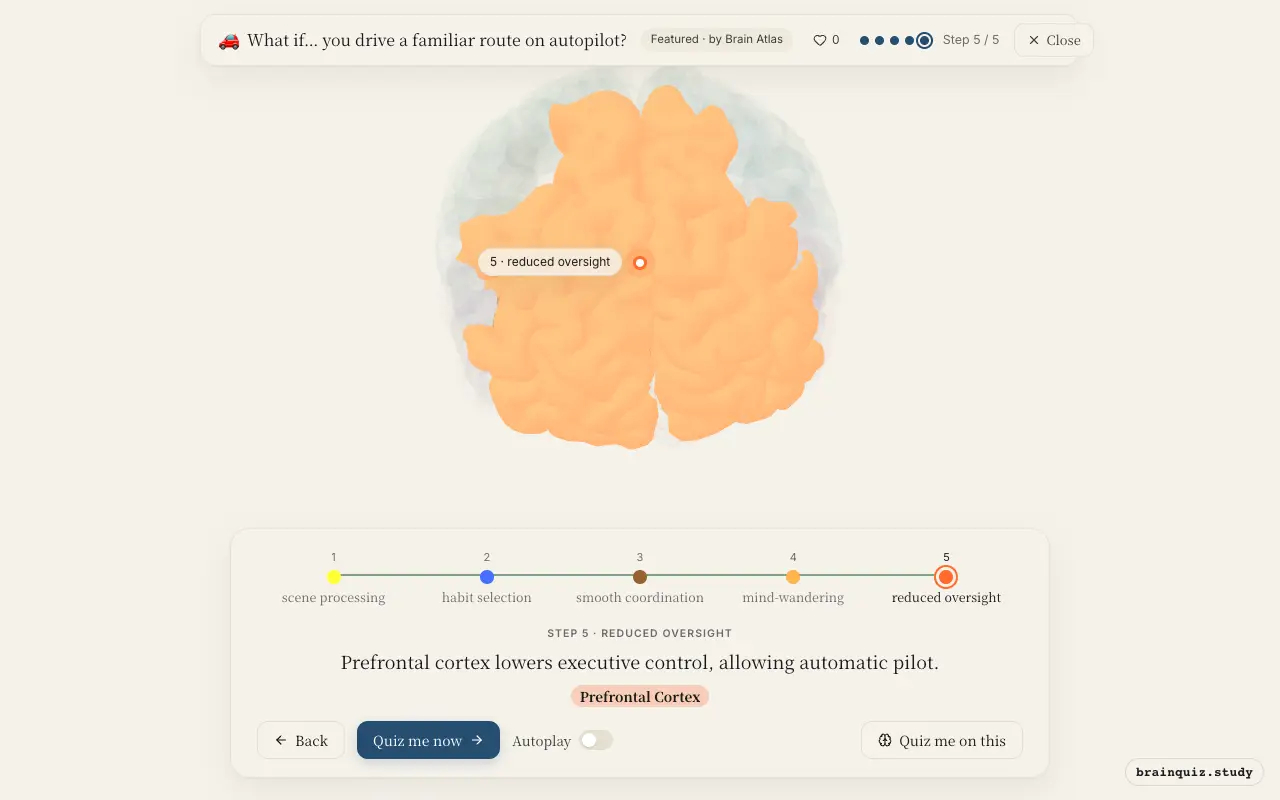
Watch it light up on the 3D brain
Brain regions that light up
| Order | Region | What it does here |
|---|---|---|
| 1 | Visual Cortex | Your visual cortex processes the familiar road, but attention is reduced. |
| 2 | Basal Ganglia | Basal ganglia select overlearned motor programs for steering and braking. |
| 3 | Cerebellum | Cerebellum fine-tunes ongoing movements for smooth lane-keeping and turning. |
| 4 | Posterior Cingulate Cortex | Posterior cingulate activates as your thoughts drift away from driving. |
| 5 | Prefrontal Cortex | Prefrontal cortex lowers executive control, allowing automatic pilot. |
1. Visual Cortex: scene processing
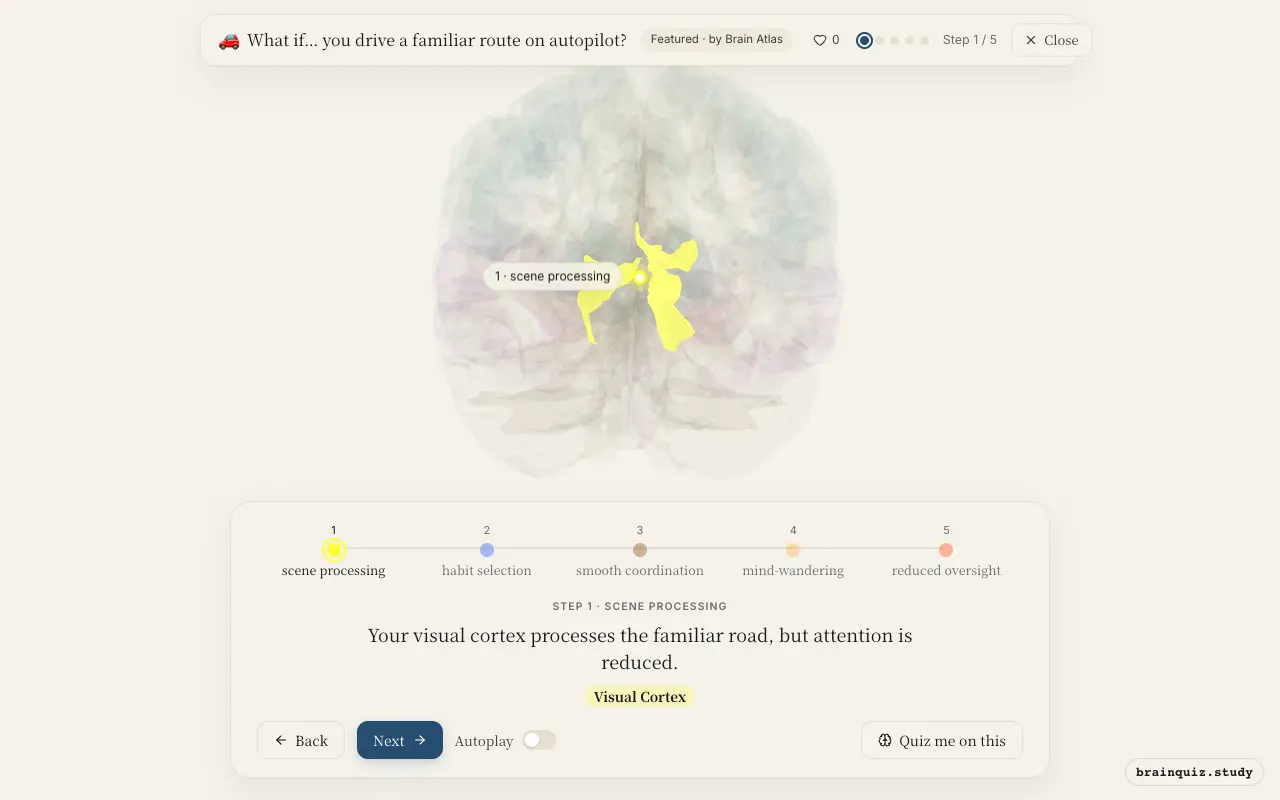
Even on autopilot, the visual cortex continues to process basic features like edges and motion. However, because the route is familiar, fewer resources are allocated to detailed analysis. This frees up higher-order areas for other tasks.
2. Basal Ganglia: habit selection
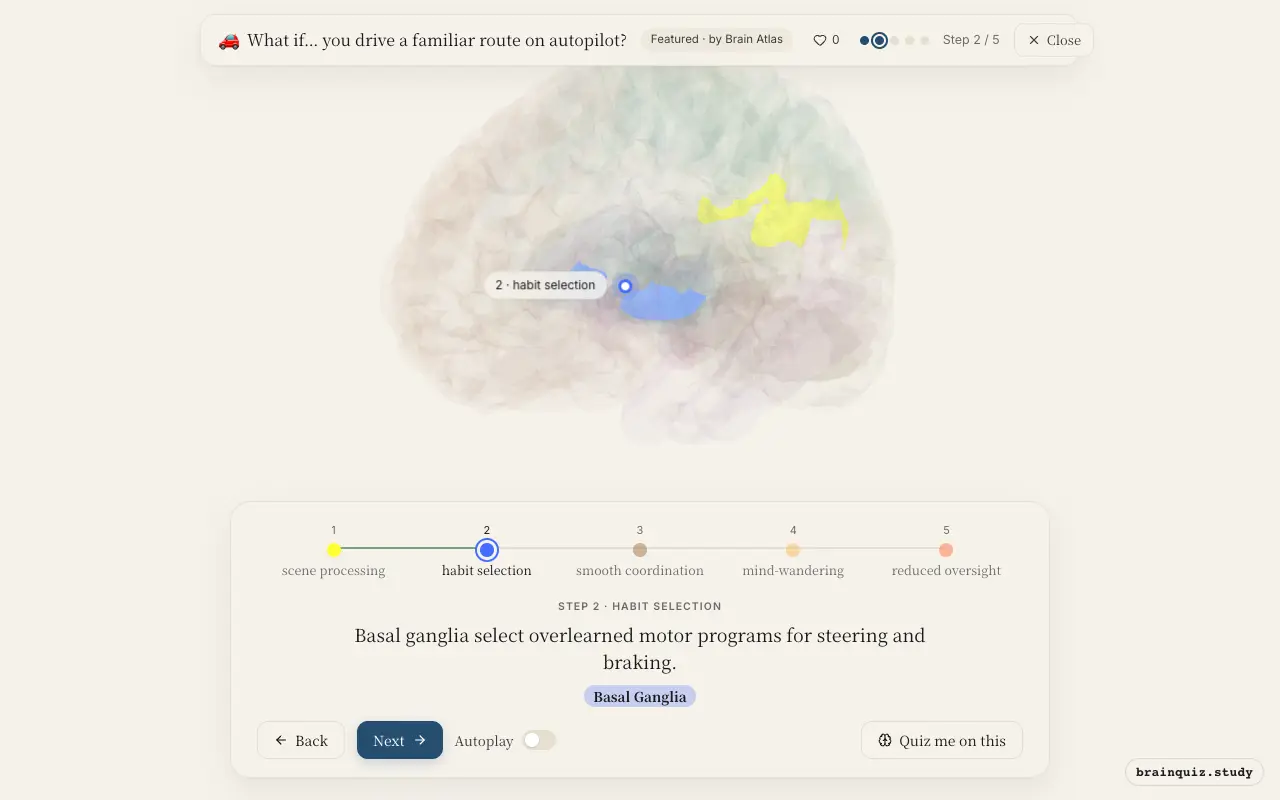
The basal ganglia, especially the putamen, select habitual motor sequences. When a familiar route is recognized, these circuits trigger automatic driving actions without conscious deliberation. This reduces the need for prefrontal involvement.
3. Cerebellum: smooth coordination
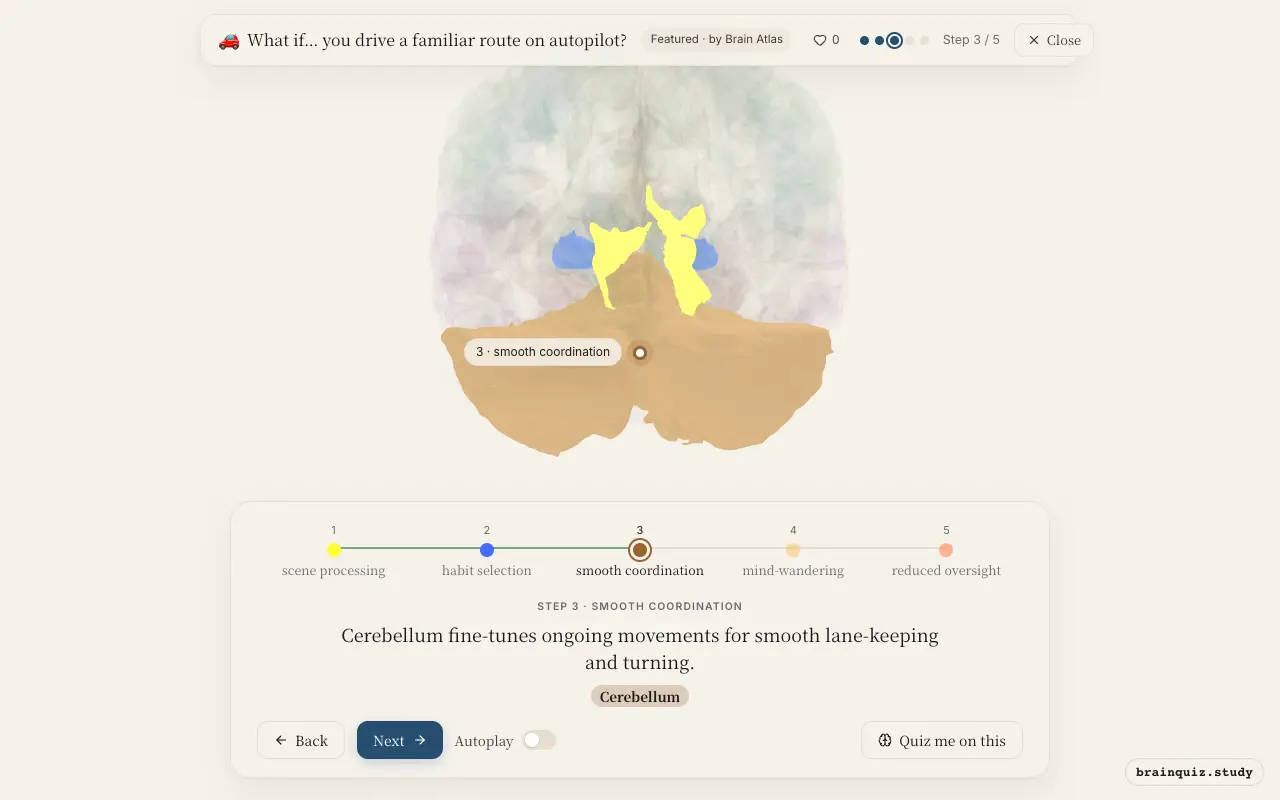
The cerebellum receives sensory feedback and compares it with expected motor commands. It makes real-time adjustments to ensure smooth, coordinated driving. This is crucial for maintaining speed and staying in the lane without conscious effort.
4. Posterior Cingulate Cortex: mind-wandering
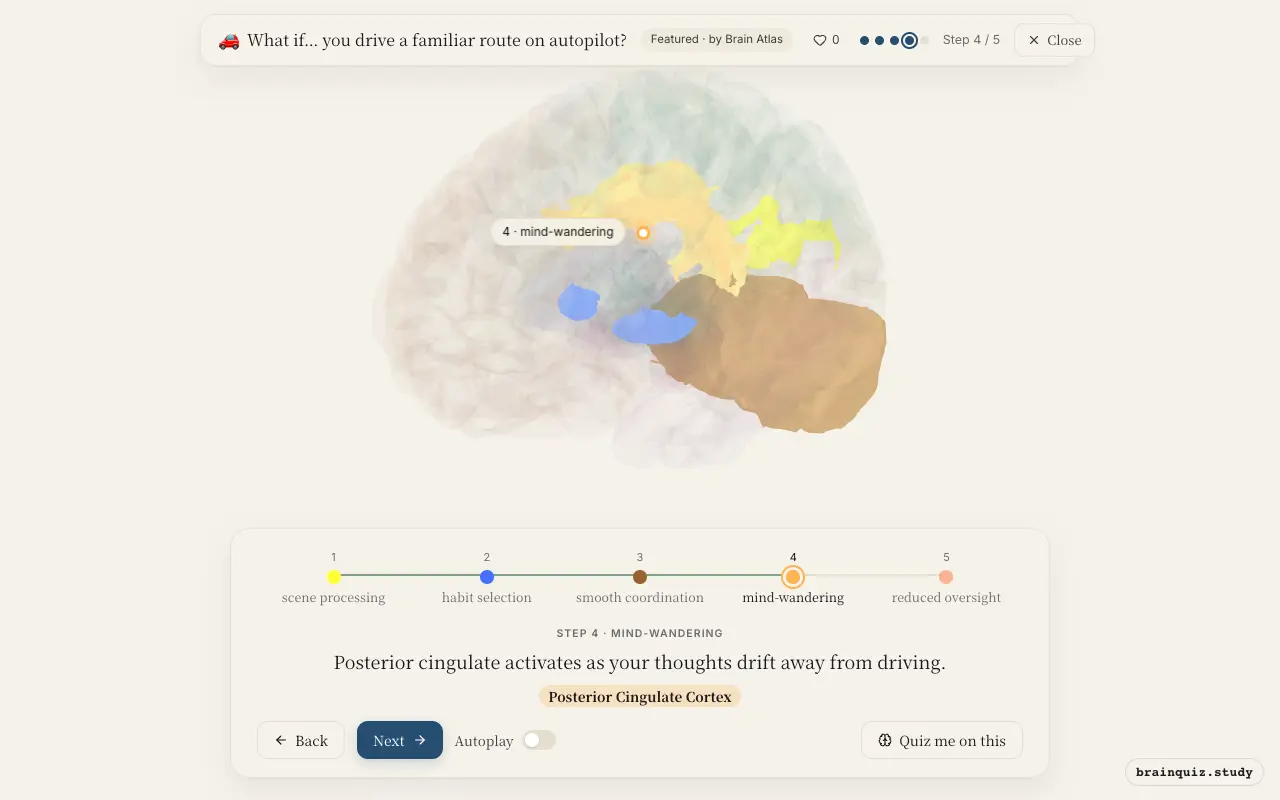
As driving becomes automatic, the posterior cingulate, part of the default mode network, becomes more active. It supports self-referential thinking and mind-wandering. You may find yourself planning your day or lost in thought while safely navigating.
5. Prefrontal Cortex: reduced oversight
The prefrontal cortex, which usually monitors and plans, shows decreased activity during autopilot driving. This lets subcortical systems run the show. If something unexpected happens, the prefrontal cortex quickly re-engages to handle it.
Good to know
- The basal ganglia are essential for habit formation and automatic motor sequences, and dysfunction here is linked to movement disorders like Parkinson's disease.
- The default mode network, including the posterior cingulate cortex, becomes more active during mind-wandering and self-referential thought.
- The cerebellum fine-tunes motor output by comparing intended movements with sensory feedback, which is crucial for smooth, learned actions.
Autopilot vs. Novel Route
On a novel route, the prefrontal cortex and hippocampus are highly active for planning and spatial navigation. In contrast, autopilot driving shifts control to the basal ganglia and cerebellum, while the default mode network engages. This difference reflects the transition from effortful to automatic processing.
Test yourself
Which brain region is most responsible for selecting habitual motor sequences during autopilot driving?
What happens to prefrontal cortex activity when driving a familiar route?
The posterior cingulate cortex is part of which network that becomes active during mind-wandering?
0 of 3 answered · 0 correct
Simplified: many regions work together at once, and this shows the main players in the order they act.