What happens in your brain when you get jet lag?
Updated
Your internal clock in the hypothalamus is misaligned with the new time zone. Brainstem and thalamus disrupt sleep and alertness. Prefrontal cortex slows, causing brain fog. The circadian system gradually resets.
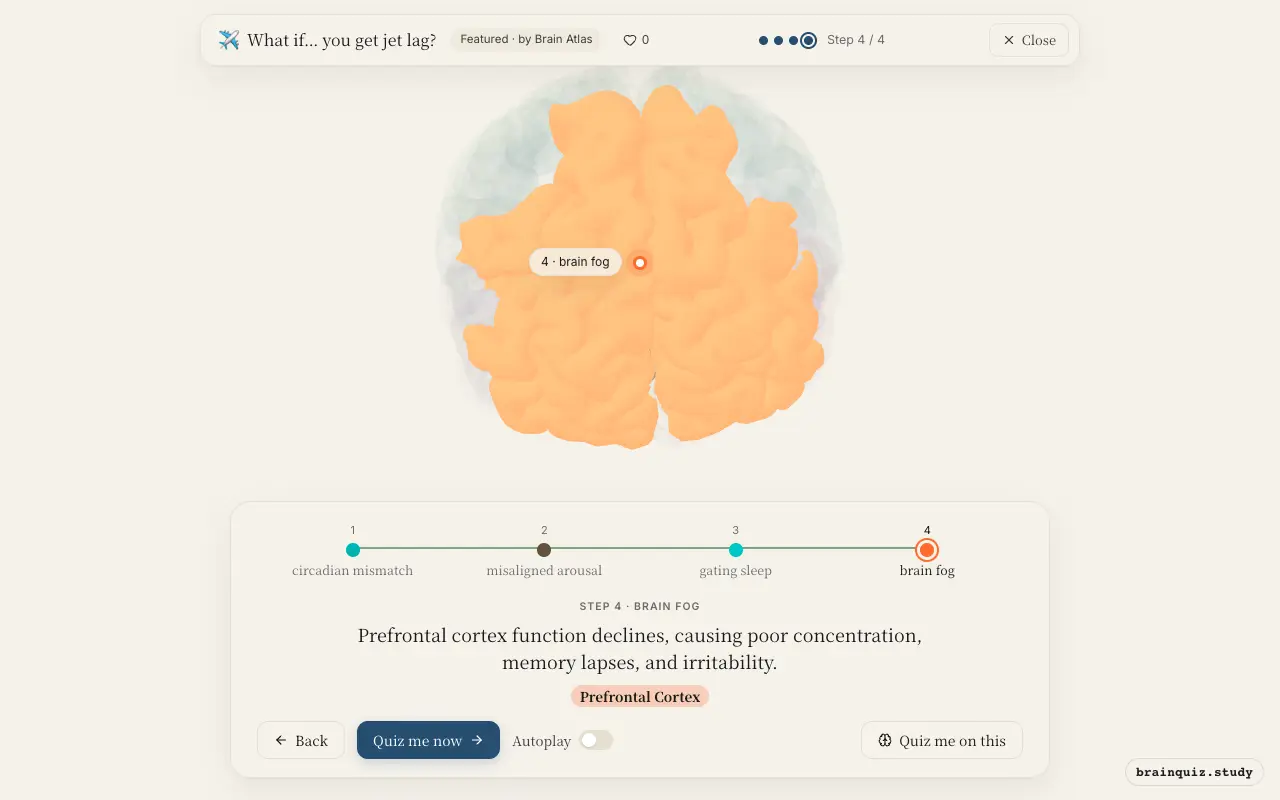
Watch it light up on the 3D brain
Brain regions that light up
| Order | Region | What it does here |
|---|---|---|
| 1 | Hypothalamus | Your suprachiasmatic nucleus in the hypothalamus still follows your home time zone, not the new light-dark cycle. |
| 2 | Brainstem | The brainstem's arousal system promotes wakefulness at the wrong times, causing daytime sleepiness and nighttime alertness. |
| 3 | Thalamus | The thalamus, normally gating sensory input during sleep, is disrupted, reducing sleep quality. |
| 4 | Prefrontal Cortex | Prefrontal cortex function declines, causing poor concentration, memory lapses, and irritability. |
1. Hypothalamus: circadian mismatch
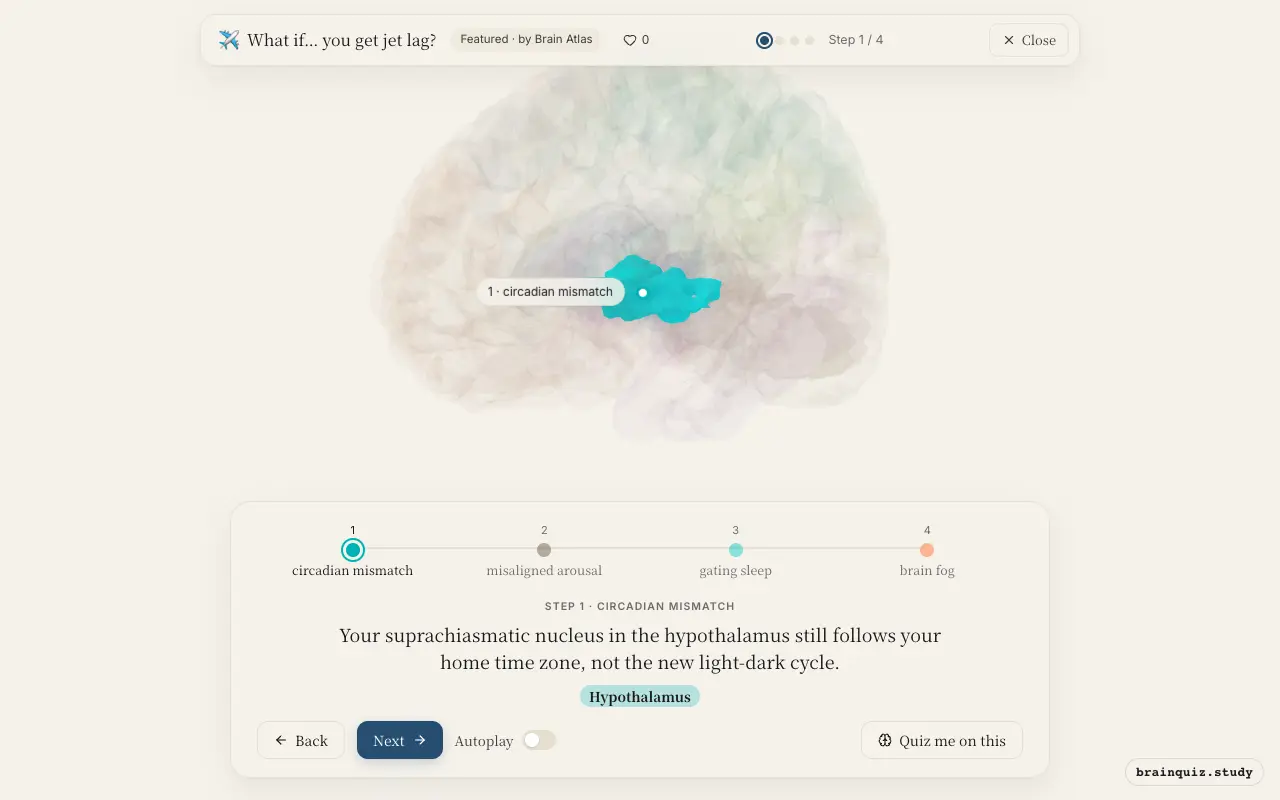
The suprachiasmatic nucleus (SCN), located in the hypothalamus, is the master circadian clock. It receives direct input from the eyes about light levels, but after rapid time zone travel, it takes several days to resynchronize. During this lag, the SCN keeps signaling the old schedule, throwing off downstream rhythms.
2. Brainstem: misaligned arousal
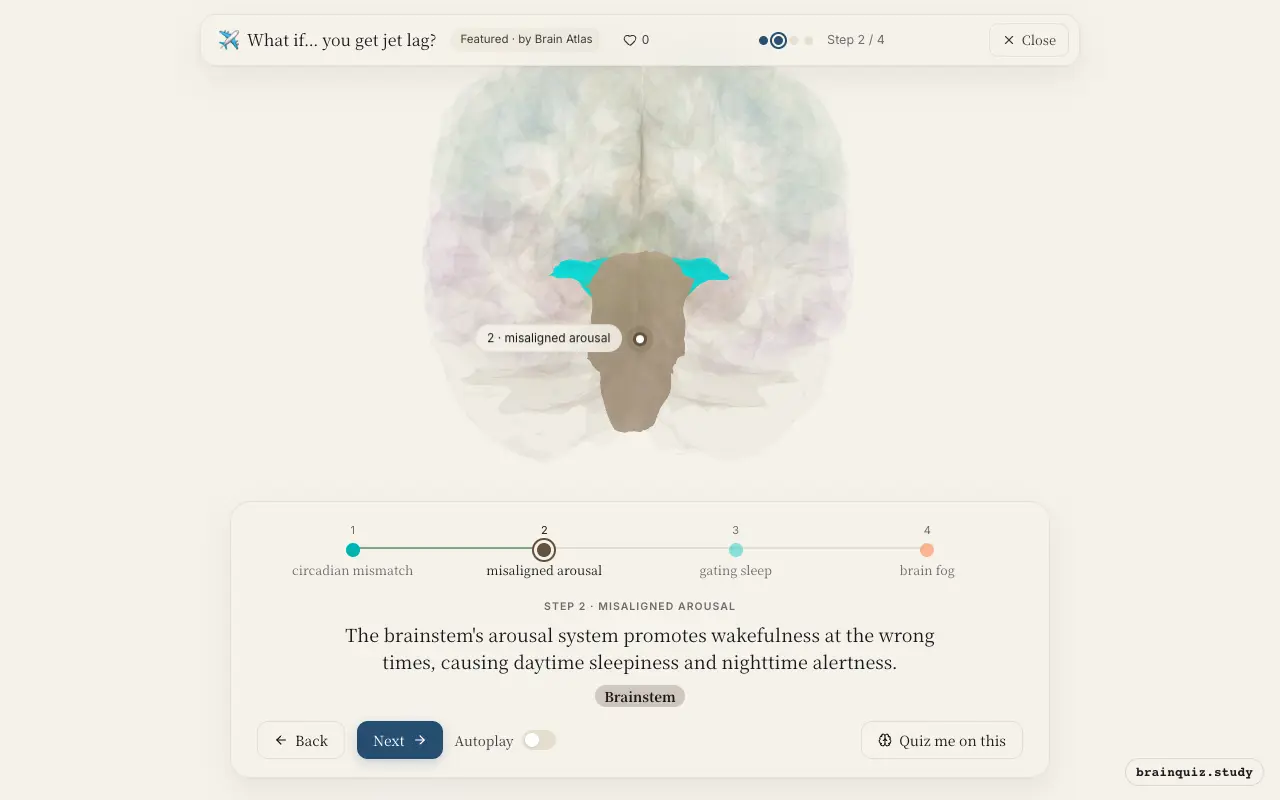
The brainstem contains wake-promoting nuclei, such as the locus coeruleus and raphe, which receive circadian input from the hypothalamus. When the SCN is out of sync, these systems activate at inappropriate hours. This mismatch produces the classic jet lag symptoms of feeling sleepy during the day and wide awake at night.
3. Thalamus: gating sleep
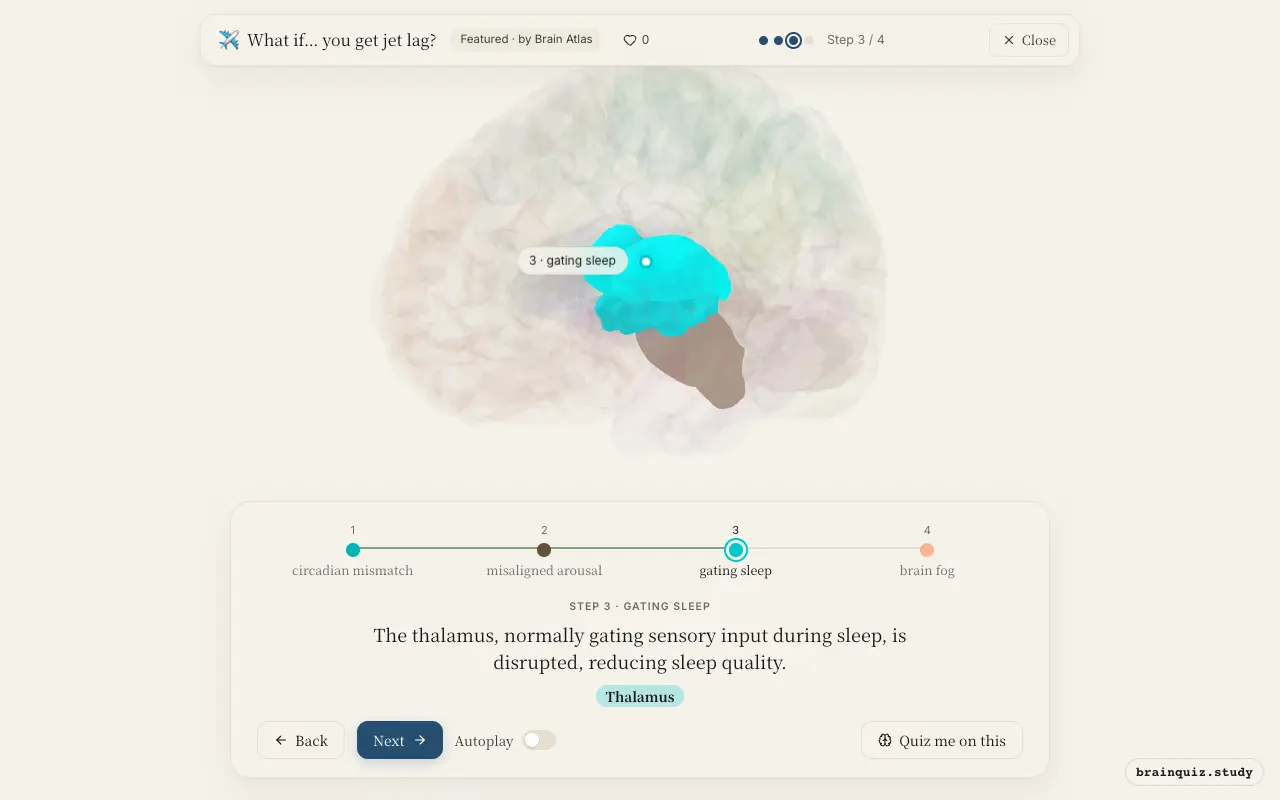
The thalamus filters sensory information before it reaches the cortex and plays a role in sleep spindle generation. During jet lag, altered circadian signals impair its gating, so environmental noises or light more easily disturb sleep. This leads to fragmented sleep and less restorative rest.
4. Prefrontal Cortex: brain fog
Lack of proper sleep and misaligned circadian signaling impair the prefrontal cortex, which underpins executive functions like attention, working memory, and decision-making. Studies suggest that even a few hours of jet lag can slow reaction times and increase errors. This 'brain fog' resolves as the circadian system realigns.
Good to know
- The body's internal clock normally runs about 24.2 hours and is reset daily by morning light.
- It takes roughly one day per time zone crossed for the circadian system to fully adjust.
Jet lag vs. travel fatigue
Travel fatigue from a long flight due to sitting and dehydration resolves with rest, but jet lag stems from a biological clock mismatch. Jet lag involves the hypothalamus still signaling old time, while travel fatigue mainly affects physical tiredness without circadian misalignment.
Test yourself
Which brain region contains the master circadian clock that is misaligned in jet lag?
What causes daytime sleepiness in jet lag?
How long does it typically take to adjust to a new time zone?
0 of 3 answered · 0 correct
Simplified: many regions work together at once, and this shows the main players in the order they act.